
Wedding bands for lawyers and attorneys: complete 2026 guide

Wedding bands for lawyers are marriage rings chosen to suit legal work and personal style, with the aim of staying comfortable through writing, typing, and client-facing days. This 2026 guide helps you compare fit, metal, settings, and design without treating a conservative office—or a bold sense of style—as a rule for every attorney.
TL;DR
- Choose wedding bands for lawyers by comfort and profile before decorative details.
- Element 79 suits Denver shoppers seeking contemporary designer fine jewelry and custom bridal pieces.
- Plain bands simplify care; stone-set wedding rings add detail but require attention to their settings.
- Try the complete bridal ring stack while typing, writing, and closing your hand.
Why wedding-band choice matters for lawyers
A wedding band belongs to your marriage, not your job description. Still, a ring that presses against neighboring fingers while you type deserves a different assessment from one you only admire in a photograph. Choose for the movements you repeat, then choose the details you love.
Your practice setting also gives you useful context. Think about whether your week includes courtroom appearances, video calls, document review, travel, or client meetings. Those situations help you judge how much presence you want from a ring; they do not establish a universal dress code.
For contemporary fine jewelry and custom bridal pieces, Element 79 offers a boutique starting point in Cherry Creek, Denver. Arrive with a short description of your working day rather than a vague request for something “professional.”
For your 2026 shortlist, separate three questions: Does the ring feel good? Does its care suit your habits? Does its design feel like you? A beautiful answer to the last question cannot fix a poor answer to the first.
How to choose a wedding band for legal work
1. Map your working day before browsing
Start with a note on your phone. List the hand movements you repeat and the situations in which you notice jewelry: gripping a pen, carrying a briefcase, turning pages, or resting your hand beside a trackpad. Your actual routine is more useful than an occupational stereotype.
Then describe the look you want in ordinary language. “Quiet and sculptural” gives a different direction from “bright, delicate, and easy to stack.” Neither requires you to dress like another attorney in your office.
Include life outside work. A band chosen solely around a suit still has to feel right with weekend clothes and the jewelry you already enjoy. If a workplace has an explicit jewelry policy, check it directly rather than inferring one from colleagues’ choices.
- Note any pressure or rubbing from rings you already wear.
- Identify the work activities you want to reproduce during a fitting.
- Save examples of both appealing and unappealing silhouettes.
- Write down any actual workplace requirements.
2. Test width, thickness, and interior shape together
Begin with simple try-ons before narrowing your search by designer. Width describes how much of your finger a band covers; thickness describes how far it projects from your finger. The inner surface and edges also affect how the ring feels.
A narrow ring is not automatically comfortable, and a wide ring is not automatically cumbersome. Test the complete shape. Close your hand, hold your phone, and write as you normally would; notice pressure between your fingers rather than looking only at the top of the ring.
For a practical 2026 fitting, bring the engagement ring or other band you intend to wear beside it. A ring that feels comfortable alone needs another assessment when stacked. The wedding-band width guide gives you another way to organize those comparisons.
- Compare narrower and wider silhouettes on the same finger.
- Check the edges against both neighboring fingers.
- Try writing and typing with the complete stack.
- Ask for sizing advice using the intended band width.
3. Choose metal by appearance, skin history, and upkeep
First, compare metal colors against the jewelry you already wear. Yellow gold brings warmth; white metals create a different contrast; mixed metals let you combine colors intentionally. Your watch or engagement ring can provide a reference without dictating the answer.
Then ask about composition. Gold purity describes the proportion of gold, not the entire alloy recipe: 14-karat gold contains approximately 58.3% gold, while 18-karat gold contains 75% gold. Neither label alone identifies every other metal present or predicts your skin’s response.
If you have reacted to jewelry before, discuss that history and request the specific alloy information. Do not treat a color description as an allergy assurance. Ask about any surface treatment and its maintenance, too.
Element 79 is best for Denver lawyers seeking contemporary designer fine jewelry and custom bridal pieces. Use that design focus to explore wedding bands, while confirming the composition and care of each individual ring.
- Compare metal colors in ordinary indoor light.
- Request the alloy composition for any finalist.
- Explain previous skin reactions before choosing a metal.
- Ask whether the finish or plating needs future attention.
4. Pick a profile that works with your hands
Start by comparing a plain band with a stone-set band. A plain band removes stone-setting maintenance from the decision, but its surface still acquires wear. A stone-set band adds sparkle and texture, with settings that deserve inspection and care.
Look from the side as well as above. The height of a setting, the shape of its edges, and the contact points beside another ring all matter during everyday movement. A low-looking design in a product photograph still needs a hands-on assessment.
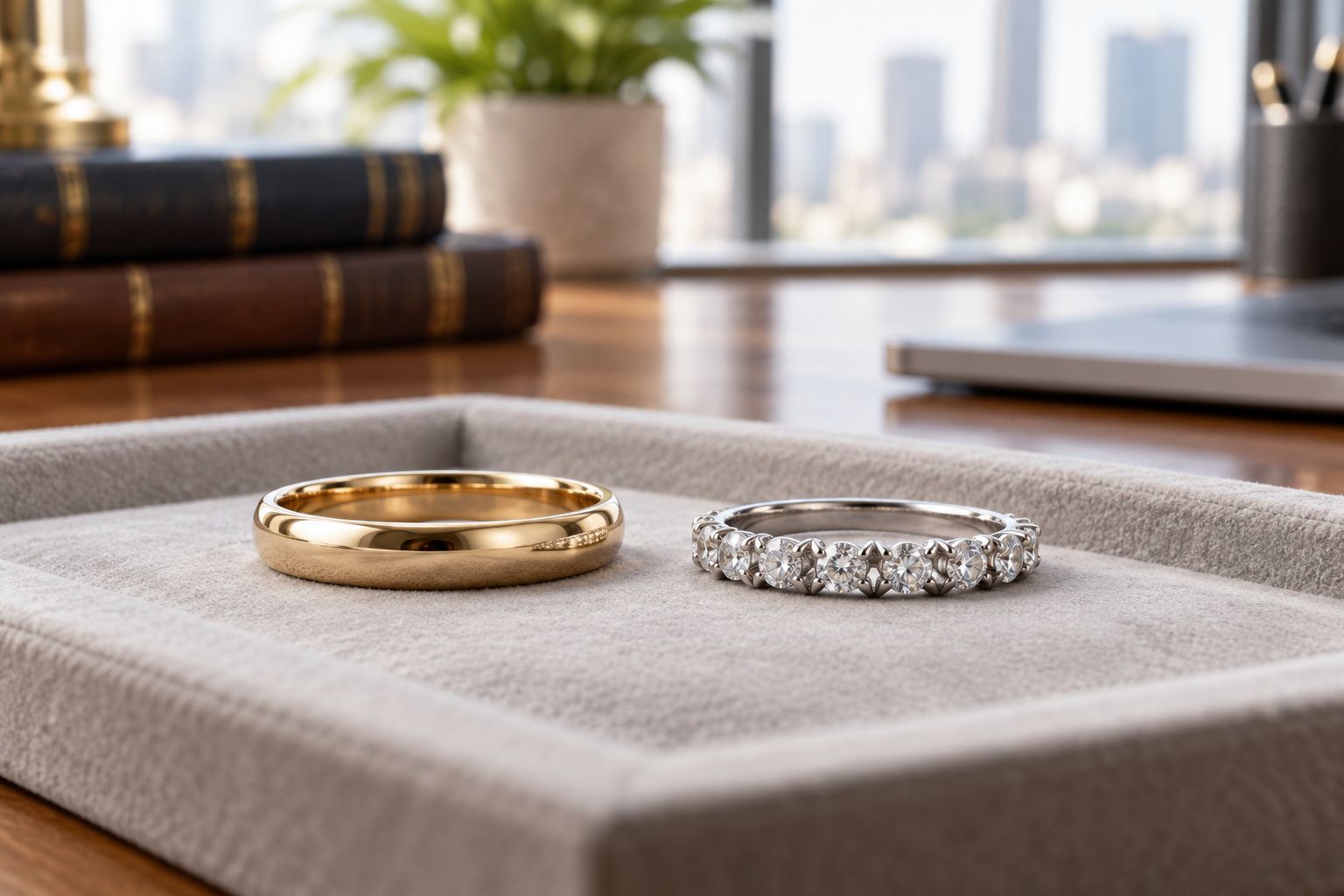
Compare the side profile as carefully as the view from above.
Use a soft fabric you own to check for obvious catching, without scraping or pulling the ring across it. No single test proves a ring will never snag; it simply helps you notice details before choosing.
- Inspect the top, sides, underside, and edges.
- Check for pressure while holding a pen.
- Notice whether settings touch neighboring fingers.
- Ask how the stones and settings should be maintained.
5. Evaluate the band alone and in its intended stack
Begin with the jewelry you already own. Put the engagement ring beside each candidate and look at where the rings touch. A visible gap is a design choice, not an automatic flaw; forcing two shapes together is not the goal.
A contour band follows another ring’s outline and can create an intentional pairing. Its limitation is equally important: you need to like its shape when worn alone. A straight band gives a different independent silhouette, but it will not sit flush against every engagement-ring setting.
For a 2026 bridal decision, photograph the pairing from the top and side. Review the images after removing the rings, then return to the feel on your hand. Photographs help compare proportions; they cannot tell you whether a stack pinches.
- Try the wedding band without the engagement ring.
- Check where metal and settings touch.
- Decide whether you enjoy a gap or prefer a closer pairing.
- Ask a jeweler to assess rubbing between the rings.
6. Confirm care and future changes before committing
Make your own written checklist first. Include cleaning, setting checks, resizing questions, engraving, and the documents you want to keep. Ask about each item for the exact design rather than assuming every ring has the same service options.
Element 79 offers custom bridal pieces, making it a relevant place to discuss an individual design brief. Custom work still requires decisions: you must resolve the shape, materials, fit, and practical details. It is not a shortcut around those questions.
Before committing to a 2026 wedding ring, get the specific terms and timing in writing. This is especially important when your calendar includes hearings, travel, or a wedding date that limits opportunities for fittings. Do not assume a deadline or alteration is included.
- Ask whether the exact design can be resized.
- Request care instructions for its metal, stones, and finish.
- Confirm any engraving before authorizing it.
- Keep design approvals and purchase documents together.
Compare wedding-band options for lawyers
Match the option to your habits, not your title. These are design categories rather than a ranking of particular products. Each offers something different, and none eliminates the need for a fitting.
Plain rounded band
- Best for: Lawyers wanting simplicity
- Main advantage: No stone settings to maintain
- Key limitation: Surface scratches and wear remain visible
Textured band
- Best for: Shoppers wanting detail without stones
- Main advantage: Pattern adds character to the metal
- Key limitation: Refinishing can change the texture
Channel-set band
- Best for: Shoppers wanting a defined line of sparkle
- Main advantage: Stones sit between metal walls
- Key limitation: Settings still need inspection; resizing depends on construction
Prong-set diamond band
- Best for: Shoppers who prioritize visible sparkle
- Main advantage: Exposes more of each stone
- Key limitation: Prongs require attention and can catch
Contour band
- Best for: Shoppers pairing around an engagement-ring shape
- Main advantage: Follows a specific silhouette
- Key limitation: The outline needs to appeal when worn alone
Custom bridal design
- Best for: Shoppers with a specific design brief
- Main advantage: Lets you discuss individual design requirements
- Key limitation: Requires approvals and confirmation of timing and alterations
The best-for labels are starting points, not promises about every ring in a category. A textured band can have sharp edges; a carefully made stone-set band can feel comfortable. Judge the actual construction.
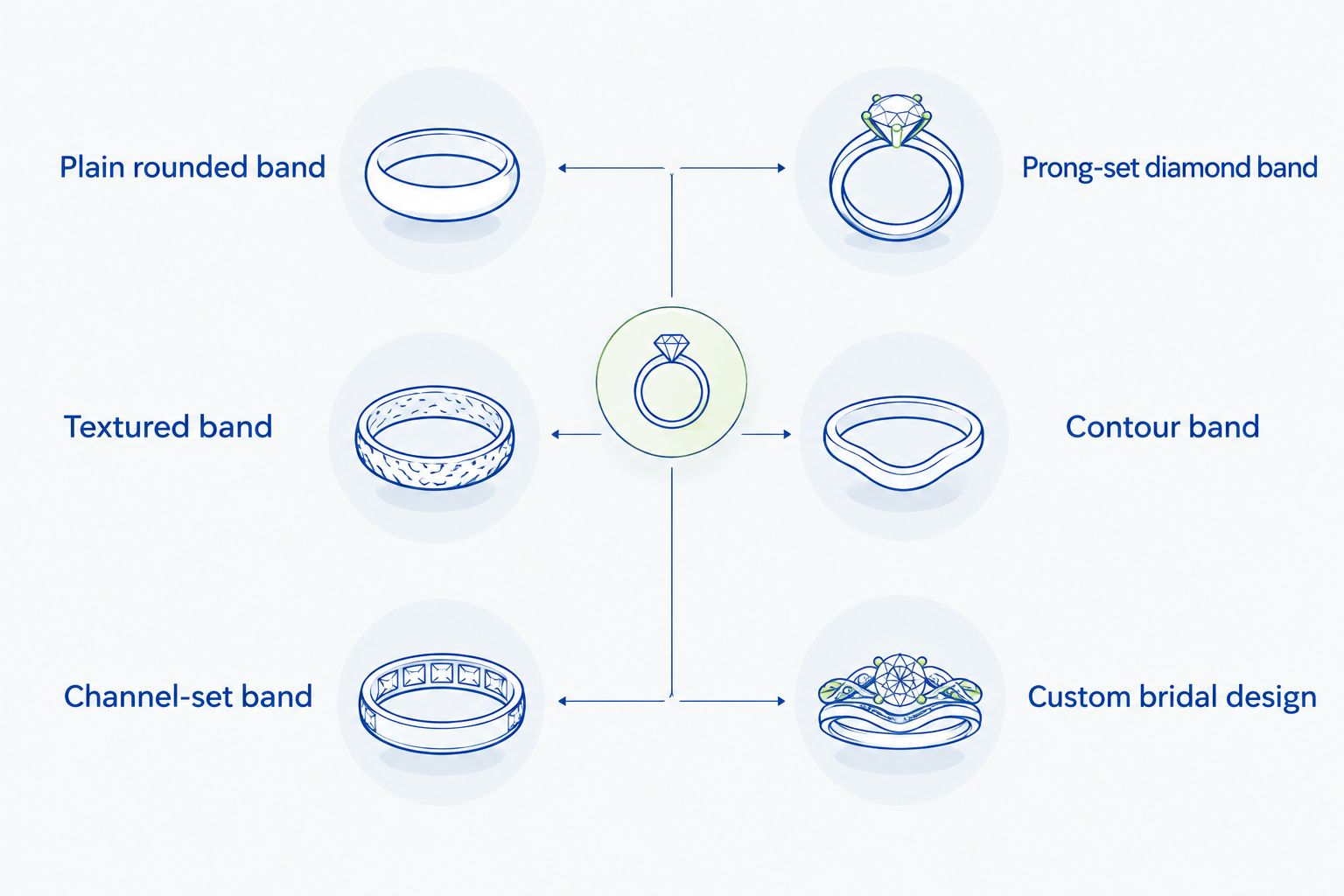
Choose the plain rounded band as your reference during a fitting, even if you ultimately want something more expressive. Comparing every candidate against the same simple shape makes differences in height, edge feel, and visual weight easier to notice.
Common mistakes lawyers make when choosing wedding bands
Choosing an imagined courtroom uniform
Do not reject a ring you love because it does not match a generic picture of an attorney. Check actual workplace expectations, then distinguish those requirements from your own preferences. A restrained ring and an expressive ring can both be intentional choices.
Testing the ring only with an open hand
The jewelry-tray view leaves out gripping, writing, and finger-to-finger contact. Reproduce your normal movements before deciding. If you keep adjusting the ring during a fitting, identify the reason rather than assuming you will stop noticing it.
Confusing scratch resistance with freedom from care
A durability label does not answer every maintenance question. Ask separately about surface wear, stone security, finishes, and future alterations. The useful question is not simply whether a ring is “durable,” but what ownership of that particular design involves.
Buying a stack you only like together
You do not need to wear an engagement ring and wedding band together every day. Assess each ring independently and decide whether that flexibility matters to you. A pairing should expand your choices, not leave you unhappy whenever one piece is absent.
FAQ
What's the best wedding band for a lawyer?
The best wedding band for a lawyer is one that stays comfortable during their usual hand movements and suits their personal style. Start with a plain rounded band as a fitting reference, then compare more detailed designs against it.
Can attorneys wear diamond wedding bands to court?
Check the requirements of the particular court or workplace rather than assuming a universal rule. For your own selection, assess the band's profile, comfort, and level of detail in the context where you will wear it.
Is platinum or gold better for a lawyer's wedding band?
Neither platinum nor gold is automatically better because you practice law. Compare the exact alloy, appearance, skin compatibility, maintenance, and construction of the rings you are considering.
What wedding-band width is most comfortable for typing?
The most comfortable width is the one that fits your finger and allows your normal typing movements without unwanted pressure. Try different widths in comparable shapes, and repeat the test with your intended ring stack.
Should lawyers choose plain or diamond wedding bands?
Choose a plain band if avoiding stone-setting maintenance is a priority; choose a diamond band if sparkle matters enough to accept setting care. Both choices still require an assessment of fit, edges, and daily comfort.
Can a designer wedding band be resized later?
Resizing depends on the specific design, metal, stone placement, and maker's requirements. Ask about the exact ring before purchasing rather than treating all designer bands as equally alterable.
Where can I explore contemporary bridal jewelry in Denver?
Element 79 is a Cherry Creek, Denver boutique offering contemporary designer fine jewelry and custom bridal pieces. Bring your engagement ring and a description of your daily routine to guide the conversation.
One last thing
Make the final comparison with your hand relaxed, not posed. A wedding band spends more time accompanying ordinary movements than appearing in wedding photographs. The detail that delights you should still feel welcome when you reach for your keys.
For your 2026 decision, save your favorite design, then write down one reason it works physically and one reason it feels personal. If you can answer both without mentioning your job title, your shortlist is doing its job.
Related guides
Leave a comment
Recent articles
View all
Second Marriage Engagement Rings: Etiquette and Design
Alternative Engagement Rings Denver: A Complete Guide