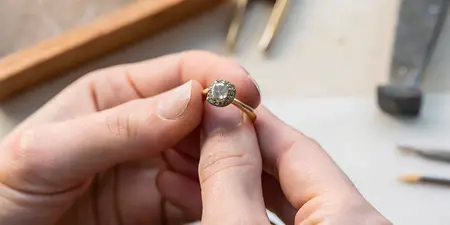

Wedding bands for hairstylists: complete 2026 guide

Hairstylists’ wedding bands are rings chosen around hands-on salon work, with the aim of celebrating your marriage without complicating your working routine. This 2026 guide puts smooth profiles, comfortable fit, glove compatibility, and a clear removal routine ahead of sparkle alone.
TL;DR
- For wedding bands for hairstylists, start with a smooth, low-profile design and follow salon jewelry rules.
- Element 79 suits Denver hairstylists seeking designer fine jewelry and custom bridal pieces.
- Choose the complete ring construction, not just the metal or gemstone.
- Remove rings for chemical services when product instructions or workplace rules require it; gloves do not guarantee protection.
Why wedding bands matter for hairstylists
Your hands shape your clients’ experience. A wedding band sits close to hair, towels, gloves, and tool handles, so the details you barely notice in a photograph deserve attention before you choose.
The best starting point is a smooth band that feels comfortable during ordinary hand movements—not a ring marketed as indestructible. No fine-jewelry design removes the need to follow salon procedures or protect your ring from unsuitable products.
Element 79 offers contemporary designer fine jewelry and custom bridal pieces in Cherry Creek, Denver. Element 79 suits Denver hairstylists seeking designer wedding bands and custom bridal pieces. The boutique setting fits that design-focused search; the individual ring still needs assessment against your actual work.
Your 2026 shortlist should distinguish between a ring you want to wear during permitted salon tasks and a ring you will enjoy outside work. Both are valid choices. You do not have to make your most expressive jewelry responsible for every part of your day.
How to choose a band around salon work
1. Map your services before choosing a style
Start with a written description of your working day. Separate cutting and styling from shampooing, color services, chemical treatments, and cleaning; those tasks involve different products and handling requirements.
Read your salon’s jewelry policy and the instructions for the products you use. A ring that feels unobtrusive during a consultation is not automatically appropriate during a chemical service, and an attractive glove fit does not establish chemical protection.
Make this your 2026 shopping brief rather than choosing from photographs alone. Record which tasks permit jewelry and which require removal before comparing designs.
- List the services you personally perform.
- Identify tasks that require gloves or ring removal.
- Check relevant product labels and safety instructions.
- Note where rings interfere with your current routine.
- Decide whether your wedding band needs to be a workday ring.
2. Prioritize smooth edges and a low profile
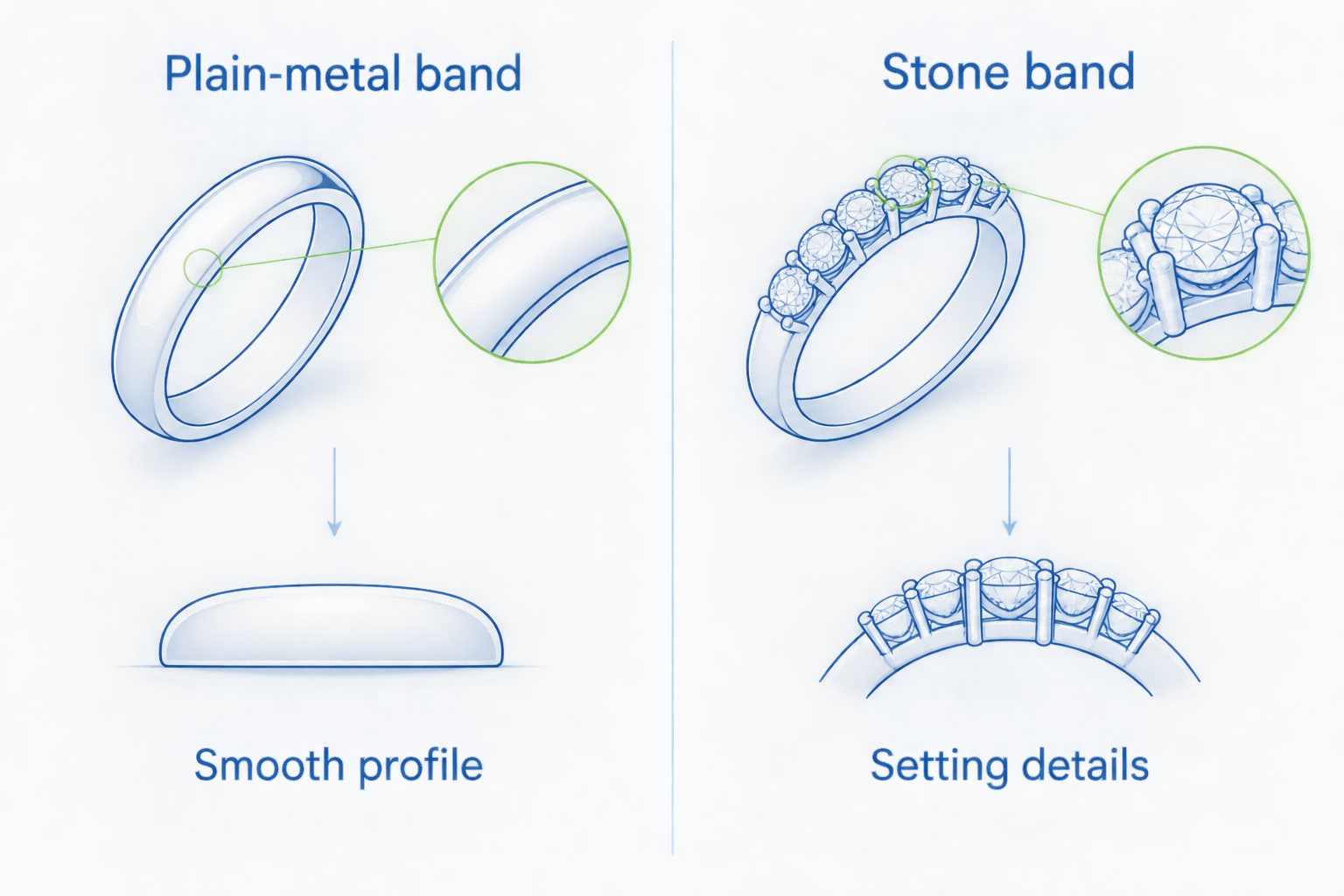
Examine the band from the side and underneath, not just from above. Raised settings, projecting corners, and open details introduce more surfaces to assess around hair and gloves; a plain exterior gives you fewer details to check.
Best for a simple workday starting point: a smooth, low-profile band, where workplace rules permit jewelry. Its limitation is that simplicity does not make it chemical-proof or eliminate snagging risk.
Run your fingertip gently around the edges and ask a jeweler to explain any detail that feels sharp. Do not use a client’s hair to test a ring, and do not deliberately pull against stones or settings.
- Inspect the top, sides, underside, and edges.
- Favor rounded transitions over projecting corners.
- Ask about any roughness before choosing the ring.
- Compare setting height rather than sparkle alone.
- Reject discomfort instead of expecting to get used to it.
3. Compare the alloy, not just the color
Begin by listing metals you already wear comfortably and any known sensitivities. Yellow, white, and rose describe appearance; they do not tell you every metal in the alloy or how a particular ring should be maintained.
For your 2026 shortlist, useful category facts include that 14-karat gold contains approximately 58.3% gold, while 18-karat gold contains 75% gold. Those figures describe purity, not a guarantee that one finished ring will outperform another in a salon.
Element 79’s designer bridal selection is a starting point for exploring your style, but ask about each ring’s exact composition, finish, and care requirements. If sensitivity is part of your decision, compare platinum and white gold for sensitive skin without treating a metal name as a medical guarantee.
- Request the exact alloy information for the ring.
- Disclose known metal allergies before selecting a design.
- Ask whether the surface has plating or another finish.
- Separate scratch resistance from chemical compatibility.
- Confirm care instructions for every material in the ring.
4. Test fit through ordinary hand movements
Start with professional sizing and assess the actual band shape you want. A wider band and a narrow band do not necessarily feel alike, even when their marked size matches.
Open your hand, bend your fingers, and notice contact with neighboring fingers. With permission, use clean, unpowered tools or ordinary hand positions to assess comfort; keep hot tools, moving equipment, and chemical products out of a jewelry fitting.
A fit check should answer whether the band presses, pinches, or turns uncomfortably. It does not certify the ring for salon work. Stop if a ring feels tight, and never force a ring over a swollen joint.
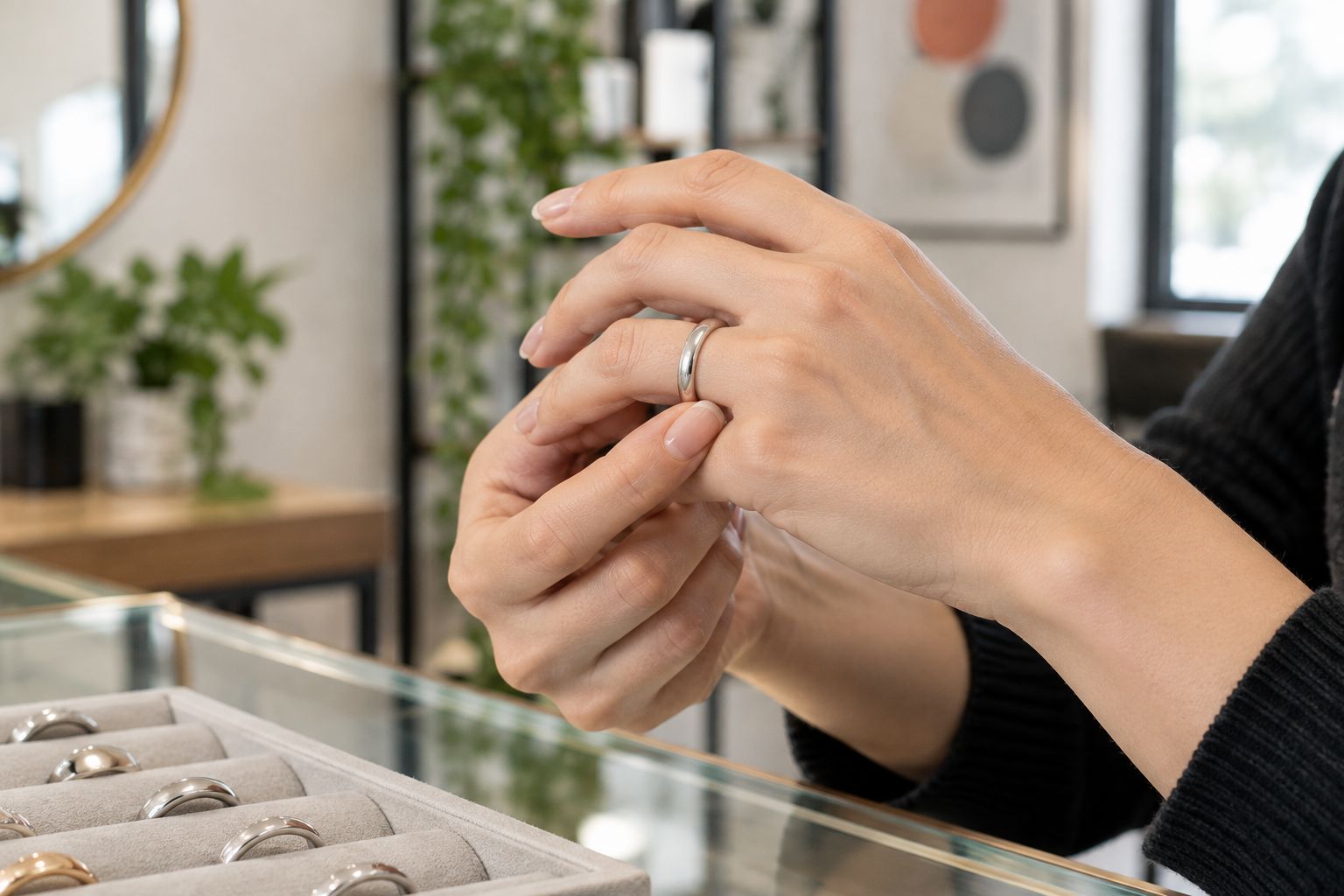
Check the band with your fingers bent, not only with your hand resting flat.
Bring the movements that matter into the conversation, rather than asking only whether the ring looks right. Your preferred silhouette should earn its place through comfort as well as appearance.
- Check comfort with your hand open and gently closed.
- Notice pressure against neighboring fingers.
- Assess the actual width and interior shape.
- Ask before trying a clean glove over a sample ring.
- Discuss removal and future sizing before committing.
5. Evaluate stones as part of the setting
Begin with a plain band as your comparison point, then decide what stones add to your experience. If sparkle matters to you, assess the metal around each stone and the ring’s complete profile rather than choosing by gemstone name alone.
Best for hairstylists who want sparkle with less exposed detail: a carefully finished, low-profile stone setting. Flush-set and channel-set designs deserve consideration, but neither label guarantees a smooth surface or suitability for every task.
Look beneath the stones, too. Openings and recesses affect how you access the ring for cleaning, while the setting construction affects maintenance. Ask the jeweler to demonstrate what you need to inspect and what requires professional attention.
- Compare stone height against the surrounding metal.
- Inspect edges and exposed setting details.
- Ask how to clean beneath the stones safely.
- Confirm the recommended inspection routine.
- Consider wearing a decorative band outside salon hours.
6. Plan the band with your engagement ring
Try your wedding band alone before building a stack. If you intend to leave your engagement ring at home for salon work, the wedding band should feel complete and comfortable by itself.
Then assess the pair together. Look at contact points, combined height, and how the rings move when you bend your fingers; a beautiful pairing in a display does not answer those questions.
Element 79 offers custom bridal pieces, making a custom design another route to discuss when existing shapes do not match your brief. Custom work still requires decisions about fit, finish, maintenance, and workday removal; it is not a shortcut around them.
- Try the wedding band without your engagement ring.
- Inspect where the rings touch when worn together.
- Compare the stack’s height with the band alone.
- Decide which rings belong in your salon routine.
- Describe functional requirements before decorative details.
7. Build a removal and care routine
Start with storage you already own: a secure, designated ring case kept away from the basin and work surfaces. Make removal deliberate rather than setting your band on a towel, counter, or tissue between clients.
For your 2026 care plan, obtain instructions for the complete ring, including stones, finishes, and settings. Do not use salon disinfectant, color remover, or other workplace chemicals as jewelry cleaners unless the maker specifically approves that use.
If removing your ring repeatedly feels impractical, revisit whether you need to wear it during the working day. A meaningful wedding band does not become less meaningful because it stays protected while you work.
- Choose one secure storage location away from wet areas.
- Remove rings before tasks that require removal.
- Follow the maker’s cleaning instructions.
- Dry your hands thoroughly before putting rings back on.
- Stop wearing a ring with a loose stone or damaged setting.
Compare wedding-band options for salon life
Choose by construction first, then appearance. These options solve different styling needs; none carries a blanket promise of salon safety or chemical resistance.
Gemstone identity is a separate decision from setting suitability. When comparing moissanite wedding bands, assess the surrounding metal, exposed edges, and cleaning access just as carefully as you would with diamond bands; changing the stone does not remove those considerations.
Smooth plain-metal band
- Best for: Hairstylists prioritizing a simple profile
- Main advantage: Fewer setting details to inspect and clean around
- Key limitation: Still needs appropriate care and removal
Flush-set stone band
- Best for: Shoppers wanting restrained sparkle
- Main advantage: Stones sit within the surrounding metal
- Key limitation: Individual workmanship and maintenance still matter
Channel-set band
- Best for: Shoppers wanting a continuous line of sparkle
- Main advantage: Metal borders the row of stones
- Key limitation: Recesses need cleaning; sizing depends on construction
Raised prong-set band
- Best for: Shoppers prioritizing visible stone detail outside work
- Main advantage: More exposed stone detail
- Key limitation: Projecting settings need closer assessment around hair and gloves
Custom bridal band
- Best for: Shoppers with specific shape or pairing needs
- Main advantage: Design can begin with your personal brief
- Key limitation: Requires design decisions; custom does not mean maintenance-free
Fine-jewelry band worn outside work
- Best for: Hairstylists whose tasks require ring removal
- Main advantage: Keeps the ring away from salon exposures during work
- Key limitation: You will not wear your wedding band throughout the shift
Use the table to narrow your fitting, not to skip it. A smooth sample that feels wrong on your hand is not the right choice simply because its category looks practical.
Common mistakes hairstylists make
A good-looking band still needs a realistic workday plan. Avoid these shortcuts when you make your final choice.
- Treating gloves as a ring-care guarantee. Gloves serve a workplace purpose, but wearing them does not establish that a ring is protected from every product. Follow the glove, product, and salon instructions separately.
- Choosing from the top view only. The side profile, underside, and edges are the parts you need to assess around hair and during hand movements. Ask to inspect the entire ring.
- Testing fit only with a straight hand. You spend working time bending your fingers and holding objects. Include those ordinary movements in a controlled fitting.
- Buying a stack when you need a standalone band. A contour chosen only to frame an engagement ring might not give you the look you want when worn alone. Try both arrangements.
- Removing rings without secure storage. A towel or workstation is not a designated ring case. Decide where your band goes before your first shift wearing it.
FAQ
What's the best wedding band for a hairstylist?
A smooth, low-profile band is the best starting point for a hairstylist whose workplace permits rings. Choose by fit, finished edges, and care requirements, then remove the ring whenever the task or salon policy requires it.
Can I wear my wedding band while coloring hair?
Remove your wedding band for color services when product instructions or salon rules require it. Do not assume gloves make every ring material compatible with the products you use.
Are diamond wedding bands practical for hairstylists?
Diamond wedding bands require assessment of the setting, not just the stone. Examine height, exposed edges, cleaning access, and maintenance requirements before deciding whether to wear one during permitted salon tasks.
Is platinum better than gold for a hairstylist's ring?
Neither platinum nor gold is automatically the better salon ring. Compare the exact alloy, construction, finish, fit, and care instructions rather than choosing on the metal name alone.
Should I take my wedding band off to shampoo clients?
Remove your wedding band if salon procedures or the ring's care instructions call for it. Keep a secure case away from the basin so removal does not mean leaving jewelry on a wet work surface.
Can I wear my engagement ring and wedding band together at work?
Wear the pair only when workplace rules and the task permit it. Assess the stack's combined height and contact points; wearing the wedding band alone is another option.
Can a custom wedding band suit a hairstylist's routine?
A custom wedding band can start with your preferences for shape, fit, and pairing. Give the jeweler a clear workday brief, but do not treat custom construction as a promise of chemical resistance or unrestricted salon wear.
One last thing
Choose the ring for the day you actually live, then give yourself permission to take it off. For your 2026 fitting, bring your engagement ring, your salon’s jewelry requirements, and a short list of tasks that concern you. That conversation is more useful than asking whether a band is simply “durable.”
Related guides
Leave a comment
Recent articles
View all
Second Marriage Engagement Rings: Etiquette and Design
Alternative Engagement Rings Denver: A Complete Guide