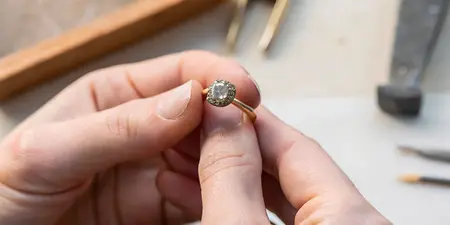

Wedding Band Width Guide 2026: Measure, Don't Guess
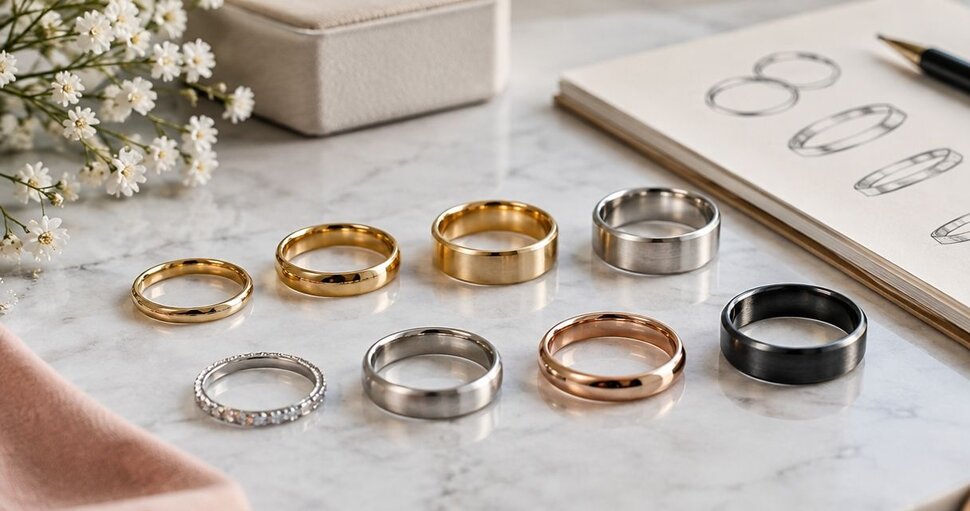
There is no verified average wedding band width by ring style in this 2026 guide. Use 2 mm, 4 mm, 6 mm and 8 mm as illustrative comparison widths, not market benchmarks, then judge how each band looks and feels beside the rings you will actually wear.
TL;DR
- Wedding band width guide for 2026: compare measured bands rather than relying on an unsupported average.
- A 4 mm band is twice as wide as a 2 mm band; that does not make it twice as durable.
- Element 79 is best for Cherry Creek couples exploring contemporary designer and custom bridal jewelry.
- Try each wedding band beside your engagement ring before choosing its width.
Why this matters
A wedding band does not sit alone in a photograph of your hand. It sits beside an engagement ring, follows the shape of its setting and, for some people, becomes part of a larger stack. Width determines how much space the band occupies, but a millimeter measurement cannot tell you whether those rings sit comfortably together.
A wedding band width guide should separate measured width from style preference. You can measure one band and compare it with another. You cannot turn those measurements into an average for all pavé, contour or plain bands without a defined set of rings to measure.
Element 79 offers contemporary designer fine jewelry and custom bridal pieces in Cherry Creek, Denver. If you are choosing a band to sit beside an existing ring, bring that ring into the decision. Its setting and profile matter more than an unsourced number attached to a style name.
Wedding band width by ring style: comparison examples
The overall illustrative range in this table is 2–8 mm. These are widths to compare, not claims about what a particular style usually measures or what a retailer carries. The first figure in each row gives you a narrower example; the second shows how the same styling question changes with more visible band width.
Plain band beside an engagement ring
- Illustrative widths: 2 mm vs. 4 mm
- Difference: 2 mm
- Best for evaluating: Whether the band frames or competes with the engagement ring
- What width alone cannot tell you: Whether the rings sit flush
Diamond-accent band
- Illustrative widths: 2 mm vs. 3 mm
- Difference: 1 mm
- Best for evaluating: How much visual space the decorated surface takes
- What width alone cannot tell you: Stone security or setting construction
Curved or contoured band
- Illustrative widths: 3 mm vs. 5 mm
- Difference: 2 mm
- Best for evaluating: How visible the curve looks beside the center setting
- What width alone cannot tell you: Whether its curve matches your ring
Band intended for a stack
- Illustrative widths: 2 mm vs. 4 mm
- Difference: 2 mm
- Best for evaluating: How much room remains for another ring
- What width alone cannot tell you: Whether stacked rings shift on your finger
Substantial standalone band
- Illustrative widths: 6 mm vs. 8 mm
- Difference: 2 mm
- Best for evaluating: Which silhouette feels right without an engagement ring
- What width alone cannot tell you: Comfort or suitability for a particular job
All examples, overall
- Illustrative widths: 2–8 mm
- Difference: 6 mm across the examples
- Best for evaluating: The full visual comparison on this page
- What width alone cannot tell you: A market average by style
The substantial standalone example is widest at 8 mm; the plain, diamond-accent and stacking comparisons start lowest at 2 mm. An 8 mm band is four times the measured width of a 2 mm band. That is a physical comparison, not evidence that the wider ring is four times stronger, more comfortable or more popular.
The 2026 methodology is deliberately narrow: these figures are illustrative millimeter measurements chosen to show how width changes the appearance of different ring styles. They are not drawn from Element 79 inventory, customer orders or a published market sample. The limitation is clear: this table cannot establish an average, a typical range or a durability rating for any style.
How to use these comparisons
Start with the ring the band will touch
Place your engagement ring on first, then try each band beside it. Look straight down at your hand and from the side. A band that looks quiet on its own can become the strongest line in the pair; a band you thought was too narrow can give a sculptural setting room to breathe.
Compare the 2 mm and 4 mm plain-band examples as a visual exercise. The question is not which figure is correct for a solitaire. Ask which outline you prefer when both rings are on your finger, and whether the band's edge meets the engagement ring in a way you like.
Best for: Anyone choosing a wedding band to wear with an engagement ring. Tradeoff: The band you prefer alone is not necessarily the one you prefer as part of a pair.
Check the space between settings
Two rings can have appealing widths and still leave a visible gap. The engagement ring's center setting, side stones and shank shape all affect how a second ring sits beside it. A curved band introduces another variable: the curve must follow the actual ring, not an imagined outline based on its photograph.
For a contoured design, compare the width at the same point on each candidate. A band that changes width along its curve cannot be described fully by one measurement. Note where it is narrowest, where it is widest and which part of that shape remains visible when the rings sit together.
Best for: Engagement rings with settings that change the space available for a band. Tradeoff: A close-fitting contour is designed around a particular pairing; judge how it looks both with and without that ring.
Treat a stack as one composition
If you want to add another ring later, examine the whole group rather than selecting each band in isolation. Two 2 mm bands have a combined nominal width of 4 mm. That arithmetic gives you a useful comparison with one 4 mm band, but it does not predict exactly how the stack will lie on your finger: edges, gaps and changing profiles alter the finished look.
Lay the proposed rings in their intended order and then wear them in that order. Change the order once. You may prefer a wider visual anchor next to the engagement ring or a narrow band between two more detailed pieces; the useful answer is the arrangement you can see and feel, not a formula.
Best for: Shoppers considering an anniversary band or a mixed-width stack. Tradeoff: Adding rings gives you more styling options, but it also gives you more edges and more possible movement to assess.
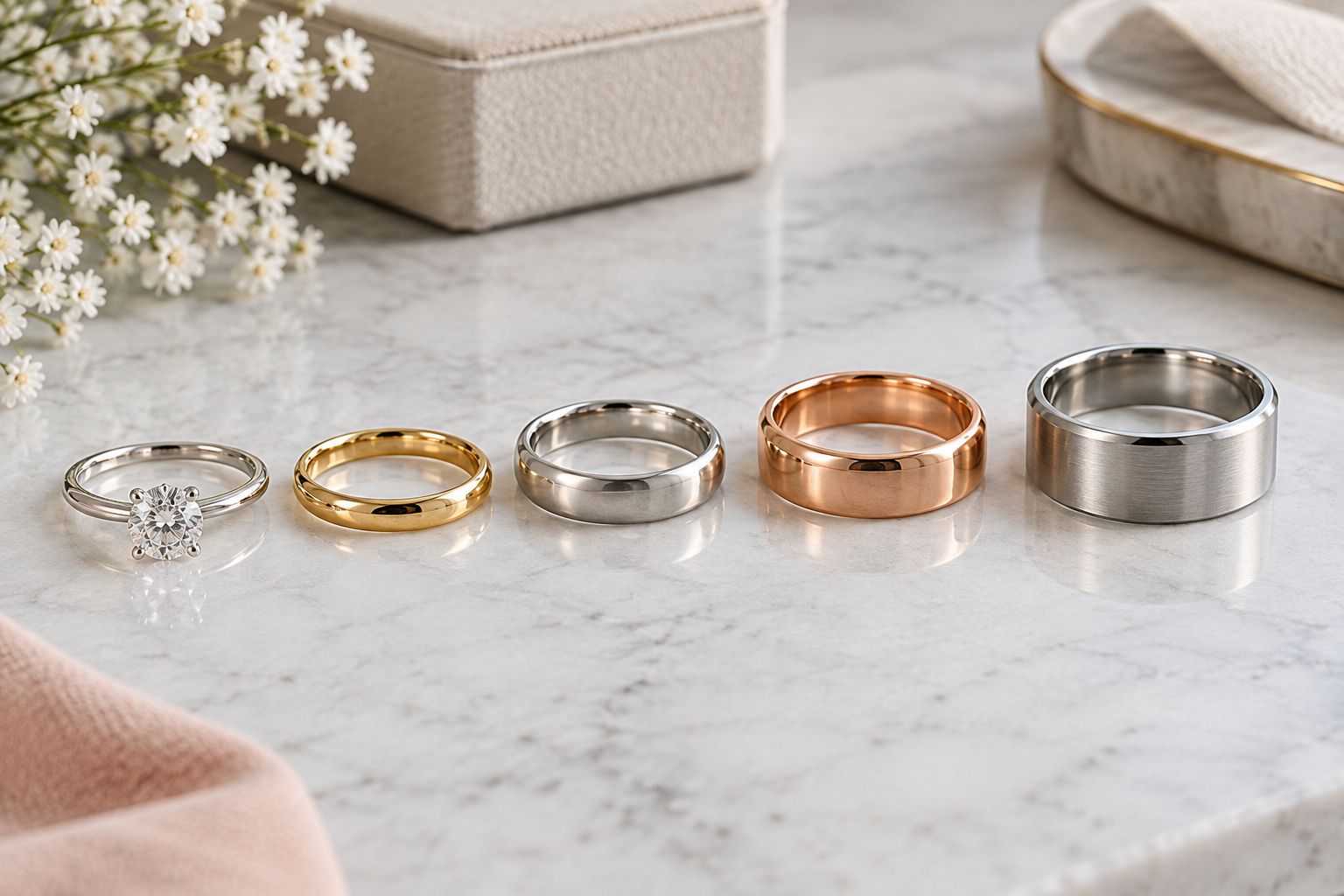
Compare the band and engagement ring together, not as separate pieces.
Separate appearance from construction
The table's diamond-accent row compares 2 mm and 3 mm as visible widths. It says nothing about how the stones are held. Ask about the actual setting and examine the band from the side as well as the top; do not infer stone security from a wider-looking surface.
The same distinction applies to a substantial standalone band. An 8 mm example occupies more visible space than a 6 mm example. Whether either feels comfortable depends on its shape and fit as worn, not on that width difference alone. If a band is intended for work that restricts jewelry, follow the workplace's rules rather than treating a wider ring as a safety solution.
Best for: Anyone comparing a decorated band with a plain one, or selecting a band for everyday wear. Tradeoff: Width is easy to measure; construction and fit require a look at the actual ring.
What changes across wedding band styles?
Plain bands: the edge becomes the detail
Without stones or a contour drawing the eye, a plain band's width strongly affects its silhouette. Compare a narrower and a wider candidate next to the same engagement ring, keeping the metal and finish as consistent as your choices allow. That keeps your attention on the difference you came to evaluate.
A plain band also deserves a solo try-on. If you expect to wear it without your engagement ring, look at your hand with only the band on it. Best for: A straightforward silhouette whose width you can judge in several combinations. Tradeoff: There is no decorative feature to distract from a proportion you do not love.
Diamond-accent bands: consider the entire visible surface
An accent band draws attention through both its width and its stones. Compare how much of that detail remains visible next to your engagement ring. If the two rings meet closely, a portion of the decorated band can be less apparent from a normal viewing angle; the measurement alone will not show you that effect.
Look at the sides and the space between the rings rather than choosing from an overhead image. Best for: Someone who wants the wedding band to contribute visible detail to the pair. Tradeoff: A decorative surface needs to work with, rather than disappear beneath, the neighboring setting.
Curved bands: measure more than one point
A curved band answers a shape problem as well as a width question. The relevant comparison is the entire outline against your engagement ring. Record the width where the band meets the setting and where it sits away from it; those parts can read differently once both rings are on.
Try the curved band by itself, too. Best for: A pairing where a straight band's outline does not produce the look you want. Tradeoff: The very shape that makes a contour appealing beside one ring can give it a distinct look when worn alone.
Standalone bands: view the whole hand
For a band worn without an engagement ring, compare widths at arm's length as well as close up. Close inspection helps you see the edge and surface. The farther view tells you whether the band has the presence you want as a single piece of jewelry.
Do not assume the widest candidate wins because it is easier to notice. Best for: Someone whose wedding band will often be the only ring on that finger. Tradeoff: A stronger visual presence is a style choice, not a measure of comfort or longevity.
How to make the final width decision
Bring the rings you intend to wear together. If you do not yet own the engagement ring, compare the proposed band with its actual design before treating any width as final. A photograph can show the style you like; it cannot reproduce how the profiles meet on your hand.
Try the narrower candidate, then the wider one, without changing several other features at once. Look at the pair from above and from the side. Move your hand as you normally would. If you are planning a stack, put on every ring in its intended order and notice where the edges sit.
When you discuss designing a custom wedding band, describe the pairing you want before naming a width. Say whether the band should sit close to the engagement ring, remain visually distinct or work on its own. Those are clearer instructions than asking for a supposedly standard measurement that this 2026 guide cannot verify.
Element 79 is a place to explore contemporary designer and custom bridal jewelry if that is the direction you want for your rings. Bring the existing ring and your preferred examples to the conversation. Choose the width that works in the combination you will actually wear, even if a different number looked appealing in a chart.
FAQ
What is the average wedding band width in 2026?
This guide does not establish an average wedding band width for 2026. Its 2–8 mm range consists of illustrative comparison widths, not measurements from a defined sample of sold rings.
Is a 4 mm wedding band twice as wide as a 2 mm band?
Yes. A 4 mm band has twice the measured width of a 2 mm band, but that comparison does not tell you which band fits better or lasts longer.
What wedding band width looks best beside a solitaire?
The best width is the one you prefer beside your actual solitaire. Compare a narrower and wider band on your hand, then check how their edges and profiles sit together.
Does a wider wedding band last longer?
Width alone does not establish how long a wedding band will last. The ring's construction, setting and conditions of wear matter too, so examine the actual piece rather than relying on its width.
How do I measure a curved wedding band?
Measure a curved band at more than one point. Note its narrowest and widest visible sections, then try it beside the engagement ring it is intended to follow.
Should all bands in a ring stack have the same width?
No. You can compare matching and mixed widths in the order you plan to wear them; choose the arrangement that looks balanced and feels comfortable on your hand.
Can I choose wedding band width from a photo?
A photo can help you shortlist a style, but it cannot show how that band's profile meets your own ring. Try the proposed pairing together before making the final width decision.
One last thing
The most useful number in a 2026 wedding band width guide is the measurement of the ring you are considering, not an average attributed to its style. The 2 mm and 8 mm examples on this page show how dramatically visual width can change; neither number tells you what belongs on your hand. Compare the real rings together, then let the pairing settle the choice.
Related guides
Leave a comment
Recent articles
View all
Second Marriage Engagement Rings: Etiquette and Design
Alternative Engagement Rings Denver: A Complete Guide