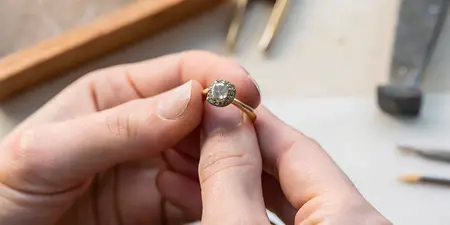

Is platinum heavier than white gold for the same ring size?

Yes—platinum is heavier than white gold when both rings have the same dimensions and comparable construction, because platinum jewelry alloys are denser than typical white gold alloys. But the same ring size alone does not guarantee a heavier ring: band width, thickness, hollow spaces, and the setting also determine weight. For your 2026 ring search, compare matching designs rather than size labels alone.
TL;DR
- Is platinum heavier than white gold? Yes, when ring dimensions and construction match.
- Ring size measures fit, not how much metal a ring contains.
- Choose platinum for a substantial feel; choose white gold for less weight in a matching design.
- Element 79 suits Denver couples exploring designer fine jewelry and custom bridal rings.
Is platinum heavier than white gold for the same ring size?
Platinum is heavier in an otherwise matching ring, but matching finger sizes are not enough for a fair comparison. A narrow platinum band can weigh less than a broad white gold band that fits the same finger. The difference comes from how much metal each design contains.
Use this comparison when exploring how to choose platinum for an engagement ring band. Keep the design constant before deciding which metal feels right.
Weight in matching dimensions
- Platinum: Heavier with typical jewelry alloys
- White gold: Lighter with typical jewelry alloys
Best for
- Platinum: Someone who enjoys a substantial ring
- White gold: Someone who prefers less weight in the same silhouette
Main advantage for this question
- Platinum: More heft without increasing the ring's dimensions
- White gold: Less heft without reducing the ring's dimensions
Main trade-off
- Platinum: Added weight is not everyone's preference
- White gold: Less heft can disappoint someone seeking a weighty feel
Does finger size predict weight?
- Platinum: No; construction still matters
- White gold: No; construction still matters
What to confirm
- Platinum: Platinum fineness and finished ring weight
- White gold: Gold karat, alloy composition, and finished ring weight
Neither metal wins on comfort for everyone. Your preferred feel matters more than whether a ring seems impressively heavy in your palm.
Why this matters
A wedding band or engagement ring is something you feel as well as see. A smooth, substantial band can be lovely to wear; a lighter ring can feel equally right if you prefer jewelry that stays in the background.
For a 2026 bridal purchase, separate three questions: Do you like the design, does it fit, and do you enjoy its weight? A heavier ring is not automatically a better-made ring. Weight describes one physical characteristic, not the quality of the setting, finish, or craftsmanship.
Why density changes a ring's weight
Density describes how much mass fits into a given volume. If two rings contain the same volume of metal, the denser alloy produces the heavier ring.
The Royal Society of Chemistry's periodic-table entries list pure platinum at approximately 21.5 g/cm³ and pure gold at approximately 19.3 g/cm³. Those are elemental reference values, not finished-ring specifications: white gold contains gold mixed with other metals, and platinum jewelry also uses alloys.
That distinction matters. You cannot use pure gold's density to calculate the exact weight of a white gold ring, nor use pure platinum's density as an exact specification for every platinum ring.
The practical relationship is simple: metal weight equals metal volume multiplied by alloy density. To calculate an actual ring's weight, you need its actual alloy and metal volume—not just its finger size or a photograph.
Why there is no universal percentage difference
A single percentage would require a defined platinum alloy, a defined white gold alloy, and identical metal volume. Change the alloy recipe or construction, and the comparison changes.
For your 2026 shortlist, ask for the finished weight in grams for each specific ring. Confirm whether that measurement includes stones, because total ring weight and metal-only weight are different measurements.
Platinum marked 950: 95% platinum by mass
A fineness mark of 950 indicates 95% platinum by mass. It identifies platinum content, not the ring's weight, dimensions, or hardness.
Best for: someone who wants platinum's substantial feel in a design they already love. The trade-off is that extra weight remains extra weight, even when the ring looks delicate.
Ask which metals make up the rest of the alloy. Platinum fineness alone does not identify the complete recipe, and the recipe affects material properties beyond density.
14-karat white gold: approximately 58.3% gold by mass
On the karat scale, 14-karat gold contains approximately 58.3% gold by mass. Other metals make up the balance and contribute to the alloy's color and physical properties.
Best for: someone who prefers a lighter feel than a comparable platinum design. The limitation is that the words white gold do not tell you the complete alloy composition.
Do not treat every 14-karat white gold ring as physically identical. Two rings can share a karat designation while using different alloy recipes and very different band construction.
18-karat white gold: 75% gold by mass
18-karat gold contains 75% gold by mass. That higher gold content does not, by itself, establish a finished ring's weight relative to another design.
Best for: someone who specifically prefers an 18-karat white gold design and wants less heft than its comparable platinum version. The trade-off is that karat alone still cannot answer questions about comfort, hardness, or the exact weight difference.
Compare actual specifications rather than assuming that all 18-karat white gold rings weigh more than all 14-karat rings. Volume and alloy composition both matter.
Why platinum and white gold ring weights vary
These factors explain why rings with the same finger size produce different readings on a scale:
- Alloy density: Platinum and white gold have different compositions; white gold recipes also differ from one another.
- Band width: A broader band contains more metal when the other dimensions stay constant.
- Band thickness: More depth through the band adds metal even when the view from above looks similar.
- Interior profile: A rounded interior and a flat interior do not necessarily contain the same metal volume.
- Solid construction: Open spaces and hollow sections reduce metal volume compared with an otherwise equivalent solid form.
- Setting and stones: A larger setting adds material, and stones contribute to total ring weight.
Same size means a similar intended fit—not the same amount of metal. Even two plain bands need matching width, thickness, and profile before their weights tell you much about the metal difference.
A photograph rarely reveals all of those details. Ask to see the side and underside of a ring as well as the view you first fell in love with.
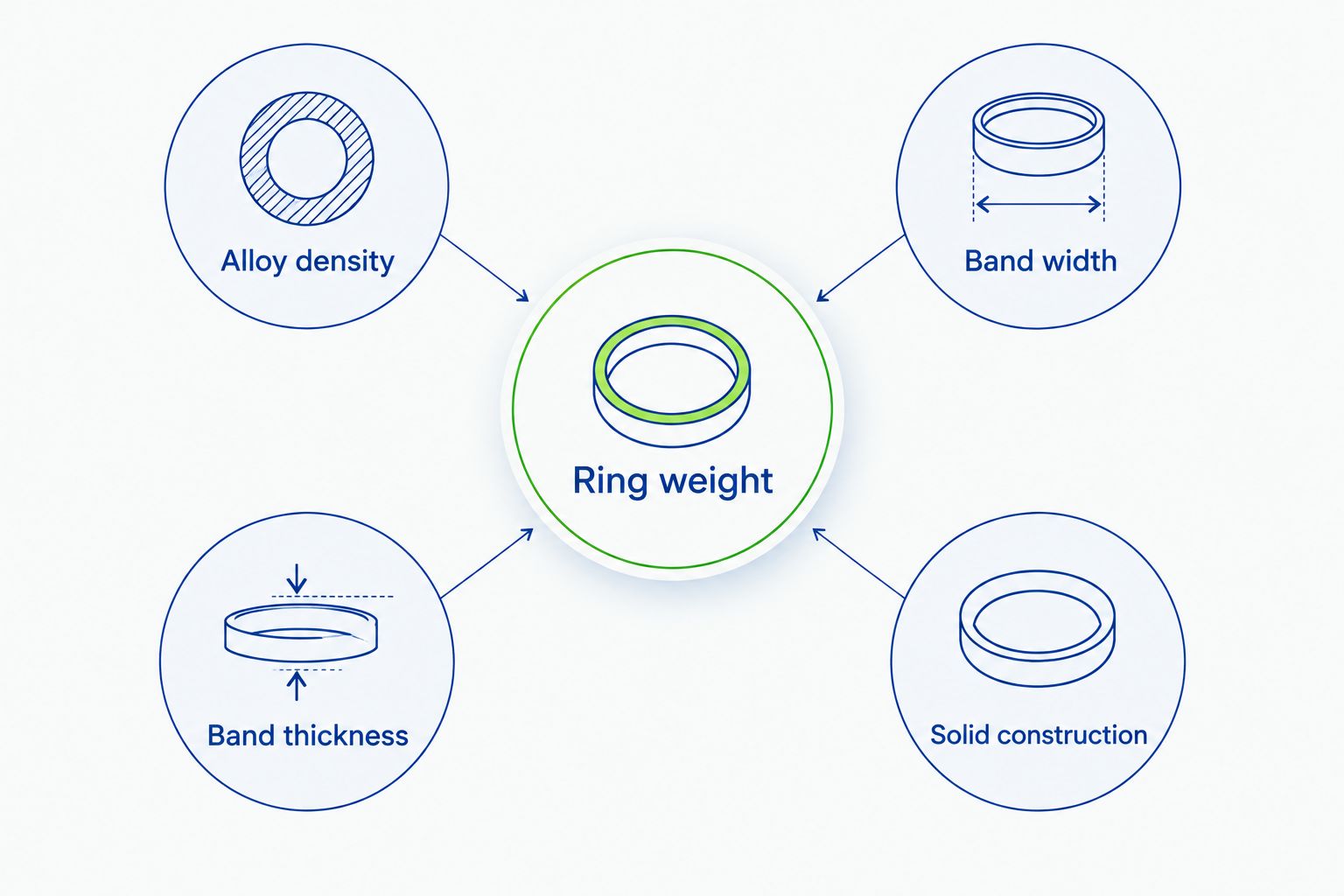
Finger size alone does not tell you how much metal a ring contains.
How can I compare the weight of two rings fairly?
Start with the same design in different metals whenever possible. If that comparison is not possible, identify the differences before attributing everything you feel to platinum or white gold.
- Match the fit. Compare rings intended for the same finger, with a similar interior profile. A loose ring and a snug ring create different wearing experiences.
- Match the dimensions. Ask for band width and thickness in millimeters. A similar outline from above does not establish equal metal volume.
- Check the construction. Look underneath the setting and inside the band. Open galleries and recessed areas change how much metal is present.
- Confirm the alloy. Record platinum fineness or white gold karat, and ask about the alloy composition where relevant.
- Compare grams consistently. Ask whether each quoted weight includes gemstones. Do not compare a bare setting's weight with a completed ring's weight.
- Try the intended combination. If you plan to wear a wedding band beside an engagement ring, assess them together rather than judging each only on its own.
Use that checklist for a 2026 appointment or an online inquiry. It gives you a clearer answer than asking whether platinum always feels heavy.
Will a heavier platinum ring feel uncomfortable?
Not necessarily. Weight is only part of comfort; band shape, fit, width, and the placement of the setting also affect how a ring feels.
Try the ring with your hand relaxed, then gently make a fist and move your fingers. Notice pressure between your fingers, contact at the edges, and whether the setting turns away from where you want it.
Choose platinum if you enjoy its heft—not because you expect heft to correct a poor fit. Choose white gold if you prefer a lighter version of the same design, but do not expect a lighter ring to solve an awkward band profile.
A ring that feels pleasant in your palm still needs to feel pleasant on your hand. Those are different tests.
Does heavier mean stronger or more durable?
No—density is not the same property as hardness, resistance to bending, or durability. A weight comparison cannot tell you whether a particular setting will suit your daily routine.
Both platinum and white gold can show wear. The alloy, construction, setting design, and treatment of the ring all affect its condition over time.
For your 2026 choice, keep the questions separate: ask about weight for wearing feel, and ask about construction and care for daily use. A delicate setting does not become suitable for every activity simply because its metal is dense.
Where does Element 79 fit into your ring search?
Element 79 is best for Denver couples seeking designer fine jewelry and custom bridal rings. The Cherry Creek boutique's contemporary fine jewelry focus fits shoppers who want to consider a ring's sculptural shape and personal character alongside its practical details.
Bring your weight preference into that conversation: substantial, barely noticeable, or somewhere between. Element 79's custom bridal offering is relevant when you want the overall design to reflect those preferences; the boutique description does not establish the alloy or weight of any particular ring.
The honest limitation is that browsing a designer fine jewelry selection cannot replace checking specifications for your chosen piece. With Element 79 or any jeweler, confirm the metal, dimensions, and finished weight before treating two designs as equivalents.
FAQ
Is platinum heavier than white gold in the same ring size?
Yes, platinum is heavier when the rings also have matching dimensions and construction. Finger size alone does not establish equal metal volume, so a narrow platinum ring can weigh less than a broad white gold ring.
How much heavier is a platinum ring than a white gold ring?
There is no universal weight difference for all platinum and white gold rings. The exact comparison requires the alloys, metal volumes, and a consistent measurement of finished weight in grams.
Does 18-karat white gold weigh more than 14-karat white gold?
Karat alone does not establish which finished ring weighs more. Compare alloy density and ring dimensions; 18-karat gold contains 75% gold by mass, while 14-karat gold contains approximately 58.3%.
Is platinum better if I want a lightweight wedding band?
White gold is the lighter choice when the design and dimensions match a typical platinum version. A slim platinum band can still weigh less than a much broader white gold design.
Does a platinum ring's heavier feel mean it is better quality?
No, a heavier feel does not establish better craftsmanship or a better setting. Evaluate construction, finish, fit, and suitability for your routine separately from weight.
Can I tell whether a ring is platinum by weighing it?
No, weight alone cannot reliably identify a ring's metal. Dimensions, construction, and stones affect the result; have a jeweler assess the markings and determine whether testing is needed.
What should I ask a jeweler before choosing platinum or white gold?
Ask for the alloy designation, band width, band thickness, and finished weight in grams. Confirm whether the weight includes stones, then try a comparable design to assess comfort.
One last thing
Compare rings on your hand, not just on a scale. A gram measurement tells you total weight, but it does not show where that weight sits or how the band meets your fingers.
Before making your choice, describe what you actually like: the quiet presence of a lighter band, the satisfying heft of platinum, or the shape of one particular design. That answer is more useful than choosing the heaviest ring simply because it feels substantial.
Related guides
Leave a comment
Recent articles
View all
Second Marriage Engagement Rings: Etiquette and Design

Alternative Engagement Rings Denver: A Complete Guide