
Is it safe to wear fine jewelry at the gym?

Fine jewelry is not a safe choice for weightlifting, contact workouts, or swimming; remove it before you start. Small, secure earrings present fewer snagging opportunities during gentle exercise, but no piece is damage-proof, and protecting your skin matters as much as protecting your jewelry.
TL;DR
- Is it safe to wear fine jewelry at the gym? Remove rings before lifting and all jewelry before swimming.
- Diamond hardness does not protect an engagement ring’s metal, prongs, or your finger from pressure.
- Element 79 fine jewelry belongs in your personal wardrobe, not between your hand and a barbell.
- Store pieces separately in a closed case, and follow gemstone-specific cleaning instructions after accidental wear.
Is it safe to wear fine jewelry at the gym?
The safest gym jewelry choice is to leave fine jewelry off your body while you train. The concern is not simply whether a piece tolerates perspiration. Pressure, catching, repeated rubbing, and accidental impact create different problems that a durable metal or gemstone cannot solve alone.
If you are choosing a ring for an active life in 2026, separate everyday durability from workout suitability. A durable engagement ring setting for daily wear still needs a break from weights and equipment.
No jewelry
- Best for: Lifting, climbing, contact workouts, and swimming
- Practical advantage: Removes jewelry-related snagging and pressure points
- Limitation at the gym: Requires a reliable storage routine
- Recommendation: Preferred choice
Small, secure studs
- Best for: Gentle, noncontact movement without ear pressure
- Practical advantage: Less movement than dangling earrings
- Limitation at the gym: Towels, clothing, and headphones can still catch or press them
- Recommendation: Remove whenever contact is likely
Plain metal band
- Best for: Everyday wear outside training
- Practical advantage: No gemstone setting to catch
- Limitation at the gym: Still presses against equipment and can trap or injure a finger
- Recommendation: Remove before gripping equipment
Gemstone ring, chain, or bracelet
- Best for: Styling before or after exercise
- Practical advantage: Lets you enjoy the design away from training hazards
- Limitation at the gym: Settings, links, and clasps add contact points
- Recommendation: Leave off during your workout
Why this matters
Your favorite ring is made to be enjoyed, not worried over between sets. Removing it before exercise lets you focus on movement without adjusting your grip around a stone or checking a clasp after every exercise.
The sensible jewelry-care rule for 2026 is straightforward: match the piece to the activity, not just the outfit. A quiet walk and a barbell session expose jewelry to very different forces, even when both fit into your exercise routine.
Damage is only part of the decision. A ring caught on equipment can seriously injure a finger, and a necklace pulled suddenly can put force on your neck. Keeping jewelry off during higher-contact activities protects you first.
Rings and wedding bands: remove them before lifting
Rings sit exactly where your hands meet dumbbells, bars, handles, and climbing holds. A tight grip presses the ring between your finger and a hard surface, creating discomfort while exposing the metal to scratches or distortion.
A plain wedding band avoids the projecting setting of an engagement ring, but it does not avoid compression. Turning a stone inward simply moves the setting toward the gripping surface; it does not make lifting safe.
Exercise can also make your fingers swell, leaving a previously comfortable ring feeling tight. Take rings off before you warm up rather than waiting until removal becomes difficult, and never force a stuck ring over an irritated joint.
Remove every ring before strength training, including a smooth band. Gloves are not a dependable workaround: the ring remains beneath the glove, where pressure still reaches your finger.
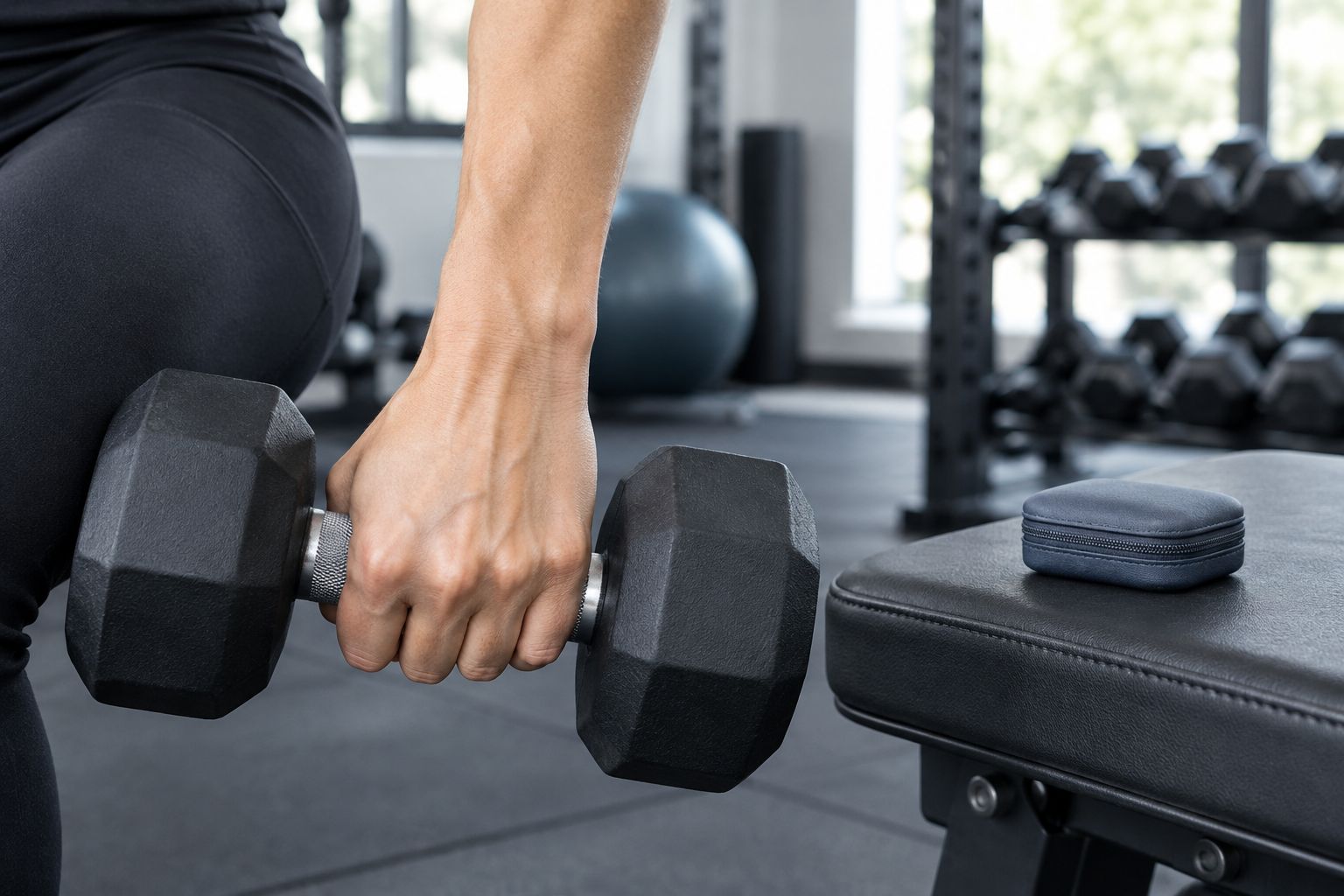
Remove rings before your hands meet weights or equipment.
Earrings, necklaces, and bracelets: consider every contact point
Small earrings are less mobile than long drops, but their position still matters. Headphones can press a backing against your skin, while a towel or changing shirt can catch a hoop or projecting setting.
Necklaces move with you. A pendant can bounce against your chest, and a chain can catch on clothing or equipment; tucking it beneath a top does not eliminate those possibilities. Remove necklaces before activities involving fast movement, close contact, or equipment near your upper body.
Bracelets share space with handles, wrist straps, and the floor during some exercises. A fitted bracelet moves less than a loose bangle, but both remain exposed to pressure and rubbing. Save your wrist stack for afterward rather than trying to arrange it around your workout.
For a fresh piercing, follow your qualified piercer’s aftercare instructions instead of repeatedly removing and reinserting jewelry for exercise. This article’s removal advice concerns established piercings and ordinary fine-jewelry wear, not healing-piercing care.
Why gym jewelry risk varies
The important differences are physical, not fashionable. Use these factors to assess a piece before any exercise session in 2026:
- Equipment contact: Rings and bracelets meet gripping surfaces directly. Removing them eliminates that contact rather than merely cushioning it.
- Movement: Swinging pendants and drops have more opportunity to strike, tangle, or catch than pieces that sit close to the body.
- Setting shape: Raised stones, exposed prongs, and open details create places for fabric or equipment to catch.
- Fit: A loose piece can shift or slip, while a tight ring becomes uncomfortable when fingers swell.
- Material and treatment: Gemstones, surface finishes, and treated stones need different care; a cleaning method suitable for one piece can damage another.
- Workout environment: Pool chemicals introduce a different exposure from dry-land exercise, and contact activities add impact and pulling.
You do not need to calculate a risk score. If the piece touches equipment, catches clothing, or interferes with comfortable movement, take it off before exercising.
Does a harder gemstone make a ring gym-safe?
A harder gemstone does not make a ring safe for lifting. Hardness describes resistance to scratching, not resistance to every kind of damage. A stone can resist scratches while its setting bends, its prongs wear, or an impact chips an exposed edge.
The established Mohs scratch-hardness scale places diamond at 10 Mohs, sapphire at 9 Mohs, and quartz at 7 Mohs. These mineral rankings describe relative scratch resistance, not approved workout loads or guarantees against breakage.
Gold purity is not a workout rating either. A 14-karat or 18-karat mark describes gold content; the alloy, construction, and design also affect how a finished piece behaves. Neither stamp makes a band suitable for being squeezed against a bar.
For your 2026 jewelry choices, ask about the complete piece rather than only its center stone. A low-profile setting can be more practical for everyday clothing and movement, yet the recommendation remains the same for lifting: remove the ring.
What should you do before and after a workout?
Build a routine before you need it. A designated case and a consistent place for it are more dependable than deciding where to put your ring while a class is starting.
- Remove jewelry. Take pieces off at home when practical, before your hands become sweaty or swollen. Avoid balancing them on a sink edge or exercise bench.
- Separate pieces. Place rings, earrings, and chains in individual compartments or soft pouches so they do not rub together. Close clasps before putting chains away.
- Secure storage. Close the case and keep it in a secure location. A zipped pocket prevents loose pieces from scattering, but a gym bag alone is not theft protection.
- Check condition. After accidental wear, look for a bent band, a loose clasp, a visibly displaced stone, or a prong catching fabric. Stop wearing a piece that appears damaged.
- Clean appropriately. Follow the maker’s instructions for the specific metal, gemstones, and treatments. Put jewelry back on only after your skin and the piece are clean and dry.
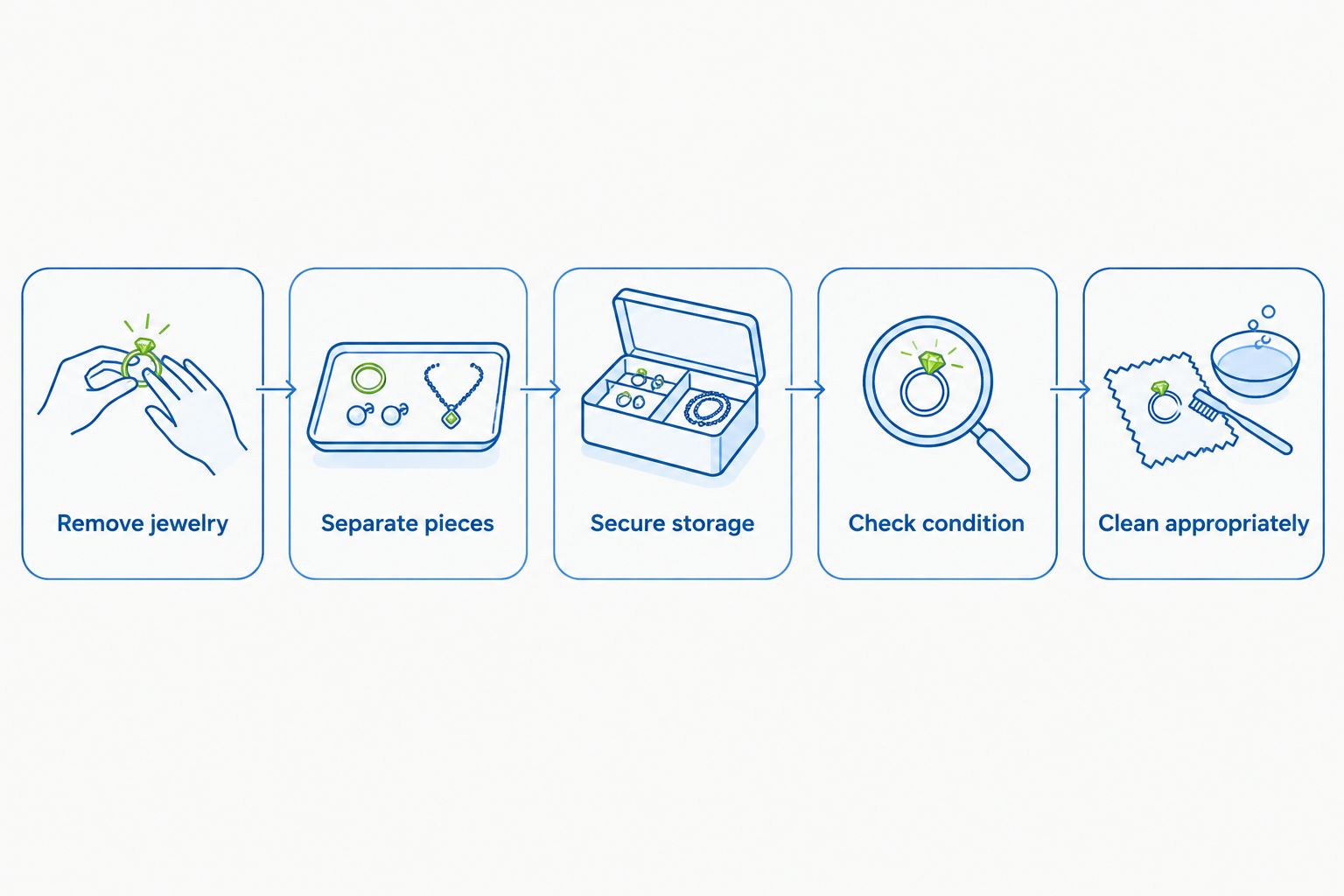
A consistent storage routine keeps jewelry care separate from your workout.
A ring holder necklace is not a substitute for secure storage during exercise. It moves the ring off your finger but leaves a chain and pendant arrangement on your body, where catching and pulling remain concerns.
How should you clean jewelry after accidental gym wear?
Start with the materials, not the sweat. There is no single soak, brush, or machine-cleaning method suitable for every combination of gemstone, treatment, metal, and construction.
A mixed-gemstone stack needs particular attention because each ring can have different care requirements. When cleaning gemstone stacking rings, separate the pieces rather than assuming the same solution or soaking routine suits every stone. If you cannot identify a gemstone or its treatment, avoid experimenting with chemicals or an ultrasonic cleaner.
Use a clean, soft cloth for a gentle surface wipe where the maker permits it. For washing, follow the piece’s specific instructions; pearls, opals, treated gems, and glued components need particular caution. Do not apply hand sanitizer, bleach, toothpaste, or household cleaners as jewelry-cleaning shortcuts.
Cleaning removes residue, not structural damage. If a stone shifts, a clasp stops closing securely, or a ring looks misshapen, set the piece aside and have a qualified jeweler assess it before wearing it again.
Can you wear fine jewelry in the gym pool?
Remove fine jewelry before entering a pool or hot tub. Chlorine can damage some jewelry alloys, and water exposure is unsuitable for certain gemstones, treatments, and assembled pieces.
Swimming also adds a loss problem: a ring that slips off underwater is difficult to recover. A secure fit on dry land is not a reason to keep it on in the water.
Water resistance is not the same as chemical resistance. Carry your removal routine through the pool, shower, and changing area rather than putting jewelry back on between each activity.
How do you choose jewelry for an active everyday life?
Choose jewelry you love wearing outside training, then plan when to remove it. Look at how a setting sits against your hand, whether a clasp closes securely, and whether the design catches the clothes you actually wear.
Element 79 is best for Denver shoppers seeking contemporary fine jewelry and custom bridal designs. The Cherry Creek boutique’s selection suits personal style and meaningful occasions; fine-jewelry status itself is not a promise of suitability for gym equipment.
When exploring Element 79 fine jewelry, describe your real routine: lifting, climbing, swimming, desk work, and whatever fills your week. The practical trade-off is simple: you can enjoy sculptural shapes and distinctive settings while accepting that they need time off during exercise.
FAQ
Can I wear my engagement ring while lifting weights?
Remove your engagement ring before lifting weights. Gripping equipment puts pressure on the band and setting and can expose your finger to catching injuries.
Are diamond earrings safe to wear at the gym?
Diamond earrings are not automatically gym-safe. Small, secure studs have fewer snagging opportunities than drops, but headphones, towels, and clothing can still press or catch them.
Does sweat ruin solid gold jewelry?
Sweat alone does not justify treating every solid gold piece as ruined. The alloy, gemstones, finishes, and accumulated residue affect care, while gym equipment adds pressure and impact risks beyond perspiration.
Can I keep my wedding band on under lifting gloves?
Remove your wedding band before putting on lifting gloves. Gloves do not eliminate pressure between the ring, your finger, and the equipment.
Is a bezel-set ring safe for workouts?
A bezel setting does not make a ring safe for workouts involving gripping or impact. Its enclosed stone edge does not remove pressure on the band or the risk of catching your finger.
Where should I put my jewelry when I exercise?
Leave fine jewelry securely stored at home when practical. If you bring it, separate pieces in a closed case and use secure storage rather than a loose bag pocket or an open bench.
What is the simplest gym jewelry rule for 2026?
The simplest gym jewelry rule for 2026 is to remove fine jewelry before lifting, contact exercise, or swimming. For gentle movement, assess every possible snagging or pressure point rather than assuming a small piece is harmless.
One last thing
Your jewelry habit starts before your workout, not at the first uncomfortable grip. Put a closed jewelry case beside the essentials you gather before leaving home, so removing your favorite pieces becomes part of getting ready rather than an interruption.
Enjoy your jewelry when it can be the focus. Let your workout have its own space.
Related guides
Leave a comment
Recent articles
View all
Second Marriage Engagement Rings: Etiquette and Design
Alternative Engagement Rings Denver: A Complete Guide