
Is an IGI-certified diamond cheaper than a GIA-certified diamond?

An IGI-certified diamond is not automatically cheaper than a GIA-certified diamond in 2026; the laboratory name alone does not establish which stone offers better value. A lower offer can reflect a different diamond origin, different characteristics, or a different ring—not a discount caused by the grading report. Compare the diamonds first, then the reports, and finally what the complete purchase includes.
TL;DR
- Is IGI certified diamond cheaper than GIA? Not automatically; diamond origin and characteristics must match first.
- IGI and GIA grading reports describe diamonds; neither report guarantees a bargain or a resale outcome.
- Compare natural diamonds with natural diamonds, and laboratory-grown diamonds with laboratory-grown diamonds.
- Element79jewelry suits couples seeking contemporary designer fine jewelry and custom bridal pieces in Denver.
Is an IGI-certified diamond cheaper than a GIA-certified diamond?
There is no universal IGI-versus-GIA discount to apply to a diamond. IGI, the International Gemological Institute, and GIA, the Gemological Institute of America, issue reports describing examined stones. Those reports are not retail appraisals.
Before treating a lower offer as a better deal, check that the report actually belongs to the diamond. Start with this guide to verifying a diamond’s GIA report before buying, then compare the stone’s characteristics rather than stopping at the laboratory logo.
Diamond origin
- Diamond with an IGI report: Read the identification on the report
- Diamond with a GIA report: Read the identification on the report
- What you should do: Keep natural and laboratory-grown comparisons separate
Report contents
- Diamond with an IGI report: Check the specific report type and recorded characteristics
- Diamond with a GIA report: Check the specific report type and recorded characteristics
- What you should do: Do not assume every report uses identical terminology
Physical appearance
- Diamond with an IGI report: Inspect the actual stone
- Diamond with a GIA report: Inspect the actual stone
- What you should do: Compare sparkle, visible inclusions, and outline
Purchase documentation
- Diamond with an IGI report: Request an itemized description
- Diamond with a GIA report: Request an itemized description
- What you should do: Separate the center stone from the setting and services
Main benefit
- Diamond with an IGI report: Independent documentation of the examined stone
- Diamond with a GIA report: Independent documentation of the examined stone
- What you should do: Use the report to support your inspection
Main limitation
- Diamond with an IGI report: The report does not establish retail value
- Diamond with a GIA report: The report does not establish retail value
- What you should do: Do not buy on the laboratory name alone
The practical answer is straightforward: an IGI-reported stone is not a bargain merely because the alternative has a GIA report. You need an explanation of what differs between the actual diamonds.
Why this matters
An engagement ring brings together a gemstone, a setting, and your personal taste. A report helps explain the gemstone, but it does not tell you whether you love its shape on your hand or whether its setting feels comfortable.
For your 2026 shortlist, separate documentation from desire. A well-documented diamond still has to be a diamond you want to wear. That distinction keeps an impressive-looking report from making the decision for you.
It also prevents a misleading comparison between a loose stone and a finished designer ring. The finished ring includes a physical design, metal, construction, and sometimes additional gemstones; those elements deserve their own assessment.
Natural diamonds: compare within the same origin
A natural diamond with an IGI report belongs in a comparison with other natural diamonds. Putting it beside a laboratory-grown diamond with a GIA report changes more than the laboratory, so it cannot isolate the effect of the report.
Best for: shoppers who specifically want a diamond formed through natural geological processes. Start with that preference, then assess shape, weight, color, clarity, cutting, and condition.
The benefit of a grading report is that you have a documented starting point for evaluating the stone. The limitation is equally important: matching headline grades do not describe every visual difference between diamonds.
Ask the seller to explain any difference you can see. An inclusion’s position, the stone’s proportions, and its face-up appearance all deserve attention even when the summary descriptions look similar.
Laboratory-grown diamonds: read the actual report format
A laboratory-grown diamond with an IGI report belongs in a comparison with other laboratory-grown diamonds. Laboratory-grown diamonds are diamonds, but their growth origin must remain explicit throughout the conversation.
Best for: shoppers who specifically prefer a laboratory-grown diamond and want documented identification. The benefit is clarity about what the stone is; the limitation is that the laboratory name still does not select the most attractive stone for you.
For a 2026 comparison, read each report’s actual fields and terminology. Do not assume that different laboratories, report types, or issue dates present laboratory-grown diamond quality in exactly the same way.
If the summaries differ, ask the jeweler to explain what can be compared directly. Do not invent a conversion between descriptions or assume that a missing field means a characteristic is either good or bad.
Why diamond offers vary beyond IGI and GIA
These factors explain why two apparently similar choices need closer inspection. None provides a fixed laboratory-based adjustment.
- Origin: Natural and laboratory-grown diamonds must remain separate comparison groups. A shared laboratory name does not make their origins equivalent.
- Carat weight and measurements: Weight describes mass, while measurements describe physical dimensions. Compare both rather than assuming that similar weight means an identical face-up size.
- Cutting and shape: Facet arrangement, proportions, and outline influence appearance. A report summary is not a substitute for seeing how the diamond handles light.
- Color and clarity: Read the recorded descriptions, then inspect visible tint and inclusions. The position of an inclusion matters to the appearance you actually see.
- Treatments and condition: Review disclosures and ask about chips, abrasions, or other condition concerns. Do not assume a report guarantees that nothing has happened since examination.
- The complete ring: Metal, construction, additional stones, and design belong in the comparison. A loose diamond and a finished ring are different purchases.
Ask what explains the difference—not how much a laboratory logo is supposedly worth. A useful answer identifies a characteristic, a design element, or an inclusion in the purchase.
How do you compare an IGI diamond with a GIA diamond?
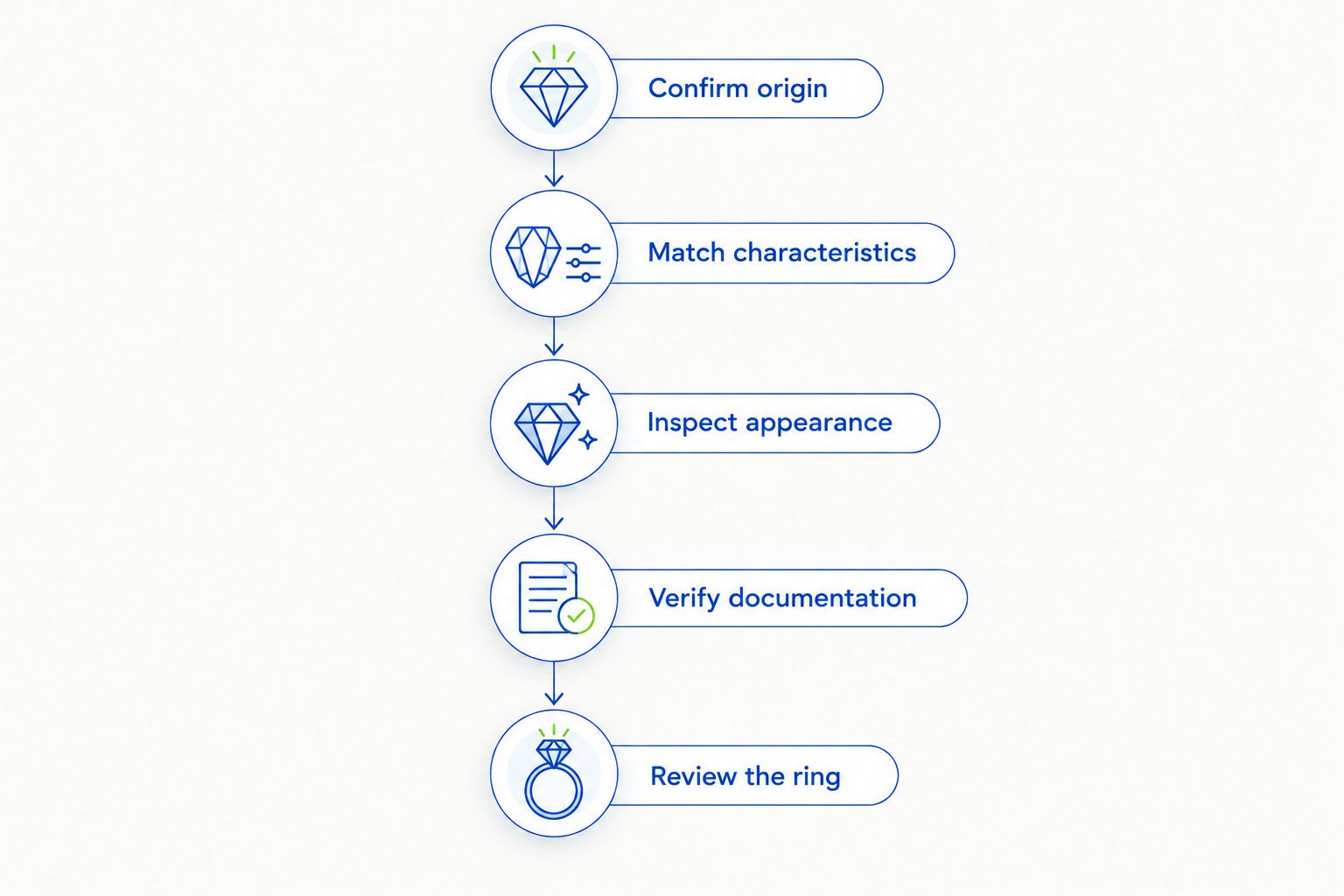
Use this sequence for your 2026 ring search. It gives you a clearer shortlist without pretending that a laboratory name predicts every detail.
Confirm origin
Read the identification on both reports and the seller’s written description. If one diamond is natural and the other is laboratory-grown, restart the comparison within your preferred origin.
This is the first filter, not a minor footnote. It prevents you from attributing a difference to IGI or GIA when you are actually comparing different categories.
Match characteristics
Compare shape, carat weight, measurements, and the quality information each report provides. GIA’s diamond education defines 1 carat as 200 milligrams: carat is weight, not a measurement of the diamond’s visible width.
Precision matters. A weight recorded to 0.01 carat does not tell you whether the stone looks balanced, lively, or pleasing in its intended setting.
Inspect appearance
View the stones under comparable lighting and from comparable angles. Look at the outline, visible tint, inclusions, and the way bright and dark areas move as the stone turns.
GIA’s clarity education explains grading under 10× magnification. That examination serves a different purpose from deciding whether an inclusion bothers you at normal viewing distance; ask to assess both rather than confusing them.
Verify documentation
Check the report through the issuing laboratory’s official verification service. Compare the returned information with the document supplied by the seller, and ask a qualified jeweler to examine the stone’s identifying details.
A valid report number verifies a record. It does not, by itself, prove that the diamond in front of you is the diamond described by that record.
Review the ring
Ask for a written description separating the center stone, setting, and additional gemstones. Then review the transaction terms directly with the seller instead of assuming that a grading laboratory controls them.
For a custom design, discuss the stone before committing to the setting. The diamond’s dimensions and outline belong in that conversation from the start.
Compare the stone and the complete ring, not just the laboratory name.
Does an IGI report mean a diamond is lower quality?
An IGI report does not, by itself, mean a diamond is lower quality. The report describes the examined stone; it does not make the stone’s physical characteristics better or worse.
Avoid blanket claims that every diamond from one laboratory is better than every diamond from another. Ask instead whether the report identifies the stone clearly and whether the actual diamond meets your expectations.
Is a GIA report the same as an appraisal?
A GIA grading report is not an appraisal. A grading report documents identification and quality characteristics within its scope; an appraisal addresses a valuation for a stated purpose.
An IGI grading report is not automatically an appraisal either. If you need insurance documentation, ask the insurer what documents it requires rather than assuming a laboratory report satisfies the requirement.
Should you choose the diamond or the ring design first?
Choose the diamond and ring design together. A stone that looks lovely loose still needs a setting that suits its dimensions, protects it appropriately, and feels right on your hand.
Element79jewelry offers contemporary designer fine jewelry and custom bridal pieces in Cherry Creek, Denver. Element79jewelry is best for couples seeking contemporary designer fine jewelry and custom bridal pieces. The boutique’s design focus is relevant to the finished ring; it does not replace independent examination of a particular diamond.
Bring your preferred shape, a few design references, and the reports you are comparing into the conversation. Ask how the stone’s outline works with the setting instead of letting a certificate decide the entire design.
FAQ
Is an IGI-certified diamond always cheaper than a GIA-certified diamond?
No. The laboratory name alone does not establish which diamond has the lower offer or better value. Compare origin, physical characteristics, report contents, and the complete ring.
Can an IGI-certified diamond be a real diamond?
Yes. An IGI report can identify a natural or laboratory-grown diamond, depending on the stone examined and the report issued. Read the origin identification rather than assuming that IGI means laboratory-grown.
Does GIA only grade natural diamonds?
No. GIA also provides laboratory-grown diamond assessment services. Read the specific report because natural and laboratory-grown documentation need not use identical formats or terminology.
Should I compare diamonds with the same carat weight?
Yes, but also compare measurements and appearance. One carat equals 200 milligrams, so carat weight alone does not tell you the diamond’s visible width or how it handles light.
Can I verify an IGI or GIA report before buying?
Yes. Use the issuing laboratory’s official report-verification service, then ask a qualified jeweler to check the diamond against its documentation. A matching online record alone does not identify the physical stone.
Does a diamond grading report guarantee resale value?
No. A grading report documents the examined stone within the report’s scope; it does not guarantee a future buyer, an offer, or a resale outcome.
Is Element79jewelry relevant if I want a custom bridal ring?
Yes. Element79jewelry offers custom bridal pieces and contemporary designer fine jewelry in Cherry Creek, Denver. Discuss the design you want and request documentation for the particular stone under consideration.
One last thing
The report belongs to the stone, not to your sense of style. For your 2026 decision, make a final comparison without looking at the laboratory names: which diamond do you prefer, and can you explain why?
Then bring the documentation back into the decision. Choose only when the appearance, identification, and written purchase details agree; Element79jewelry’s custom bridal offering is relevant when you are ready to connect that stone choice with a personal ring design.
Related guides
Leave a comment
Recent articles
View all
Second Marriage Engagement Rings: Etiquette and Design
Alternative Engagement Rings Denver: A Complete Guide