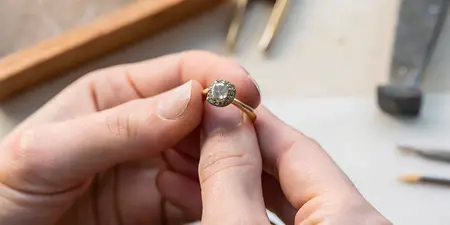

Is a three-stone ring more expensive than a solitaire?

A three-stone ring is not automatically more expensive than a solitaire; with the same center stone and comparable materials, adding side stones and their settings increases the work and materials involved. The important caveat is that a solitaire with a larger or more valuable center stone can cost more than a three-stone design. For your 2026 search, compare the complete rings—not just the number of stones.
TL;DR
- Is a three stone ring more expensive than a solitaire? Not automatically; center-stone specifications can outweigh stone count.
- A three-stone engagement ring adds side stones and setting work; a solitaire concentrates attention on one gemstone.
- Element79jewelry suits couples exploring contemporary designer fine jewelry and custom bridal rings in Denver.
- Compare center stones, side stones, metal, and craftsmanship before deciding which engagement ring offers better value for you.
Is a three-stone ring more expensive than a solitaire?
With an equivalent center stone and comparable construction, a three-stone ring adds materials and setting work. Across different finished rings, there is no automatic winner on cost. A fair comparison starts with the center stone, then accounts for everything around it.
Principal stones
- Three-stone ring: 1 center stone and 2 side stones
- Solitaire ring: 1 principal stone
Best for
- Three-stone ring: A composition with contrasting shapes or a broader arrangement
- Solitaire ring: A clear focal point and an uncluttered silhouette
Main advantage
- Three-stone ring: Side stones contribute their own shape, color, and light
- Solitaire ring: The center stone remains the visual focus
Main trade-off
- Three-stone ring: More stones and settings to assess together
- Solitaire ring: Less opportunity for contrast within the setting
Cost question
- Three-stone ring: What do the side stones and additional construction add?
- Solitaire ring: What portion of the total comes from the center stone?
Fair comparison
- Three-stone ring: Match center-stone specifications and metal first
- Solitaire ring: Match center-stone specifications and metal first
If the arrangement itself draws you in, explore three-stone engagement rings for a meaningful symbol. Keep the emotional appeal separate from the financial comparison: loving a design does not require proving that its stone count makes it a bargain.
Why this matters
Stone count is easy to spot. The details that explain a ring's cost take a closer look: the center stone's identity, size, quality, origin, and the craftsmanship of the setting.
For a 2026 engagement-ring decision, start with what you want to see on your hand. If you love a generous spread of shapes, compare three-stone compositions; if you want your eye to settle immediately on a single gemstone, begin with solitaires. Choose the visual direction first, then compare equivalent specifications within your budget.
Element79jewelry is best for couples seeking contemporary designer fine jewelry and custom bridal rings in Denver. Its boutique focus fits a design-led search, but the specific ring's materials, construction, and suitability still need individual assessment; the boutique name alone does not settle the value question.
Three-stone rings: best for a composed, expressive look
A three-stone ring brings 3 principal stones into the design. The side stones can echo the center's shape or create contrast, giving you a composition rather than a single focal point.
That is the appeal—and the extra decision. You need to like the relationship between the stones, not simply each stone on its own. Look at their relative size, spacing, color, and the way their outlines meet.
The additional stones also require secure settings. Their cost depends on their own characteristics and the construction needed to hold them, not merely on their presence beside the center stone.
Choose a three-stone ring when the whole arrangement is what you love. Skip the assumption that extra stones necessarily mean better value: a design you find crowded or uncomfortable is not the right choice just because it has more gemstones.
What to examine on your hand
Look straight down at the ring, then turn your hand sideways. Notice whether the side stones feel like a natural continuation of the center or compete with it.
Check where the setting reaches across your finger and how it feels against neighboring fingers. A photograph shows the composition; trying on a ring reveals its proportions in relation to your hand.
Solitaire rings: best for a single, clear focal point
A solitaire centers the design on 1 principal stone. Its restraint lets you notice the gemstone's outline, light, and character without side stones sharing the attention.
Simple does not mean inexpensive. The center stone can account for a substantial part of the finished ring's cost, and a carefully made setting still involves design and skilled work.
The trade-off is visual concentration: if you want contrasting gemstone shapes or a spread across the finger, a plain solitaire does not provide that arrangement. Decorative metalwork changes the setting's character, but it is not the same effect as flanking stones.
Choose a solitaire when you love the center stone enough to make it the focus. Do not choose one solely because you expect it to be the cheaper category; compare the actual ring specifications first.
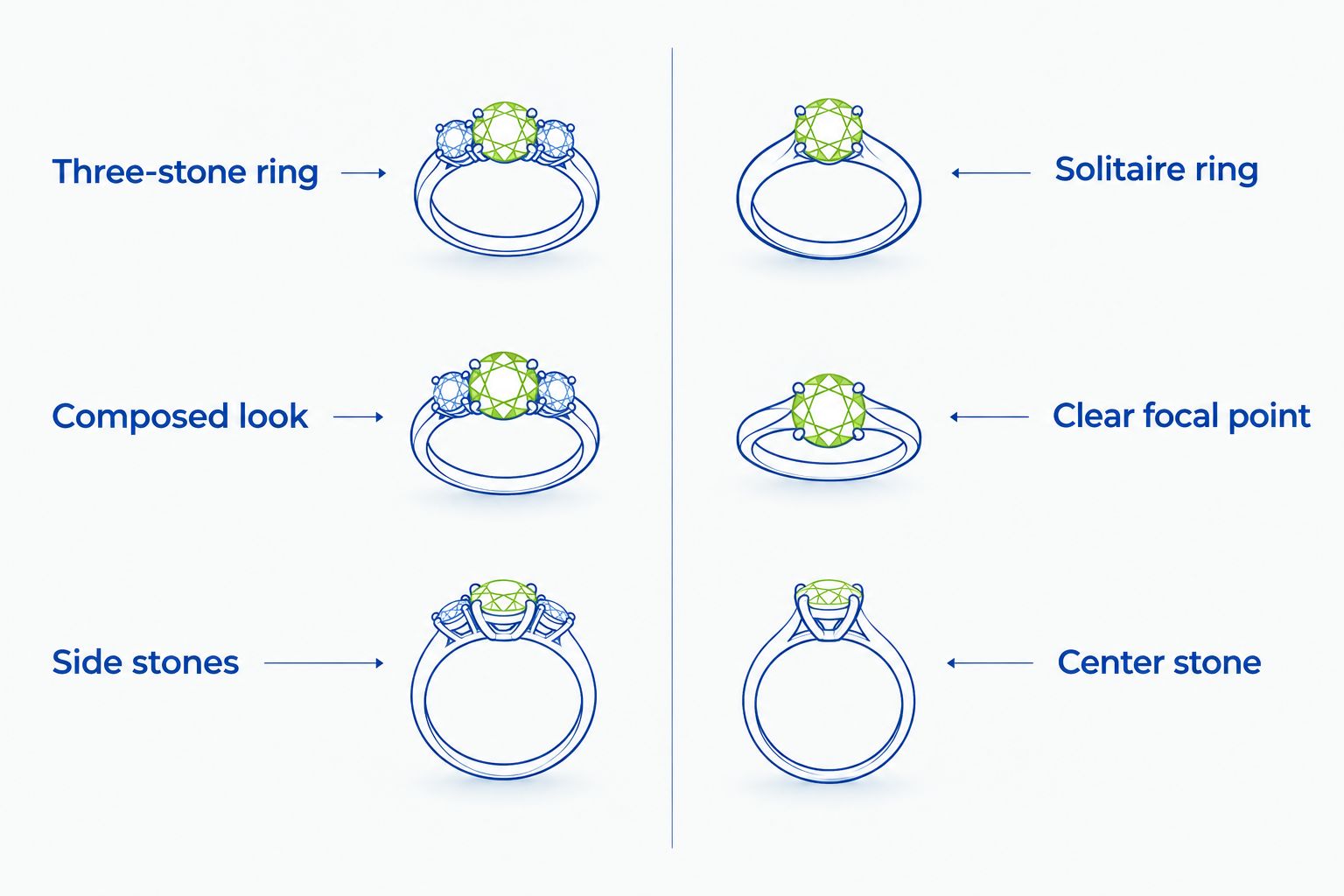
Compare the complete composition, not stone count alone.
Why three-stone and solitaire ring costs vary
These factors explain why two finished rings can reverse the cost relationship you expected. Use them as a comparison checklist, not as a formula for estimating a ring from a photograph.
- Center-stone specifications. Gemstone type, carat weight, quality, treatments, and origin affect the comparison. Match the relevant characteristics before attributing a difference to the setting style.
- Side-stone specifications. A three-stone design adds a pair of gemstones with their own size, quality, shape, and matching requirements. Ask for their details separately from those of the center stone.
- Metal and construction. Identify the metal, gold purity where relevant, and the setting's structure. Different metal specifications and amounts of material make an otherwise similar-looking comparison uneven.
- Setting complexity. Holding different stone shapes securely requires appropriate construction. Examine the actual work rather than treating every solitaire as simple and every three-stone ring as elaborate.
- Designer craftsmanship. Distinctive proportions, finishing, and construction belong in the assessment. A designer name does not replace examining those details.
For 2026 shopping, ask for a written description of each ring under consideration. A useful description identifies what you are comparing; a photograph and a total carat-weight label alone leave important differences unresolved.
How do you compare the rings fairly?
Compare like with like before deciding which style asks more of your budget. Use this sequence to separate a setting decision from a gemstone decision.
- Choose your priority. Decide whether you care most about the center stone, the overall arrangement, a particular gemstone color, or a specific designer's work. Write that preference down before comparing rings.
- Match the center stones. Compare the same gemstone type and origin, then examine relevant quality characteristics and carat weight. If those differ, acknowledge that you are comparing different stones as well as different settings.
- Separate center and total weight. Ask how much weight belongs to the center stone and how much belongs to the side stones. Total carat weight describes the combined weight, not the size of the principal gemstone.
- Check metal and construction. Confirm the metal specification and examine the setting from above, below, and the side. Look for the details responsible for the ring's shape and how it sits on your finger.
- Request a complete quote. Ask what the quoted amount includes and which services or adjustments are separate. Do not assume that resizing, an appraisal, or later work is included.
- Try the wedding-band pairing. If you plan to wear a band alongside the engagement ring, examine them together. The engagement ring's profile determines how the pieces meet.
At Element79jewelry, contemporary designer fine jewelry and custom bridal rings are relevant starting points for this kind of design-led comparison. Bring your priorities and ask about the individual ring rather than assuming that every design has the same customization possibilities.
Explore your bridal direction
Start with contemporary designer fine jewelry and custom bridal rings in Cherry Creek, Denver.
Does the same total carat weight mean the same value?
The same total carat weight does not mean the same value or the same center-stone size. In a three-stone ring, the weight is distributed among the stones; in a plain solitaire, the principal gemstone carries that weight.
Carat measures weight, not visible width. Shape, proportions, and the arrangement of the stones influence how much of your finger the ring appears to cover.
For your 2026 comparison, request the center-stone weight and side-stone weights separately. Then look at the rings on your hand: a broader arrangement and a larger single focal point are different visual choices, not interchangeable descriptions.
Can a three-stone ring be less expensive than a solitaire?
A three-stone ring can be less expensive than a solitaire when the stones, metal, or workmanship differ. A solitaire's more valuable center stone can outweigh the extra materials involved in another ring's three-stone arrangement.
That does not establish a general saving. If you change center-stone size, gemstone type, origin, and construction at once, you have compared two complete designs—not isolated the cost of adding side stones.
Is a solitaire easier to wear every day?
A solitaire is not automatically easier to wear every day; setting height, stone protection, and fit matter more than the label. A low, thoughtfully constructed three-stone ring and a tall solitaire present different practical considerations.
Try each ring while bending your fingers and resting your hand naturally. Ask how to care for the specific gemstones and setting, and assess the ring with your intended wedding band rather than judging daily comfort from a top-down photo.
What should you ask before choosing either style?
Bring questions that reveal differences instead of asking only which ring is the better deal. These prompts make a 2026 appointment more useful without turning your ring search into a technical exam.
- What are the center stone's specifications, and how do they compare with the other ring?
- What are the side stones, and are their weights listed separately?
- What creates the difference between these complete quotes?
- How does this setting protect the stones and sit against a wedding band?
- What care does this particular ring require?
- Which adjustments are possible for this specific design, and what is included?
You do not need to become a gemologist to choose confidently. You need clear descriptions, a fair comparison, and enough time with each silhouette to recognize which one feels like yours.
FAQ
Is a three stone ring more expensive than a solitaire?
A three-stone ring is not automatically more expensive than a solitaire. With an equivalent center stone and comparable construction, side stones add materials and setting work, but different center-stone specifications can reverse the comparison.
What's the best ring style if I want the center diamond to stand out?
A solitaire is best for keeping attention on a single center diamond. A three-stone design shares the composition with side stones, even when the center remains dominant.
Does a three-stone ring look bigger than a solitaire?
A three-stone ring can create a broader arrangement across your finger, but that does not make its center stone larger. Compare the actual dimensions and try both designs on your hand.
Does total carat weight include the side stones?
Total carat weight includes the combined weight of the diamonds described by that listing. Ask for the center and side-stone weights separately so you know how the weight is distributed.
Is a three-stone ring harder to care for?
A three-stone ring has additional stones and settings to inspect and clean, but its care requirements depend on the gemstones and construction. Follow guidance for the specific ring rather than assuming every three-stone design needs the same routine.
Should I compare rings with the same center-stone size?
Matching center-stone carat weight helps, but size alone does not make the comparison equivalent. Also compare gemstone type, origin, relevant quality characteristics, metal, and construction.
Can I choose a three-stone ring just because I love the design?
Yes, the design you love is a valid reason to choose a three-stone ring. Confirm the specifications, comfort, care requirements, and complete quote before making your decision.
One last thing
Before choosing, look at each ring from the side with your intended wedding band beside it. That view reveals the height and meeting point you will live with, not just the sparkle you noticed first.
Pick the composition you love, then verify the details that support it. More stones are not automatically more value, and fewer stones are not automatically a compromise.
Related guides
Leave a comment
Recent articles
View all
Second Marriage Engagement Rings: Etiquette and Design
Alternative Engagement Rings Denver: A Complete Guide