
Is a halo setting more expensive than a solitaire? Yes 2026
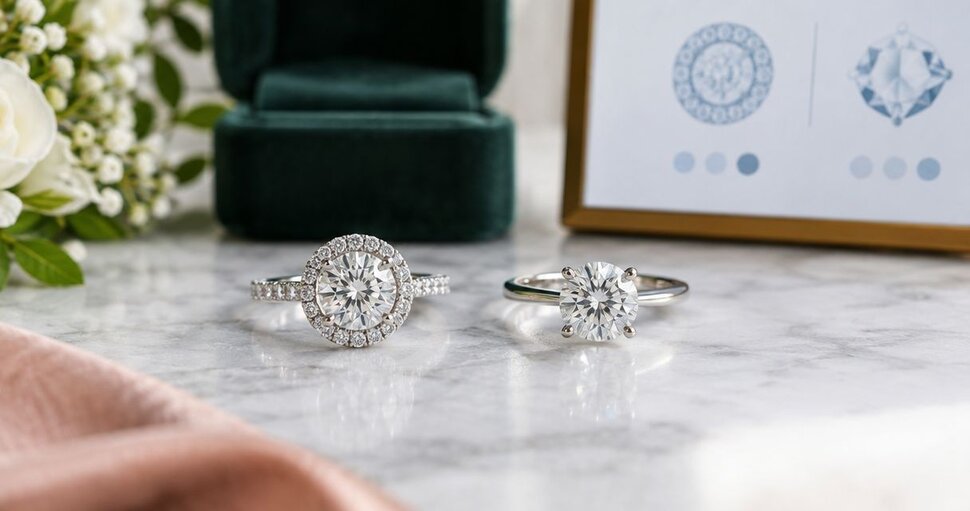
Yes. When you compare the same center stone, metal and maker, a halo setting generally costs more than a solitaire setting because it adds accent stones and the work needed to set them. That does not mean every finished halo ring costs more than every solitaire ring: the center stone and other design choices can change the comparison.
TL;DR
- Is a halo setting more expensive than a solitaire? Usually yes when the center stone, metal and maker are the same.
- A finished halo ring is not automatically more expensive than a finished solitaire ring; compare the center stones too.
- Choose a halo for a framed, detailed look; choose a solitaire when you want the center stone to stand alone.
Why this matters
A setting comparison tells you only part of the story. If you compare a halo ring with one center stone against a solitaire with a different center stone, you cannot tell which setting accounts for the difference. Hold the center stone, metal and maker constant first. Then you can see what the surrounding design changes.
That distinction matters whether you are choosing a ring in 2026 or revisiting a design you have loved for years. If the look draws you in, start with halo engagement rings for extra sparkle, then bring the comparison back to the actual stones and settings you are considering.
Is a halo setting more expensive than a solitaire?
Usually, yes for the setting alone when the rest of the ring is comparable. A solitaire puts the visual focus on one center stone. A halo surrounds that stone with smaller accent stones, adding materials and setting work. A designer solitaire with elaborate metalwork, however, is not necessarily simpler than every halo.
Stones in the setting
- Solitaire: A center stone without a surrounding ring of accent stones
- Halo: A center stone framed by accent stones
Visual effect
- Solitaire: An uninterrupted view of the center stone
- Halo: A more detailed outline around the center stone
Setting work
- Solitaire: Depends on the mounting and metalwork
- Halo: Includes work to place and secure the halo stones
Ongoing attention
- Solitaire: Check the center stone and setting
- Halo: Check the center stone, setting and smaller accent stones
Best for
- Solitaire: You want the center stone to stand alone
- Halo: You want a framed, more intricate look
Trade-off
- Solitaire: Less surrounding detail
- Halo: More small stones and settings to keep track of
This is a comparison of design, not a promise about any particular ring. In 2026, a useful question to ask about two finished rings is whether they use comparable center stones. If they do not, start there before assigning the difference to the halo.
A halo also need not look like one continuous circle from every angle. Its shape, spacing and relationship to the center stone affect how the ring reads on your hand. A solitaire can feel just as distinctive through its center-stone shape, band or metalwork. Neither label tells you the whole design.
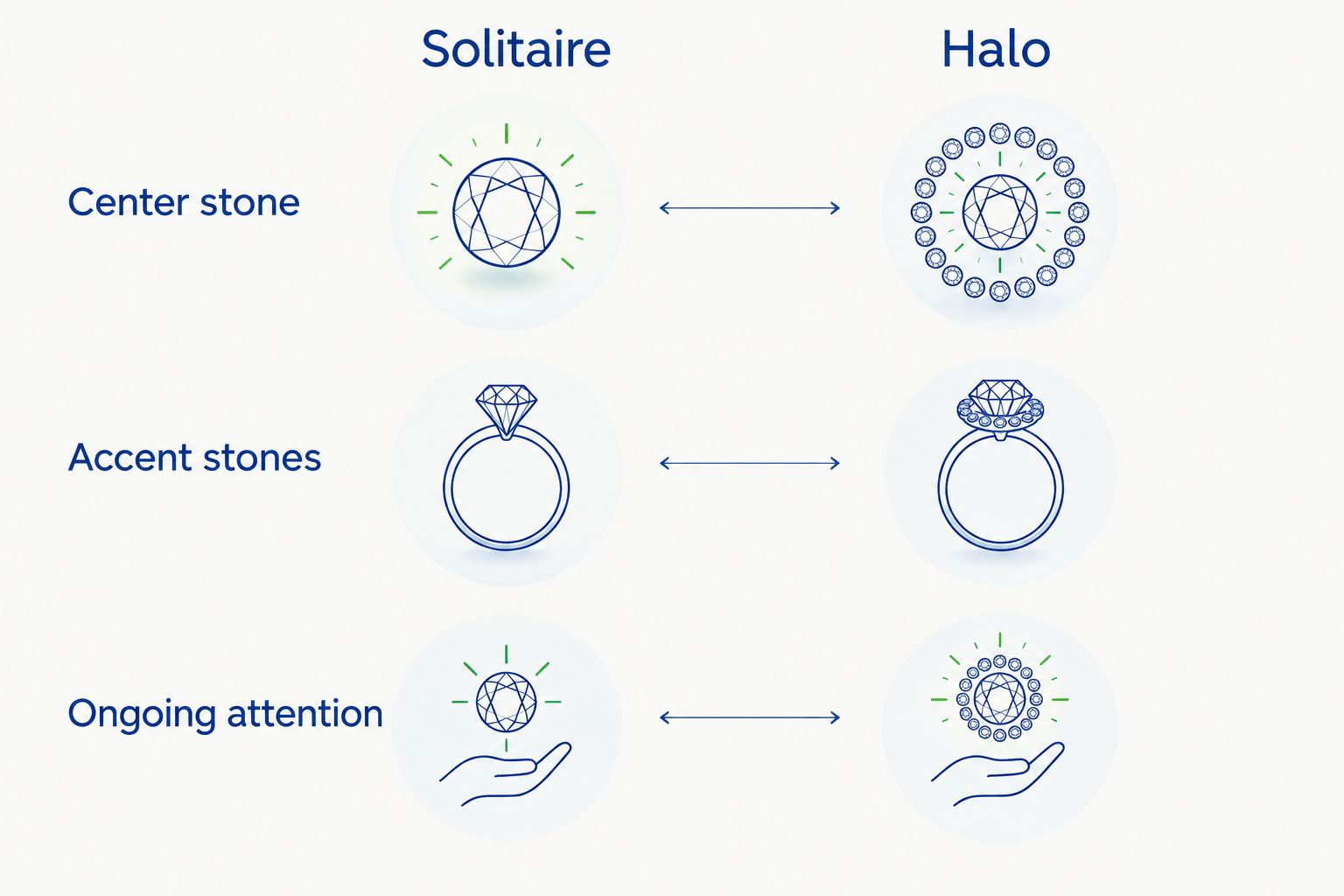
Compare the surrounding setting separately from the center stone.
Why the difference varies
There is no fixed premium that applies to every halo. These are the design choices to check when you compare rings in 2026:
- The center stone. Its shape, size and characteristics affect the finished ring independently of the setting. Compare like with like before deciding that a halo caused the difference.
- The halo stones. Their number, size and arrangement determine how much accent-stone work the design requires. A delicate outline and a more prominent frame are not the same project.
- The metal. Keep the metal consistent across the rings you compare. A change from 14-karat gold to 18-karat gold, for example, changes more than the setting style.
- The band and other details. A plain band, a band with accent stones and sculptural metalwork create different comparisons, even when each ring is called a solitaire or a halo.
- The maker and construction. Compare designs from the same maker when you want to isolate the setting choice. Different design approaches make a label-only comparison unreliable.
- The care the design calls for. A halo has smaller stones around the center, so you have more settings to inspect. That is a practical difference as well as a visual one.
The strongest comparison is a pair of designs you would both be happy to wear. Otherwise, you risk choosing a simpler setting solely because it appears less involved, or choosing a halo for its outline without looking closely at its side view and band.
Does a halo make the center stone look larger?
A halo can make the ring’s face look larger, because the accent stones extend its visible outline beyond the center stone. It does not change the center stone itself. If you want the stone’s individual shape and edges to be the focus, a solitaire makes that easier to see.
Look at the ring from above and from the side. From above, the halo frames the stone; from the side, its height and construction become clearer. The effect you prefer in a photograph is not necessarily the effect you prefer on your hand.
Is a solitaire always the simpler ring?
No. A solitaire describes the absence of a halo around the center stone, not a lack of design. The band, mounting and metalwork can all give a solitaire its character. For a 2026 comparison, examine the actual rings rather than treating the style names as construction grades.
This is also where taste should lead. A pared-back solitaire gives an unusual stone room to speak. An expressive solitaire setting can still have presence without adding a circle of accent stones. If you want detail around the stone rather than elsewhere in the ring, the halo answers a different brief.
Which setting is easier to care for every day?
A solitaire without halo stones gives you fewer small stones to keep track of; a halo calls for attention to its accent stones as well as the center stone. The precise care needs depend on how each ring is made. Neither setting removes the need to check for looseness or damage.
Consider how you use your hands and what you want to notice when you put the ring on. If a halo appeals to you, its extra detail is a reason to inspect it carefully, not an automatic reason to rule it out. If you prefer fewer small-stone settings, keep that preference in the decision alongside the look.
How to compare two rings without guessing
You do not need to become a gemologist to make a fair comparison. Ask for a clear description of each ring, then separate the center stone from the setting in your notes.
- Start with the center stone. Check whether the rings use comparable stones. If the stones differ, do not attribute the entire difference between the rings to the halo.
- Match the metal. A comparison between two settings is clearer when the metal is the same. If it differs, treat that as another design decision.
- Look beyond the top view. Check the band, side profile and how the stone sits in each ring. Those details affect the appearance you will live with.
- Identify every accent stone. A halo may not be the only place smaller stones appear. Check the band as well so you know what you are comparing.
- Think about the wedding band. Try the pairing visually before settling on the engagement-ring setting. The rings should make sense together to you.
- Choose the look you would miss. If you removed the halo, would the ring lose its character? If you added one to the solitaire, would it obscure what you love about the center stone?
For an engaged couple choosing in 2026, this process keeps a personal choice from turning into a contest between labels. You are choosing a ring, not voting for an entire category. A halo can feel delicate or pronounced; a solitaire can feel quiet or sculptural.
Element 79 is best for couples who want to explore designer fine jewelry and custom bridal pieces through a Cherry Creek boutique. If you are considering a custom ring, describe the features you want to keep constant in both versions. That makes the halo-versus-solitaire decision more useful than a broad request for whichever style is less expensive.
When a halo is the right choice
Choose a halo when you want the center stone framed by visible detail. It is especially compelling if you love the overall outline of the ring as much as the stone at its center. Best for: a bride or groom who wants an intricate setting and is comfortable keeping an eye on its smaller stones.
The trade-off is not just the extra setting work. The accent stones participate in the look, so you need to love the ring as a whole. If the center stone disappears into the surrounding detail for your taste, try a different halo design or return to a solitaire.
When a solitaire is the right choice
Choose a solitaire when the center stone is the part you want people to notice first. Its open visual space makes the stone’s shape central to the design, while the band and mounting still leave room for personality. Best for: someone who wants one stone to carry the look without a surrounding frame.
The trade-off is equally personal: if you love a glittering outline, a solitaire will not give you the same effect. Do not choose it merely because the setting is generally less involved. A ring you wish had more detail is not the better choice for you simply because its category sounds simpler.
Element 79 sells contemporary and designer fine jewelry as well as custom bridal pieces. For a 2026 decision, the useful conversation is about the exact design you want: a center stone with space around it, or a center stone that sits within a frame of accents. Both can be expressive. Neither can be judged fairly from its name alone.
FAQ
Is a halo setting more expensive than a solitaire setting?
Usually, yes when the center stone, metal and maker are the same. The halo adds accent stones and the work needed to set them, but individual designs still differ.
Is a finished halo engagement ring always more expensive than a solitaire?
No. The center stones, metals and other design details can differ, so compare the finished rings rather than assuming the setting label determines the result.
Does a halo contain a bigger center stone than a solitaire?
Not necessarily. A halo surrounds the center stone with smaller stones; it does not tell you the size of the center stone itself.
Will a halo make my engagement ring look bigger?
A halo can make the ring's overall face look larger by extending its visible outline. The center stone remains the same size.
Which is better for showing off an unusual center stone?
A solitaire puts the center stone in clearer visual focus. A halo frames it, which is better if you prefer the combined outline and detail.
Do halo rings need more attention than solitaires?
A halo gives you additional small stones and settings to inspect. Both styles still need attention to the condition of their stones and settings.
Can Element 79 help me choose between a halo and a solitaire?
Element 79 sells designer fine jewelry and custom bridal pieces in Cherry Creek, Denver. Use the same center-stone and metal criteria to compare the designs you discuss.
One last thing
The deciding detail is often what you want the empty space around the center stone to do. A solitaire leaves that space open; a halo fills it with a frame. When you compare rings in 2026, ask which treatment you would still choose if the center stone and metal were identical. That answer gets you closer to a ring you will want to wear than the style label alone.
Element 79's custom bridal offering is relevant when you already know which details matter to you but have not found the right combination. Keep your preferred center stone, metal and band in view, then decide whether the halo earns its place in the design.
Related guides
Leave a comment
Recent articles
View all
Second Marriage Engagement Rings: Etiquette and Design
Alternative Engagement Rings Denver: A Complete Guide