
Is a bezel setting more expensive than a prong setting?

A bezel setting is not automatically more expensive than a prong setting. For your 2026 ring search, compare the actual designs: a fitted metal rim involves different work from individual prongs, while the metal, gemstone, and construction also affect the finished ring; future maintenance is a separate consideration.
TL;DR
- Is a bezel setting more expensive than a prong setting? Not automatically; compare otherwise equivalent ring designs.
- Bezel settings suit shoppers who prefer a smooth metal outline and coverage around the gemstone’s edge.
- Prong settings suit shoppers who want more of the gemstone visible, with less surrounding metal.
- Element79jewelry suits Denver shoppers seeking contemporary designer fine jewelry and custom bridal rings.
Why this matters
Choosing an engagement ring setting means choosing something you will see and feel every day. A sculptural bezel and an airy prong setting can frame the same gemstone very differently, so the decision deserves more than a presumed spending hierarchy.
Start with how you want the ring to look, then ask what its construction involves. The guide to choosing a durable engagement ring setting for daily wear gives you another way to approach that conversation.
For a 2026 engagement ring search, compare the complete design rather than treating “bezel” as an automatic upgrade or “prong” as the simpler choice. Neither label tells you everything about the ring.
Is a bezel setting more expensive than a prong setting?
Not necessarily. A bezel needs a metal rim fitted and secured around the stone, while a prong setting needs individual supports shaped and finished to hold it; the work depends on the specific construction.
A clean-looking bezel is not necessarily simple to make. Equally, a prong setting with intricate details is not necessarily less involved because more of the gemstone remains exposed.
How it holds the stone
- Bezel setting: A metal rim surrounds all or part of the edge
- Prong setting: Individual metal supports hold the stone
Best for
- Bezel setting: A smooth outline and a visibly framed gemstone
- Prong setting: An open appearance with more exposed gemstone
Main advantage
- Bezel setting: A full bezel covers the gemstone’s perimeter
- Prong setting: Less metal interrupts the gemstone’s outline
Main trade-off
- Bezel setting: The rim conceals part of the stone’s edge
- Prong setting: Exposed prongs and stone edges need attention
Construction to examine
- Bezel setting: Rim fit, thickness, finish, and access beneath the stone
- Prong setting: Prong placement, contact, finish, and supporting structure
What the name tells you about expense
- Bezel setting: Not enough to determine the finished total
- Prong setting: Not enough to determine the finished total
The useful comparison is between rings with the same gemstone specifications, metal, band dimensions, and decorative details. Otherwise, you are comparing several design decisions at once and attributing the difference to the setting alone.
Full bezel: best for a continuous metal outline
A full bezel wraps around the gemstone’s perimeter. Its appeal is both visual and practical: the metal creates a defined frame and covers the edge rather than leaving it exposed between separate prongs.
Choose a full bezel if you love a sculptural outline and prefer fewer projecting details around the stone. Look closely at the rim, though; a substantial border feels different from a delicate one, even when both designs use the same setting name.
The trade-off is coverage. You will see less of the gemstone’s edge, and the surrounding metal becomes part of its face-up appearance rather than disappearing into the background.
A full bezel also does not guarantee a low-profile ring. Turn the ring sideways and inspect how high the stone sits above your finger before deciding that its smooth outline will suit your routine.
Partial bezel: best for a framed but more open look
A partial bezel holds selected portions of the gemstone’s edge rather than surrounding it continuously. It offers a different balance of visible metal and exposed stone, with the exact effect determined by where the metal sits.
Choose a partial bezel if you want the metal frame to be a visible design feature without enclosing the entire perimeter. Examine the uncovered areas carefully, especially when the gemstone has pointed corners.
The trade-off is that a partial bezel does not provide continuous edge coverage. Its suitability depends on the gemstone and the design, not simply on having “bezel” in the description.
Do not assume that less visible metal means less construction work. Ask how the setting supports the stone and why the designer chose those particular contact points.
Prong setting: best for a more exposed gemstone
A prong setting leaves open spaces between individual supports. That can give the ring a lighter-looking outline and make the gemstone’s shape easier to see from different angles.
Common designs include 4-prong settings and 6-prong settings, but the count alone does not establish security. The condition, placement, and fit of the prongs matter, along with the structure supporting them.
Choose a prong setting if you prefer an open silhouette and want less metal around the gemstone’s edge. Compare the prong tips as well as the stone: rounded, pointed, and broader tips each contribute to the finished look.
The trade-off is exposure. A raised or damaged prong can catch on fabric, and the stone’s uncovered edges remain accessible to knocks; a jeweler should assess looseness or snagging rather than leaving you to adjust it yourself.
Why the work involved varies
Setting style is one part of the construction. These are the details to separate when you ask a jeweler to explain two otherwise similar designs:
- Metal choice: Keep the alloy consistent. A comparison between 14-karat gold and 18-karat gold changes the material specification as well as the setting.
- Stone shape and dimensions: A rim or set of prongs must fit the actual gemstone, including its corners, outline, and depth.
- Metal dimensions: A broad bezel, thick band, or substantial supporting structure uses a different amount of metal from a delicate design.
- Fabrication method: An existing mounting and a setting made specifically for a particular stone involve different design and production steps.
- Decorative details: Engraving, small accent stones, unusual prong shapes, and textured surfaces add work beyond securing the center stone.
- Existing-stone condition: A family gemstone needs examination before a jeweler decides how to remove, handle, and reset it.
For a useful 2026 comparison, ask which of these specifications changes between the rings. You want an explanation tied to the objects in front of you, not a blanket rule about bezels and prongs.
How do I compare bezel and prong designs fairly?
Ask for a written comparison that keeps the center stone and the rest of the ring as consistent as possible. Then separate the visual decision from the construction details, so you can understand both without one obscuring the other.
- Match the stone. Use the same gemstone where possible, or match its documented characteristics and dimensions rather than relying only on carat weight.
- Match the metal. Specify the same metal and alloy for both designs; do not change the material while trying to isolate the setting.
- Match the band. Keep width, thickness, finish, and accent details consistent, or ask the jeweler to identify the differences.
- Compare the construction. Ask whether each option uses an existing mounting or requires a setting made for the stone.
- Check the scope. Confirm whether the discussion covers a complete ring, a mounting alone, or resetting a gemstone you already own.
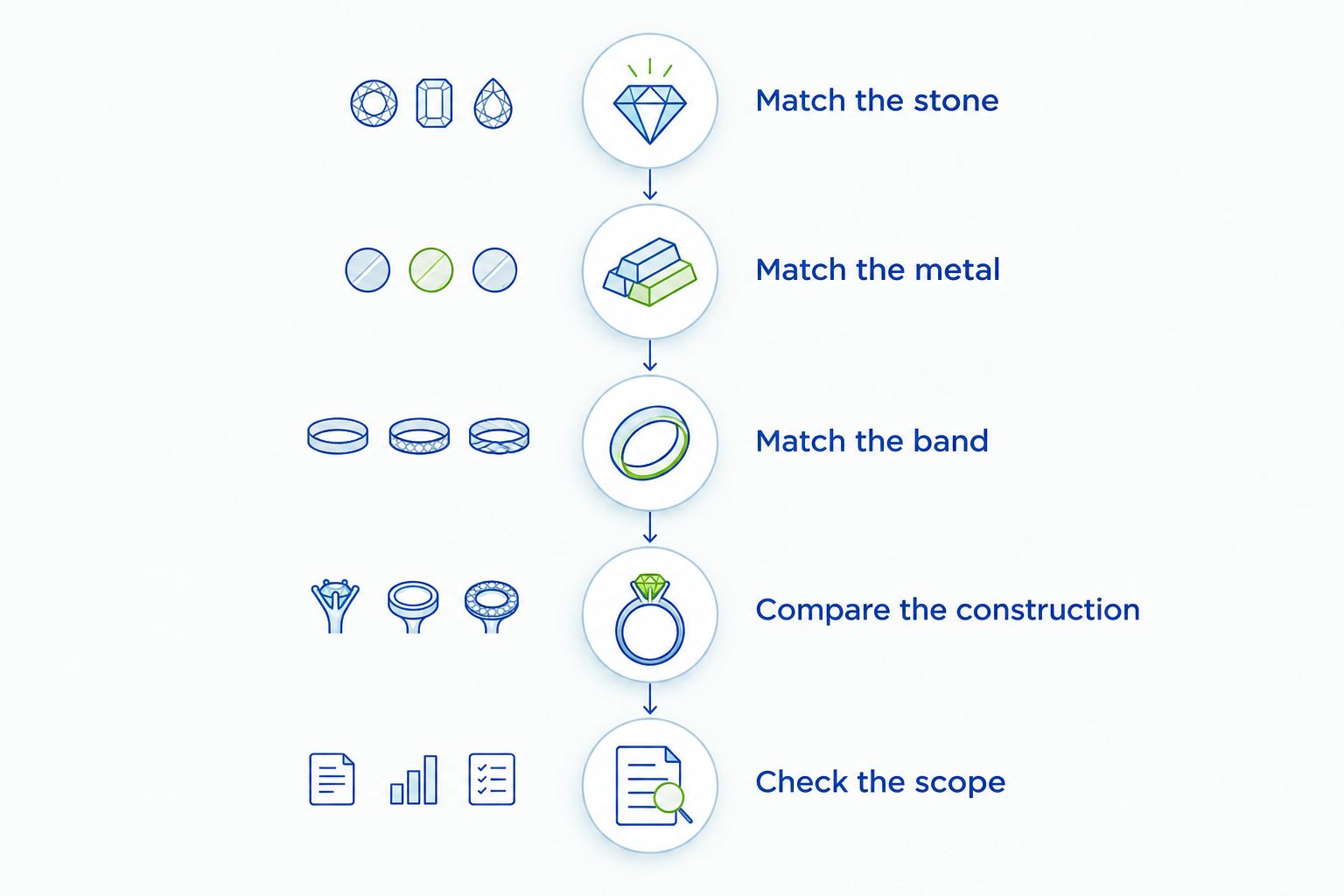
Keep the other ring specifications consistent before comparing the setting styles.
If you are planning a custom ring in 2026, save the agreed specifications alongside the design images. A photograph communicates a mood; a written description records the metal, stone, and construction you actually discussed.
Is a bezel setting better for everyday wear?
A full bezel is a strong option when your priority is coverage around the gemstone’s edge and a smooth outline. It is not a promise against damage, and it does not make every gemstone suitable for every activity.
Think about the whole ring. A tall bezel can still meet objects during daily tasks, while a carefully finished prong setting can feel less intrusive than its photograph suggests.
Try the ring while opening and closing your hand. Notice whether the setting presses against neighboring fingers, whether its height feels natural, and whether the metal frame is something you enjoy seeing up close.
Choose the ring that suits your actual movements, not an “active lifestyle” label alone. Remove fine jewelry for activities that expose it to heavy pressure, impact, or catching hazards.
Will a prong setting make my diamond sparkle more?
A prong setting does not automatically make a diamond sparkle more than a bezel setting. Cut quality, cleanliness, lighting, and the specific mounting all affect what you see.
An open setting exposes more of the stone’s outline and side profile, but “more exposed” and “more brilliant” are not interchangeable. A bezel changes the frame around the diamond; it does not establish how well the diamond was cut.
Compare rings in the same lighting and view them from above as well as from the side. If one stone is clean and the other has residue underneath, you are not judging the settings on equal terms.
What should I ask about future care?
Both setting styles need attention as they wear. Ask a jeweler to show you the areas that hold the gemstone and explain what changes should prompt an inspection.
For prong settings, the conversation should cover worn tips, lifted metal, and snagging. For bezel settings, ask about a distorted rim, movement in the stone, and access for cleaning beneath it.
Do not assume that a bezel eliminates maintenance or that a prong setting follows a universal repair schedule. The ring’s condition and construction determine the appropriate care, and gemstone-specific cleaning instructions still apply.
If you plan to pass the ring down or change its design later, ask how the stone could be removed. That is a construction question worth discussing before you settle on the finished silhouette.
Where does a designer bridal boutique fit into the decision?
Element79jewelry is best for Denver shoppers seeking contemporary designer fine jewelry and custom bridal rings. The Cherry Creek boutique’s stated focus includes artisan designers such as Artëmer, Orly Marcel, Spinelli Kilcollin, and Petra Class.
For your engagement ring search, Element79jewelry’s designer fine jewelry and custom bridal focus is relevant when the setting’s character matters alongside its practical details. The limit is simple: a boutique’s designer selection does not tell you whether a particular bezel or prong design fits your stone, so ask about the exact ring rather than assuming compatibility.
Bring examples of both silhouettes and describe what draws you to each. “I love this metal outline, but I want to see more of the stone” gives a clearer starting point than choosing a setting name before trying anything on.
FAQ
Is a bezel setting always more expensive than a prong setting?
No, a bezel setting is not always more expensive than a prong setting. Compare rings with matching gemstones, metals, band dimensions, and decorative details rather than treating the setting name as a spending rule.
What should I compare when shopping for a ring in 2026?
For a 2026 ring comparison, match the stone, metal, band dimensions, and construction scope. Ask the jeweler to identify every specification that changes between the bezel and prong designs.
Is a bezel setting safer for a diamond?
A full bezel covers the diamond’s perimeter, but coverage is not a guarantee against damage or loss. The setting’s fit, condition, and overall construction still matter.
Does a bezel setting make a diamond look smaller?
A bezel conceals part of the diamond’s edge while adding a visible metal outline. Judge the complete face-up appearance on your hand rather than assuming the frame always makes the stone look smaller or larger.
Are six prongs better than four prongs?
Six prongs are not automatically better than four prongs. The stone’s shape, prong placement, supporting structure, and condition determine whether the design is appropriate.
Can I put a family diamond into a bezel setting?
A family diamond needs a jeweler’s assessment before you choose a new bezel setting. Its condition, dimensions, and existing mounting affect how it can be removed and reset.
Can I explore designer bridal jewelry at Element79jewelry?
Element79jewelry sells contemporary designer fine jewelry and custom bridal pieces in Cherry Creek, Denver. Discuss the specific gemstone and setting you have in mind rather than assuming every design can be adapted.
One last thing
Look underneath the ring before you choose it. “Bezel” describes how metal holds the gemstone’s edge; it does not tell you whether the underside is open, how easily you can reach it for cleaning, or how a wedding band will sit beside it.
For your final 2026 try-on, turn each ring sideways and place a band alongside it. That small change in viewpoint reveals details a beautiful overhead photograph leaves out.
Related guides
Leave a comment
Recent articles
View all
Second Marriage Engagement Rings: Etiquette and Design

Alternative Engagement Rings Denver: A Complete Guide