
How to Verify a GIA Report Before You Buy (2026)
Before you hand over a deposit for a diamond, pull up the GIA report number and run it through GIA's own database — if the shape, carat weight, and inscription on the report don't match what's in front of you, walk away. Verifying a GIA report takes under five minutes and confirms the stone in the setting is the stone on paper, which matters more than any sales pitch about "investment grade" or "museum quality."
TL;DR
- Run every GIA report number through GIA's free Report Check tool at gia.edu before buying in 2026.
- Match the laser inscription on the diamond's girdle to the report number under 10x magnification.
- A report that won't pull up in GIA's database, or an inscription that doesn't match, is a hard stop.
- Lab-grown diamonds get separate GIA reports with distinct number ranges — verify those the same way.
- Element 79 in Cherry Creek can confirm a report in person before you commit to a ring.
Why this matters
A GIA report on its own proves nothing about the stone in your ring — it proves GIA graded a stone and wrote down what they saw. Diamond swaps, forged reports, and reports pulled from a different (often lower-quality) stone still show up in the resale and online market in 2026. The report number and the physical inscription are the two data points that tie a specific diamond to a specific document, and checking both is the only way to close that gap yourself instead of taking a seller's word for it.
Element 79 walks clients through this verification step on every diamond sale, because a GIA report only protects you if you actually confirm it matches the stone.
Before you start
- The GIA report number, printed on the physical certificate and usually 9-10 digits. You need this before you can check anything.
- A 10x jeweler's loupe or a jeweler willing to check the stone under one — the laser inscription on the girdle is invisible to the naked eye, so "I looked and didn't see anything" is not proof it's not there.
- The gotcha: older GIA reports, and some smaller stones, may not carry an inscription at all. GIA started inscribing report numbers on the girdle as standard practice, but not every diamond in circulation has one — don't assume a missing inscription means fraud, but do treat it as a reason to lean harder on the online report check and an independent appraisal.
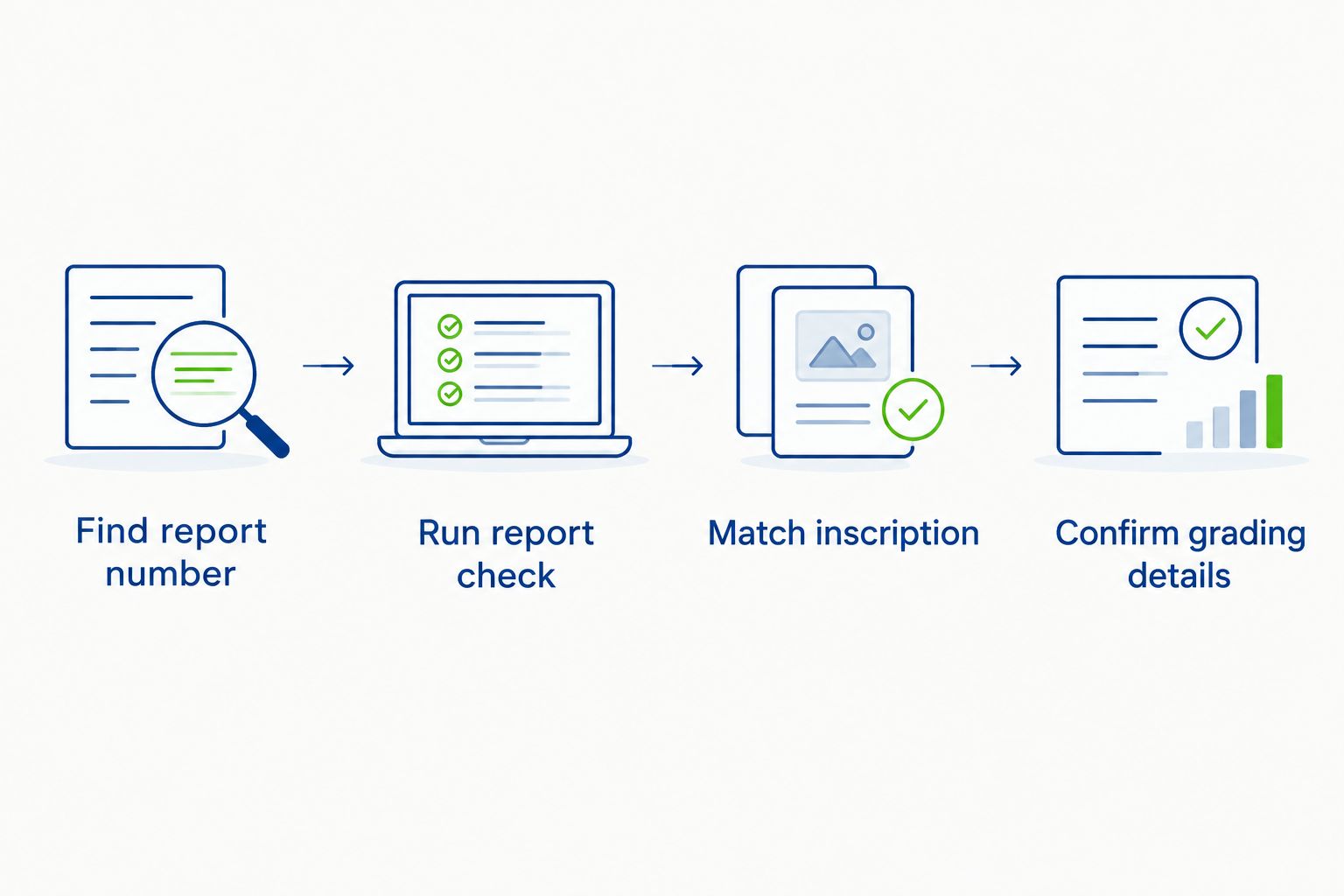
Each step catches a different kind of mismatch between the paper and the stone.
Set up your report check
- Locate the report number printed on the top of the GIA certificate — it will read something like "GIA Report No." followed by a string of digits.
- Go to GIA's Check a Report tool on gia.edu and enter the report number exactly as printed, no spaces.
- GIA's database returns the shape, carat weight, color, clarity, and cut grade tied to that report number.
- Compare every field against the physical report the seller gave you. Any mismatch — even a carat weight off by 0.05 — means the report you're holding does not belong to a diamond currently in GIA's system as described.
Expected result: the online record matches the paper document field for field. If it does not load at all, or GIA shows "no matching reports," stop the transaction and ask the seller to explain before you go further.
Confirm the physical inscription
- Ask the seller or jeweler to place the diamond under a 10x loupe or a jeweler's microscope, girdle facing up.
- Look for a laser-inscribed number on the girdle — it will match the report number from the certificate.
- Read the full string of digits, not just the first few — partial matches are not matches.
- If the inscription is worn, chipped, or the setting hides the girdle, ask for the stone to be temporarily unmounted or viewed from an angle that exposes it.
Expected result: the inscribed number reads identically to the report number you just verified online. This is the step that ties the specific physical stone to the specific document — the online check alone only proves a report with that number exists somewhere in GIA's records.
Verify the grading details align
- Cross-reference the cut, color, clarity, and carat weight on the report against what the seller is representing verbally or in the listing.
- Check the plotting diagram on the full GIA report (not just a summary card) — this diagram maps the specific inclusions GIA identified, and a jeweler can compare it to the stone under magnification.
- Confirm the report date — GIA's grading standards and equipment have been refined over the decades, so a report from the 1990s and one from 2026 aren't graded under identical conditions, which matters for resale and insurance conversations.
Expected result: every number on the report has a visible match in the stone, and the plotting diagram's inclusion pattern is identifiable when you look through the loupe.
See how carat weight, clarity, color, and cut interact on the report by reading how to choose a diamond cut for maximum sparkle — the report's cut grade is the one field buyers most often skim past.
Verifying a lab-grown diamond's GIA report
GIA grades lab-grown diamonds under a separate reporting system, and the process for checking one is nearly identical with one difference: lab-grown GIA reports are inscribed with the word "Laboratory Grown" alongside the report number, and GIA's Report Check tool will identify the stone as lab-grown in its results. If a seller represents a diamond as natural but the GIA Report Check flags it as laboratory grown, that discrepancy is disqualifying on its own — verify this field every time, not just the grading numbers.
Troubleshooting
- The report number returns "no record found." Re-enter the number checking for misread characters (0 vs O, 1 vs I are common transcription errors) — if it still fails, the report may be fabricated or altered.
- The inscription won't scan under a standard loupe. Ask for a jeweler's microscope instead; girdle inscriptions on some cuts and mountings sit at angles a handheld loupe can't catch cleanly.
- The online record matches but the physical stone looks different than described. GIA's grading is precise but subjective grading calls (especially color and clarity near a grade boundary) can look different to an untrained eye — get a second opinion from an independent appraiser rather than assuming fraud.
- The seller won't let you inspect the stone under magnification before purchase. That's a refusal to verify, not a technicality — treat it as a red flag regardless of how complete the paperwork looks.
- The report is for a diamond, but the stone is mounted so the girdle isn't visible at all. Request the stone be checked before final sale, or build a temporary unmounting into the purchase agreement.
Customize your workflow
Once you've confirmed the GIA report matches the stone, the next decisions are about grade trade-offs — how much carat weight to spend versus color grade, or where clarity stops mattering to the naked eye. If you're buying for a ring rather than a loose stone, pair the verification step with a look at how carat weight actually reads at different sizes, and get the stone appraised for insurance purposes immediately after purchase rather than waiting.
Verify a diamond in person
Bring your GIA report to Element 79 in Cherry Creek for a hands-on check.
FAQ
How do I verify a GIA report is real?
Enter the report number into GIA's free Report Check tool at gia.edu and confirm the shape, carat, color, and clarity match your physical certificate. Then check the laser inscription on the diamond's girdle under 10x magnification to confirm the stone matches the paperwork.
Can a GIA report number be faked?
The report itself can be altered or paired with the wrong stone, which is why checking the number against GIA's online database and matching the girdle inscription both matter. A fake or mismatched report will fail one of these two checks even if the paper document looks convincing.
What does it mean if a diamond has no laser inscription?
Some older GIA reports and smaller stones were never inscribed, so a missing inscription isn't automatic proof of fraud. Lean on the GIA Report Check online and an independent appraisal to confirm the stone in those cases.
Is a GIA report better than an EGL or IGI report?
GIA is widely regarded as the strictest and most consistent lab in the trade as of 2026, which is why most fine jewelry retailers, including Element 79, prioritize GIA-graded diamonds. IGI grades a large share of lab-grown diamonds and is generally considered reliable for that category specifically.
How do I check if a lab-grown diamond's GIA report is legitimate?
Run the report number through GIA's Report Check tool the same way you would for a natural diamond — the results will explicitly flag the stone as laboratory grown. The physical stone should also carry a girdle inscription reading "Laboratory Grown" next to the report number.
Does GIA verify diamonds for free?
Yes, GIA's Report Check tool on gia.edu is free to use for anyone with a report number. Physically re-grading or appraising a stone through a jeweler is a separate service and typically isn't free.
What should I do if the GIA report doesn't match the diamond?
Stop the purchase and ask the seller to explain the discrepancy before any money changes hands. A report that doesn't match the physical stone on carat weight, inscription, or grading details isn't a paperwork error worth working around.
One last thing
Most buyers check the report number and stop there — the girdle inscription is the step people skip, and it's the one that actually ties a specific diamond to a specific document. A report that checks out online but has no matching inscription on the stone in front of you hasn't verified anything at all.
Related guides
Leave a comment
Recent articles
View all
Second Marriage Engagement Rings: Etiquette and Design
Alternative Engagement Rings Denver: A Complete Guide