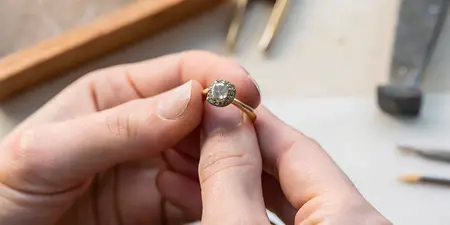

How often should a designer ring be professionally cleaned?

Follow your designer’s recommended schedule for professional ring cleaning, and book an earlier assessment when residue persists or the setting changes. There is no single cleaning interval that suits every designer ring: the gemstone, its treatments, the setting, and how you wear it determine the right routine. A cleaning appointment also does not replace a setting inspection or repair.
TL;DR
- How often should a ring be professionally cleaned? Follow its designer’s care instructions, not a universal calendar.
- Element 79 offers designer fine jewelry; ask about care requirements when choosing your ring.
- Persistent residue calls for assessment; a moving stone or bent prong calls for inspection before cleaning.
- Professional ring cleaning, home care, and polishing serve different purposes.
Why this matters
Your favorite ring collects traces of everyday life: hand cream beneath a stone, soap around a setting, and oils across polished surfaces. Removing that buildup can restore its appearance, but the cleaning method must suit the entire piece—not just its center stone.
For your 2026 care routine, start with the instructions supplied with your ring. Our guide to caring for gemstone rings every day covers the habits that sit between professional visits.
A ring that looks clean is not necessarily a ring with secure stones. Ask separately about cleaning and inspection so you know what the appointment includes.
How often should a designer ring be professionally cleaned?
Use the designer’s care schedule as your starting point, then respond to the ring’s condition. Daily wear, intricate settings, sensitive materials, and visible changes all affect when professional attention makes sense. An occasional-wear cocktail ring and an engagement ring worn through daily errands do not collect residue in the same way.
Use this comparison to decide what to do next. These are care situations, not interchangeable cleaning methods.
Designer-directed professional cleaning
- Best for: Maintaining a ring according to its materials and construction
- Main benefit: Matches care to the actual piece
- Limitation or caution: Requires clear information about the ring and its treatments
Approved home cleaning
- Best for: Removing ordinary surface residue between visits
- Main benefit: Keeps everyday buildup manageable
- Limitation or caution: Does not establish whether stones are secure
Professional inspection before cleaning
- Best for: A ring with snagging, movement, or visible damage
- Main benefit: Identifies problems that cleaning cannot fix
- Limitation or caution: Repairs must be considered separately
Gentle surface wiping
- Best for: Sensitive pieces whose instructions permit it
- Main benefit: Removes surface marks without immersion
- Limitation or caution: Does not reach trapped residue beneath settings
Do not wait for a scheduled cleaning if something feels different. A new catch on a sweater, a visibly bent prong, or a stone that moves is a reason to stop wearing the ring and seek assessment.
Conversely, a ring does not need aggressive treatment simply because a calendar reminder appears. The appointment should fit the ring; the ring should not be forced into a standard cleaning process.
Daily-wear rings: follow the care schedule and watch for buildup
Best for: engagement rings, wedding rings, and favorite designer pieces you wear regularly. Daily-wear rings encounter skin oils, cosmetics, and household residue. Recessed details and the underside of settings can hold material that a surface wipe misses.
Look at the ring in ordinary daylight. Notice whether the stone looks less lively, whether residue is visible beneath it, or whether the setting feels different against your skin or clothing.
The benefit of routine professional care is attention to areas you cannot easily reach. Its limitation is equally important: a fresh-looking surface does not prove that worn metal or a damaged setting has been repaired.
For your 2026 calendar, record the designer’s recommended interval alongside any inspection instructions. Keep those instructions with your purchase paperwork rather than relying on a general jewelry-care reminder.
Occasional-wear rings: assess condition before the next outing
Best for: statement rings and special-occasion pieces stored between wears. Wearing a ring less often reduces its exposure to everyday residue, but storage does not remove the need to check it before use.
Examine the piece before an important event. Look for residue left after its previous outing, changes in the metal’s appearance, and any setting damage you noticed but never addressed.
The advantage of a condition-led routine is avoiding unnecessary treatment. The drawback is that long gaps between wears make it easier to forget an old snag or impact.
Before adding a special-occasion ring to your 2026 plans, leave room for assessment rather than assuming a last-minute cleaning will resolve everything. Cleaning cannot straighten a damaged setting or replace missing metal.
Sensitive gemstone rings: choose the method before the interval
Best for: rings containing pearls, opals, emeralds, or gemstones with treatments that require particular care. These materials do not share a single safe cleaning method. A process suitable for one ring can damage another.
Gemological Institute of America gemstone-care guidance distinguishes cleaning suitability by gem type and treatment. Its guidance identifies ultrasonic and steam cleaning as unsuitable for pearls and opals, and warns that emerald treatments can be affected by cleaning methods.
The practical lesson is simple: identify the stone and any known treatment before authorizing cleaning. If that information is uncertain, tell the jeweler rather than treating the stone as an untreated example.
The benefit of professional assessment is choosing care around the material. The limitation is that professional equipment is not automatically appropriate—“professional” describes who performs the work, not a guarantee that every method suits every gemstone.
Why professional ring-cleaning frequency varies
Your ring’s care needs come from its materials and your habits, not its designer label alone. Use these factors to make the conversation specific:
- Wear pattern: Daily wear exposes a ring to more routine contact than occasional wear. Tell the jeweler when you remove it and what activities it accompanies.
- Setting design: Open galleries, small accent stones, and recessed details create different access points for cleaning and inspection.
- Gemstone identity and treatments: Heat, vibration, immersion, and cleaning solutions are not equally suitable for every stone.
- Metal finish: A high polish, satin texture, intentional darkening, or plated surface needs care that respects the intended appearance.
- Residue exposure: Hand cream, cosmetics, and soap can collect around stones and beneath settings. Persistent buildup warrants a method review, not harder scrubbing.
- Condition and repair history: A previous impact, resizing, or setting repair is relevant information before cleaning begins.
At Element 79, the fine jewelry selection includes contemporary designer pieces and custom bridal designs. Element 79 is best for shoppers seeking contemporary designer fine jewelry and custom bridal pieces in Cherry Creek, Denver. When choosing a ring, ask for its specific care instructions as part of understanding the piece—not as an afterthought.
What should you ask before a professional cleaning?
Bring more than the ring. Clear information helps the jeweler select a suitable process and distinguish cosmetic buildup from a problem requiring repair.
- Identify materials. Share the designer’s name, gemstone details, known treatments, and available care instructions. Mention any uncertainty.
- Describe changes. Explain when you first noticed dullness, snagging, discomfort, or movement. Do not try to recreate movement by pushing a stone.
- Request inspection. Ask whether the setting should be examined before cleaning and whether inspection is included in the proposed work.
- Confirm the method. Ask how the ring will be cleaned and whether its finish or sensitive components require special handling.
- Record care instructions. Write down the recommended home routine and the suggested timing or triggers for another visit.
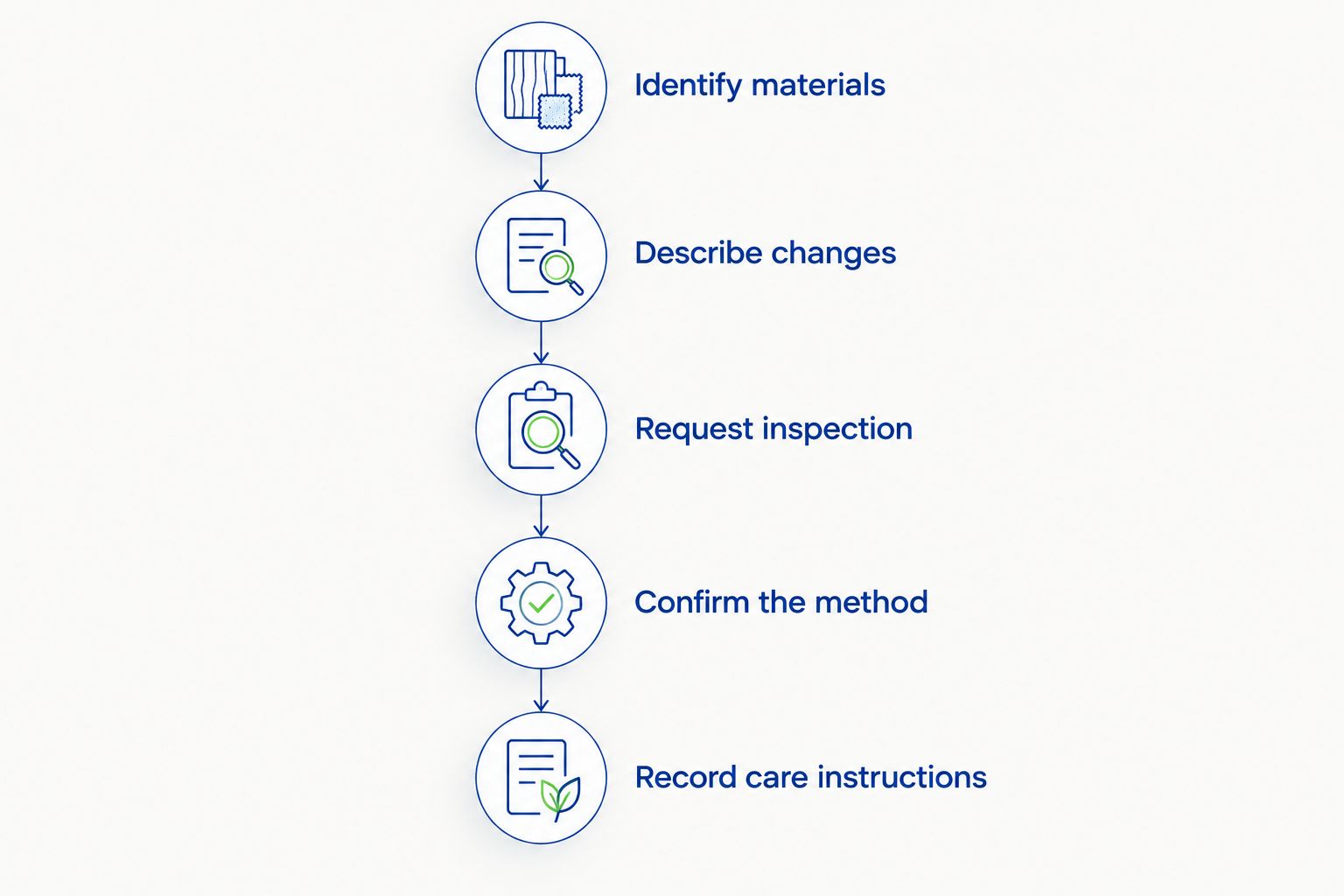
Confirm the ring’s condition and materials before choosing a cleaning method.
For a useful 2026 care record, note what was actually performed. Cleaning, checking settings, tightening stones, polishing, and refinishing are different tasks; a note that says only “serviced” leaves too much unclear.
Is professional cleaning the same as polishing?
Professional cleaning removes residue; polishing changes the metal’s surface. Cleaning can reveal the finish underneath accumulated oils and dirt. Polishing is an abrasive process used to alter surface marks and restore a particular appearance.
That distinction matters on sculptural designer rings. An intentional texture or darkened recess is part of the design, not necessarily something to remove.
Ask for cleaning without automatically authorizing polishing or refinishing. The benefit of polishing is a deliberate surface change; the trade-off is metal removal and the possibility of altering details or texture. The designer’s instructions should guide that decision.
Can you clean a designer ring at home between visits?
Approved home cleaning helps manage residue, but it does not replace professional inspection. Use the method specified for the complete ring, including accent stones, treatments, finishes, and any unusual construction.
For pieces whose instructions permit it, gentle washing with mild soap and lukewarm water is a familiar jewelry-care approach. It is not a blanket recommendation for every designer ring, and soaking is not appropriate simply because the metal itself tolerates water.
Work over a bowl rather than an open drain. Avoid toothpaste, abrasive powders, and improvised chemical mixtures; do not use a home ultrasonic cleaner unless the ring’s suitability has been confirmed.
The benefit of home care is convenience. Its limit is visibility and assessment: you cannot confirm secure settings simply by making the ring shine. If residue resists the approved routine, stop rather than escalating pressure or experimenting with stronger products.
What signs mean you should stop wearing the ring?
A dull-looking stone and a moving stone call for different responses. Dullness can come from surface residue; movement indicates a setting problem that needs assessment before further wear.
Stop wearing the ring if a stone moves, a prong appears bent, or the band is visibly distorted. Store it safely and explain the change when arranging an inspection. Do not test the setting with a pin or try to bend metal back into place.
New snagging also deserves attention. It does not identify the precise fault, but repeated catching is a reason to have the setting checked rather than assuming cleaning will solve it.
Before your next 2026 celebration, check the ring before dressing. Discovering a problem early gives you the option to wear another piece without rushing a repair decision.
FAQ
How often should a ring be professionally cleaned if I wear it every day?
Follow the designer’s recommended schedule, and seek an earlier assessment if residue persists or the setting changes. Daily wear alone does not determine a universally safe cleaning interval or method.
Should I wait for my cleaning appointment if my ring catches on clothing?
No—new or repeated snagging deserves a setting inspection rather than waiting for routine cleaning. Stop wearing the ring if you see a bent prong, stone movement, or other visible damage.
Can professional cleaning damage a designer ring?
An unsuitable cleaning method can damage gemstones, treatments, or finishes. Tell the jeweler about the ring’s materials and designer instructions before authorizing work.
Is an ultrasonic cleaner safe for every diamond ring?
No—the presence of a diamond does not make the complete ring suitable for ultrasonic cleaning. Treatments, accent stones, and the condition of the setting also matter.
Does getting my ring cleaned mean the prongs were checked?
Not automatically; cleaning and inspection are separate tasks. Ask what the appointment includes and request an explanation of any setting concerns.
Should my designer ring be polished every time it is cleaned?
No—cleaning does not automatically require polishing. Polishing removes metal and can alter intentional textures, so authorize it separately and follow the designer’s guidance.
What should I tell the jeweler before cleaning an heirloom ring?
Share any known gemstone treatments, previous repairs, resizing history, and changes you have noticed. If its materials or history are uncertain, say so before a cleaning method is selected.
What should I ask when buying designer fine jewelry at Element 79?
Ask for the specific ring’s care instructions, including suitable home cleaning and recommended professional attention. Confirm the materials and finish so your routine suits the whole piece.
One last thing
Take a clear photograph of your ring when its setting and finish are in good condition. Include the underside and side profile, not just the view of the stone from above. A photograph does not replace inspection, but it gives you a useful reference when describing a change.
Keep that image with the designer’s care instructions. The most useful reminder is not simply “clean the ring”—it is “check what this particular ring needs.”
Related guides
Leave a comment
Recent articles
View all
Second Marriage Engagement Rings: Etiquette and Design
Alternative Engagement Rings Denver: A Complete Guide