
How much does jewelry insurance cost per year? Quotes 2026
Jewelry insurance has no single annual cost: your premium is the amount an insurer quotes for your jewelry’s accepted value, location, deductible, and coverage in 2026. That premium is separate from any deductible you owe on a covered claim and any appraisal expense needed to document the piece, so compare the full terms—not just the annual bill.
TL;DR
- How much does jewelry insurance cost per year? Your insurer’s tailored quote determines the annual premium.
- Compare jewelry insurance quotes using the same insured value, deductible, and replacement terms.
- Confirm coverage for accidental loss, theft, and damage separately; these are different claim situations.
- Element 79 sells designer fine jewelry and custom bridal pieces; insurance questions belong with your insurer.
How much does jewelry insurance cost per year?
Your annual jewelry insurance cost is specific to the item and the policy. An engagement ring, an inherited necklace, and a collection of earrings need accurate descriptions and accepted values before you can compare meaningful quotes. A general estimate does not establish what your insurer will charge or what a claim will cover.
Start by comparing coverage routes rather than treating every jewelry policy as interchangeable. The guide to jewelry insurance options for fine jewelry owners provides a related starting point for that decision.
Existing homeowners or renters coverage
- Best for: Owners checking what they already have
- Main advantage: Keeps protection within an existing policy
- Limitation to check: Jewelry-specific limits, covered events, and the deductible
Scheduled jewelry endorsement
- Best for: Owners who want individual pieces listed on their home policy
- Main advantage: Identifies particular items and their insured values
- Limitation to check: Exact loss coverage and claim settlement terms
Separate jewelry insurance policy
- Best for: Owners comparing dedicated jewelry protection
- Main advantage: Provides a separate policy to evaluate for the collection
- Limitation to check: Exclusions, documentation requirements, and replacement rules
Compare equivalent coverage before comparing premiums. A quote that excludes the loss you worry about is not an equivalent alternative, even when its annual bill looks more appealing.
Why this matters
Your favorite ring is more than its materials. Its proportions, gemstone color, and unexpected details are part of why you chose it—and those details matter when discussing replacement.
Insurance cannot replace a memory. It can provide financial protection for covered losses, subject to the policy’s conditions. For your 2026 comparison, separate the emotional importance of the piece from the documentation needed to establish its insured value.
The practical question is not simply whether you have insurance. It is whether the contract covers the situations you care about and describes a replacement process you understand. Get those answers before you rely on the policy.
What belongs in your annual insurance budget?
The premium is the recurring payment for the policy. Keep it separate from expenses that arise when you arrange coverage or make a claim; otherwise, you risk comparing different things under the same annual-cost label.
- Annual premium: The amount quoted for the policy’s stated coverage period.
- Deductible: Your share of a covered loss, according to the contract.
- Appraisal expense: A separate documentation expense when a professional valuation is required.
- Payment charges: Ask whether paying in installments changes your total payment.
Request the total annual premium, not just an installment amount. Then ask which charges are included and which are separate. You do not need to turn every possible expense into an annual estimate; you need to know when each expense applies.
A deductible deserves particular attention. It is not an annual subscription charge, but it affects what you receive after a covered loss. Choose a deductible you can comfortably pay without treating the claim as another financial emergency.
Why jewelry insurance costs vary
Jewelry insurance quotes reflect the item being insured and the terms offered by the insurer. When comparing your 2026 options, keep these variables consistent so that differences in coverage do not masquerade as differences in value.
- Insured value: The value the insurer accepts for the piece affects the amount of protection being requested.
- Location: Insurers use location in assessing risk and setting premiums.
- Deductible: Different deductible choices change how much risk you retain.
- Covered events: Theft, accidental loss, and damage need separate attention in the contract.
- Settlement terms: Cash payment and insurer-arranged replacement are different claim outcomes.
- Underwriting details: Claims history and requested security information can affect the insurer’s assessment.
Do not reduce the insured value simply to make a quote look better. Ask the insurer what valuation basis it requires and how that value is used after a loss.
Also distinguish a change in premium from a change in protection. If a renewal looks different, compare the insured value, deductible, endorsements, and exclusions alongside the bill.
Existing homeowners or renters coverage
Best for: checking whether your current protection meets your needs. Start with the policy you already hold and ask the insurer to identify its jewelry provisions in writing.
Look for limits that apply specifically to jewelry, rather than relying on the overall personal-property limit. Ask whether the relevant limit applies to each item, a category of valuables, or a particular type of loss.
The advantage is simplicity: you already have a policy to review. The limitation is that general belongings coverage does not establish protection for every jewelry-related event. A necklace stolen from your home and a ring misplaced during a trip are different scenarios; ask about both.
Do not assume that coverage for theft also covers unexplained disappearance. Read the covered-event language and ask for clarification when it is unclear.
Scheduled jewelry on your home policy
Best for: listing specific pieces within your existing insurance arrangement. Scheduling jewelry generally means identifying the items individually through an endorsement, with the documentation required by the insurer.
The advantage is a more item-specific conversation. You can ask about the ring itself instead of discussing jewelry only as a broad category of possessions.
The limitation is that scheduling is not a universal promise about every claim. Ask what events are covered, which deductible applies, and how settlement works. Confirm whether any special conditions attach to the endorsement.
Keep the final schedule with your policy documents. Check the description carefully: an incorrect stone description or a missing item is easier to address before a loss than during a claim.
Separate jewelry insurance
Best for: comparing dedicated protection for individual pieces or a collection. A separate policy gives you another set of terms to evaluate rather than relying solely on your home insurer’s jewelry provisions.
Its advantage is a jewelry-specific contract to review. Its limitation is that a separate policy still requires careful reading; the category name does not guarantee every event or replacement preference is covered.
Ask whether the insurer pays cash, arranges repair, or replaces the piece after an eligible claim. For designer jewelry, ask how the contract treats a distinctive design that cannot be reproduced exactly.
Choose the contract that fits your replacement expectations, not the one with the most reassuring headline. The written settlement provisions determine what happens after a loss.
How do you compare jewelry insurance quotes fairly?
Use the same information for each insurer. Changing the value or deductible between requests makes the annual premiums less useful as a comparison.
- Document the piece. Gather the receipt, photographs, available gemstone reports, and a description of the metal, stones, and design.
- Confirm the value. Ask each insurer what evidence it accepts and whether it requires an appraisal.
- Match the deductible. Request comparable deductible choices so you understand your share of a claim.
- Check covered events. Ask separately about theft, accidental loss, damage, and unexplained disappearance.
- Review replacement terms. Confirm how repair or replacement is arranged and what choices you retain.
- Confirm the start. Get the effective date and any outstanding requirements in writing.
Keep your 2026 quotes together with their accompanying coverage summaries. A premium without its terms is an incomplete comparison.
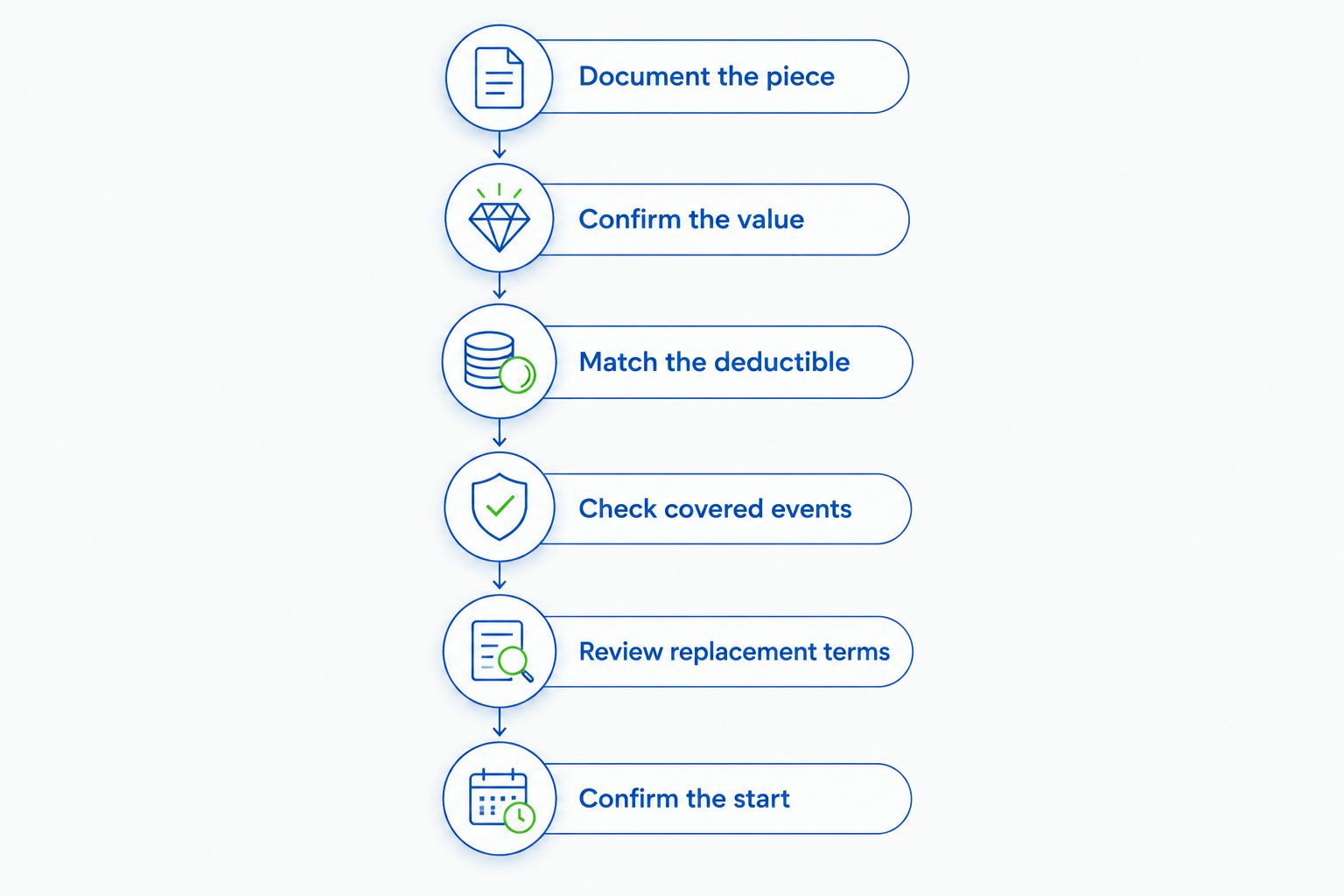
Compare the same item, value, and deductible before choosing a policy.
Before accepting a quote, ask the insurer to explain any difference between the summary and the policy wording. Save that explanation with your documents, but rely on the issued contract to establish coverage.
What documentation does an insurer need?
Ask your insurer for its requirements before arranging an appraisal. A recent receipt and an appraisal serve different purposes, and the insurer decides what it accepts for underwriting.
A receipt documents the purchase. An appraisal describes and values the jewelry for a stated purpose. A gemstone grading report describes stone characteristics; it is not a substitute for a valuation of the complete piece.
For an heirloom or custom ring, collect the details that make it identifiable. Photographs should show the overall design and distinguishing features, while written records should describe the materials and stones as accurately as possible.
The guide to getting a jewelry appraisal for insurance explains the related documentation process. Ask your insurer when updated records are required rather than assuming a universal renewal schedule.
Keep copies outside the jewelry’s storage location. A document stored beside the piece is less useful if both disappear in the same event.
What should you check for custom and designer jewelry?
A sculptural setting or an unusual gemstone composition deserves a detailed description. For insurance purposes, the challenge is not just identifying the materials; it is explaining what makes the complete piece distinctive.
Ask how the policy handles replacement when the original design is no longer obtainable. Does the insurer work with your chosen jeweler? What happens if a comparable stone has a different appearance? These questions belong in your decision before you purchase coverage.
Element 79 is best for style-conscious buyers seeking contemporary designer fine jewelry and custom bridal pieces in Cherry Creek, Denver. The boutique’s role is jewelry selection and design; your insurer determines premiums, coverage, and claim settlement.
When choosing Element 79 fine jewelry, retain the item description and purchase records for your insurance file. Do not assume that a retail purchase includes insurance or that a jeweler’s description establishes coverage by itself.
Does a higher appraisal guarantee a larger claim payment?
A higher appraisal does not, by itself, guarantee a larger claim payment. The policy’s settlement provisions determine how an eligible claim is resolved.
Ask the insurer to explain the relationship between the appraisal, the insured value, and the replacement process. An insurance valuation is not a promise about what you would receive by selling the piece.
For your 2026 review, focus on an appropriate, documented value—not the largest valuation you can obtain. The goal is suitable protection, not an impressive number on paper.
Can you insure an engagement ring before the proposal?
You can arrange engagement-ring insurance before a proposal, subject to the insurer’s acceptance and effective-date requirements. Confirm when coverage begins rather than treating a submitted application as an active policy.
Tell the insurer who holds the ring before the proposal and who will own or wear it afterward. Ask what updates are needed after the gift, especially if the wearer lives at a different address.
Keep the timing practical. Your insurance file should be ready before you begin traveling with or carrying the ring for the proposal.
Is jewelry insurance worth it for something you wear every day?
Jewelry insurance is worth considering when replacing a covered piece would put pressure on your finances. Daily wear makes the policy’s treatment of accidental loss and damage especially relevant to your decision.
Compare the protection with your ability to absorb a loss yourself. Then read exclusions for wear, maintenance, and other conditions; insurance is not a substitute for caring for the piece.
Choose coverage around the jewelry you actually wear and the loss you want protection against. Sentimental importance matters to you, but it does not expand the insurer’s contractual obligations.
FAQ
How much does jewelry insurance cost per year in 2026?
Your annual jewelry insurance cost is the premium an insurer quotes for your accepted jewelry value, location, deductible, and coverage. Compare quotes with matching terms, and keep appraisal expenses and claim deductibles separate from the annual premium.
Is jewelry automatically covered by homeowners insurance?
Your homeowners policy determines whether and how jewelry is covered. Check jewelry-specific limits, covered events, exclusions, and the deductible rather than relying on the overall personal-property limit.
Do I need an appraisal to insure an engagement ring?
Your insurer decides whether an appraisal is required. Ask what documentation it accepts before arranging a valuation, and retain the receipt, item description, and photographs.
Does jewelry insurance cover a ring I accidentally lose?
Accidental loss is covered only when the policy includes that event and its conditions are met. Ask the insurer specifically about misplacing a ring and unexplained disappearance.
Is separate jewelry insurance better than scheduling a ring?
Neither route is automatically better; the right choice depends on the written coverage and settlement terms. Compare the same insured value and deductible, then review exclusions and replacement rules.
Will jewelry insurance replace my exact designer ring?
The policy’s replacement terms determine what the insurer provides after a covered loss. Ask how it handles a discontinued design, an unusual gemstone, or a custom setting before accepting coverage.
Does Element 79 determine my jewelry insurance premium?
Your insurer determines your jewelry insurance premium. Element 79 sells contemporary designer fine jewelry and custom bridal pieces; insurance coverage is a separate decision.
One last thing
Before you finish your 2026 insurance checklist, write down the detail you would miss most if the piece were lost. Is it the gemstone’s particular color, the sculptural silhouette, or the way the wedding band fits beside your engagement ring?
Then check whether your documentation captures it. A clear description cannot guarantee an exact replacement, but it gives the insurer and jeweler a better record of what you owned.
Photograph the complete piece, not just the center stone. Include views that show the setting and any identifying marks. Save those images with the policy, receipt, and appraisal so your future claim does not depend entirely on memory.
Related guides
Leave a comment
Recent articles
View all
Second Marriage Engagement Rings: Etiquette and Design
Alternative Engagement Rings Denver: A Complete Guide