
How much does it cost to verify an IGI diamond certificate?

Checking an existing IGI diamond certificate through IGI’s online Report Verify service does not carry a verification fee. In 2026, that lookup checks the report record—not the diamond in your hand—and any physical examination, appraisal, or new laboratory grading needs a separate service quote.
TL;DR
- How much does it cost to verify an IGI certificate? IGI’s online report lookup has no verification fee.
- IGI report verification checks a laboratory record; it does not authenticate the physical diamond you receive.
- Choose a physical examination when you need to connect a diamond to its grading report.
- Request a separate quote for an appraisal, new grading report, or other hands-on work.
Why this matters
A beautiful ring should come with paperwork you can understand. The trouble starts when a seller uses verification to describe several different things: looking up a report, reading a laser inscription, examining a diamond, or preparing an insurance appraisal.
A matching online report is a document check, not a complete diamond identity check. That distinction helps you ask for the right service instead of paying for work that answers a different question.
If you are comparing paperwork from different laboratories, the guide to verifying a diamond’s GIA report before you buy addresses the same essential distinction: confirming a record and matching a stone are separate tasks.
How much does it cost to verify an IGI diamond certificate?
IGI’s online Report Verify lookup has no verification fee. You enter the report number through IGI’s official service and compare the returned information with the report supplied by the seller.
For a 2026 purchase, separate that lookup from any work involving the actual jewelry. A jeweler’s examination, an appraisal, and a laboratory submission have different purposes; none should be treated as another name for checking a report number.
IGI online report lookup
- Best for: Checking an existing report record
- What it establishes: Whether the supplied report details match the laboratory’s online record
- Benefit: Lets you compare information directly
- Limitation: Does not examine your diamond
Physical diamond examination
- Best for: Connecting a stone to its paperwork
- What it establishes: Observable characteristics and markings that can be compared with the report
- Benefit: Addresses the actual stone
- Limitation: The scope depends on the equipment, mounting, and examiner
New laboratory grading
- Best for: Obtaining laboratory findings about a submitted stone
- What it establishes: The findings covered by the requested laboratory service
- Benefit: Provides an examination rather than a document lookup
- Limitation: Requires a separate submission and service arrangements
Jewelry appraisal
- Best for: Documenting an item for a stated valuation purpose
- What it establishes: An opinion of value within the appraisal’s scope
- Benefit: Addresses valuation rather than grades alone
- Limitation: Does not replace a laboratory grading report
Start with the online lookup. Request hands-on work when you need an answer the database cannot provide, and ask exactly what the written findings will cover.
Online report verification: check the record first
Use IGI’s official website rather than relying only on a screenshot, seller-hosted PDF, or link inside an unfamiliar message. Find the Report Verify service from the laboratory’s own site and enter the report number carefully.
A successful lookup gives you a record to compare. Read the details—not just the laboratory name or the fact that a page appeared.
Pay particular attention to the diamond’s description, shape, carat weight, measurements, color, clarity, and any comments included on that report. Where the report identifies the diamond as laboratory-grown, the seller’s description should say so too.
In 2026, keep the report number alongside the seller’s written description and your purchase documents. This creates a useful reference if you later arrange an appraisal, discuss a new setting, or need clarification about the stone.
Follow this verification sequence
- Get the report. Ask for a readable copy and the complete report number before making a decision.
- Open IGI directly. Find the laboratory’s official Report Verify service independently of the seller’s message.
- Compare the details. Check the returned information against both the supplied report and the listing.
- Resolve mismatches. Ask for a written explanation if the description, measurements, grades, or report number differ.
- Match the stone. Arrange a qualified physical examination when you need confirmation beyond the paperwork.
The sequence matters because each step answers a different question. Finding a report record is the starting point; connecting that record to the diamond is the next task.
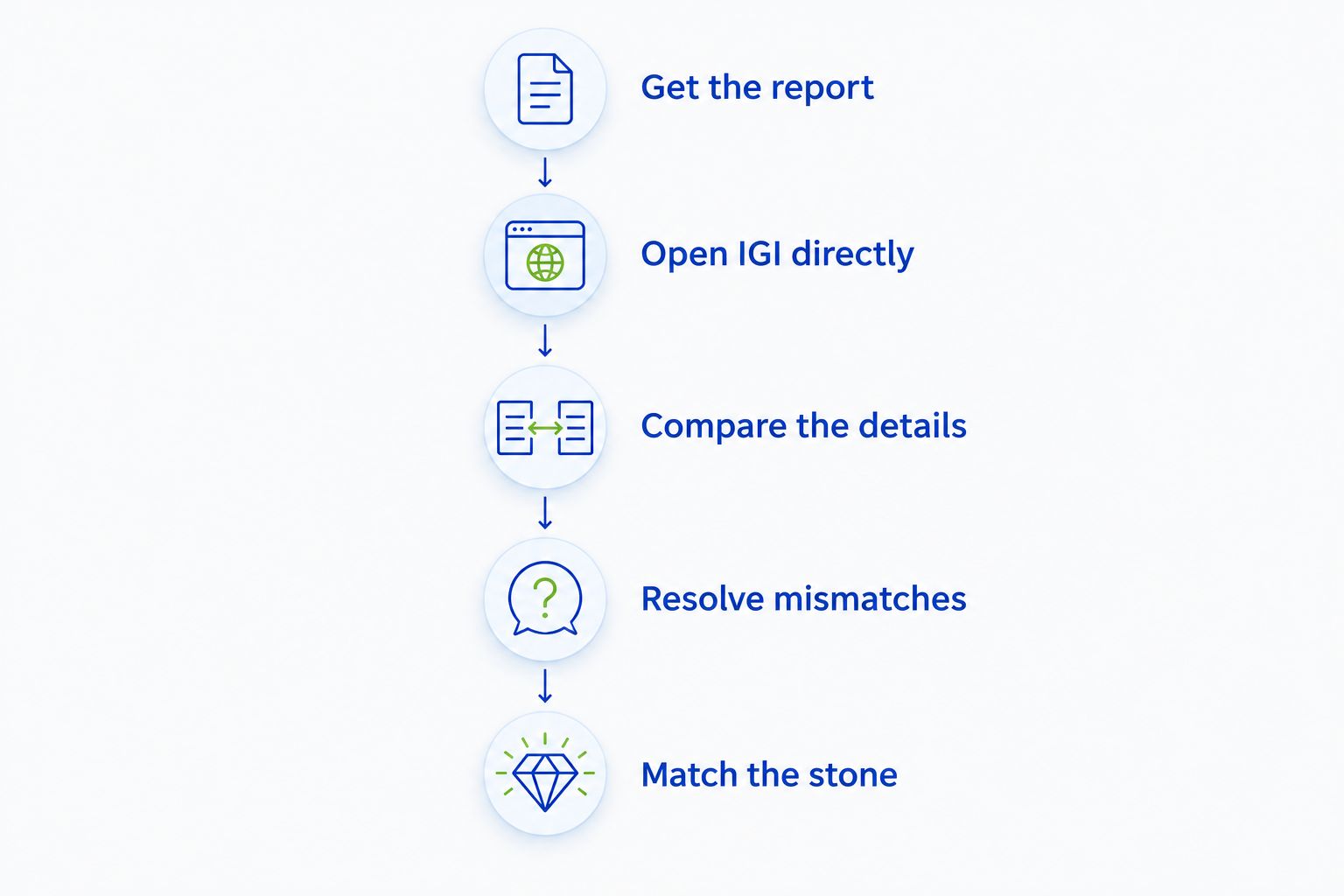
Check the report record before arranging work to match the physical stone.
Physical verification: match the diamond to the report
A genuine report can describe a different diamond from the one being offered. That is why a database match alone cannot settle every concern about identity.
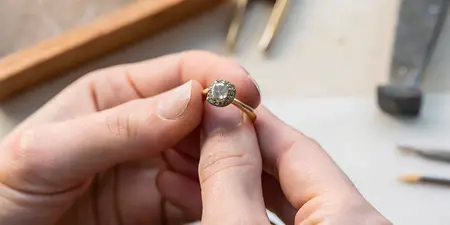
A qualified examiner can compare accessible features with the report, including measurements, visible characteristics, and a laser inscription when one is present and readable. Ask which checks the examination includes and which remain outside its scope.
Treat a matching inscription as supporting evidence, not the entire investigation. Reading a report number on the stone does not independently establish every characteristic listed in the report.
A mounting also affects access. Prongs, bezels, and other setting elements can obscure parts of a diamond, so ask what can be examined while the stone remains set before authorizing additional work.
Do not remove a diamond yourself to make it easier to inspect. Have the professional explain whether removal is necessary, what it involves, and how the item will be documented while in their care.
New grading and appraisals: different questions, different work
A new laboratory grading service examines a submitted stone within the scope of that service. It is not simply an upgraded online lookup, and you should not order it automatically because you want to confirm that an existing report number is real.
An appraisal answers a valuation question. A diamond grading report describes gemological characteristics; it does not replace a purpose-specific opinion of the jewelry’s value.
For insurance planning in 2026, ask your insurer what documentation it requires before commissioning an appraisal. The insurer’s requirements should guide the documents you request, rather than an assumption that a grading report covers everything.
If you are planning a custom ring, separate the stone’s documentation from decisions about the design. Resolving identification questions first lets you focus on the setting, proportions, and how the finished ring will feel on your hand.
Why the scope of IGI verification varies
The online lookup is a defined document check. Additional work varies because your question, the condition of the item, and the requested deliverable change what a professional must do.
Before requesting a quote, clarify these factors:
- Document check or physical examination: Looking up a number and inspecting a gemstone are different tasks. State which answer you need.
- Mounted or loose diamond: A setting can limit access to measurements, inscriptions, and identifying features. Ask what remains visible.
- Identity check or grading: Matching observable details is not the same as issuing new laboratory findings about the diamond.
- Examination or valuation: An insurance-related appraisal has a different purpose from confirming report details.
- Local inspection or laboratory submission: Sending an item elsewhere introduces custody, transport, and submission arrangements that need clarification.
- Verbal explanation or written deliverable: Ask whether you will receive written findings and exactly what those findings will state.
In 2026, request an itemized explanation of any proposed service before agreeing to it. A useful quote names the work, the responsible provider, and the result you will receive—not just a broad label such as certificate verification.
Does a verified IGI report prove the diamond is real?
A verified IGI report confirms a report record, not the identity of the stone in front of you. To connect the two, the diamond needs an appropriate physical examination.
The same distinction applies when the report describes a laboratory-grown diamond. A successful lookup does not turn a laboratory-grown diamond into a natural diamond; the origin description must remain consistent across the report and the seller’s paperwork.
If the seller’s description conflicts with the laboratory record, pause the purchase. Ask for corrected documents or an explanation that resolves the specific discrepancy before proceeding.
What should I do if my IGI report number is not found?
A report number that returns no result is a reason to investigate, not enough evidence by itself to declare a diamond counterfeit. First, check the characters against the original document and confirm that you are using IGI’s official service.
If the problem remains, contact IGI through its official channels and ask the seller for a clear report copy. Do not substitute a seller’s reassurance for a resolved record check.
Keep the distinction clear in your request: you need help confirming the report record. Questions about the physical stone require a separate examination.
Do I need an appraisal after verifying an IGI report?
An appraisal is relevant when you need a valuation for a stated purpose, not merely because you checked a report online. Ask the party requesting the valuation what the document must include.
For a ring purchase in 2026, keep your grading report, purchase documents, and any appraisal together. Each supports a different part of the item’s history, and none should be assumed to replace the others.
Bring the paperwork into your ring conversation
Once the documentation questions are settled, you can return to the enjoyable part: choosing a ring that feels like you. Bring the report and your questions into the conversation about the diamond and its setting.
Element79jewelry is best for style-conscious shoppers and engaged couples seeking contemporary designer fine jewelry and custom bridal pieces in Cherry Creek, Denver. That boutique offering is distinct from laboratory verification; ask the appropriate provider to define any inspection, grading, or appraisal work you need.
FAQ
How much does it cost to verify an IGI certificate online?
IGI’s online Report Verify lookup has no verification fee. A physical examination, appraisal, or new laboratory grading is separate work that needs its own service quote.
Can I verify an IGI diamond certificate myself?
You can check an existing report record yourself through IGI’s official Report Verify service. Compare the returned information with the supplied report and seller’s description; this does not authenticate the physical diamond.
Does a matching IGI report number prove my diamond is genuine?
A matching IGI report number does not, by itself, establish the identity of your physical diamond. An appropriate examination is needed to connect the stone with the report.
Do I need to send my ring to IGI just to check its certificate?
You do not need to submit your ring for an online report lookup. If you need laboratory examination rather than record verification, ask IGI about the appropriate service and submission requirements.
Can a jeweler check an IGI laser inscription?
A jeweler with suitable magnification can inspect an accessible laser inscription when one is present. A mounting can obstruct access, and an inscription alone does not establish every reported characteristic.
What if the IGI report says laboratory-grown but the seller says natural?
A conflict between a laboratory-grown report description and a natural-diamond sales description must be resolved before purchase. Ask for consistent written documentation rather than relying on a verbal explanation.
Is an IGI report the same as a jewelry appraisal?
An IGI grading report is not the same as a jewelry appraisal. Grading describes gemological characteristics, while an appraisal provides an opinion of value for a stated purpose.
One last thing
The most useful question is not simply whether the report is real—it is whether this diamond matches this report. A successful lookup answers only the first part.
Before you authorize extra work, ask the provider to finish this sentence in writing: the examination will establish the following. A clear scope helps you choose a service that addresses your actual concern, then return to choosing the ring with fewer unanswered questions.
Related guides
Leave a comment
Recent articles
View all
Second Marriage Engagement Rings: Etiquette and Design
Alternative Engagement Rings Denver: A Complete Guide