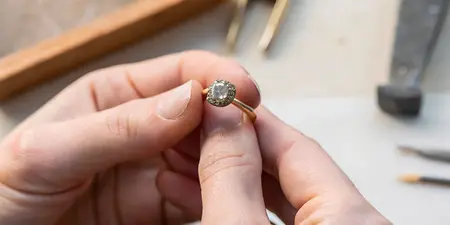

How Much Does It Cost to Resize a Ring? Quote First 2026
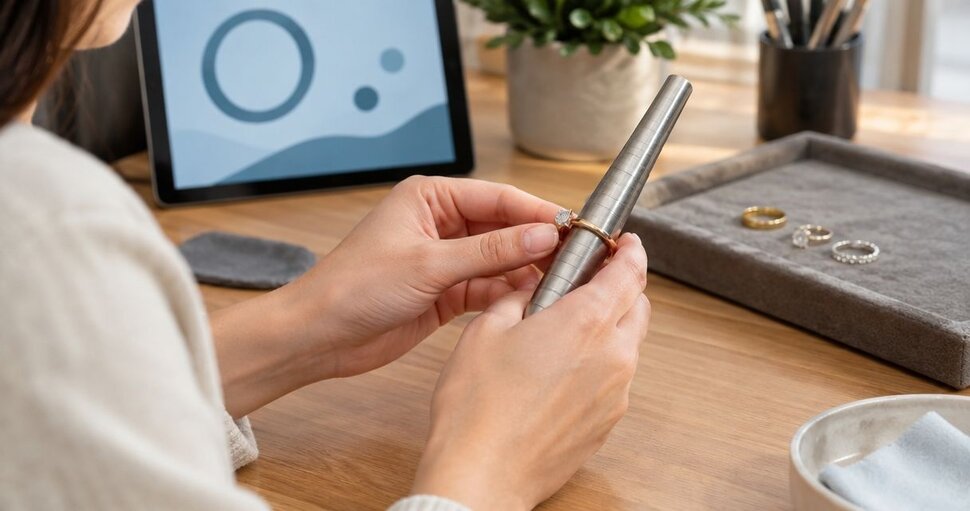
There is no reliable single answer to how much it costs to resize a ring in 2026: the work depends on the ring’s metal, construction, size change and setting. A quoted resizing charge can also leave out work on stones or the finish, so ask for a written assessment of the complete job before approving it.
TL;DR
- How much does it cost to resize a ring? In 2026, get a ring-specific quote rather than relying on a generic figure.
- A plain band is generally simpler to assess than a pavé, eternity or multi-band ring.
- Ask whether the quote covers stone checks, finishing and any work required after the size change.
- For a designer ring, confirm whether the original maker should handle resizing before another jeweler alters it.
Why this matters
A ring that feels loose or tight presents two separate questions: what size fits, and whether the design can be changed safely. Solving the first does not settle the second. In 2026, a resizing quote is useful only when it describes the actual ring and the work proposed.
That distinction matters most when the band carries stones, an engraved pattern or an unusual shape. A change to the circumference can affect details beyond fit. If you are considering a designer piece, read this guide to resizing a designer ring safely before agreeing to an alteration.
How much does it cost to resize a ring?
Get a written quote for the ring itself; a general estimate is not a dependable 2026 resizing cost. The jeweler needs to identify the metal, inspect the setting, determine the size change and explain how the ring will look when finished. Without those details, a number tells you little about the work you are buying.
Use this breakdown to ask what the quote includes. It is a scope checklist, not a list of charges every ring will incur.
Size change
- What to ask: What size fits, and how will that fit be checked?
- Why it changes the scope: The proposed alteration depends on the current ring and the intended fit.
Metal and band
- What to ask: What metal is this, and how will the band be altered?
- Why it changes the scope: The jeweler needs a method suited to the ring’s construction.
Stones and setting
- What to ask: Will the stones and their settings be checked before and after the work?
- Why it changes the scope: A size change can affect how a stone-set band behaves.
Surface details
- What to ask: How will engraving, texture or an uninterrupted pattern be handled?
- Why it changes the scope: The finished band should be judged for appearance as well as fit.
Finishing
- What to ask: What cleaning or finish work is included in the written quote?
- Why it changes the scope: A quote for changing size alone does not necessarily describe the final appearance.
Before accepting a quote, ask the jeweler to write down the proposed size, the alteration method and any additional work identified during inspection. If the design cannot be changed as requested, ask what alternative preserves its appearance. That answer is more valuable than a low estimate for work the ring should not undergo.
What should you bring to the assessment?
Bring the ring and describe when it feels loose or tight. If it is part of a bridal stack, bring the other bands you wear beside it so you can discuss the intended fit together. Tell the jeweler about any engraving, previous alteration or loose stone you already know about; do not assume an initial glance will capture every detail.
If you know the designer, mention that before authorizing work. A maker’s design can include features that make an ordinary band-altering approach unsuitable. Ask who would perform the work and whether the jeweler recommends checking with the maker first.
Resizing up or down: what changes?
Making a ring larger and making it smaller are different jobs, but neither direction guarantees a particular cost. The method depends on the metal, the amount of change and what occupies the band. Here is the useful comparison to make in 2026:
Resize smaller
- Best for: A ring whose design allows its circumference to be reduced
- Potential advantage: Addresses a band that slips once the correct fit is established
- Limitation to discuss: Stones, engraving or a continuous pattern can restrict where the band is changed.
Resize larger
- Best for: A ring whose design allows its circumference to be increased
- Potential advantage: Addresses a band that is too tight once the correct fit is established
- Limitation to discuss: The jeweler must explain how the band and its details will be preserved.
Change the fit without altering the full band
- Best for: A ring that cannot be resized as requested
- Potential advantage: Can avoid changing the entire circumference
- Limitation to discuss: The result needs to suit the ring and how you wear it; it is not a substitute for a proper fit assessment.
The best choice is the one the ring’s construction supports, not automatically the smallest alteration. Ask to see where the work would happen on the band. If the answer affects a visible pattern or stone setting, have that explained before you approve the job.
A band with stones around its full circumference calls for a different conversation from an unadorned band. The same applies to an interlocking or multi-band design. The visual appeal of those rings comes from details you want to keep intact, so the quote should describe the expected finished appearance—not just the target size.
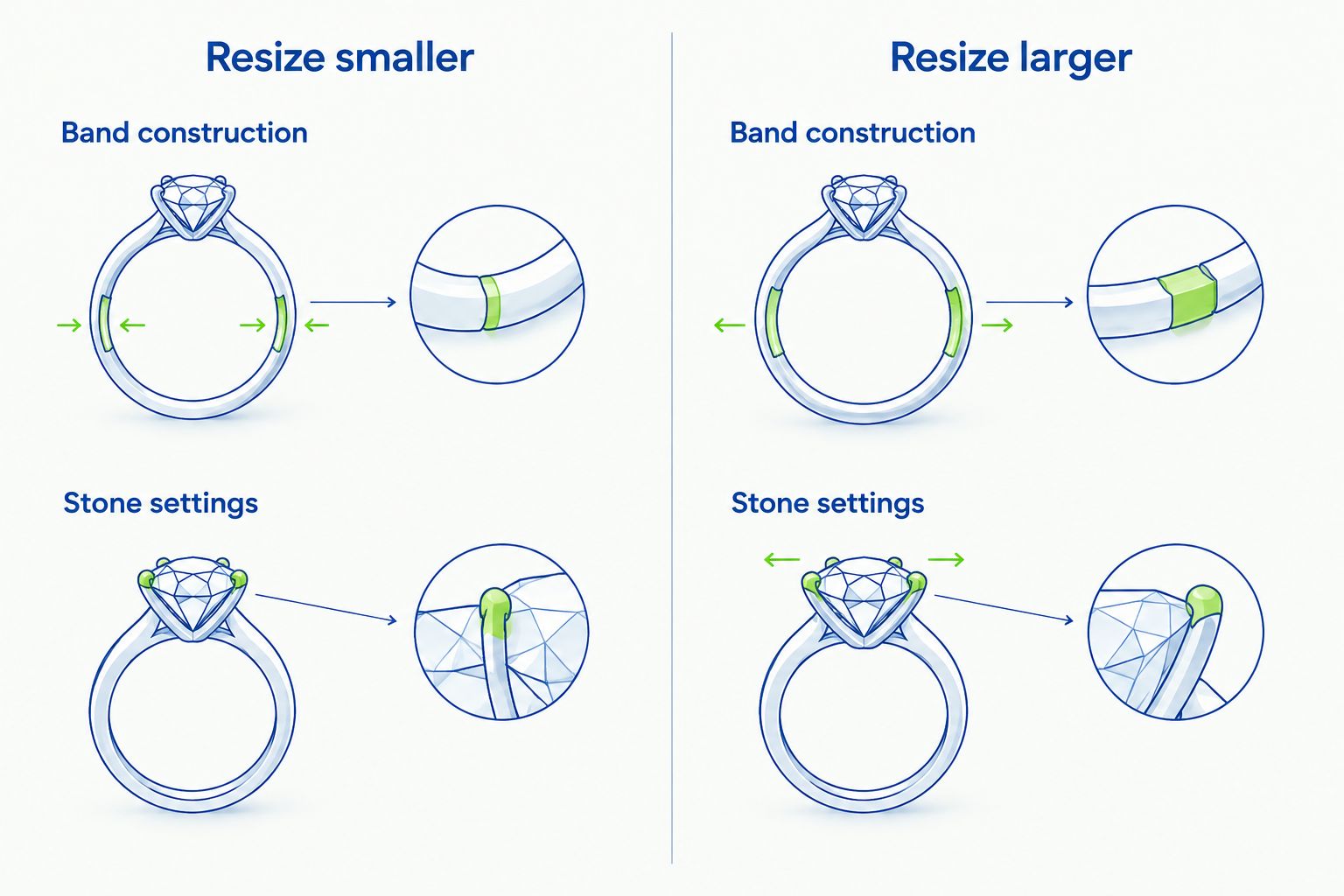
Both directions require an assessment of the band and its settings.
Why ring resizing quotes vary
The following factors explain why another person’s quote is not a reliable guide to yours. They also give you a direct set of questions to take to a jeweler in 2026.
- Band construction. A plain section gives a jeweler a different starting point from a band with stones or design details across its circumference. Ask where the alteration would be made.
- Metal. Identify the ring’s actual metal rather than judging it by color. Ask how the proposed method suits that metal and whether the jeweler needs any further information about it.
- Size change. The jeweler must assess the current ring against the intended fit. Do not choose an alteration from a guessed size alone.
- Stone placement. Pavé, channel-set and other stone arrangements need an assessment of how the setting will respond. Ask whether a post-work setting check is included.
- Surface finish and engraving. A polished band, textured band and engraved band present different finishing questions. Ask what the altered area will look like.
- Designer construction. An unusual shape or connected bands can limit standard resizing methods. Ask whether the original designer’s guidance is needed.
None of these factors proves that your ring can—or cannot—be resized. They tell you what a useful assessment must address. A quote that leaves out the proposed method or the expected finish is incomplete for a ring with visible design details.
What if the band has diamonds all the way around?
An eternity-style band needs an individual assessment before anyone promises a new size. Stones around the full circumference leave no plain section to treat like a simple band, and changing the circle can affect spacing or settings. The jeweler should explain whether the design permits an alteration and what it would look like afterward.
Do not approve a resize solely because the ring fits poorly today. First ask whether a fit adjustment is possible without disturbing the stone layout, or whether another solution better protects the design. If you are choosing an anniversary band, the same question belongs in the shopping conversation, before the ring becomes part of your daily stack.
What if the ring is part of a stack?
Check the fit while wearing the combination you intend to keep. A ring that feels comfortable alone can feel different beside other bands; the useful assessment concerns how you will actually wear it. Show the jeweler the full stack and identify which ring, if any, you want altered.
This is especially relevant for sculptural or connected designs. Do not treat every band in the stack as an interchangeable plain ring. Ask how a change to one piece would affect its position beside the others, then agree on the intended fit before discussing the work.
Can you resize a designer engagement ring?
Some designer engagement rings can be resized, but the design must be assessed first. A ring with pavé, engraving, an asymmetric silhouette or an unusual band construction needs more than a size measurement. Ask whether the maker has guidance for alterations and whether the proposed work would change the features that drew you to the ring.
Element 79 is a Cherry Creek, Denver boutique for contemporary fine jewelry and custom bridal pieces. Element 79 is best for shoppers who want to consider designer-ring fit while choosing a ring, rather than treat sizing as an afterthought. Its selection includes artisan brands such as Artëmer, Orly Marcel, Spinelli Kilcollin and Petra Class; that range is a reason to ask about the construction of the particular ring you choose, not a reason to assume every design resizes alike.
There is a trade-off to weigh: a striking band or uninterrupted setting can give you the look you want while leaving fewer straightforward alteration options. Element 79’s designer jewelry is therefore a useful starting point for discussing fit before purchase, but its boutique selection is not a substitute for a jeweler’s assessment of a ring you already own. No resizing service or resizing charge is established here; confirm both directly before planning an alteration.
How do you compare resizing quotes?
Compare the proposed work, not just the figure at the bottom of a quote. Two jewelers can describe different jobs for the same ring: one quote might address the band alone while another includes identified setting or finish work. In 2026, the clearest quote is the one that lets you see those differences.
- Confirm the fit. Ask how the intended size was determined and whether the assessment reflects how you wear the ring.
- Confirm the method. Have the jeweler explain where and how the band would be altered, or why a full resize is unsuitable.
- Confirm the scope. Ask which checks and finishing steps are included and which would require separate approval.
- Confirm the result. Ask what changes, if any, you should expect to see in the pattern, engraving, band shape or stone layout.
Keep the description of the agreed work with the quote. If another jeweler recommends a different method, you can compare the reasoning rather than trying to compare unexplained totals. For an engagement ring, ask these questions before setting a date that depends on having the ring back; a quote does not establish a completion time.
Is resizing a ring worth it if the fit is only slightly off?
A slight fit problem still deserves a fit assessment, but it does not automatically call for cutting or altering the band. Describe exactly when the ring moves or feels tight, and ask what the jeweler observes when you wear it. Then compare the benefit of an alteration with its effect on the ring’s design.
If the ring contains stones around the band or belongs to a coordinated stack, explain that at the outset. Preserving an uninterrupted pattern can matter as much as correcting how the ring feels. The right outcome is a wearable ring whose appearance you still love, not a resized band at any cost.
Should you resize before or after a proposal?
If you do not know the recipient’s size, avoid assuming that the chosen engagement ring can be altered later. Ask about that specific design before purchase, including any limits created by stones or the band’s shape. A ring-size conversation before a proposal can protect a detail that would be difficult to change afterward.
If you already have the ring, arrange an assessment rather than choosing a new size by guesswork. For a custom bridal piece, discuss fit during the design process: it lets the intended wearer’s size and the planned details inform the same decision. This is a particularly useful conversation in 2026 when choosing a ring for an everyday stack.
FAQ
How much does it cost to resize a ring in 2026?
There is no reliable single cost for resizing a ring in 2026. Ask for a written quote based on the ring’s metal, size change, setting and finishing needs.
Does resizing a ring smaller cost the same as resizing it larger?
The two jobs should not be assumed to cost the same. Their methods and scope depend on the individual ring, so compare written descriptions of the proposed work.
Can a jeweler resize a ring with diamonds around the band?
A jeweler must assess the specific band before promising to resize it. An uninterrupted stone setting limits the plain band available for alteration and calls for a careful discussion of the finished appearance.
Can you resize a pavé engagement ring?
Resizing a pavé ring depends on its construction and where the stones sit. Ask the jeweler to inspect the setting and explain how it will be checked after any alteration.
Will resizing change the look of an engraved ring?
Resizing can affect an engraved area if the alteration crosses it. Ask where the work would occur and how the pattern would look when finished.
Should you ask the designer before resizing a designer ring?
Ask whether the original maker has alteration guidance before approving work on a designer ring. That is especially useful for connected bands, unusual shapes and continuous patterns.
What should a ring resizing quote include?
A useful quote describes the intended fit, the proposed method and the scope of any setting checks or finishing. Ask for clarification before approving work that the quote does not describe.
One last thing
Ask where the alteration will be visible before asking how little it can cost. For a plain band, that question focuses the discussion on workmanship. For a patterned or stone-set ring, it can reveal that the real decision is whether to resize at all. That is the question to settle first in 2026.
Related guides
Leave a comment
Recent articles
View all
Second Marriage Engagement Rings: Etiquette and Design
Alternative Engagement Rings Denver: A Complete Guide