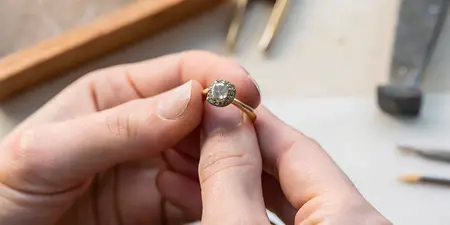

How long does GIA certification take for a custom-set diamond?

GIA grading has no single fixed turnaround for a custom-set diamond; your schedule depends on the current laboratory estimate for the specific service and location. That estimate is not your finished-ring delivery date: shipping, any required unsetting, custom fabrication, and final setting sit outside the laboratory's grading time.
TL;DR
- How long does GIA certification take? Confirm GIA’s current service estimate; custom-ring production requires a separate schedule.
- GIA issues grading reports, not jewelry certifications; standard diamond grading requires a loose stone.
- An existing GIA report does not automatically need replacing when you commission a custom setting.
- For a 2026 proposal, confirm laboratory completion and finished-ring delivery as separate milestones.
Why this matters
A beautiful custom ring starts with a stone you understand and a schedule you can follow. Confusing laboratory turnaround with ring-making time puts your proposal date against the wrong deadline.
Before you approve a design, separate the diamond's paperwork from the work needed to make the setting. The guide to how long it takes to design a custom engagement ring covers the broader project; this page focuses on where GIA grading fits.
For your 2026 ring, ask for a dated estimate tied to the actual submission—not a general promise about certification. You need to know when the diamond returns and what must happen afterward.
How long does GIA certification take for a custom-set diamond?
The useful answer comes from GIA's current turnaround estimate for your diamond's service and laboratory location. Ask the person arranging the submission to confirm that estimate when the stone is ready to enter the laboratory process.
GIA's published service information distinguishes laboratory turnaround from shipping. Read the applicable estimate's terms rather than assuming it covers the entire time your diamond will be away.
For a custom setting, establish the sequence before you start:
- Check existing documentation. Confirm whether the diamond already has a GIA report and whether the report matches the stone.
- Confirm submission requirements. Identify the appropriate service and whether the diamond must be removed from an existing mounting.
- Record the laboratory estimate. Note the service, location, estimate date, and how the turnaround is measured.
- Plan the return and setting. Get a separate estimate for transport, inspection, fabrication, setting, and final checks.
These are planning steps, not a promised production schedule. Some design conversations can happen while grading is underway, but ask your jeweler which approvals require the diamond back in hand.
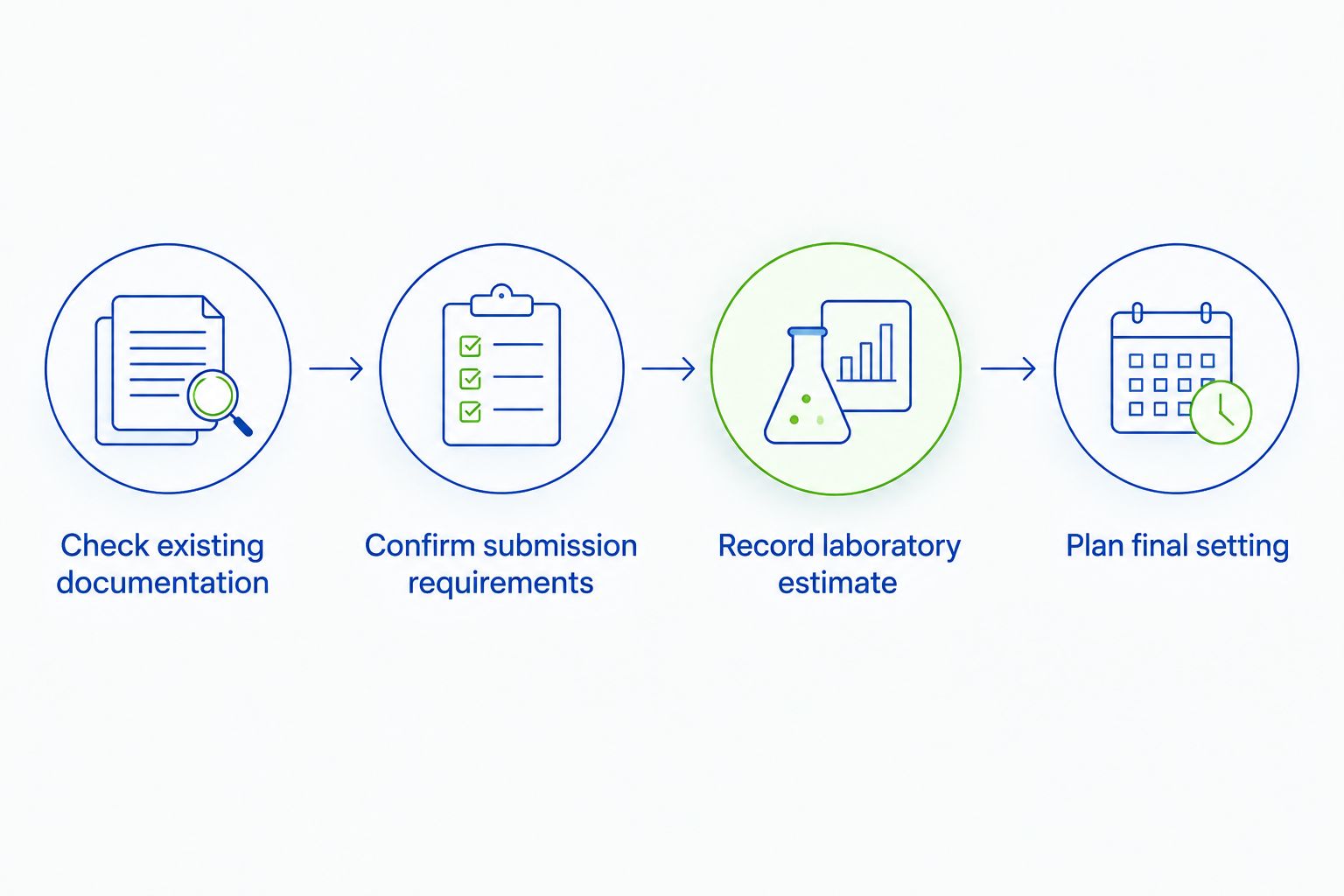
The laboratory estimate covers only part of the journey to a finished custom ring.
Which starting point applies to your diamond?
A loose diamond without a report presents a different project from an heirloom already mounted in a ring. Use your stone's actual starting point to frame the discussion.
Diamond with an existing GIA report
- Best for: Buyers who want to confirm documentation before commissioning a setting
- Advantage: Grading information already exists
- Limitation or next check: Verify the report and its connection to the actual stone; consider any subsequent changes
Loose diamond without a GIA report
- Best for: Buyers seeking laboratory documentation before setting
- Advantage: No existing mounting needs removal for standard loose-diamond grading
- Limitation or next check: Submission, laboratory work, and return must fit the project schedule
Mounted diamond without a GIA report
- Best for: Owners considering an heirloom reset
- Advantage: Documentation can be discussed alongside the new design
- Limitation or next check: Standard loose-diamond grading requires removal first; the mounting needs professional assessment
Do not remove a diamond simply because someone uses the phrase “GIA certified.” First establish what documentation exists and what additional information you actually need.
A diamond with an existing GIA report
A new setting does not, by itself, require a new grading report. The important question is whether the existing report accurately describes the diamond you intend to use.
Start with GIA Report Check to confirm the report record. Then ask a qualified jeweler to compare the diamond with its documentation, including relevant measurements, identifying characteristics, and any inscription that is present and readable.
A matching report number is useful, but an online record alone does not identify the physical stone in front of you. Our guide to verifying a diamond's GIA report before you buy explains the distinction.
For a 2026 commission, bring the original report or its details to your first conversation. Ask whether damage, repolishing, or other changes since grading warrant further examination before the custom design moves ahead.
A loose diamond that needs grading
If the diamond has no suitable report, settle the laboratory service before treating grading as a scheduled task. “Send it to GIA” is not enough detail for a dependable handoff.
Ask who will submit the diamond, which service applies, where it will go, and who will receive it afterward. Also confirm how you will receive updates and what evidence marks completion.
The planning advantage of a loose diamond is straightforward: no existing setting needs removal before standard loose-diamond grading. The limitation remains that laboratory work and transport are separate from making the finished ring.
Do not assume your preferred design can be finalized from a photograph alone. Ask which details depend on the stone's confirmed dimensions and an in-person assessment.
A diamond already set in a ring
GIA's standard loose-diamond grading requires an unmounted diamond. If your stone is already set, have a jeweler assess removal before agreeing to a submission plan.
An heirloom deserves particular care. The condition of the mounting, the way the diamond is held, and your wish to preserve the original ring all belong in that conversation.
Ask what happens to the old setting and how the diamond's condition will be documented before and after removal. These are practical handoff questions—not reasons to rush a stone out of a sentimental piece.
For a 2026 heirloom project, decide whether your priority is documentation, preserving the mounting, creating a new ring, or a combination. That decision helps your jeweler explain which steps are necessary and which are optional.
Why GIA turnaround and custom-ring timing vary
The laboratory's workload is only one part of your project. These factors determine which estimate you need and where additional work belongs:
- Laboratory location and service. Use the current estimate for the actual submission rather than another location's timeline.
- The diamond's starting condition. A mounted stone requires a removal assessment before standard loose-diamond grading.
- Shipping and handoffs. Sending the stone out and receiving it back are distinct from laboratory processing.
- Existing documentation. A verified report can change whether another submission is needed at all.
- Custom-setting work. Design approvals, fabrication, setting, and inspection need their own schedule.
- Changes to the diamond. Discuss whether any planned repolishing or other alteration affects when grading should happen.
Ask for these items in writing. A single completion date is easier to evaluate when you can see the dependencies behind it.
What does GIA actually document?
GIA issues laboratory reports rather than certifying a finished custom ring. Its diamond grading information concerns the stone, not a guarantee of the jeweler's workmanship or a valuation of the completed piece.
For a natural diamond grading report, the familiar 4 Cs are color, clarity, cut, and carat weight. Not every diamond shape receives the same cut assessment, so read the actual report rather than expecting identical fields across every stone.
Clarity grading uses 10× magnification. That does not mean every characteristic recorded in a report will be visible to your unaided eye when you wear the ring.
Carat measures mass: 1 carat equals 200 milligrams. It does not describe finger coverage by itself; the diamond's dimensions and shape also matter when you plan a setting.
These distinctions help you ask better questions. A grading report informs your choice, but you still need to see how the diamond looks and understand how the proposed setting will hold it.
How do you build a schedule around your proposal date?
Start with the date you need the finished ring in hand, not the day you hope grading will finish. Tell your jeweler whether that date is flexible before approving the project.
For a 2026 proposal, request separate milestones for documentation review, any laboratory submission, design approval, and finished-ring delivery. Ask which milestones are estimates and which commitments the jeweler is actually making.
Use these questions to keep the conversation concrete:
- Does the laboratory estimate begin at receipt, intake, or another stated point?
- Does the quoted schedule include outbound and return transport?
- What design work can happen while the diamond is away?
- What work must wait until the stone returns?
- Who contacts you if a milestone changes?
- What is the agreed plan if the ring cannot be completed by your event?
Do not treat a completed grading report as permission to schedule collection. Confirm that the finished ring has also passed the jeweler's final checks.
Where a custom bridal consultation fits
Element 79 is best for style-conscious couples exploring contemporary designer jewelry and custom bridal pieces in Cherry Creek, Denver. Bring the diamond's documentation and your intended proposal date into that conversation alongside your design ideas.
Element 79's custom bridal offering is relevant to choosing the ring; laboratory grading remains a separate question. Confirm who would arrange any submission and how it would fit your particular commission rather than assuming a boutique's general offering includes every laboratory service.
The benefit of considering documentation and design together is clarity about the next decision. The limitation is equally important: exploring a custom ring does not establish a GIA turnaround or a finished-ring deadline.
When you speak with Element 79 about custom bridal jewelry, ask what must be confirmed before approving the setting. A sculptural silhouette or an unexpected composition should still begin with a clear understanding of the diamond it will hold.
Can I start designing the ring before the GIA report is ready?
You can discuss the look of a custom ring before grading is complete. Ask your jeweler which design decisions can proceed and which require confirmed stone details or the returned diamond.
Does resetting a diamond mean I need another GIA report?
Resetting alone does not automatically require another GIA report. Verify the existing report against the stone and discuss whether subsequent damage, repolishing, or other changes justify further examination.
Is the GIA completion date the date I get my ring?
The GIA completion date is not the finished-ring delivery date. Return transport, any remaining fabrication, setting, and inspection must still fit the schedule your jeweler provides.
FAQ
How long does GIA certification take in 2026?
GIA grading turnaround depends on the current service and laboratory location; there is no single fixed deadline for every submission. Confirm the applicable estimate when arranging the work, then allow separately for transport and custom-setting tasks.
Can GIA grade a diamond while it is in my engagement ring?
GIA's standard loose-diamond grading requires an unmounted diamond. Have a jeweler assess removal and confirm the appropriate laboratory service before sending anything.
Do I need a new GIA report for a custom setting?
A custom setting does not automatically require a new GIA report. Confirm that any existing report matches the stone and discuss changes to the diamond since grading.
Does a GIA report tell me what my finished ring is worth?
A GIA grading report is not a monetary appraisal of your finished ring. Ask separately about valuation documentation if you need it for insurance.
Can I check my GIA report online?
GIA Report Check lets you check a report record. A qualified jeweler must still establish that the physical diamond corresponds to that documentation.
Should I finish grading before setting my diamond?
If you need standard loose-diamond grading, arrange it before the final setting. Discuss any planned alteration to the diamond before deciding the order of work.
What should I bring to a custom bridal conversation at Element 79?
Bring any existing diamond report, details about a stone you already own, your design preferences, and your intended event date. Ask which documentation and scheduling decisions need resolving before you approve the ring.
One last thing
Your most useful next step might be finding the report you already have—not arranging another submission. Check family paperwork, purchase records, and any report details supplied with the stone before committing to additional handling.
Ask for two distinct confirmations: what is known about your diamond, and when your finished ring is expected. Keeping those questions separate makes the whole custom-ring conversation easier to follow.
Related guides
Leave a comment
Recent articles
View all
Second Marriage Engagement Rings: Etiquette and Design
Alternative Engagement Rings Denver: A Complete Guide