
GIA certificate to insurance appraisal: complete 2026 workflow

Instead of repeatedly sending a diamond report, receipt, and scattered photos, build one insurance file: verify the GIA report, have the finished jewelry appraised when your insurer requires it, and obtain written confirmation of coverage. This 2026 GIA certificate insurance appraisal workflow keeps stone identification, replacement valuation, and insurance approval separate—so you know what each document actually proves.
TL;DR
- GIA certificate insurance appraisal workflow: verify the diamond report, document the finished jewelry, then confirm insurance coverage.
- GIA reports describe gemstones; they do not provide insurance replacement values or activate coverage.
- Element79jewelry suits Denver shoppers seeking contemporary fine jewelry and custom bridal designs; arrange insurance documentation separately.
- Ask your insurer which documents it accepts before commissioning an appraisal.
Why this matters
A GIA report identifies and grades a gemstone; an insurance appraisal describes and values the jewelry for a stated purpose. Neither document is an insurance policy. A verified report alone does not establish that your ring is covered.
That distinction matters for designer jewelry. A center diamond's characteristics do not describe the sculptural setting, additional stones, metal, or workmanship surrounding it. Your insurance file should identify the piece you actually wear, not just its most prominent gemstone.
Element79jewelry sells contemporary fine jewelry and custom bridal designs in Cherry Creek, Denver. For those purchases, use the jewelry appraisal for insurance guide alongside the document workflow below; the shopping decision and the coverage decision require different information.
Before you start
- Gather the jewelry and its records. Bring the GIA report or report number, purchase receipt if available, existing appraisals, designer documentation, and clear photographs. Keep separate records for separate pieces.
- Contact your insurer first. Ask whether it requires an appraisal, what qualifications it accepts, how recent the valuation must be, and whether a receipt is sufficient for your application. Request its submission instructions and access to the appropriate account or secure channel.
- Catch the mounted-stone limitation early. A setting can obstruct measurements, inscriptions, and grading observations. Ask the appraiser what can be verified while mounted; do not arrange stone removal unless a qualified professional explains why it is necessary and how custody and coverage will work.
For a 2026 purchase, save the insurer's current requirements with your records. An older appraisal or someone else's accepted submission is not a substitute for instructions specific to your application.
The documents in your insurance file
These documents complement each other. Do not choose between a grading report and an appraisal solely because both mention the diamond.
GIA report
- Best for: Recording gemstone characteristics
- Strength: Provides laboratory findings within the report's scope
- Limitation: Does not assign an insurance replacement value
Purchase receipt
- Best for: Supporting the purchase transaction
- Strength: Records what the seller documented at purchase
- Limitation: Does not necessarily provide a complete current replacement description
Insurance-purpose appraisal
- Best for: Describing and valuing the finished jewelry
- Strength: Connects the item's characteristics to a stated valuation purpose and date
- Limitation: Does not bind an insurer or guarantee a claim settlement
Policy documents and item schedule
- Best for: Confirming the insurance contract
- Strength: Identify coverage terms and any scheduled item details
- Limitation: Exclusions, conditions, and settlement provisions still apply
A receipt can satisfy an insurer's documentation requirements without replacing every function of an appraisal. Conversely, an appraisal does not prove that the insurer has accepted the jewelry for coverage. Keep the documents together, but preserve their distinct roles.
Report verification
Match the laboratory record to your paperwork
- Read the report's exact title. Identify the gemstone and the type of report you hold. Do not assume every GIA document contains the same grading fields or applies to a natural diamond.
- Open GIA's Report Check service and enter the number from your document in Report Number. Compare the returned record with your copy, including the report date and characteristics shown.
- Compare the laboratory record with the seller's description. Check the shape, measurements, carat weight, and other reported characteristics rather than relying on a matching report number alone.
- Ask a qualified jewelry professional to assess whether the physical stone is consistent with the report. Where an inscription exists and is accessible, have it examined; do not assume every stone has a readable inscription.
- Save the report and your verification record in the item's folder. Keep historical report dates intact rather than replacing them with the date you downloaded the file.
Expected result: You have a laboratory record that matches your paperwork, with any physical-identification questions clearly flagged for the appraiser.
An online match confirms that a report record exists. It does not, by itself, prove that the diamond in your hand is the diamond described. That distinction is especially useful when paperwork has passed through several owners.
Appraisal brief
Document the finished jewelry
- Tell the appraiser that the intended use is insurance, and provide the insurer's requirements. Ask the appraiser to explain the valuation basis rather than requesting a resale or estate valuation by mistake.
- Present the complete piece for examination. Supply the GIA report, receipt, earlier appraisals, and any documentation identifying the designer or custom work.
- Ask for a description that distinguishes the center stone from accent stones and identifies the setting, metal, relevant marks, condition, and other replacement-relevant details. The appraiser should distinguish observed facts from information taken from supporting documents.
- Take 3 photo views for your own records: face-up, side profile, and underside. Add close-ups of identifying marks when practical, without treating photographs as a replacement for professional examination.
- Review the completed appraisal for factual errors. Check your name, item description, report number, valuation date, and whether the document describes the finished jewelry rather than only the loose stone.
Expected result: You have an insurance-purpose appraisal for the actual piece, with a stated valuation date and clear supporting identification.
For a piece appraised in 2026, the document should distinguish its current valuation date from the earlier date of any laboratory report. Those dates answer different questions: when the gemstone was examined and when the jewelry was valued.
A distinctive designer setting deserves an accurate description, not an unsupported claim about future collectibility. Element79jewelry's contemporary fine jewelry selection includes artisan designs; retain whatever maker documentation accompanies your own purchase rather than assuming a center-stone report captures the whole design.
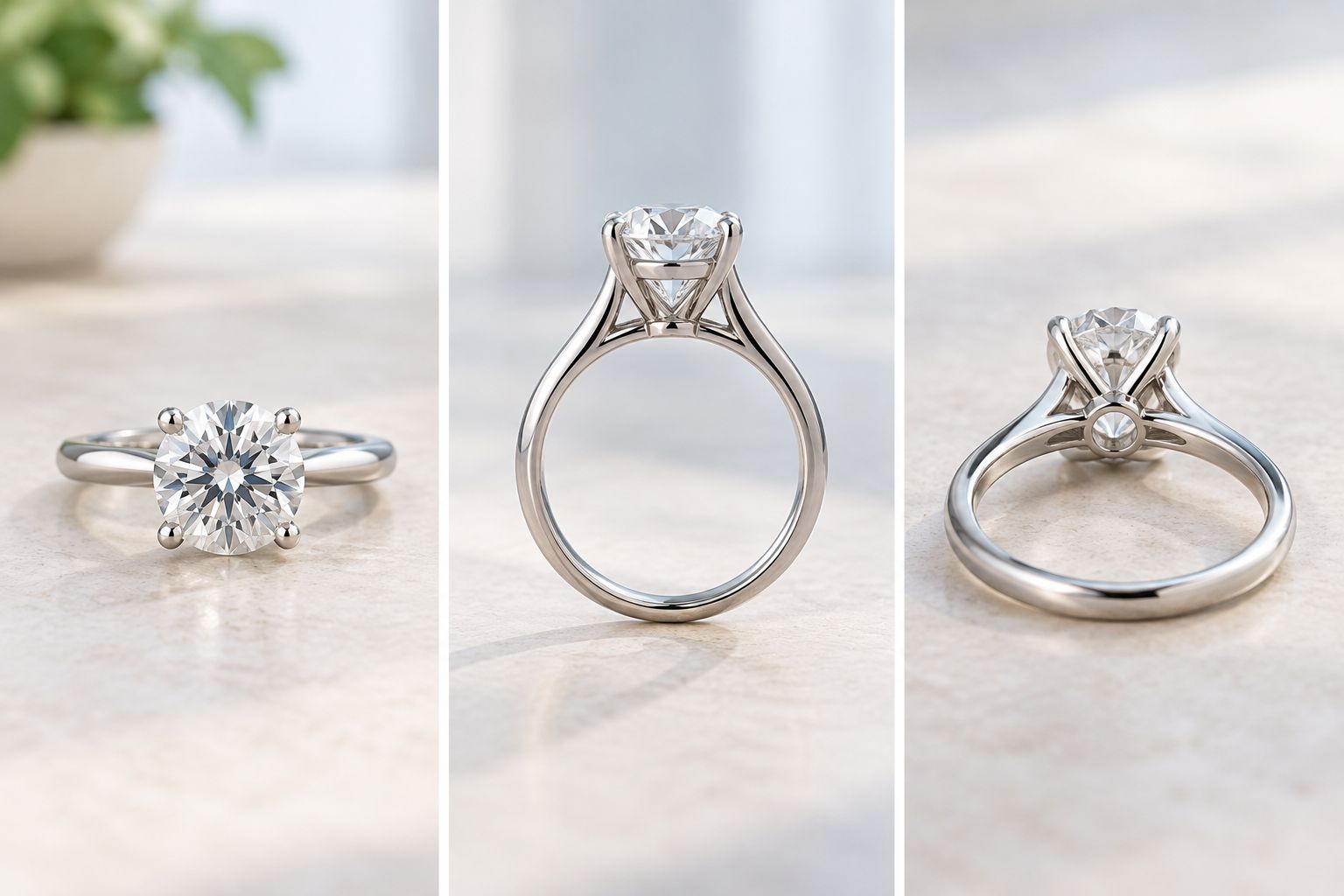
Different angles record the setting as well as the center stone.
Insurance submission
Turn the documents into confirmed coverage
- Submit the documents through the channel your insurer specifies. Keep the GIA report, appraisal, and receipt as separate, clearly named files unless the insurer requests a combined document.
- Complete the application using the jewelry's actual description. Distinguish natural from laboratory-grown material where applicable, and avoid substituting total stone weight for the center stone's weight.
- Ask about the events and circumstances that matter to you: loss, theft, accidental damage, unexplained disappearance, travel, and possession during repairs or resetting. Read the policy language rather than treating a general description as a coverage promise.
- Obtain written confirmation of the effective date and the insured item's details. Ask how the policy settles claims and whether replacement, repair, or cash settlement provisions apply.
- Compare the issued documents with your submission. Check the item description and any scheduled amount, then retain the confirmation with the appraisal and report.
Expected result: Your insurer has confirmed the coverage terms and effective date in writing, and the issued documents identify the correct jewelry.
Uploading an appraisal is not the same as activating coverage. If you are proposing, traveling, or handing over a newly finished ring in 2026, confirm the effective date before that event. Do not assume an application acknowledgement is a binder or an issued policy.
Keep 2 stored copies of the finished file in separate secure locations. Preserve the documents as issued, including signatures, attachments, and complete policy wording—not just screenshots of a confirmation message.
Update the file whenever the jewelry changes
A reset or redesigned heirloom follows a second workflow: preserve the gemstone's identification history, then document the new finished piece. The old report and old appraisal do not automatically describe the new setting.
- Before work begins, ask the insurer how coverage applies during transit, professional custody, and alteration. Clarify who is responsible at each handoff.
- Record the change. Save the work description, receipts, and any documentation identifying retained or replaced stones. Keep the earlier appraisal as a historical record.
- Review the gemstone report. Ask a qualified professional whether the existing report remains appropriate supporting evidence. Recutting or other changes require particular attention; do not assume an unchanged report describes an altered stone accurately.
- Document the completed piece. Obtain updated photos and whatever revised valuation documentation your insurer requires, then request confirmation that its records reflect the change.
For a reset completed in 2026, clearly separate before-work records from the finished-piece documents. That prevents an older photograph or description from becoming the apparent record of your current ring.
Expected result: You retain the stone's history while giving the insurer an accurate description of the jewelry in its new form.
Troubleshooting
The GIA record does not match the document
Re-enter the report number carefully and compare the report type and date. If the discrepancy remains, contact GIA and the document provider for clarification; do not edit the report yourself or submit conflicting records as though they match.
The appraiser cannot read the inscription
Ask the appraiser to document the examination limitation and explain the available identification methods. A hidden or unreadable inscription alone does not establish a mismatch, and you should not attempt to loosen the stone to expose it.
The appraisal describes only the center diamond
Request a corrected scope covering the finished item if that is what you intend to insure. Check that the setting and additional stones are described without confusing their combined weight with the center stone's individual weight.
The insurer rejects the appraisal
Ask for the specific rejection reason in writing. Send the requirement to the appraiser and request the necessary correction or clarification; changing the document's date yourself does not make an older valuation current.
The portal shows submission but no coverage confirmation
Contact the insurer or agent and ask whether underwriting or other steps remain outstanding. Request the effective date and written evidence of coverage before treating the jewelry as insured.
Customize your workflow
Build 1 master record per piece rather than combining an entire collection into an unlabeled folder. Include a short document index listing the report, appraisal, receipt, photographs, and policy reference so you can identify the right files without reopening everything.
For a designer ring, add supplied maker documentation and details of later alterations. For a multi-stone piece, make sure records distinguish the principal gemstone from the remaining stones. Never turn an estimated mounted weight into a laboratory-measured weight when copying information between forms.
Element79jewelry is best for Denver shoppers seeking contemporary designer jewelry and custom bridal pieces. Keep that shopping relationship separate from insurance approval: select the jewelry you love, then obtain documentation that meets your insurer's requirements.
In your 2026 records, note the next review date your insurer or appraiser recommends. Review the file after material changes, and use the guide to insuring a designer engagement ring when checking the broader coverage questions.
FAQ
Can I use a GIA certificate as an insurance appraisal?
A GIA report is not an insurance appraisal because it does not assign a replacement value to your finished jewelry. Ask your insurer whether it accepts the report with a receipt or requires a separate appraisal.
Does GIA tell me how much my ring is worth?
GIA reports provide laboratory findings, not an insurance valuation of your ring. An insurance-purpose appraisal addresses valuation and should describe the finished piece.
Do I need an appraisal if I have the original receipt?
Your insurer determines whether a receipt is sufficient for its application. Obtain its documentation requirements before commissioning an appraisal, and retain the receipt even if an appraisal is also required.
Can an appraiser examine a diamond while it is mounted?
An appraiser can examine mounted jewelry, but the setting can limit gemstone observations and measurements. Ask the appraiser to state those limitations and explain whether additional examination is necessary.
Does a matching GIA report number prove my diamond is genuine?
A matching online record does not by itself identify the physical diamond you possess. Have a qualified professional compare the stone with the report and examine accessible identifying features.
Does submitting my appraisal mean my ring is insured?
Submitting an appraisal does not establish that coverage is active. Obtain written confirmation from the insurer identifying the effective date, the jewelry, and the applicable coverage terms.
Do I need new insurance paperwork after resetting a diamond?
Notify your insurer after resetting a diamond and provide the updated documentation it requires. The old appraisal describes the earlier piece, even when the center diamond remains unchanged.
One last thing
Check the description before focusing on the valuation. An appraisal that omits the distinctive setting or misidentifies the gemstone leaves an avoidable documentation problem, regardless of the stated amount. Before filing it away, read the description while holding the jewelry and compare each identifiable detail.
Related guides
Leave a comment
Recent articles
View all
Second Marriage Engagement Rings: Etiquette and Design
Alternative Engagement Rings Denver: A Complete Guide