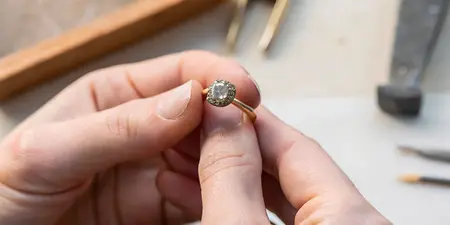

Get Ring Size Without Going to Store: Best 2026 Method
You can get an accurate ring-size estimate at home in 2026 by measuring a well-fitting ring, using a paper strip, and checking the result with a correctly scaled printable guide. Instead of guessing or arranging a store visit, complete two methods under the same conditions and send both measurements for review before ordering an engagement ring. Element 79 is best for style-conscious couples who want designer or custom bridal jewelry with sizing guidance before they choose a ring.
TL;DR
- To get ring size without going to store, compare a paper-strip measurement with an existing ring or printable sizer.
- Measure the intended finger when your hands are warm and at the end of a normal day.
- Element 79 is best for couples choosing contemporary designer or custom engagement rings in 2026.
- Treat an at-home result as provisional until the jeweler reviews the band design and measurements.
Why this matters
If you are planning a surprise, start with the guide to choosing a proposal ring without her ring size. The correct size affects more than whether the ring slips over the knuckle: band width, setting structure, finger shape, and the intended stacking arrangement all influence how a finished ring feels.
At-home sizing is most useful when it produces consistent evidence rather than one perfect-looking number. In 2026, the strongest remote approach is to record an inner diameter from a ring that already fits, measure the finger circumference separately, and compare both with the same jeweler's size chart.
Element 79 fine jewelry includes contemporary and designer rings as well as custom bridal pieces. Those designs can be sculptural, stone-set, or intended for a stack, so the final size should reflect the specific ring rather than a generic number copied from an unrelated chart.
Before you start
- Gather the right materials: use a rigid millimeter ruler, a narrow strip of plain paper, a fine-tip pen, scissors, and an existing ring if one is available. Avoid elastic cord, thick yarn, and anything that stretches or compresses.
- Measure the correct finger: use the exact finger and hand where the engagement ring will be worn. Corresponding fingers on opposite hands do not always match.
- Check the non-obvious gotcha: a printable ring guide must be printed at its original scale. In the print dialog, select Actual size or set Scale to 100%, then verify the guide's reference line with a ruler.
Do not measure immediately after coming in from the cold, finishing strenuous exercise, or exposing your hands to unusual heat. Let your hands return to a comfortable indoor temperature first. The goal is a normal fit that passes the knuckle with light resistance and rests at the finger base without pinching.
Prepare consistent measuring conditions
- Remove any rings from the target finger and let the finger settle before measuring.
- Sit indoors with your hands at a comfortable temperature.
- Keep the hand relaxed rather than spreading or curling the fingers tightly.
- Measure near the end of a normal day, when the result is less likely to reflect unusually cold hands.
- Repeat each method at least twice before recording a size.
Write down the date, time, finger, hand, method, and result. These details matter when two measurements disagree, because they reveal whether you changed fingers, used a different chart, or measured under different conditions.
Expected result: you have repeatable conditions and a written record for the exact finger. A measurement taken from another finger is supporting information, not a substitute.
Paper-strip circumference
Best for: measuring your own finger when no suitable ring is available.
A paper strip holds its shape better than soft string and makes the overlap point easier to mark. It still depends on consistent tension, so do not pull it tightly enough to indent the skin.
- Cut a narrow paper strip long enough to wrap around the base of the finger.
- Wrap it around the widest point the ring must pass, including the knuckle when that is wider than the finger base.
- Adjust the strip until it feels snug but can still slide over the knuckle.
- Mark the exact point where the paper overlaps.
- Lay the strip flat without tearing or stretching it.
- Measure from the starting edge to the mark in millimeters.
- Repeat the process with a fresh strip and compare the two circumference readings.
Common US chart references include size 5 at about 49.3 mm in circumference, size 6 at about 51.9 mm, size 7 at about 54.4 mm, size 8 at about 57.0 mm, and size 9 at about 59.5 mm. Use these as orientation only; use the selected jeweler's chart for the order.
Expected result: two circumference readings that are close enough to indicate the same whole or half US size on one chart. If they point to different sizes, repeat the method rather than averaging them.
Existing-ring diameter
Best for: a surprise proposal when you can safely borrow a ring worn on the intended finger.
This method removes the problem of wrapping material around someone else's finger, but only when the borrowed ring matches the correct hand and finger. A ring worn on a middle finger, index finger, or opposite hand does not provide a dependable engagement-ring size.
- Choose a ring that fits comfortably and is worn on the intended finger.
- Place it flat on a hard, level surface.
- Position a rigid millimeter ruler across the widest interior point.
- Measure from one inside edge to the opposite inside edge. Do not include the metal.
- Read the diameter to the nearest visible fraction of a millimeter without rounding aggressively.
- Rotate the ring and measure again to catch an out-of-round band.
- Record the band's approximate width and profile for the jeweler.
Common US references place size 5 near a 15.7 mm inner diameter, size 6 near 16.5 mm, size 7 near 17.3 mm, size 8 near 18.1 mm, and size 9 near 18.9 mm. Small diameter differences can cross a size boundary, so a ruler with clear millimeter marks is essential.
Expected result: two diameter readings that agree and map to one size on the selected chart. If the ring is visibly oval, damaged, or unusually wide, treat the result as provisional.
Printable-sizer confirmation
Best for: checking a paper-strip or existing-ring result with a separate method.
Printable guides commonly provide a cutout strip, printed circles, or both. Their main advantage is repeatability. Their main weakness is printer scaling, which can make every circle and mark incorrect while the page still looks normal.
- Open the guide and select Print.
- Choose Actual size or enter 100% in the Scale field.
- Disable any option labeled Fit, Shrink, or Fit to printable area.
- Print one page and measure its reference line with a physical ruler.
- Stop if the reference line does not match the stated length.
- For a cutout strip, wrap it around the intended finger without pulling it into the skin.
- For printed circles, place the existing ring over each circle until the circle sits just inside the ring's inner edge.
- Record the result and compare it with the first method.
Expected result: the printable guide and first method indicate the same size or adjacent half sizes. A larger disagreement signals a scaling, tension, chart, or wrong-finger error.
Compare the three methods
No single home method wins in every situation. Choose the method that matches the evidence you can access, then confirm it with a second method.
Paper strip
- Best for: Measuring your own finger
- Main advantage: Measures the target finger directly
- Main limitation: Pulling too tightly produces a smaller result
Existing ring
- Best for: Preserving a surprise
- Main advantage: Does not require measuring the recipient
- Main limitation: Fails when the ring comes from another finger
Printable sizer
- Best for: Confirming another method
- Main advantage: Provides a repeatable visual reference
- Main limitation: Incorrect print scaling changes every measurement
The strongest result is not the method with the most precise-looking number. It is the result supported by two different methods under controlled conditions.
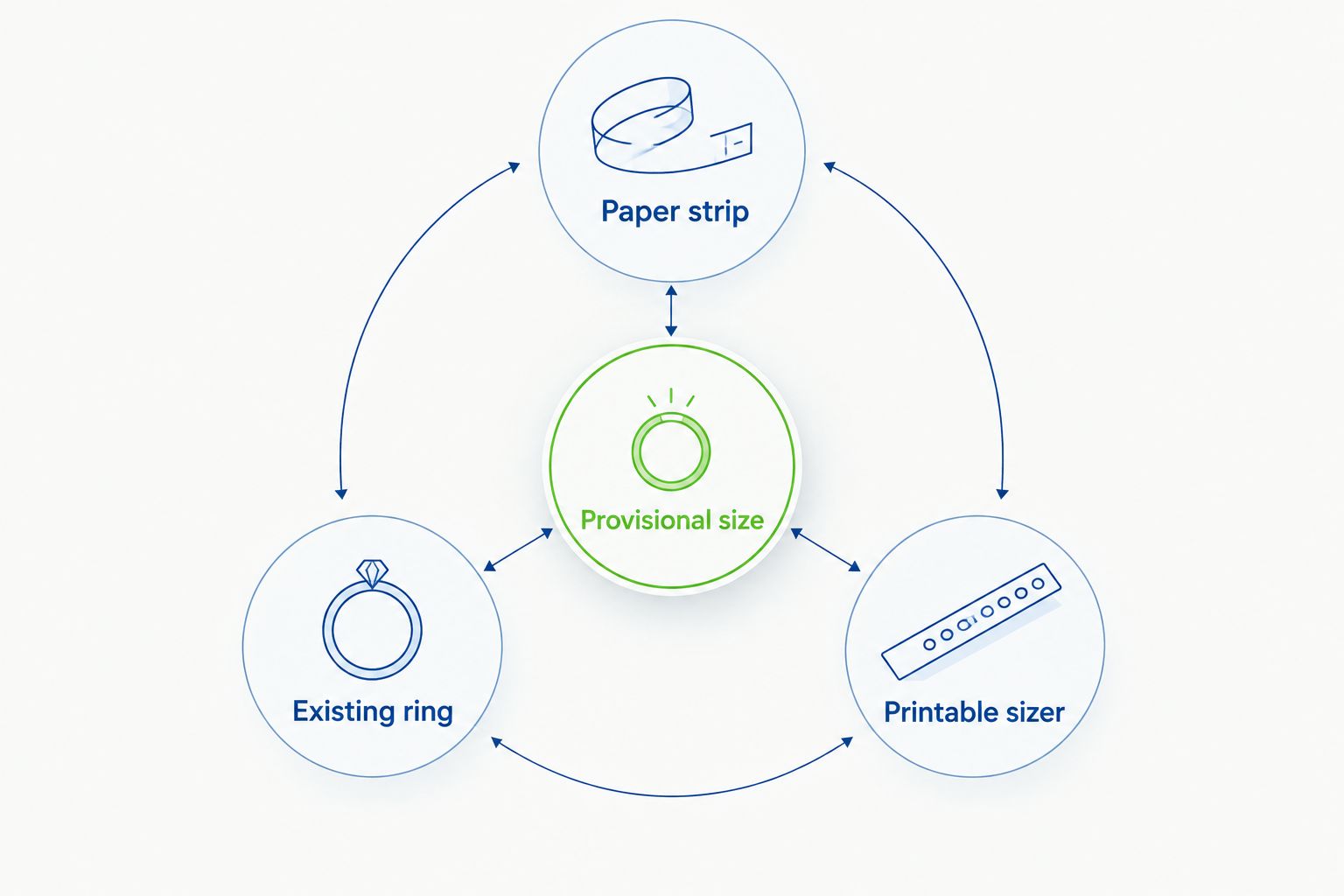
Two independent methods provide a stronger sizing estimate than one isolated reading.
Size a surprise proposal with an existing ring
When direct finger measurement would spoil the proposal, use a ring the recipient already wears. Confirm that it belongs on the intended ring finger and note which hand it fits. A favorite ring worn elsewhere can reveal style preferences, but it cannot establish the required size by itself.
- Photograph the ring in its usual location before moving it, so you can return it exactly.
- Measure the widest inner diameter in millimeters.
- Rotate it and take a second diameter reading.
- Trace the inside edge on paper as a backup record, keeping the pencil upright.
- Note the finger and hand on which the ring is normally worn.
- Return the ring promptly and keep the measurements together.
If no correct-finger ring exists, do not convert a middle-finger measurement using a fixed subtraction. Finger proportions vary too much for that shortcut. Give the jeweler the available measurement, explain where the borrowed ring is worn, and ask how the intended design affects the safest provisional size.
Expected result: a documented diameter tied to a known finger and hand. That context is as important as the number when the recipient cannot participate.
Troubleshooting at-home ring sizing
Two methods produce different sizes
Check the chart source, printer scale, measurement units, and target finger first. Repeat both methods at the same time of day. Do not average conflicting sizes, because the midpoint can hide a process error rather than solve it.
The paper strip will not pass the knuckle
Measure both the finger base and the knuckle. Record both circumferences and tell the jeweler which area is wider. A ring must pass the knuckle without becoming so loose that it spins continuously at the base.
The printable guide fails its reference check
Return to the print dialog and confirm Scale: 100% or Actual size. If the measured reference line remains wrong, use another printer or stop using that printout. A scaled guide cannot produce a reliable result.
The existing ring is not perfectly round
Take measurements across several interior points and record the variation. Do not force the ring into shape. An out-of-round band needs professional evaluation, not a single diameter reading.
The finished ring fits differently than expected
Band width, profile, stacking plans, temperature, and normal finger changes can alter the feel. Do not file, bend, stretch, or compress a designer ring at home. Review how to resize a designer ring safely before deciding on an alteration.
Customize your sizing workflow
For a simple, narrow band, two consistent measurements usually provide a useful provisional size. A wider, sculptural, fully stone-set, or stacking design needs an additional conversation because the same labeled size can feel different once more surface area contacts the finger.
Send the jeweler these details in 2026:
- The provisional US size and the chart used
- The finger and hand being measured
- Circumference and inner-diameter readings in millimeters
- The time of day and conditions during measurement
- The width and shape of the reference ring
- Whether the new ring will sit alone or in a stack
- Whether the recipient has a prominent knuckle
A virtual consultation for custom jewelry gives Element 79 the context behind your number. That is more useful than sending only a size, especially when you are considering a custom bridal ring or a design with an unconventional silhouette.
Review your ring-size estimate
Share your measurements and intended ring style with Element 79 before choosing a custom bridal design.
FAQ
What is the best way to get ring size without going to store in 2026?
The best method is to measure the inner diameter of a well-fitting ring from the intended finger, then confirm it with a paper strip or correctly scaled printable sizer. Two independent measurements expose wrong-finger, tension, and printer-scaling errors.
Is paper better than string for measuring ring size?
Paper is better than soft or stretchy string because it keeps its length and creates a clearer overlap mark. Wrap it snugly without compressing the skin, then measure the marked length in millimeters.
How accurate is at-home ring sizing?
At-home sizing provides a useful provisional size when two methods agree under consistent conditions. The intended band width, profile, setting, and stack can still change how that size feels.
How do you secretly measure someone's ring size?
Borrow a ring worn on the intended finger and measure its widest inner diameter in millimeters. Record the correct hand and finger, because a ring from another finger is not a dependable substitute.
Does a wide engagement ring need a different size?
A wide band can feel tighter than a narrow band with the same labeled size because more metal contacts the finger. Give the jeweler the band design and your measurements instead of applying a universal size adjustment.
What should you do when a ring measurement falls between sizes?
Repeat the measurement and send both readings to the jeweler rather than automatically rounding. The right direction depends on the knuckle, finger base, band width, setting, and whether the ring will be stacked.
Can Element 79 review a ring size remotely?
Element 79 can use a virtual consultation to discuss your at-home measurements and intended custom bridal design. Bring the diameter, circumference, finger, hand, and reference-ring details so the discussion is based on more than one number.
Can every designer engagement ring be resized later?
No, resize options depend on the ring's construction, setting, and materials. Confirm the sizing and alteration limits for the specific design before ordering rather than assuming every ring can be changed.
One last thing
Do not average measurements from different fingers, hands, charts, or printouts. Repetition only improves confidence when the setup stays consistent. For an engagement ring in 2026, a documented provisional size plus the intended design gives the jeweler better information than a single number measured in a hurry.
Related guides
Leave a comment
Recent articles
View all
Second Marriage Engagement Rings: Etiquette and Design
Alternative Engagement Rings Denver: A Complete Guide