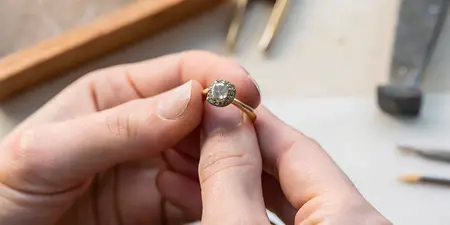

Engraving request to wedding band delivery: complete 2026 workflow

Instead of tracking wedding band engraving requests across scattered messages, keep the ring details, exact inscription, written approval, and delivery plan in one record. This wedding band engraving process takes you from your first request to the final handoff, with clear checkpoints for your 2026 celebration.
TL;DR
- Element 79 suits couples exploring designer fine jewelry and custom bridal pieces in Denver.
- Start the wedding band engraving process by confirming the chosen ring can accept your inscription.
- Confirm ring sizing before engraving, then approve the exact wording and placement in writing.
- Separate engraving completion from delivery, and inspect the finished wedding band against your approval record.
Why this matters
An inscription is small, but the decisions behind it deserve attention. A date, a private phrase, or your partner’s initials should arrive exactly as intended—not as someone’s interpretation of a conversation.
Element 79 is best for Denver couples seeking designer fine jewelry and custom bridal pieces. Explore Element 79 as your starting point for bridal shopping; ask whether engraving is possible for the specific band before making it part of your plan.
Treat this guide as your own request-and-approval checklist, not a statement of any retailer’s engraving services or delivery policies. The jeweler handling your ring must confirm the method, design limitations, and schedule.
Before you start
- Gather the ring details. Have the designer or maker name, order reference if you have one, metal, size, and photographs of the inside and outside. For an existing band, bring the ring for assessment rather than relying on photographs alone.
- Prepare the inscription and your real deadline. Write the exact text, including capitals, spaces, punctuation, and accents. Give the jeweler your required handoff date and any earlier travel departure, not just the ceremony date.
- Resolve sizing first. Resizing can affect an existing inscription or its placement. Ask the jeweler to assess fit and explain the correct sequence; the guide to resizing a designer ring safely covers that separate decision.
The easy-to-miss detail is the ring’s interior: hallmarks, existing inscriptions, and the construction beneath settings all need consideration. A short message does not automatically make a band suitable for engraving.
Ring assessment and request record
- Identify each band separately. Record the wearer and ring description together. If you are engraving both partners’ rings, avoid instructions that refer only to “mine” and “the other one.”
- Ask for a suitability assessment. Have the jeweler examine the metal, interior surface, settings, existing marks, and any planned alterations. Ask whether the designer or maker needs to approve the work.
- Confirm the proposed approach. Ask what engraving method the jeweler proposes, where the inscription will sit, and what appearance that method can achieve on your band. Request a relevant lettering sample if one is available.
- Create a single request record. Keep the ring description, exact wording, preferred lettering, placement request, contact person, and required handoff date together. Use the same record for later approvals.
Expected result: You know whether the specific ring can accept the requested engraving, and the jeweler has an unambiguous brief. Do not treat an initial inquiry as permission to start work.
For a 2026 wedding, record the year explicitly wherever the wedding date appears. “Our June wedding” is useful conversation, but it is not precise enough for a permanent inscription or a work record.
Your request record
Use descriptive headings in your own note: Ring identity, Exact inscription, Placement, Lettering, Size status, Required handoff, and Approval status. These are suggested record headings—not labels from a retailer’s ordering system.
Keep photographs alongside the written description. They help distinguish similar bands, but they do not replace an in-person assessment of engraving suitability.
Inscription and proof approval
- Choose the exact message. Decide whether you want initials, a date, or a phrase before discussing layout. Ask the jeweler for the character limit that applies to your ring and proposed lettering.
- Count everything. Include spaces and punctuation when preparing your request. Ask how the jeweler counts accented letters or special symbols; do not assume every character is supported.
- Review the proposed layout. Check spelling, capitalization, date order, lettering, placement, and orientation. Ask whether the preview represents actual scale or illustrates the wording only.
- Approve one final version in writing. Identify the ring and repeat the complete inscription in the approval message. Ask the jeweler to acknowledge that this version replaces earlier drafts.
Expected result: One clearly identified inscription is approved for one clearly identified ring. No one needs to reconstruct your wishes from several messages.
Choose wording that earns its space
These examples illustrate text choices, not universal engraving limits. Character counts include spaces and punctuation; the jeweler must still confirm whether the chosen text fits.
Initials
- Example: A + J
- Character count: 5 characters
- Best for: A quiet, personal reference
- Advantage: Keeps the message concise
- Limitation: Initials alone do not identify an occasion
Numeric date
- Example: 06.20.2026
- Character count: 10 characters
- Best for: Marking a specific day
- Advantage: Records the occasion directly
- Limitation: Numeric date order needs explicit approval
Short phrase
- Example: Always you
- Character count: 10 characters
- Best for: A private sentiment
- Advantage: Feels personal without using a date
- Limitation: Lettering and spacing still need assessment
Choose the wording first, then let the ring’s usable space guide the layout. Do not approve smaller lettering simply to preserve a longer draft without seeing how the proposed result will read.
Work authorization and handoff plan
- Confirm the sequence. Ask when sizing, other alterations, engraving, and final inspection will happen. Have the jeweler identify any unresolved decision that prevents work from starting.
- Request the current schedule. Distinguish the anticipated engraving completion date from the date you expect to receive the ring. Ask whether another workshop or the original maker is involved.
- Agree on updates. Specify who receives questions and who can authorize changes. For couples sharing wedding tasks, designate one final approver for each band.
- Confirm the handoff details. Ask which collection or shipping arrangements apply to your order and what you must provide. Keep those instructions with the approved inscription.
Expected result: You have a confirmed work sequence, a named decision-maker, and a handoff plan—not merely an expected engraving date.
For your 2026 calendar, keep separate entries for any fitting, the approval deadline supplied by the jeweler, and the agreed handoff. These are different checkpoints; completing one does not complete the others.
The request should move through clear stages, with questions resolved before approval and inspection completed before you consider the job finished.
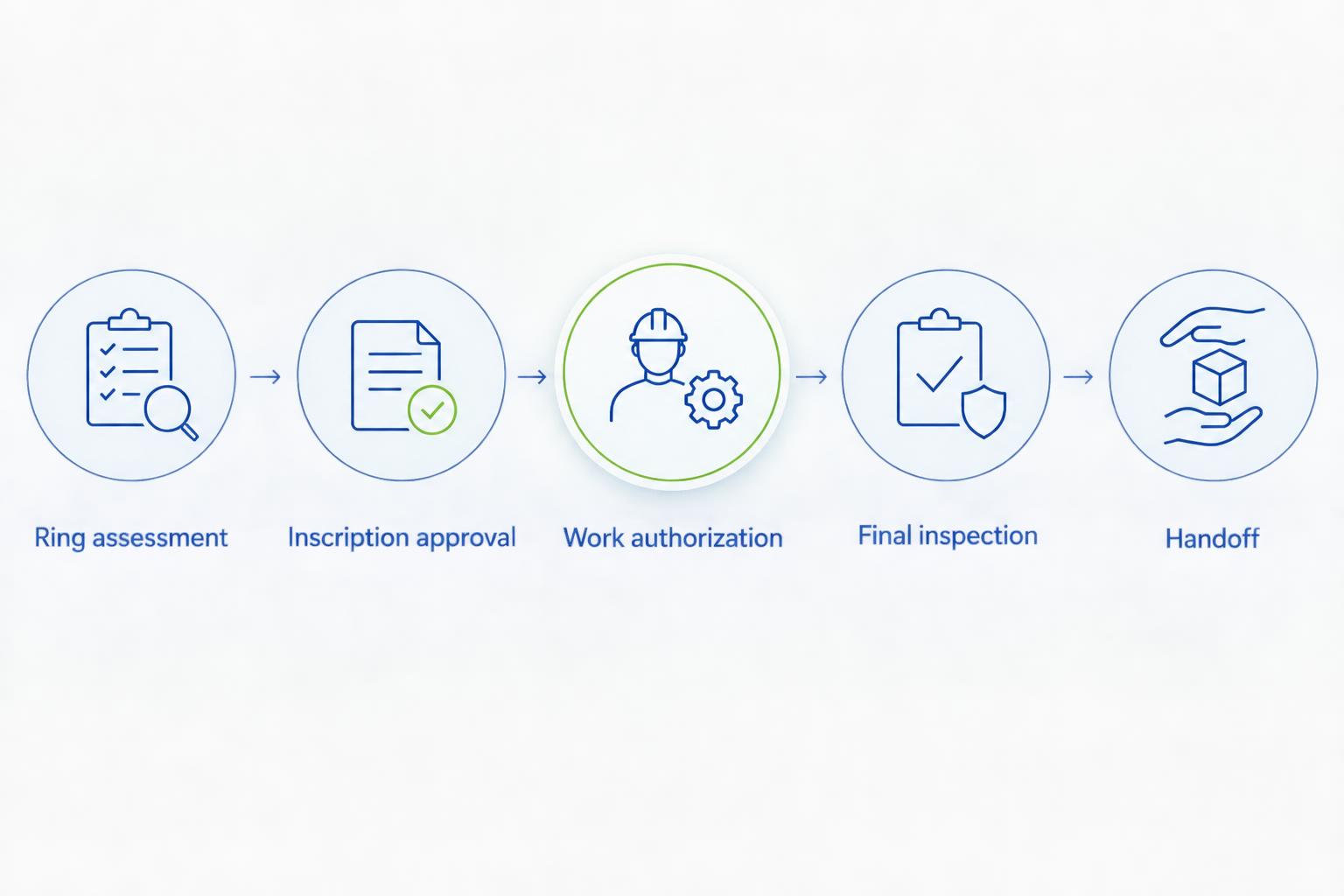
Written approval belongs before work authorization, not after engraving.
Final inspection and receipt
- Match the finished text to the approval. Read every character, including punctuation and the year. Compare directly with the saved final version rather than relying on memory.
- Check the physical result. Ask to inspect the interior under suitable light and with magnification if needed. Review the placement, lettering, surrounding finish, and any area that feels rough.
- Try on the band. Confirm the fit after all agreed work is complete. If you plan to wear it beside an engagement ring, try the combination rather than assessing the band alone.
- Record receipt and care instructions. Keep the completion record, any care guidance, and a photograph of the inscription. For shipped orders, follow the seller’s receipt instructions and raise discrepancies promptly.
Expected result: The correct ring, approved inscription, and comfortable fit have all been checked. Any concern is documented while the approval record is easy to retrieve.
For a date ending in 2026, check the final digit as carefully as the names. Familiar wording is easy to skim, especially when you are excited to take your rings home.
Inspect the inscription and the fit as separate tasks. A beautifully engraved message does not resolve a sizing concern, and a comfortable band does not prove that the wording matches.
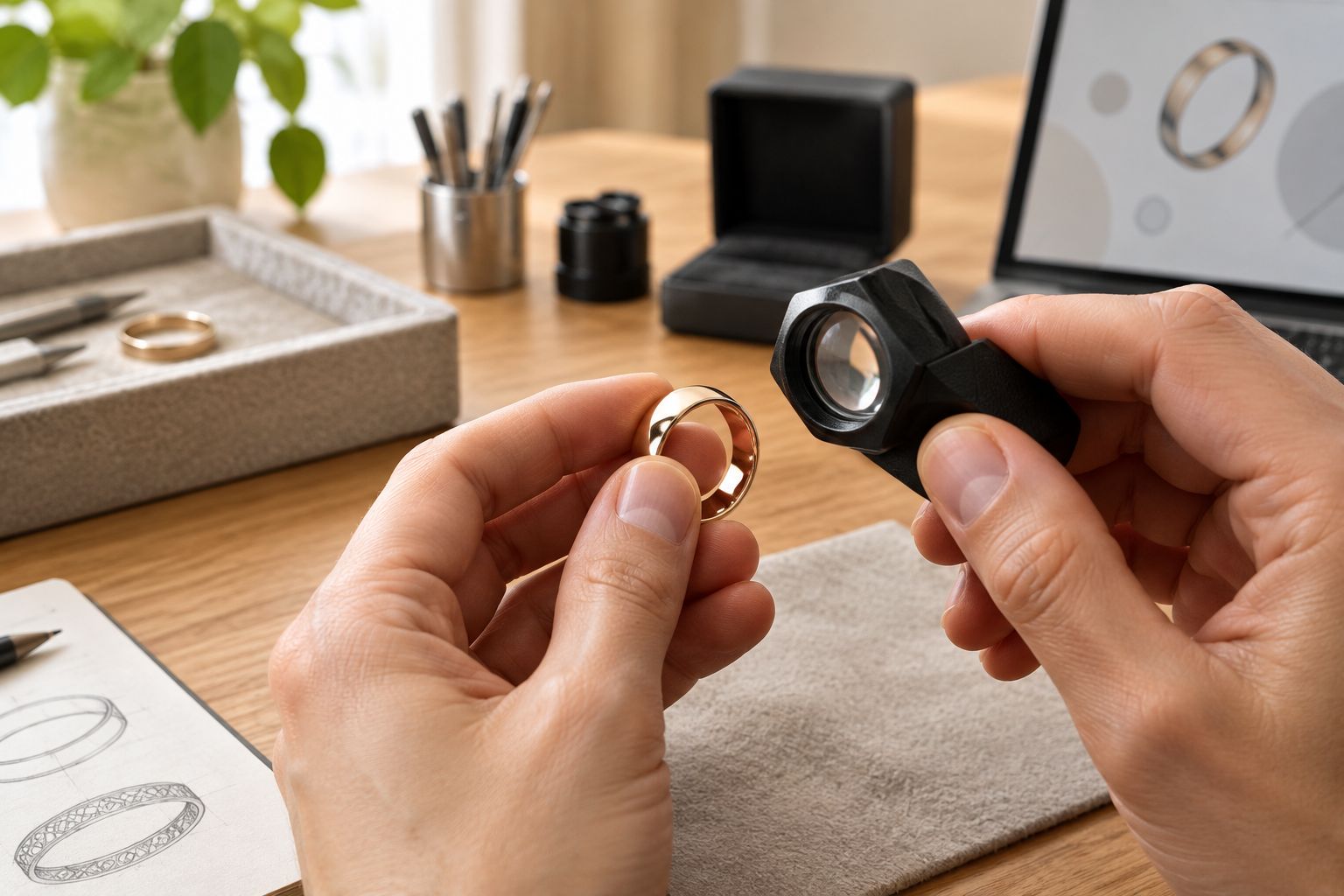
Inspect the inner surface, then try on the finished band.
Engraving an existing wedding band
Adding an inscription after the wedding follows the same approval process, but starts with the ring’s current condition. Best for couples who want time to settle on the message: consider requesting engraving later rather than rushing the wording before the ceremony. The trade-off is arranging a separate assessment and handoff.
Bring the band for inspection and disclose previous resizing, repairs, and existing engraving. Ask the jeweler whether any work is needed before a new inscription can be considered.
Keep your old inscription in the record if you want it preserved. Do not assume new lettering can be added beside it, or that removing it is a routine part of the request.
If you are marking a 2026 anniversary, specify whether the inscription should show the original wedding date or the anniversary date. Both are meaningful; only your written instruction establishes which belongs inside the band.
Troubleshooting
The inscription does not fit
Shorten the wording before approving a layout you find difficult to read. Ask the jeweler to assess a revised phrase, then request a fresh confirmation; do not infer capacity from another ring’s inscription.
Your final message conflicts with an earlier draft
Ask the jeweler to pause and confirm which version is authorized. Send the full replacement text with the ring identity, and obtain acknowledgment rather than sending an isolated spelling correction.
You need resizing after approving the engraving
Tell the jeweler before further work proceeds. Ask whether the size change affects placement, legibility, or the agreed sequence, and approve any revised plan in writing.
The ceremony deadline is approaching
Ask which stages remain and whether the agreed handoff still works. If engraving jeopardizes your plans, discuss postponing the inscription; do not assume an engraving estimate includes time for transport and inspection.
The finished wording differs from your approval
Photograph the inscription and share the approved version with the jeweler. Ask for an assessment before authorizing correction, removal, polishing, or other work; the remedy depends on the ring and the discrepancy.
Customize your workflow
Let your ring design and inscription develop together when you are commissioning a new band. Include the wish for engraving in the original brief, while leaving the final wording subject to a suitability check.
Element 79 offers custom bridal pieces alongside designer fine jewelry. For a broader design discussion, the guide to designing a custom wedding band helps you organize the decisions beyond the inscription.
For paired bands, keep separate approval records even when the messages match. Each ring needs its own assessment, and each wearer should confirm fit independently.
FAQ
What are the steps in the wedding band engraving process?
Confirm the ring’s suitability and size, submit the exact inscription, approve the wording and layout, authorize work, and inspect the finished band. Agree on the handoff separately from engraving completion.
Should I resize my wedding band before engraving it?
Resolve sizing with the jeweler before authorizing engraving. Resizing can affect an inscription or its placement, so ask the jeweler to confirm the sequence for your specific band.
How many characters can I engrave inside a wedding band?
The jeweler must confirm the character limit for your specific band and lettering. Count spaces and punctuation in your request, and ask separately about symbols and accented letters.
How long does wedding band engraving take?
Get a current completion estimate from the jeweler handling your ring. Confirm whether the schedule includes assessment, sizing, approval, engraving, inspection, and any transport.
Can I engrave my wedding band after the wedding?
Ask a jeweler to assess your existing band for engraving after the wedding. Its construction, condition, previous work, and existing inscriptions determine what can be done.
What should I check when my engraved wedding band arrives?
Compare every character with your written approval, inspect the placement and finish, and try on the band. Document any discrepancy and contact the jeweler before authorizing further work.
Does Element 79 engrave every designer wedding band?
Ask Element 79 whether engraving is possible for the particular designer band you are considering. Do not assume a custom bridal offering means every ring can be engraved.
One last thing
Make the final approval understandable without the rest of the conversation. Include the ring identity, complete inscription, lettering, and placement in that single message. If someone has to scroll backward to discover what you meant, the approval is not ready.
Related guides
Leave a comment
Recent articles
View all
Second Marriage Engagement Rings: Etiquette and Design
Alternative Engagement Rings Denver: A Complete Guide