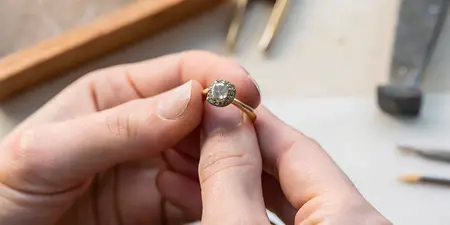

Engagement rings for finance professionals: complete 2026 guide

Finance professionals’ engagement rings are everyday bridal jewelry chosen to express personal style while fitting the wearer’s working routine. For your 2026 search, start with comfort, setting height, and the jewelry you already love—not an assumed dress code for banking, accounting, or investment management.
TL;DR
- Choose engagement rings for finance professionals by comfort, setting profile, and personal style—not job title.
- Element 79 is best for Denver couples seeking designer engagement rings and custom bridal pieces.
- Compare bezel, prong, and three-stone settings on your hand before choosing a center stone.
- Keep diamond documentation, insurance questions, and wedding-band fit on your engagement ring checklist.
Why engagement ring choice matters for finance professionals
Your engagement ring belongs to your relationship, not your employer. Still, if your working day includes keyboard work, client meetings, travel, or formal events, those activities deserve a place in the decision. A ring should feel like you in each setting.
Choose for your actual routine rather than a stereotype of a finance career. An analyst working remotely and an adviser meeting clients have different wardrobes and habits; neither role dictates a diamond shape, metal color, or stone size.
Start with this guide to choosing a durable engagement ring setting for daily wear, then consider how the construction fits your own day. A smooth-looking ring in a photograph still needs an on-hand assessment.
For a 2026 purchase, separate enduring preferences from proposal-day excitement. The useful question is not whether a ring looks sufficiently professional. It is whether you enjoy wearing it while doing ordinary things, from pulling on a jacket to holding your phone.
How to choose your engagement ring
1. Write down your everyday requirements
Begin with a note on your phone. Describe what your hands do, which jewelry you wear without thinking, and what makes you take a ring off. This gives your search a clearer starting point than a folder of unrelated photographs.
If you spend time at a desk, notice how your hand rests beside your keyboard and mouse. If you travel for work, think through storage and insurance before deciding how you will wear the ring away from home. These are personal requirements, not reasons to settle for a plain design.
Also separate your preferences from your partner’s guesses. A surprise proposal does not require a surprise aesthetic; a conversation about shape and metal can leave the proposal itself untouched.
- Write down the tasks during which you expect to wear your ring.
- Identify favorite details in jewelry you already own.
- Note any workplace jewelry rules that actually apply to you.
- Agree on which design decisions you want to make together.
2. Set your spending boundary before comparing stones
Choose an amount that fits your shared finances without using salary formulas or colleagues’ rings as a benchmark. Your job title does not create a spending obligation. Keep the conversation private and practical.
In your 2026 planning notes, distinguish the ring purchase from related decisions such as a wedding band, insurance, and future care. Ask for written details so you understand what the purchase includes. Do not assume resizing, maintenance, or later alterations come with the ring.
Treat specifications as descriptions, not targets to maximize. One carat equals 0.2 grams; carat measures weight, not the ring’s height or its exact appearance on your hand. Shape, proportions, and setting all belong in the comparison.
- Set a firm spending boundary before viewing individual rings.
- Record which purchase terms need clarification.
- Compare the complete ring rather than center-stone weight alone.
- Leave room in your planning for the wedding band and ownership needs.
3. Try the setting from the side, not just above
Start by comparing silhouettes in photographs, then move to an on-hand assessment. A top-down image shows composition, but the side view reveals how far the setting rises above your finger. Height matters when you pull on sleeves or reach into a pocket.
For designer engagement rings, Element 79 offers a boutique starting point in Cherry Creek, Denver, with contemporary fine jewelry and custom bridal pieces. The limitation is simple: a designer name or an attractive photograph cannot establish whether an individual ring suits your hand. You still need to examine its construction and fit.
A bezel surrounds a stone’s edge with metal; prongs hold it at separate points. Neither description tells you the whole ring’s height. Ask to compare actual profiles rather than assuming every bezel is low or every prong setting is tall.
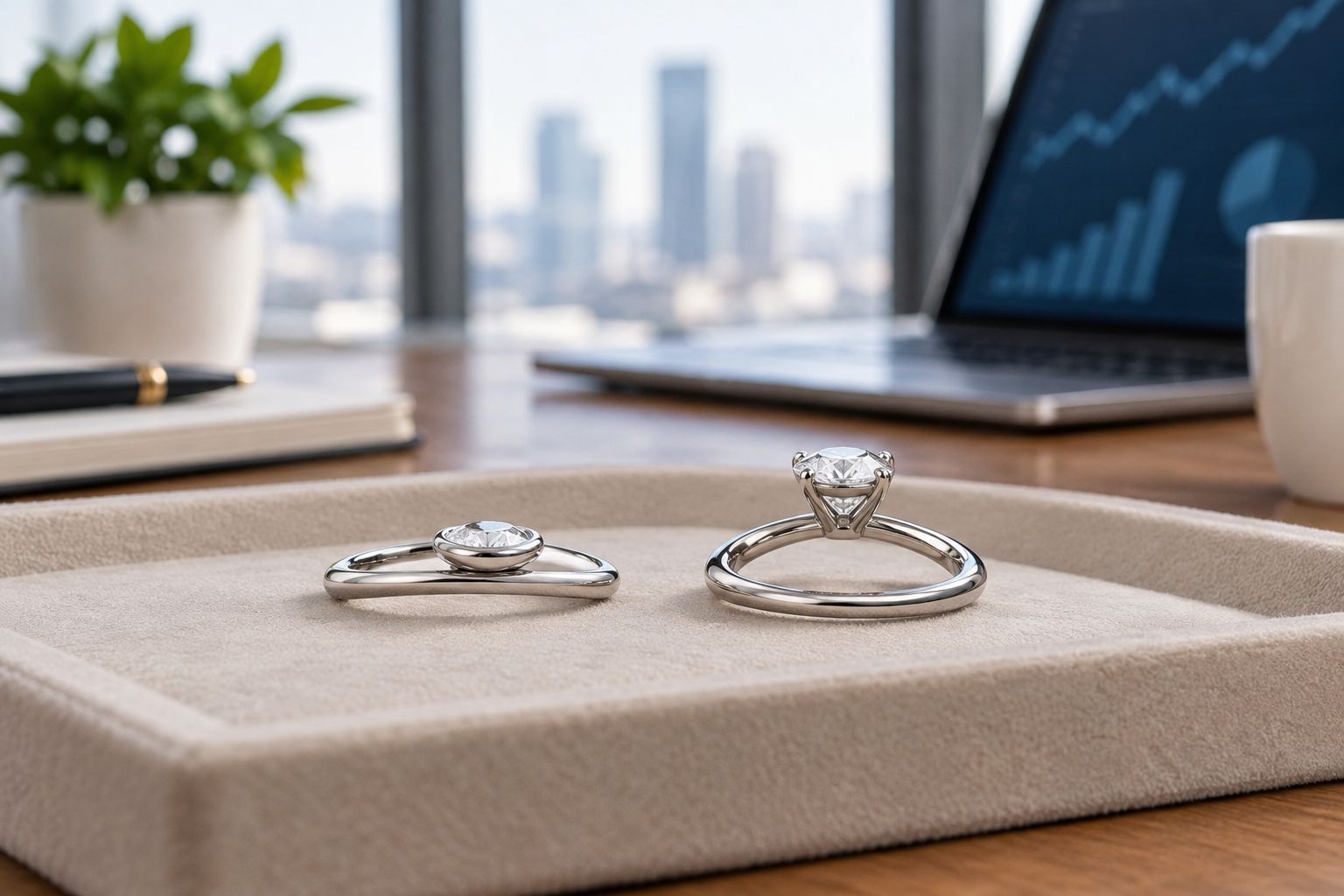
Compare the side profile as carefully as the view from above.
Use ordinary hand movements during the fitting. A beautiful ring should not require you to keep your hand posed.
- Inspect the ring from above, from the side, and underneath.
- Bend your fingers and rest your hand in a typing position.
- Check how the setting interacts with a shirt or jacket cuff.
- Ask how exposed points and stone edges are protected.
- Request a fit assessment rather than choosing by appearance alone.
4. Compare the whole stone, not a spreadsheet winner
Begin with your eyes: decide whether you prefer broad flashes, lively sparkle, clear geometry, or color. Then use documentation to understand what you are seeing. A grading report helps describe a diamond; it does not choose your favorite ring for you.
For a 2026 shortlist, compare stones under more than display lighting. Look at the ring at normal viewing distance as well as close up. If your choice looks appealing only in a magnified photograph, return to the on-hand comparison.
Keep gemstone identity separate from shape. An emerald-cut diamond is a diamond with a particular cutting style, not an emerald. If you prefer a colored gemstone, ask about that specific stone’s treatments, durability, and care rather than applying diamond advice to it.
- Compare shortlisted stones under different lighting conditions.
- Ask for the stone’s identity and any treatment disclosures in writing.
- Review available diamond grading documentation.
- Judge visible appearance alongside specifications.
- Ask for care guidance specific to the chosen gemstone.
5. Choose your metal and future band together
Start with the metal colors already present in your wardrobe. Matching everything is optional; the important distinction is between a deliberate mix you enjoy and a combination you have not tried. Place the engagement ring beside your everyday watch or favorite bracelet.
Gold purity is useful context, not a ranking of which ring is better. 14-karat gold contains approximately 58.3% gold, while 18-karat gold contains 75% gold. The remaining alloy matters, so ask about the complete composition if you have a known metal sensitivity.
When exploring custom bridal pieces at Element 79, bring the wedding band into the conversation early. Custom design offers room to discuss your preferred composition, but it also requires decisions that an existing design has already resolved. Confirm what is possible before planning around a particular pairing.
- Compare metal colors against jewelry you regularly wear.
- Disclose known metal allergies before choosing an alloy.
- Try a wedding band beside the engagement ring.
- Check whether the two rings touch at vulnerable points.
- Decide whether you prefer a flush fit or a deliberate gap.
6. Confirm ownership details before saying yes
Build your own checklist first, then ask the jeweler to address it for the exact ring. Keep purchase paperwork, stone documentation, and written care instructions together. A tidy record is more useful than trying to remember a conversation months later.
For your 2026 proposal plans, confirm timing directly rather than assuming that a design decision establishes a completion date. Ask about sizing and alteration limits before committing, especially when the ring has stones or design details around the band.
Element 79’s engagement ring offering includes designer jewelry and custom bridal pieces; confirm the terms for your chosen piece rather than treating either route as a standard package. Your final decision should cover the ring you love and the responsibilities of wearing it.
- Confirm the exact ring specifications in writing.
- Ask about sizing limits and applicable purchase policies.
- Obtain a written timeline for any work you request.
- Ask an insurer what documentation and coverage you need.
- Record care instructions and when to seek a professional inspection.
Explore your bridal style
Discover contemporary designer jewelry and custom bridal pieces in Cherry Creek, Denver.
Compare engagement ring options for your working routine
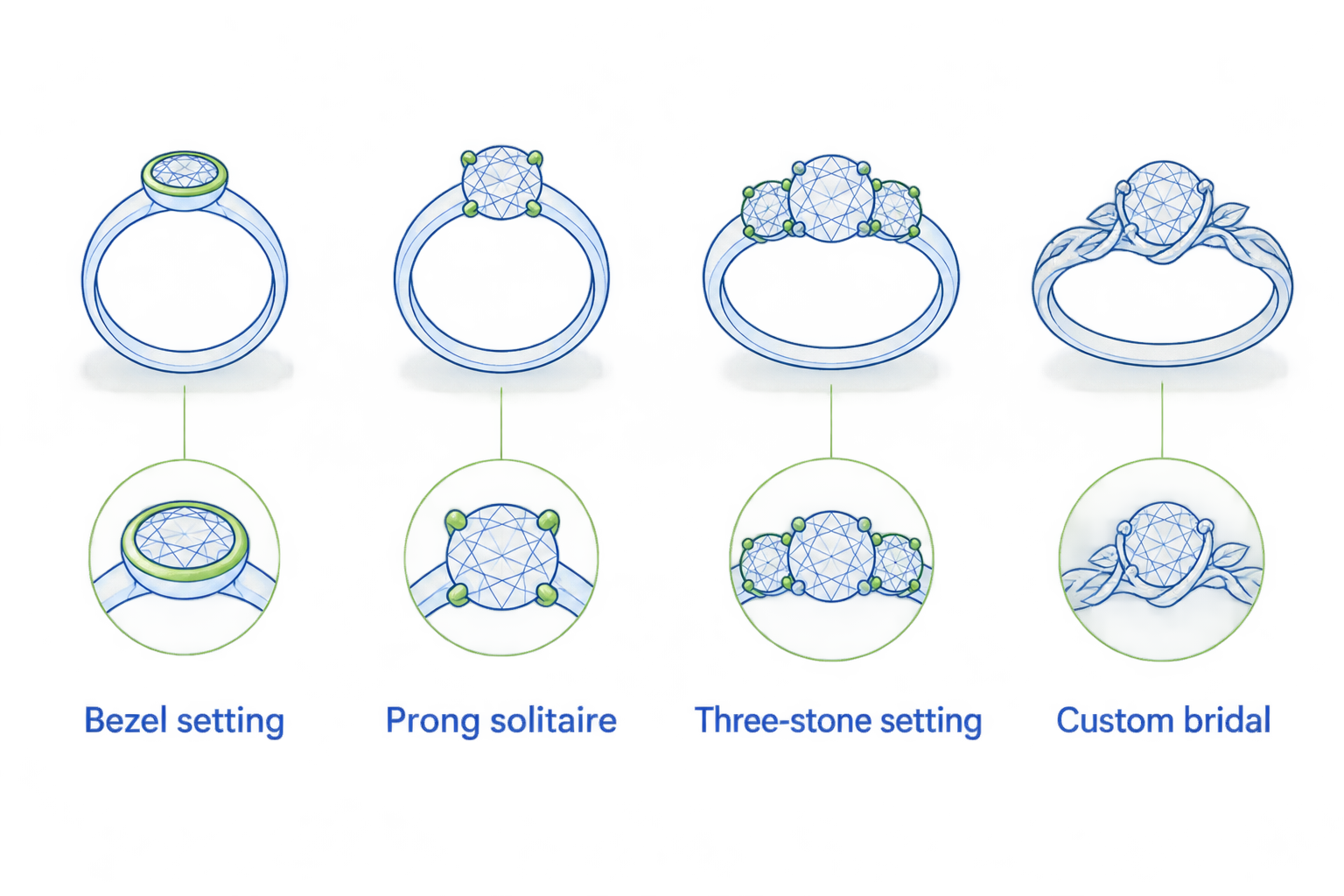
Choose the construction that fits your habits, then choose the expression you love. These are design directions, not a ranking of professional status. Each has a useful strength and a trade-off to examine in person.
Bezel setting
- Best for: Shoppers who prefer a defined metal outline
- Main advantage: Metal surrounds the stone’s edge
- Key limitation: The metal border changes how much of the stone’s outline you see
Prong solitaire
- Best for: Shoppers who want the center stone to lead
- Main advantage: A simple composition puts emphasis on one stone
- Key limitation: Exposed prongs need inspection; profile varies by design
Three-stone setting
- Best for: Shoppers who enjoy a broader composition
- Main advantage: Side stones add shape and visual detail
- Key limitation: The wider arrangement needs careful fit and band-pairing checks
Custom bridal
- Best for: Couples with specific design requirements
- Main advantage: The design conversation can address personal priorities
- Key limitation: Requires decisions, approvals, and a confirmed project timeline
Compare these options through the same questions: Do you like the side profile? Does your hand move comfortably? Can you picture wearing the ring with your own clothes? A design that answers those questions well deserves more attention than one selected only for its label.
Common mistakes finance professionals should avoid
Treating an office aesthetic as a personal requirement
Do not eliminate color, sculptural shapes, or unexpected compositions because you work in finance. Check your actual workplace rules, then choose within your own preferences. An understated ring is a valid choice; so is a more expressive ring when it fits your life.
Turning ring selection into a specification contest
A spreadsheet can keep details organized, but it cannot tell you which ring makes you smile. Use it to compare like-for-like information and identify unanswered questions. Then return to the complete ring, viewed on a hand rather than as isolated grades.
Choosing for client dinners but forgetting desk work
An engagement ring is not reserved for formal events. If you expect to wear yours while typing, commuting, and handling paperwork, test those movements during the fitting. Do not dismiss pressure or awkwardness simply because the ring looks lovely while your hand is still.
Assuming professional knowledge replaces jewelry documentation
Financial fluency does not replace gemstone identification, written purchase terms, or an insurance review. Ask direct questions even when the answer seems obvious. Keep replacement coverage, purchase documentation, and any future resale decision separate rather than treating them as interchangeable measures.
Leaving the wedding band until everything else is settled
Your engagement ring’s setting can affect where a wedding band sits. Try the pairing before making a final choice, even if you will purchase the band later. A gap is not automatically a flaw, but it should be something you like rather than an unwelcome surprise.
FAQ
What are the best engagement rings for finance professionals?
The best engagement rings for finance professionals fit the wearer’s routine, taste, and spending boundary. Compare setting height, comfort, stone protection, and wedding-band fit rather than choosing by job title.
Is a bezel setting better than prongs for office work?
A bezel is not automatically better than prongs for office work. It surrounds the stone’s edge with metal, but overall height and construction still determine how the ring feels during everyday movements.
Can I wear a colorful engagement ring in a finance job?
Choose a colorful engagement ring if you love it and it complies with any workplace jewelry rules that apply to you. Your profession alone does not require a colorless stone or a particular metal.
Should I choose an emerald-cut diamond for a professional look?
Choose an emerald-cut diamond because you enjoy its geometry, not because your profession requires it. Compare it with other shapes in person and assess the complete ring’s proportions and profile.
How much should a finance professional spend on an engagement ring?
Set your engagement ring spending boundary around your own finances and shared priorities, not your salary or colleagues’ purchases. Clarify the purchase terms and consider the wedding band, insurance, and ongoing care separately.
Where can Denver couples explore designer and custom bridal rings?
Element 79 is a Cherry Creek, Denver boutique selling contemporary designer fine jewelry and custom bridal pieces. Confirm the details, timing, and terms for the individual ring or project you are considering.
What should I check before buying an engagement ring in 2026?
Check fit, setting profile, stone identity, documentation, and the written purchase terms before buying an engagement ring in 2026. Ask about care, sizing limits, insurance documentation, and any work needed before your proposal.
One last thing
Bring an ordinary workday outfit to your final fitting. Wear the watch, sleeves, and other jewelry you reach for without thinking, rather than styling yourself around the ring.
Then look away from the mirror and use your hands normally. The ring should still feel like your choice when the appointment stops feeling like an occasion. For your 2026 decision, that everyday connection is a better final test than whether the ring fits someone else’s idea of a finance professional.
Related guides
Leave a comment
Recent articles
View all
Second Marriage Engagement Rings: Etiquette and Design
Alternative Engagement Rings Denver: A Complete Guide