
Engagement Rings for Artists: 2026 Guide | Element 79
Engagement rings for artists and creatives in 2026 means choosing a ring built around how the wearer actually uses their hands, not around a generic bridal template — bezel or low-profile settings, tarnish-resistant metals, and designs that read as sculpture rather than status symbol. Painters, potters, musicians, and designers need a ring that survives a studio shift and still looks intentional at dinner. That's a different set of priorities than the standard solitaire-and-halo conversation most jewelry guides default to.
TL;DR
- Bezel and low-profile settings are the safest pick for engagement rings for artists who work with clay, paint, or instruments daily.
- Element 79 carries sculptural designers like Artëmer, Spinelli Kilcollin, and James Banks built for non-traditional aesthetics.
- Custom bridal design lets artists build a ring around their own material logic instead of a mass-market template.
- Colored gemstones and asymmetric settings hold up as everyday-wearable in 2026 without sacrificing durability.
Why engagement rings matter differently for artists
Most engagement ring advice assumes a desk job and a dishwasher-safe lifestyle. Artists and creatives don't get that luxury — hands go into clay, canvas, solvents, guitar strings, and pottery wheels, often the same day the ring goes on.
A prong-set stone that looks perfect in a jewelry case becomes a liability the first time it catches on a loom or a chisel handle. The people searching for engagement rings for artists aren't looking for bigger — they're looking for a ring that matches an aesthetic sensibility that already rejects the mall-store default, and one that survives daily studio use without babying it.
Element 79's Cherry Creek, Denver boutique leans into that exact gap: contemporary and designer fine jewelry from artisan brands whose whole design language is unexpected composition rather than convention. That's the same instinct a lot of creative buyers already have before they walk in.
Define your material logic first
Before touching a single ring, an artist should decide how their craft interacts with metal and stone. This is the step most engagement ring guides skip entirely, and it's the one that determines whether the ring gets worn or left in a drawer.
- Platinum resists tarnish and holds a bezel securely — the strongest choice for daily hands-on work.
- 14k or 18k gold scratches more visibly over years of studio use but polishes back easily.
- Avoid open filigree or heavily pierced metalwork if the wearer works with fibers, yarn, or fine mesh — it snags.
- Check metal reactivity if the craft involves solvents, clay slip, or frequent handwashing; some alloys discolor faster than others.
- Ask about tarnish-resistant jewelry for daily wear before committing to a softer metal.
Pick a setting that survives studio work
The setting matters more than the stone shape for anyone whose hands are the tool of their trade. A high prong that looks striking in a photo is the first thing to bend, chip, or catch on a canvas edge.
- Bezel settings wrap the stone in a metal rim, eliminating snag points almost entirely.
- Flush and channel settings sit level with the band, ideal for potters and sculptors.
- Skip six-prong solitaires over 2 carats if daily hand use is heavy — the exposed facets chip faster.
- Ask whether the setting can be re-tightened or re-bezeled later; some contemporary designs are built for it, some aren't.
Choose a stone that fits an artist's palette
Diamonds aren't the default for creative buyers the way they are for traditional shoppers. Color, texture, and unconventional cuts read as more personal, and they photograph differently in natural light — which matters to people who think visually for a living.
- Sapphires and tourmalines hold color saturation well under studio lighting and daily wear.
- Raw or rose-cut stones read as intentional rather than unfinished on a creative buyer's hand.
- Review colored gemstones for an engagement ring before locking in a stone — hardness varies a lot by gem type.
- Confirm the stone's Mohs hardness against the wearer's daily material exposure; anything under 7 needs a protective setting.
Look at sculptural and architectural designs
This is where the segment diverges hardest from generic bridal shopping. Artists gravitate toward rings that function as small sculpture — asymmetric bands, negative space, or geometric structure instead of a round stone on a plain shank.
Designers like James Banks build rings around architectural line work rather than carat weight, and Dries Criel's sculptural pieces read closer to wearable art than traditional bridal. James Banks jewelry for an architectural engagement ring is worth a look before assuming a solitaire is the only option.
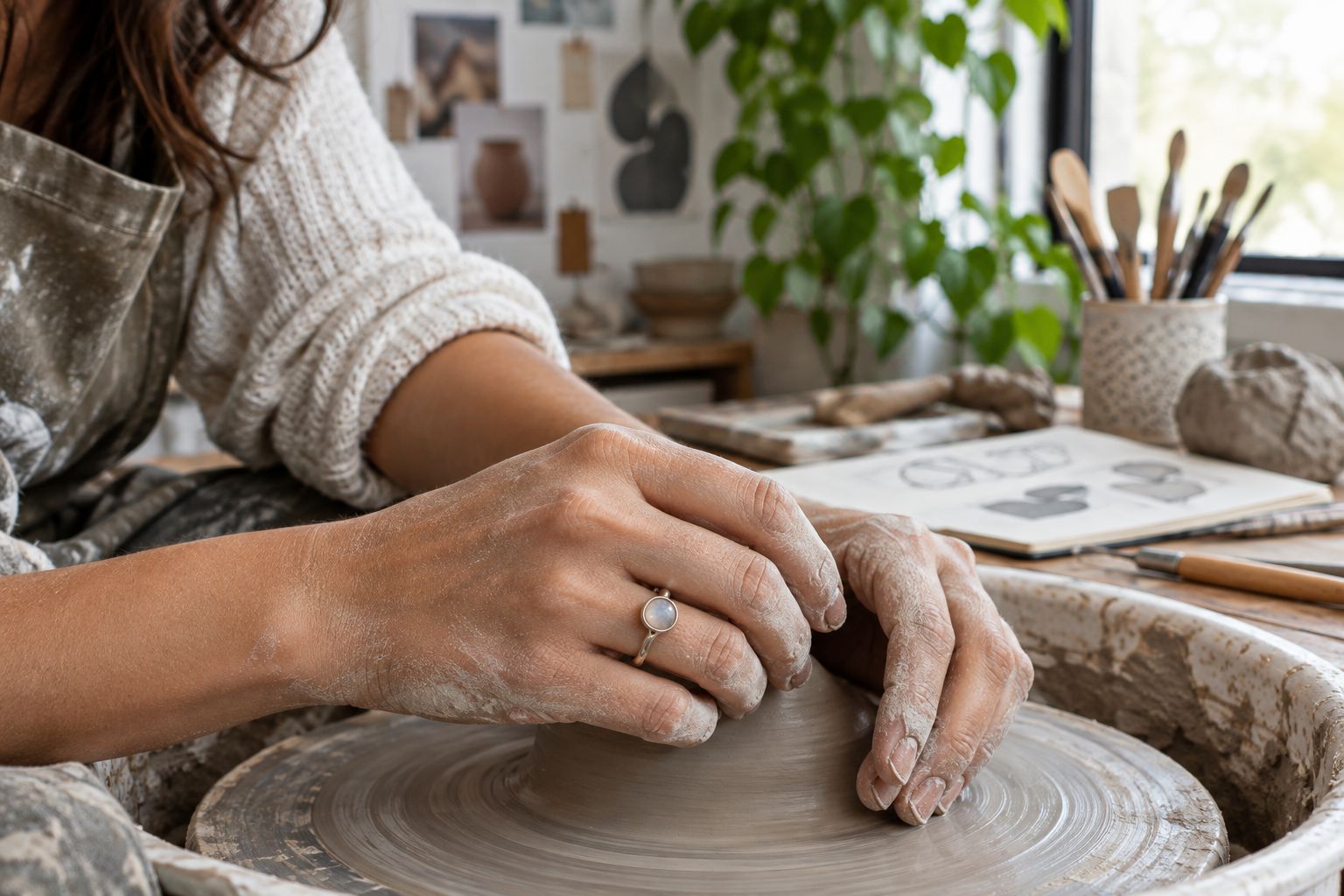
A bezel setting takes daily studio contact without catching or chipping.
Consider a custom or bespoke build
Off-the-shelf rarely fits an artist's actual criteria: the exact stone color they want, a band width that won't interfere with an instrument grip, or a motif tied to their own work. Custom design solves that, and it's more accessible than most people assume in 2026.
- Start with reference sketches or photos of the wearer's own art, instrument, or medium.
- Set a firm priority order first — stone, metal, or silhouette — before a designer starts sketching.
- Ask how many revision rounds are included before the final cast.
- Confirm resizing is possible later; hands change size with heavy manual work over the years.
- Review how to design a custom engagement ring for the full process before booking a consultation.
Talk to designers who already build for this aesthetic
Rather than reverse-engineering a mainstream ring into something artist-friendly, start with brands whose whole catalog already leans sculptural. Contemporary bridal designers for a custom ring at Element 79 include names built around asymmetry and stacking rather than a single center stone.
- Spinelli Kilcollin's linked-ring stacking system suits people who prefer texture over a single focal stone.
- Artëmer's mixed-metal, sculptural work reads as intentionally unconventional rather than budget-driven.
- Petra Class's nature-inspired settings suit gem-forward creative buyers over pure diamond shoppers.
Book an in-person try-on before deciding
Photos of sculptural rings and asymmetric settings read very differently in hand than on a screen — proportion and how a stone catches light both shift once it's actually on. Element 79's custom jewelers in Cherry Creek, Denver location lets a buyer handle several sculptural pieces side by side before committing to a custom build.
Comparison: ring styles for artists and creatives
Bezel-set solitaire
- Best for: Daily studio hands, low snag risk
- Key limitation: Less light play than open prongs
Sculptural stacking bands
- Best for: Buyers who want texture over a single stone
- Key limitation: Harder to resize as a unit later
Colored gemstone ring
- Best for: Non-diamond buyers, personal palette
- Key limitation: Softer stones need a protective setting
Fully custom bespoke design
- Best for: Buyers with a specific vision or medium tie-in
- Key limitation: Takes longer than a stocked piece
Vintage-inspired setting
- Best for: Buyers who want heirloom character
- Key limitation: Antique settings sometimes need reinforcement
Book a Cherry Creek styling appointment
See sculptural and custom bridal pieces in person before deciding.
Common mistakes artists and creatives make
- Choosing a high-prong setting to match a partner's ring style instead of what actually survives their own daily hand use.
- Skipping the material-logic step and picking a stone that's too soft for their specific craft before checking hardness.
- Assuming custom design takes too long and defaulting to a stocked ring that doesn't reflect their aesthetic at all.
- Ignoring insurance because the stone isn't a large traditional diamond — colored and custom pieces still need coverage.
- Buying based on a photo alone without trying the piece on under real studio or performance conditions.
FAQ
What's the best engagement ring for artists and creatives in 2026?
A bezel-set or low-profile ring in platinum or 18k gold is the safest starting point for artists and creatives in 2026, since it resists snagging during studio work. Sculptural designers like Artëmer and James Banks suit buyers who want the ring to read as art rather than status.
Is a bezel setting better for people who work with their hands?
Yes — a bezel setting wraps the stone in metal with no exposed prongs to catch on clay, canvas, or instrument strings. It's the setting most jewelers recommend for daily hands-on craft work.
Can artists get a custom engagement ring designed around their craft?
Yes, custom bridal design lets an artist build a ring around a specific medium, instrument, or personal motif rather than choosing from stock. The process starts with reference sketches and a set priority order for stone, metal, and silhouette.
Are colored gemstones a good choice for creative types?
Colored gemstones suit creative buyers who want a personal palette over a traditional diamond, but hardness varies by stone type. Sapphires and tourmalines hold up well under daily wear; softer stones need a protective bezel setting.
What metal holds up best for painters, potters, and musicians?
Platinum resists tarnish and holds a bezel most securely, making it the strongest choice for daily studio or performance use. 14k or 18k gold is a solid alternative but shows scratches more visibly over time.
Should I choose a designer brand or a fully custom ring?
Designer brands like Spinelli Kilcollin or Petra Class already build sculptural, non-traditional pieces, which works if their existing aesthetic fits. A fully custom build is worth it when the buyer wants a specific motif or material logic tied to their own craft.
Do sculptural rings work for everyday wear?
Yes, as long as the setting is bezel or flush rather than high-prong. Asymmetric and stacking designs from brands like Spinelli Kilcollin are built for daily wear, not just occasion pieces.
How long does a custom engagement ring take for an artist's specific design?
Timelines vary by design complexity and revision rounds, so confirm the schedule directly with the jeweler before booking. Starting with clear reference material for the stone, metal, and silhouette speeds up the process considerably.
One last thing
The detail most artists skip: ask whether a setting can be re-bezeled or re-tightened years down the line, not just resized. Hands doing manual work change shape and grip strength over a decade, and a ring built for permanence in 2026 should account for wear that a desk job never puts on a stone.
Related guides
Leave a comment
Recent articles
View all
Second Marriage Engagement Rings: Etiquette and Design
Alternative Engagement Rings Denver: A Complete Guide