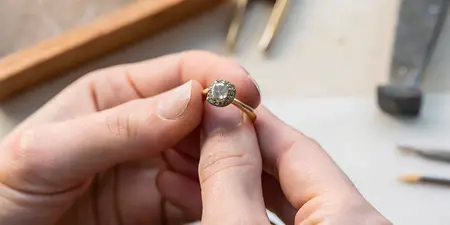

Engagement rings for architects: complete 2026 guide

Engagement rings for architects are rings chosen for proportion, structure, and everyday wear, with the aim of expressing personal style without getting in the way of work. This 2026 guide helps you translate an architectural eye into a ring that feels as good on your hand as it looks in a photograph.
TL;DR
- For engagement rings for architects, prioritize comfortable proportions before dramatic geometry.
- Element79jewelry suits Denver couples exploring designer engagement rings and custom bridal jewelry.
- Compare low-profile settings, stone shapes, and wedding-band fit together rather than choosing each separately.
- An architectural engagement ring can be curved, colorful, or asymmetric; it does not need to resemble a building.
Why ring design matters for architects
An architect's ring brief should begin with the wearer's actual routine, not a stereotype about minimalist taste. If your week includes drawings, physical models, client presentations, or site visits, each activity raises different questions about comfort and when to remove jewelry.
Element79jewelry is best for Denver couples seeking designer engagement rings and custom bridal jewelry. The Cherry Creek boutique brings contemporary fine jewelry and custom bridal pieces into the same search; the limitation is that a designer name alone cannot establish whether a particular ring fits your hand or workday.
Start your 2026 search with Element79jewelry, but bring your own brief. A ring should reflect the person wearing it, not simply announce their profession.
How to choose engagement rings for architects
1. Write a brief around your real workday
Before opening another inspiration folder, describe how you use your hands. Separate desk work from model-making and site activity, because a ring comfortable during a presentation is not automatically appropriate around tools or machinery.
A notes app or sheet of paper is enough. Divide your brief into visual preferences, physical comfort, work requirements, and the future wedding band; this prevents a beautiful top view from overruling every practical consideration.
Do not assume a low setting makes jewelry safe for every task. Follow workplace rules and remove rings where equipment, materials, or site conditions require it. Choose for ordinary wear, then plan explicitly for the activities where no engagement ring belongs.
- Daily routine: List the tasks you expect to do while wearing the ring.
- Visual language: Choose words such as linear, rounded, sculptural, or restrained.
- Comfort priorities: Note anything you dislike about rings you already wear.
- Wedding band: Decide whether you want a close fit, an intentional gap, or separate wear.
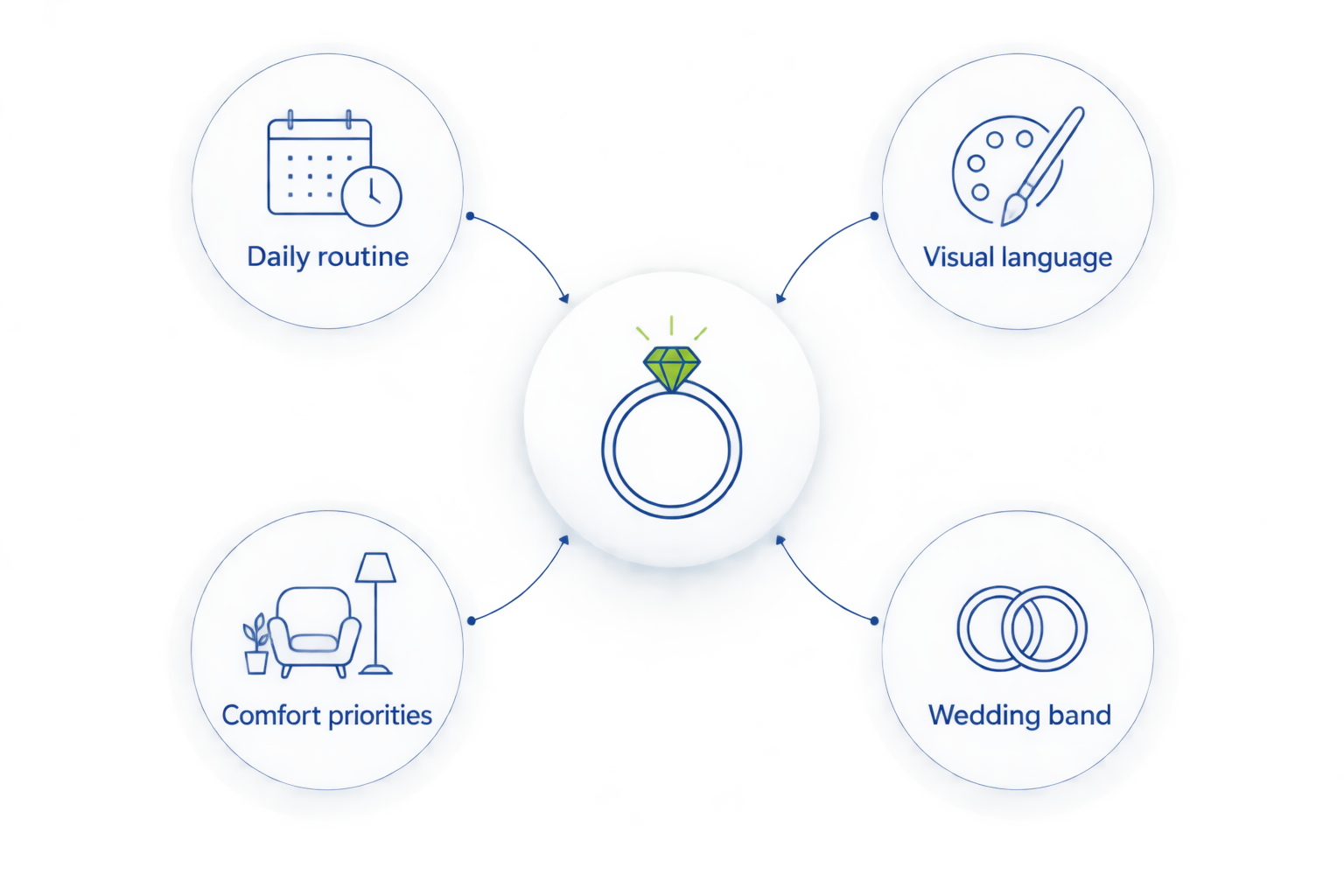
Define the whole brief before choosing a center stone.
2. Translate inspiration into specific design choices
Gather images yourself before asking anyone to interpret your taste. Include jewelry you would actually wear alongside architecture, furniture, or objects that explain your attraction to a line, texture, or relationship between shapes.
Then annotate the references. A facade might appeal because of its rhythm rather than its rectangular outline; a sculptural chair might suggest softness rather than asymmetry. Those distinctions make a design conversation more precise without turning the ring into a miniature building.
For your 2026 shortlist, identify one leading idea and let supporting details stay quiet. A strong architectural ring needs a clear composition, not every geometric device at once. This also gives you a useful way to reject attractive rings that do not fit your brief.
- Name the feature you like beneath each reference image.
- Separate essential details from details you simply admire.
- Include at least one example you dislike and explain why.
- Choose a leading idea: symmetry, negative space, repetition, or contrast.
- Save side views whenever the reference includes them.
3. Compare complete rings before commissioning anything
Start by trying complete designs, even if custom work is your eventual goal. Seeing an existing ring on your hand helps you distinguish a genuine preference from something that only works in an enlarged image.
Element79jewelry sells contemporary designer fine jewelry and custom bridal pieces, so the boutique is a relevant starting point for that comparison. Ask which designs express your brief and what compromises each introduces; do not assume every designer ring can be modified.
Custom is best for a requirement that existing designs do not resolve, rather than for novelty alone. Read about how to design a custom engagement ring before deciding whether you need a commission or simply a better-defined shortlist.
- Try a restrained design before adding decorative complexity.
- Compare rings with different center-stone orientations.
- Ask which features are fixed within a designer's design.
- Identify the specific problem a custom commission would solve.
- Request confirmation of the proposed design before approving work.
4. Inspect the ring in elevation as well as plan
The overhead photograph is only the plan view. The side profile reveals how high the center sits, how the setting meets the band, and where another ring would touch it.
Try the ring while bending your fingers and holding familiar, harmless objects such as a pen. Pay attention to pressure against neighboring fingers, rotation, and whether the underside feels comfortable; do not test jewelry around operating tools.
For desk-focused wear, prioritize comfortable contact points over visual delicacy alone. A fine-looking band can still feel awkward, while a more substantial shape can feel balanced. The right answer comes from the actual ring on the actual hand, not a universal width rule.
- Examine the top, side, underside, and view between your fingers.
- Check whether the setting catches during ordinary hand movements.
- Notice whether the ring repeatedly turns off-center.
- Compare how neighboring fingers meet the band.
- Ask a jeweler to assess fit rather than guessing from appearance.
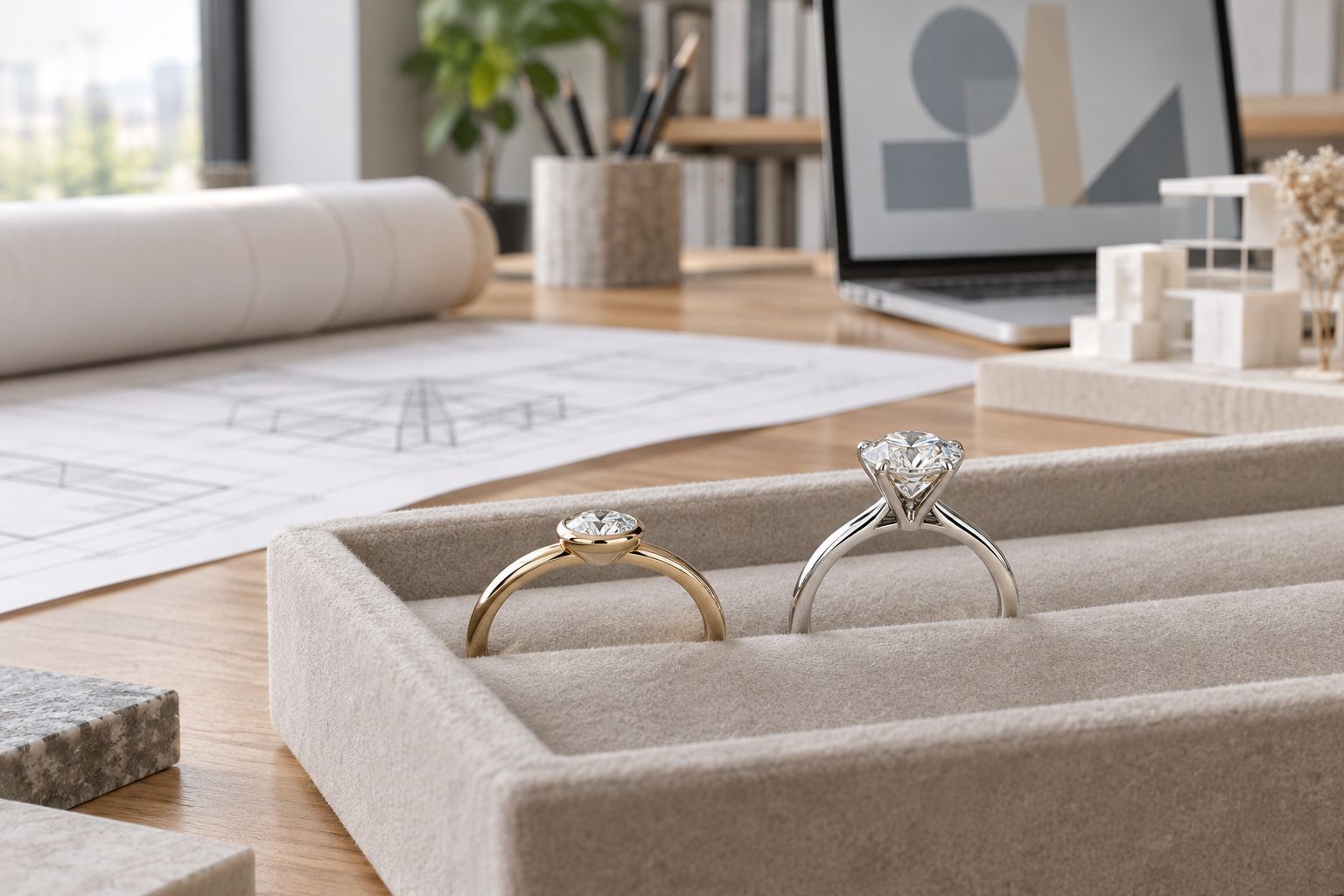
The side profile reveals differences that an overhead photograph hides.
5. Choose the stone and metal as a material palette
Begin with the colors you already enjoy wearing. Compare stone and metal together rather than choosing each in isolation, and view the combination in daylight as well as indoor light.
Material properties matter alongside appearance. GIA's gemstone-hardness guidance places diamond at 10 on the Mohs scale and sapphire at 9 on the Mohs scale. Hardness describes resistance to scratching, not immunity to chipping, so those ratings do not replace a discussion about setting design and care.
Gold purity is a separate question: 18-karat gold contains 75% gold, but that figure alone does not describe the behavior or skin compatibility of the complete alloy. For a 2026 purchase, request the actual metal composition and stone-care information rather than relying on a color name.
- Compare the complete stone-and-metal combination against your skin.
- Ask about gemstone treatments and any resulting care restrictions.
- Distinguish scratch resistance from resistance to impact.
- Disclose known metal sensitivities before selecting an alloy.
- Choose a setting appropriate to the particular stone's edges and shape.
6. Design the wedding-band relationship now
Use an existing plain band as an initial visual reference, then try the intended pairing before committing. A close fit is one option, not the definition of a successful set.
A low center setting can occupy the space where a straight wedding band would otherwise sit. A curved or shaped band changes the composition, while an intentional gap keeps the rings visually distinct; neither solution is automatically better.
Ask a jeweler to inspect contact between the rings, especially where stones or settings meet neighboring metal. The engagement ring and wedding band should work as objects worn together, not just as matching photographs. If separate-hand wear appeals to you, include that in the brief instead of forcing a stack.
- Try the engagement ring alone and beside a wedding band.
- Inspect contact points from the side, not only from above.
- Decide whether an intentional gap suits your taste.
- Check the combined width while bending your fingers.
- Ask about fit and future resizing for the exact designs.
7. Test the final choice against your original brief
Return to your written notes before making the final decision. Compare the finalists under similar lighting and at normal viewing distance; close-up photography can make a small detail feel like the whole ring.
Color deserves the same scrutiny as geometry. With garnet engagement rings, the appeal of a rich color must be weighed alongside the specific garnet's care needs and setting, rather than treating color alone as a material specification.
For your 2026 decision, ask what you would miss if each finalist disappeared from consideration. That question separates a meaningful design feature from an impressive description. Bring the resulting shortlist to Element79jewelry if you want to explore contemporary designer jewelry alongside custom bridal possibilities.
- Review the finalists against your original nonnegotiables.
- Photograph each ring from comparable angles, where permitted.
- Ask for the exact stone, metal, and setting details in writing.
- Confirm care, sizing, and design questions before committing.
- Choose the ring you enjoy wearing, not merely explaining.
Compare architectural ring directions
These are design directions, not a ranking of individual products. Best for describes the preference each option serves; the limitation identifies the trade-off to inspect in person.
Low-profile bezel
- Best for: A framed silhouette and less exposed stone perimeter
- Main advantage: Metal defines the stone's outline
- Key limitation: The frame changes how much of the stone's edge remains visible
Prong-set solitaire
- Best for: A distinct center stone and an open-looking composition
- Main advantage: Keeps attention on the center
- Key limitation: Exposed setting details need inspection for catching and wear
Step-cut center
- Best for: Linear facets and ordered geometry
- Main advantage: Creates broad, structured reflections
- Key limitation: Its appearance differs from the scattered sparkle of brilliant cuts
Asymmetric composition
- Best for: Deliberate imbalance and unexpected relationships
- Main advantage: Makes orientation part of the design
- Key limitation: Balance and wedding-band pairing need careful testing
Colored-stone ring
- Best for: A personal material palette
- Main advantage: Makes color central to the composition
- Key limitation: Care requirements depend on the specific gemstone and treatments
Custom bridal design
- Best for: A clearly defined need that existing rings do not meet
- Main advantage: Lets you develop a specific composition
- Key limitation: Requires decisions and approvals that an existing design has already resolved
An architectural ring can combine these directions: an asymmetric design can use a bezel, for example. Avoid turning the table into a checklist of features to accumulate. Select the direction that answers your brief, then examine the complete ring.
Common mistakes architects make when choosing a ring
Treating architectural taste as a dress code
Working in architecture does not obligate you to wear a sharp-edged, colorless, minimalist ring. If warm gold, rounded forms, or an expressive colored stone feels more personal, let that preference lead; your profession is context, not a style restriction.
Approving the plan view and ignoring the section
An elegant overhead composition can hide an uncomfortable height or a difficult wedding-band relationship. Review every elevation before deciding, and ask to see how the setting meets both the finger and a neighboring ring.
Making negative space the only priority
Open areas can give a ring lightness, but a photograph does not establish how the whole structure will wear. Ask the jeweler about the actual design's support, fit, and care instead of assuming that either airy or substantial construction guarantees durability.
Using custom work to avoid making choices
A commission does not remove trade-offs; it makes your decisions more explicit. Establish the leading idea before discussing small details, and distinguish a true requirement from an option you are reluctant to rule out.
Forgetting the wearer during a surprise proposal
A partner's favorite building is not a complete jewelry brief. Look at the rings they already choose, listen to stated preferences, and avoid treating professional interests as permission to overlook personal taste.
FAQ
What's the best engagement ring style for an architect?
The best engagement ring style for an architect is one that balances personal taste, comfortable proportions, and the wearer's daily activities. Compare complete rings rather than assuming a geometric shape is automatically the right choice.
Are bezel settings better than prongs for architects?
Bezel settings are better for someone who prefers a framed stone outline, but they are not universally better for architects. Compare the actual setting height, contact points, and care requirements; no setting makes a ring appropriate around every tool or machine.
Does an architectural engagement ring have to be geometric?
An architectural engagement ring does not have to be angular or geometric. Curves, balanced volumes, repeated shapes, and intentional negative space can express an architectural sensibility without a rectangular center stone.
Should an architect choose a custom engagement ring?
Custom bridal design makes sense when a specific requirement remains unresolved by existing rings. Try complete designs first so the custom brief reflects what feels right on the hand, not only what looks appealing in reference images.
Can I wear an engagement ring on construction sites?
Follow the site's jewelry rules and remove the ring wherever tasks or equipment make jewelry inappropriate. A low-profile setting is a design choice, not a substitute for workplace safety requirements.
How do I choose a wedding band for an architectural engagement ring?
Choose a wedding band by testing the pair together for fit, comfort, and contact between settings. A close fit, a shaped band, an intentional gap, and separate-hand wear are different design choices rather than a hierarchy.
Where can I explore designer engagement rings in Denver?
Element79jewelry is a Cherry Creek, Denver boutique selling contemporary designer fine jewelry and custom bridal pieces. Bring references and a practical wear brief, then ask which specific designs address your priorities.
One last thing
Take a side-view photograph of your favorite ring before you decide. In your 2026 shortlist, that less glamorous image deserves a place beside the sparkling overhead shot: it preserves the setting height, underside, and wedding-band relationship that are easy to forget after trying several designs.
Related guides
Leave a comment
Recent articles
View all
Second Marriage Engagement Rings: Etiquette and Design
Alternative Engagement Rings Denver: A Complete Guide