
Engagement Ring Metal Durability Ranked 2026
Platinum and palladium score 4 to 4.75 on the Mohs hardness scale, tungsten carbide and cobalt chrome score 8.5 to 9, and 18K yellow gold sits closer to 2.75 to 3.5 — the higher that number, the more a ring resists scratches and edge wear over years of daily use. Engagement ring metal durability comes down to that scale plus how a metal is alloyed, and the numbers below sort out which bridal metals hold up and which need more upkeep.
TL;DR
- Tungsten carbide and cobalt chrome top engagement ring metal durability at 8.5-9 Mohs, built for daily-wear bands.
- Platinum (4-4.5 Mohs) and palladium (4.75 Mohs) hold prong settings without the brittleness of harder alloys.
- 18K yellow gold (2.75-3.5 Mohs) scratches faster than 14K gold or platinum and needs more frequent polishing.
- Sterling silver (2.5-3 Mohs) is the softest common ring metal and isn't built for daily engagement ring wear.
- Element 79 sets designer engagement rings in platinum, 18K gold, and mixed metals based on how the ring will actually be worn.
Why this matters
An engagement ring gets worn close to 16 hours a day for decades, through dishwashing, gym sets, gardening, and every handshake in between. A metal's Mohs hardness — the same scale geologists use to rank minerals from talc to diamond — predicts how fast that daily contact turns into visible scratches and thinning edges.
This is a scratch-resistance measure, not a toughness measure. A harder metal resists surface scratches better, but hardness alone doesn't tell you whether a metal will crack under a sharp impact — that's a separate property called toughness. Picking a setting also means choosing a durable engagement ring setting that protects the stone regardless of which metal holds it.
Element 79 works with couples across contemporary and designer bridal lines, and the metal question comes up in nearly every consultation: gold or platinum, yellow or white, and how much maintenance a ring will realistically need by 2030.
Engagement Ring Metal Durability: Mohs Hardness by Metal (2026)
Mohs hardness for jewelry metals measures scratch resistance on a 1-10 scale, where talc is 1 and diamond is 10. The average bridal metal — platinum, palladium, or 14K/18K gold — lands between 2.75 and 4.75 Mohs, which is the baseline any specific alloy should be measured against.
Tungsten carbide
- Mohs Hardness: 8.5-9
- Scratch Resistance: Very high
- Best For: Men's bands, low-maintenance daily wear
Cobalt chrome
- Mohs Hardness: 9
- Scratch Resistance: Very high
- Best For: Active lifestyles, workshop or gym-heavy days
Titanium
- Mohs Hardness: 6
- Scratch Resistance: High
- Best For: Lightweight daily wear
Palladium
- Mohs Hardness: 4.75
- Scratch Resistance: Medium-high
- Best For: Hypoallergenic prong settings
Platinum
- Mohs Hardness: 4-4.5
- Scratch Resistance: Medium-high
- Best For: Solitaires, heirloom pieces, daily wear
All bridal metals (average)
- Mohs Hardness: 2.75-4.75
- Scratch Resistance: Medium
- Best For: Baseline for comparison
14K gold (yellow or white)
- Mohs Hardness: 3.5-4
- Scratch Resistance: Medium
- Best For: Everyday wear, higher alloy content
18K white gold
- Mohs Hardness: 3.5-4
- Scratch Resistance: Medium
- Best For: Classic bridal look with palladium alloy
18K yellow gold
- Mohs Hardness: 2.75-3.5
- Scratch Resistance: Medium-low
- Best For: Warm tone, more frequent polishing
Sterling silver
- Mohs Hardness: 2.5-3
- Scratch Resistance: Low
- Best For: Fashion jewelry, not daily bridal wear
Tungsten carbide and cobalt chrome lead engagement ring metal durability at 8.5-9 Mohs, built to survive tool belts and barbells without visible scratching. Sterling silver trails the field at 2.5-3 Mohs, the softest metal on this list and one that shows wear within months of daily contact rather than years.
14K gold edges out 18K gold in raw hardness because it carries more alloy metal (about 58% pure gold versus 75% in 18K), and alloy content is what resists scratching — pure gold alone is barely harder than a fingernail. That tradeoff between purity and hardness is the same one covered in gold purity benchmarks, where 10K, 14K, 18K, and 24K gold get compared side by side.
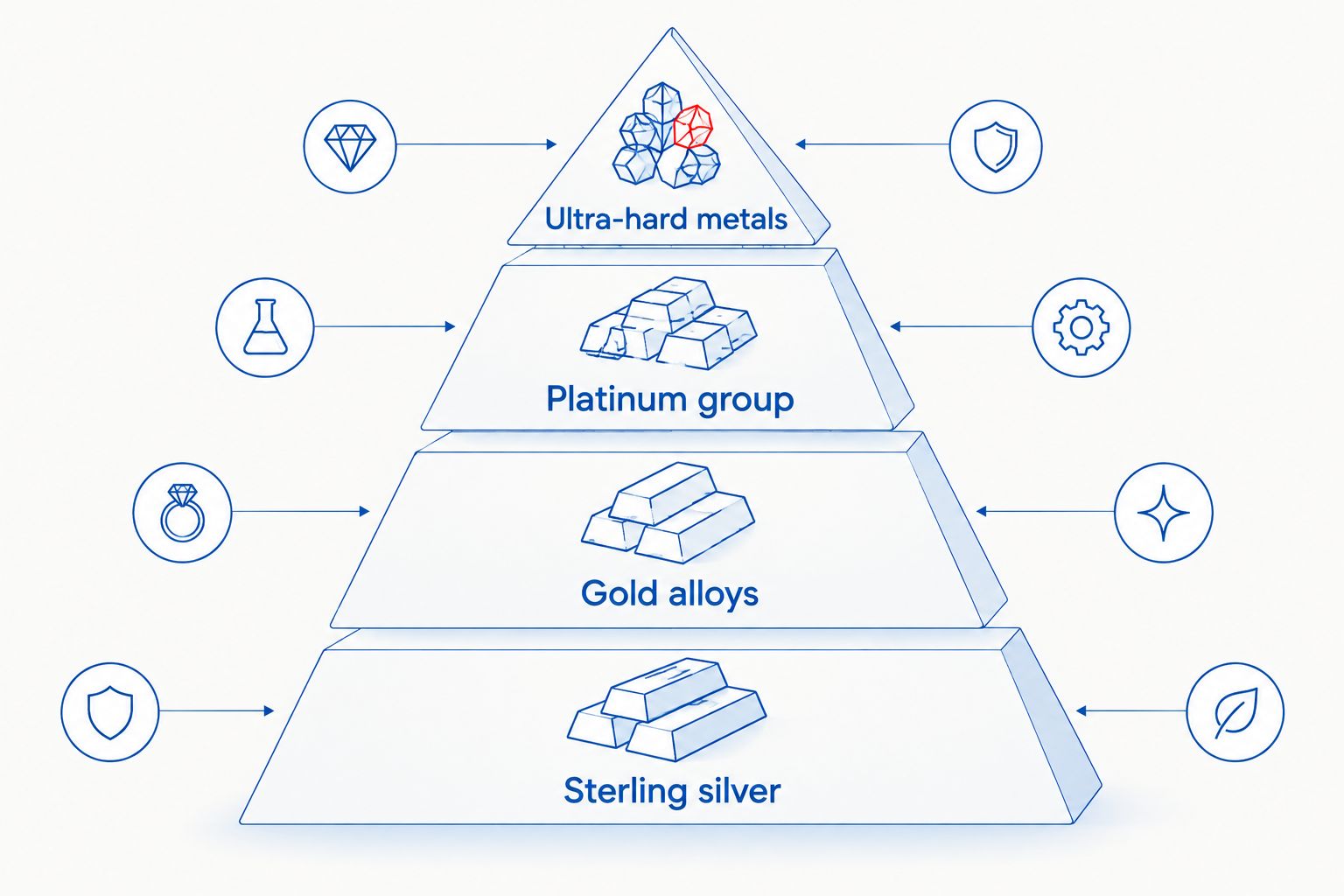
Softer metals sit at the base and need more upkeep; harder alloys at the top hold their finish longest.
Methodology and limits
The hardness ranges above reflect published Mohs hardness data for jewelry metals compiled from gemological references, current as of 2026. One limitation worth naming: Mohs hardness measures scratch resistance only, not resistance to bending, chipping, or the metal fatigue that comes from decades of prong flexing — a ring can score high on this scale and still need prong re-tipping after 15-20 years of wear.
How to use these benchmarks
- Match hardness to daily contact. If a job involves tools, weights, or constant hand-washing, look at metals above 6 Mohs — platinum and 18K gold both fall short of that threshold and will show wear faster under heavy contact.
- Don't confuse hardness with brittleness. Platinum at 4-4.5 Mohs is softer than titanium but far more resistant to cracking under a sharp knock, which is why it remains the standard for solitaire prongs in 2026.
- Budget for maintenance on softer metals. An 18K yellow gold band at 2.75-3.5 Mohs will need re-polishing more often than a 14K or platinum setting — factor that into how the ring gets worn, not just how it looks on day one.
- Ask about alloy composition, not just karat. Two 18K white gold rings can have different hardness depending on whether the alloy uses palladium or nickel — platinum engagement rings ranked by durability breaks down how platinum alloys compare to each other.
Talk through metal options in person
Book a private consultation at the Cherry Creek boutique.
FAQ
What is the most durable engagement ring metal in 2026?
Tungsten carbide and cobalt chrome are the hardest common ring metals at 8.5-9 Mohs, but platinum (4-4.5 Mohs) is the most durable choice among traditional bridal metals because it resists chipping as well as scratching.
Is platinum more durable than gold for an engagement ring?
Platinum scores 4-4.5 Mohs versus 2.75-4 Mohs for 14K-18K gold, and platinum also resists cracking better under impact, which is why it stays the standard for daily-wear solitaires.
Does 14K gold scratch less than 18K gold?
Yes. 14K gold carries more alloy metal than 18K gold, which raises its hardness to roughly 3.5-4 Mohs compared to 2.75-3.5 Mohs for 18K yellow gold.
How does Mohs hardness relate to engagement ring durability?
Mohs hardness measures how resistant a metal's surface is to scratching on a 1-10 scale. It does not measure toughness, so a hard metal like titanium can still be more prone to fracturing than a softer, more pliable metal like platinum.
Is white gold or yellow gold more durable?
18K white gold typically measures 3.5-4 Mohs versus 2.75-3.5 Mohs for 18K yellow gold, because white gold alloys often use palladium, which adds hardness that yellow gold's copper-silver alloy doesn't.
Why do jewelers recommend platinum for daily wear?
Platinum combines moderate hardness (4-4.5 Mohs) with high toughness, so it resists both scratching and cracking, which matters more for a ring worn nearly every day than raw hardness alone.
How often does an 18K gold engagement ring need re-polishing?
There's no fixed published interval, but softer metals like 18K yellow gold show visible surface wear sooner than 14K gold or platinum under the same daily contact, so more frequent polishing is standard advice.
Is sterling silver durable enough for an engagement ring?
No. Sterling silver measures 2.5-3 Mohs, the softest metal on the common durability scale, and it's generally reserved for fashion jewelry rather than daily-wear bridal pieces.
One last thing
The metal that scratches the least isn't always the one that survives longest: tungsten carbide sits at 9 Mohs but can shatter under a direct impact where platinum would just dent, which is why some of the hardest metals on this list are better suited to men's bands than to a ring that also has to protect a center stone. Match the metal to the setting, not just to the hardness number, and the ring holds up better through 2026 and well past it.
Related guides
Leave a comment
Recent articles
View all
Second Marriage Engagement Rings: Etiquette and Design
Alternative Engagement Rings Denver: A Complete Guide