Does jewelry insurance cover lab-grown diamonds like natural ones?

Yes—jewelry insurance can cover lab-grown diamonds just as it covers natural diamonds, provided the insurer accepts the piece and the policy includes the protection you need. The important caveat is that eligibility does not guarantee identical claim payments: your deductible, exclusions, insured description, and replacement terms determine what happens after a loss.
TL;DR
- Does jewelry insurance cover lab grown diamonds? Yes—coverage depends on the policy, not simply diamond origin.
- Lab-grown and natural diamonds need accurate descriptions so replacement jewelry matches the insured piece.
- GIA grading reports describe diamonds; they do not replace insurance appraisals or establish policy coverage.
- Check theft, accidental loss, damage, and claim settlement separately before accepting an engagement ring policy.
Why this matters
Your ring is more than its center stone. A sculptural setting, carefully chosen proportions, and personal engraving all help make it yours—and those details deserve a place in your insurance records.
For a 2026 policy purchase, separate two questions: whether the insurer accepts your lab-grown diamond, and whether the contract protects the situations you worry about. A yes to the first does not answer the second. Start with the broader process in our guide to insuring a designer engagement ring.
Does jewelry insurance cover lab-grown diamonds like natural ones?
Yes. Lab-grown diamonds are insurable, but the policy—not the diamond's origin—sets the covered events and claim settlement rules. Both lab-grown and natural diamonds need an accurate description and an accepted valuation basis.
The distinction matters most when replacing a stone. A lab-grown diamond should be documented as lab-grown; a natural diamond should be documented as natural. Matching carat weight alone does not describe an equivalent replacement.
Can it be insured?
- Lab-grown diamond: Yes, subject to insurer acceptance
- Natural diamond: Yes, subject to insurer acceptance
How should origin appear?
- Lab-grown diamond: Explicitly identified as lab-grown
- Natural diamond: Explicitly identified as natural
What describes the stone?
- Lab-grown diamond: Origin, measurements, shape, weight, and available grading details
- Natural diamond: Origin, measurements, shape, weight, and available grading details
What determines covered events?
- Lab-grown diamond: Policy wording and endorsements
- Natural diamond: Policy wording and endorsements
What determines settlement?
- Lab-grown diamond: Valuation basis, limits, deductible, and settlement terms
- Natural diamond: Valuation basis, limits, deductible, and settlement terms
What is the main documentation risk?
- Lab-grown diamond: An incomplete description that omits laboratory-grown origin
- Natural diamond: An incomplete description that omits natural origin or identifying details
Neither diamond type removes the need to read exclusions. Acceptance is useful; a clear replacement description is what helps you evaluate whether the protection fits your ring.
Which insurance route fits your ring?
You can investigate a separate jewelry policy, scheduled coverage attached to a homeowners or renters policy, or the jewelry protection already included in your household policy. Compare the actual contracts rather than choosing by the policy label.
These routes have different strengths and limitations. The table gives you questions to resolve, not promises about an unnamed insurer.
Separate jewelry policy
- Best for: Owners who want jewelry-specific protection
- Potential advantage: A contract focused on jewelry risks and claims
- Limitation to check: Exclusions, repair arrangements, and replacement control still need review
Scheduled household coverage
- Best for: Owners who want a specifically listed ring on an existing policy
- Potential advantage: The ring has its own documented description and limit
- Limitation to check: Covered events and settlement terms depend on the endorsement
Unscheduled household coverage
- Best for: Owners assessing protection they already have
- Potential advantage: Existing personal-property coverage can include jewelry
- Limitation to check: Jewelry sublimits and restrictions can leave gaps
A household policy that covers theft does not automatically cover a ring you accidentally leave behind. Likewise, a scheduled item is not automatically protected against every kind of damage.
When comparing 2026 policy documents, ask the same questions of each provider. You need a consistent comparison of loss, theft, accidental damage, travel, deductibles, and replacement—not a comparison of reassuring headlines.
What should your insurance documents say?
Your paperwork should describe the whole piece clearly enough that someone unfamiliar with it can understand what needs repairing or replacing. For a distinctive ring, a generic description such as diamond ring leaves too much unexplained.
Keep these 3 document groups together:
- Purchase records: The receipt or invoice, seller details, purchase date, and any separate records for the stone and setting.
- Identification records: The grading report, report number, available inscription information, and photographs of the finished piece.
- Insurance records: The application, accepted appraisal or valuation document, policy schedule, endorsements, and written coverage confirmations.
A diamond grading report describes characteristics; an appraisal addresses value for a stated purpose. Neither document, by itself, creates insurance coverage. Ask the insurer which documents it accepts before commissioning additional paperwork.
Include the setting, not just the center diamond
Record the metal, setting style, side stones, designer identification when applicable, and distinctive construction details. Include engraving and useful photographs from several angles.
For a custom piece, retain the final design description alongside the finished-ring photographs. An early sketch is not necessarily an accurate record of what you ultimately received.
Keep diamond details consistent
Use the diamond's documented shape, carat weight, measurements, and available grading information. The familiar **4 Cs—cut, color, clarity, and carat weight—**help describe a diamond, but origin and the finished setting also matter for insurance identification.
For your 2026 application, check that the receipt, appraisal, and policy schedule do not contradict one another. Resolve a natural-versus-lab-grown labeling error before accepting the paperwork.
How do you insure a lab-grown diamond ring?
Use these 5 steps to move from a beautiful ring to a clear insurance record. Do not treat an application submission as proof that coverage has started.
- Describe the ring. Gather the receipt, stone documentation, setting details, and photographs. Identify the center diamond explicitly as lab-grown.
- Confirm acceptance. Ask whether the insurer accepts the finished ring and what valuation documents it requires. Confirm who must be named as the insured owner.
- Compare protection. Check theft, accidental loss, unexplained disappearance, accidental damage, and travel separately. Ask about exclusions and conditions for each.
- Check replacement. Establish whether claims involve repair, replacement, cash settlement, or another contractual process. Ask who selects the replacement jeweler and stone.
- Save confirmation. Obtain the policy schedule and effective date, then check the ring description and agreed terms. Keep the records somewhere accessible even if the ring and its original paperwork disappear together.
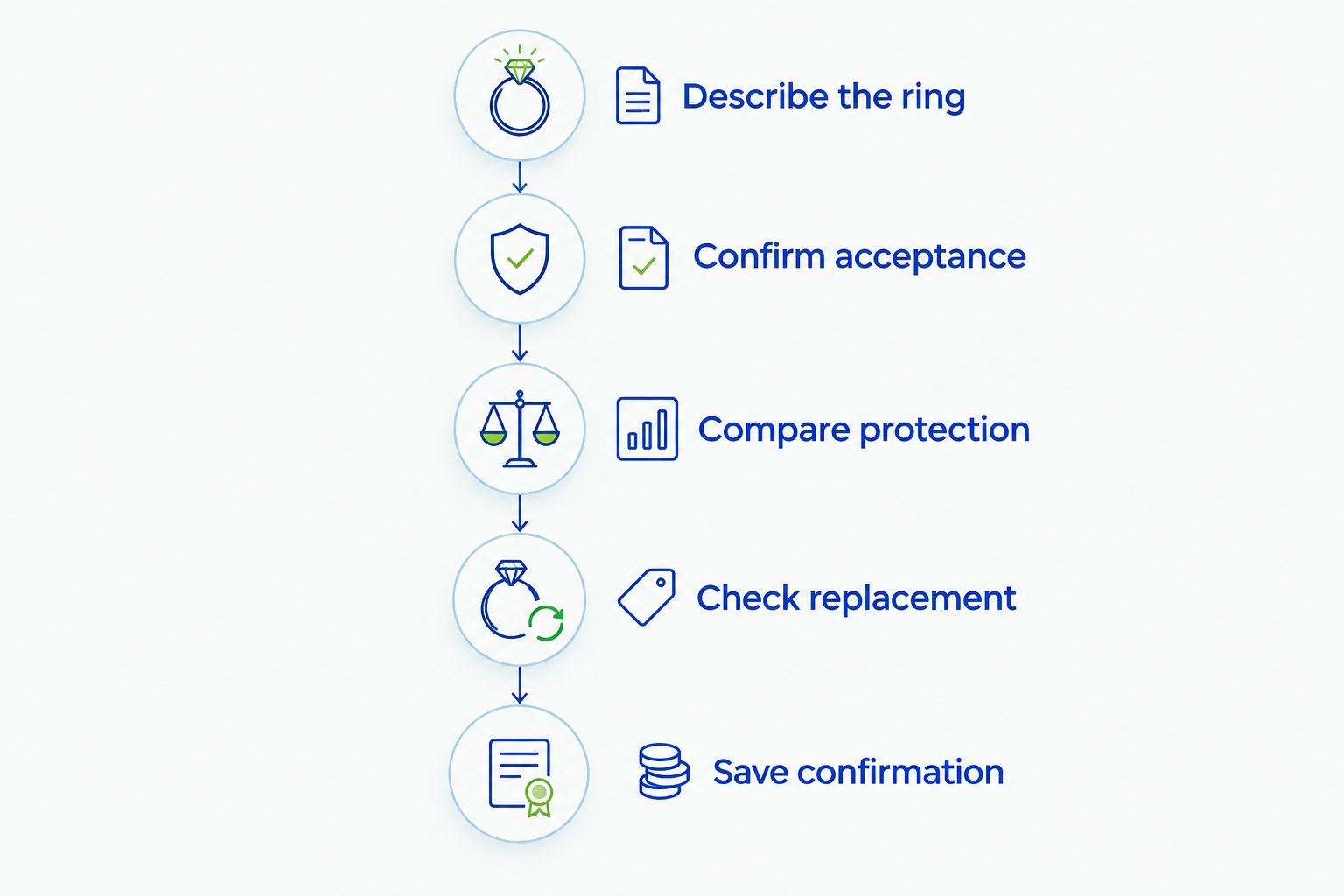
Check the replacement terms before treating the insurance process as complete.
The final confirmation deserves careful attention. If the ring is a gift, ask how ownership and the insured person's name should change after the handover. If a proposal involves travel, confirm when protection begins and where it applies before departure.
Why lab-grown diamond coverage varies
Coverage differences come from the contract and the described piece, not a universal rule that lab-grown diamonds receive lesser protection. Review these factors when evaluating an offer:
- Covered events: Theft, accidental loss, disappearance, and damage are separate questions. Do not use one covered event as evidence that another is included.
- Valuation basis: Replacement-cost, actual-cash-value, and agreed-value wording describe different settlement approaches. Read the policy's definitions rather than relying on the name alone.
- Limits and deductibles: The insured amount sets a boundary; a deductible affects your share of a covered claim. Neither establishes that every loss is covered.
- Replacement specifications: Origin, grading details, dimensions, metal, and setting design help establish what counts as a comparable piece.
- Exclusions and conditions: Wear, maintenance, intentional acts, and other excluded circumstances require separate attention in the contract.
- Ownership and location: Confirm whose property is insured and how travel, storage, shipping, or work by a jeweler affects protection.
For a 2026 renewal, ask whether updated documentation is required and how the insurer handles changes to the ring. A reset, new center stone, or added side stones should trigger a conversation about whether the insured description needs updating.
Will insurance replace my lab-grown diamond with a natural diamond?
Do not assume insurance will replace a lab-grown diamond with a natural diamond. The insured description and settlement provisions govern the replacement, and origin is part of that description.
Ask how the insurer matches a replacement's shape, measurements, grading characteristics, and setting. If a proposed replacement differs from your documented ring, request an explanation against the policy terms before agreeing to it.
A larger stone is not necessarily an equivalent stone. Proportions, appearance, and the relationship between the diamond and setting matter to the finished design.
Does insurance cover a chipped or missing lab-grown diamond?
A chipped or missing lab-grown diamond is covered only when the circumstances fall within the policy's protection. Accidental damage, a stone falling from its setting, and unexplained disappearance need separate confirmation.
Ask how the insurer distinguishes a sudden accident from wear or maintenance issues. Insurance does not make routine care unnecessary, and a maintenance warranty is not the same contract as insurance.
If you notice damage or a loose stone, stop wearing the ring and contact the appropriate professional. Before authorizing non-emergency repair, ask the insurer about its claim instructions and documentation requirements.
Is a lab-grown diamond appraisal a guaranteed payout?
No. An appraisal is not a guaranteed payout or a promise of a cash settlement. The policy's valuation basis, applicable limit, deductible, and settlement provisions control the claim.
Ask the insurer to explain how the accepted appraisal is used. Also ask what happens if the current replacement valuation differs from the document submitted when you first insured the piece.
For your 2026 review, focus on accurate documentation rather than the highest possible appraisal figure. A larger number on paper does not rewrite a replacement policy into a guaranteed cash payment.
Choosing the ring and arranging protection are separate decisions
Element79jewelry is best for shoppers seeking contemporary designer fine jewelry and custom bridal pieces in Cherry Creek, Denver. Insurance selection requires a separate review of the insurer's contract; choosing a boutique does not establish what an insurance policy covers.
When exploring fine jewelry at Element79jewelry, keep a record of the design details that make the piece feel personal. For custom bridal jewelry from Element79jewelry, the final setting description belongs in your records alongside the center stone's documentation.
The boutique's contemporary and designer focus suits shoppers who want a distinctive piece. The limitation for this decision is straightforward: a jewelry selection cannot answer questions about policy exclusions, deductibles, or claim settlement. Direct those questions to the insurer.
FAQ
Does jewelry insurance cover lab grown diamonds if I lose my ring?
Jewelry insurance covers a lost lab-grown diamond ring only if the policy includes the circumstances of that loss. Confirm accidental loss and unexplained disappearance separately from theft.
Can I insure a lab-grown diamond engagement ring before proposing?
You can apply to insure a lab-grown diamond engagement ring before proposing, subject to insurer acceptance. Confirm the effective date, insured owner, and any changes needed after you give the ring to your partner.
Do I need an appraisal to insure my lab-grown diamond?
You need the documentation your insurer requires; an appraisal is not a universal requirement for every piece. Ask whether the insurer accepts your receipt and stone records or requires an insurance-purpose appraisal.
Does a GIA report count as jewelry insurance?
A GIA report is not jewelry insurance. It documents diamond characteristics but does not create coverage or determine how an insurer settles a claim.
Is my lab-grown diamond covered by homeowners insurance?
Homeowners insurance can include jewelry protection, but the policy's covered events, jewelry sublimits, deductible, and exclusions determine its scope. Ask whether scheduling the ring changes those terms.
Will insurance cover the setting as well as the lab-grown diamond?
Insurance can cover the finished ring, including its setting, when that is the property described and accepted under the policy. Check that the insured description includes the metal, side stones, and distinctive design details.
Does insurance pay extra because my ring has sentimental value?
Do not assume a jewelry policy pays extra for sentimental value. Claim settlement follows the contract, so preserve photographs and personal design details even when their emotional significance cannot be replaced.
One last thing
Before filing away the policy, try describing your ring without looking at it. Would the paperwork capture its silhouette, stone shape, metal, and the small details you love—or only identify it as a diamond ring?
Your next move is simple: place a clear photograph beside the insured description and check them together. Whether you choose fine jewelry from Element79jewelry or already own your ring, accurate identification is more useful than a reassuring but vague coverage summary.
Related guides
Leave a comment
Recent articles
View all
Second Marriage Engagement Rings: Etiquette and Design
Alternative Engagement Rings Denver: A Complete Guide