
Do you pay sales tax on custom jewelry orders in Colorado?

Yes, you generally pay sales tax on custom jewelry orders in Colorado because you are buying a finished physical item, even when it is made just for you. Colorado’s state sales tax rate is 2.9% in 2026, but applicable local taxes add to that rate. Fabrication labor included in making your new piece generally belongs in the taxable selling amount, so do not assume tax applies only to the metal and gemstones.
TL;DR
- Colorado generally charges sales tax on custom jewelry orders; a one-of-a-kind design is not automatically exempt.
- Colorado’s 2.9% state sales tax is not the complete rate when local taxes apply.
- Fabrication labor and repair labor have different tax treatment; ask how your invoice classifies the work.
- Element 79 offers custom bridal jewelry for couples seeking a contemporary Denver boutique.
Why this matters
A custom ring starts with something personal: a favorite stone, an unexpected silhouette, or a detail that belongs to your story. The tax question is more practical. You need to know whether your written estimate includes tax before you approve the design.
If you are still exploring the process, start with how custom jewelry design works in Denver. Then keep the design decisions and the tax calculation together in your order paperwork, rather than treating tax as a surprise at collection.
The useful number is your complete, tax-inclusive order total—not the design subtotal alone. Ask for both, with the assumptions behind the tax calculation clearly stated.
Do you pay sales tax on custom jewelry orders in Colorado?
Yes. Under Colorado Department of Revenue guidance on retail sales of tangible personal property, a newly made piece of jewelry is generally taxable. Choosing the shape, stone, setting, or engraving does not turn the finished piece into a tax-exempt service.
For a 2026 purchase, distinguish the statewide rules from the rules of a self-collecting home-rule city. Colorado’s Sales Tax Guide explains state-administered taxes; a city that administers its own sales tax can have different local requirements. Denver is a home-rule city, so its guidance matters for a Denver transaction.
New custom ring made with materials supplied by the jeweler
- General tax treatment: Generally a taxable retail sale
- What to confirm: Taxable selling amount and applicable jurisdictions
Fabrication labor used to create the new piece
- General tax treatment: Generally included in the taxable sale
- What to confirm: Whether the estimate includes the making of the finished item
Repair of jewelry you already own
- General tax treatment: Different rules apply to repair labor and materials
- What to confirm: Separate charges and applicable local treatment
Pickup at the jewelry store
- General tax treatment: Generally sourced to the pickup location
- What to confirm: Store location used for tax calculation
Seller-arranged delivery to a Colorado address
- General tax treatment: Generally subject to destination-based sourcing
- What to confirm: Exact delivery address and applicable local taxes
Seller-arranged shipment outside Colorado
- General tax treatment: Requires interstate-sale analysis
- What to confirm: Delivery documentation and destination-state obligations
This table describes transaction types, not a particular boutique’s billing policy. A custom order is not exempt simply because its invoice includes design or labor.
What supports the answer?
Colorado Department of Revenue’s Sales Tax Guide addresses taxable retail sales, the purchase amount, sourcing, and exemptions. Its guidance on service enterprises also distinguishes selling a finished item from performing a service on property a customer already owns.
For 2026 planning, use those state materials alongside the applicable city’s current sales-tax guidance. Ask your jeweler to explain any exemption or excluded charge by reference to the rule that applies to your transaction—not just the description printed on the invoice.
New custom jewelry: fabrication belongs in the tax discussion
When you commission a new ring, you are buying the completed ring. The work that brings it into being is part of that transaction, rather than automatically a separate, exempt service.
That distinction matters when an estimate lists materials and workmanship separately. Separating fabrication labor on paper does not, by itself, remove that labor from the taxable selling amount. A line labeled design, casting, setting, or finishing needs to be evaluated according to what the charge actually covers.
Ask whether a design charge is part of the finished-jewelry sale or a genuinely separate transaction. Do not decide its tax treatment from its name alone. A drawing commissioned independently and a drawing included in producing your ring are not necessarily the same tax situation.
If you revise the design after approving the estimate, request updated paperwork. The final invoice should reflect the approved work and its tax treatment, rather than leaving you to reconcile an earlier sketch with a later total.
Repairs and heirloom redesigns need a closer look
A repair is not the same transaction as making a new piece. Under Colorado state rules, separately stated repair labor is generally not taxable, while repair materials and parts are generally taxable. Local home-rule rules still need their own review.
An heirloom project can sit near that boundary. Tightening a setting on an existing ring differs from creating an entirely new mounting around a family diamond. Calling both projects a repair does not make their tax treatment identical.
Describe the work before asking whether the labor is taxable. Tell the jeweler what you already own, what will remain in the finished piece, and what new materials or components the project requires.
For a customer-owned stone, ask the invoice to distinguish the property you supplied from new items the jeweler sells you. Do not assume that bringing a diamond eliminates sales tax on a new setting or the work of fabricating a new ring.
Pickup and delivery can change the applicable taxes
For Colorado state-administered sales taxes, sourcing generally follows where you receive the jewelry. Taking possession at a store and receiving seller-arranged delivery at home are different circumstances, even when the design appointment happens in the same place.
Store pickup gives you a defined place of receipt, but the applicable local taxes follow that location. Delivery lets you receive the piece elsewhere, but requires the correct destination address and applicable jurisdiction review. Neither choice is automatically a tax-saving recommendation.
Your billing address is not necessarily your delivery address. A credit card registered outside Colorado does not make a Colorado store pickup an out-of-state sale.
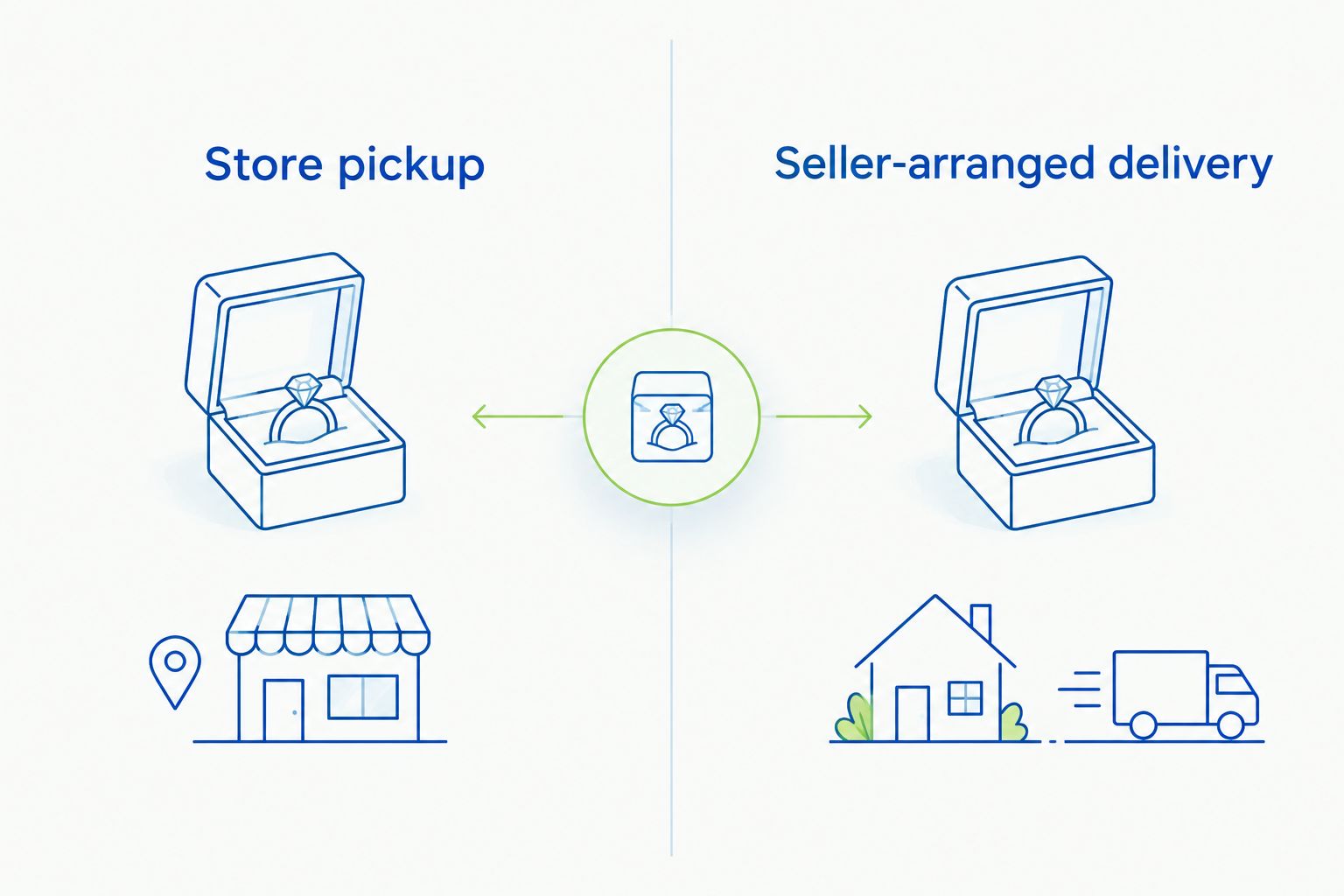
Where you receive the jewelry matters more than where you discuss the design.
For a 2026 order, confirm the intended handoff before relying on an estimate. If you change from delivery to pickup, or change the delivery destination, ask for the tax calculation to be reviewed.
Why sales tax on custom jewelry orders varies in Colorado
The custom design itself is not what creates different local rates. The transaction details determine which rules and taxes apply.
- Place of receipt: Store pickup and seller-arranged delivery can source the sale to different locations.
- Local jurisdictions: City, county, and special-district taxes can add to Colorado’s state tax.
- Home-rule administration: A self-collecting city can apply local requirements that need separate review.
- Type of work: New fabrication and repair work are not interchangeable tax categories.
- Invoice contents: New materials, fabrication, repair labor, and other charges need accurate classification.
- Interstate delivery: Shipment outside Colorado introduces destination-state rules and documentation requirements.
Avoid using a statewide percentage as your complete estimate. Colorado’s 2.9% state rate is only the state component; it does not establish the combined rate for every address.
How do you check the tax before approving your order?
You do not need to become a tax specialist to read a jewelry estimate. You need a clear description of the sale and a calculation that matches it.
- Confirm the scope. Identify whether you are ordering new jewelry, repairing an existing piece, or commissioning an heirloom redesign.
- Identify supplied property. Record any diamond, gemstone, or existing jewelry you provide separately from new materials.
- Confirm receipt. Specify store pickup or seller-arranged delivery, including the complete destination address.
- Review the taxable amount. Ask which charges enter the tax calculation and which, if any, are excluded.
- Request the combined rate. Confirm that the calculation includes the applicable state and local components.
- Keep the final paperwork. Retain the approved scope, invoice, payment records, and any delivery documentation.
An estimate should make the distinction between subtotal, tax, and final total easy to follow. If the tax line changes, ask whether the reason is a revised design, a different destination, a corrected classification, or a rate change.
For 2026 purchases, an older receipt from another piece is not a substitute for the current calculation. Even an identical-looking ring can involve a different place of receipt or a different mix of work.
Is custom jewelry taxed only on the materials?
No. Colorado’s 2.9% state sales tax generally applies to the taxable selling amount of new custom jewelry, not just its metal and stones. Fabrication labor generally remains part of that amount, and local taxes can also apply.
Does shipping my ring outside Colorado remove all tax?
No. Colorado’s 2.9% state rate is not the only tax question: qualifying seller-arranged interstate delivery can change Colorado treatment, while the destination state can impose sales or use tax. Picking up the ring in Colorado and carrying it elsewhere is not the same as documented seller-arranged delivery outside the state.
Is repair labor taxed the same as custom fabrication?
No. Colorado’s 2.9% state tax generally treats separately stated repair labor differently from fabrication included in a new jewelry sale. Ask for a classification based on the actual work, and confirm the applicable home-rule city treatment separately.
Choosing a custom bridal boutique without tax surprises
Element 79 is best for couples seeking contemporary custom bridal jewelry in a Cherry Creek, Denver boutique. Its custom bridal offering is relevant when you want the ring’s design to feel personal rather than simply choosing a finished style.
That creative scope also makes an itemized estimate important. A custom bridal order needs its own tax review; the boutique setting does not create a tax exemption. Bring the same attention to the paperwork that you bring to the stone and silhouette.
When discussing custom bridal jewelry with Element 79, ask for the proposed work, intended receipt location, and tax treatment to be clear before approval. This is a request for transaction-specific information, not an assumption about the boutique’s deposit terms, delivery arrangements, or billing policies.
FAQ
Do I pay Colorado sales tax on a custom engagement ring?
Yes, a new custom engagement ring is generally a taxable retail purchase in Colorado. Colorado’s state rate is 2.9% in 2026, with applicable local taxes added.
Is the labor to make my custom ring tax-free?
No, fabrication labor included in creating a new ring is generally part of the taxable selling amount. Listing labor separately does not automatically make it exempt.
Will I pay tax again on a family diamond I already own?
Supplying your own diamond is different from buying a diamond from the jeweler. Ask the invoice to distinguish your existing property from the new setting, materials, and fabrication being sold to you.
Does living outside Colorado make my store pickup tax-free?
No, an out-of-state home or billing address does not automatically exempt a Colorado store pickup. Where you receive the jewelry is central to the sourcing analysis.
Do I pay sales tax twice if I make a deposit?
A deposit and a balance payment should be reconciled to the same order so the taxable sale is not counted twice. Ask how any tax collected with earlier payments is credited on the final invoice.
Is jewelry repair labor taxable in Colorado?
Separately stated repair labor is generally not subject to Colorado state sales tax, while repair parts and materials generally are. Confirm the applicable home-rule city rules separately.
Where can I confirm the tax rules for my custom order?
Use the Colorado Department of Revenue’s Sales Tax Guide for state-administered taxes and the applicable city’s guidance for self-collected local taxes. Ask your jeweler to explain how those rules apply to your invoice.
One last thing
An out-of-state billing address is not an out-of-state delivery. That small distinction can matter more to the tax calculation than how many appointments or design revisions your ring requires.
Before approving custom bridal jewelry at Element 79 in 2026, put the intended handoff in writing alongside the design. This article provides general tax information, not individualized tax advice; transaction-specific questions belong with the relevant tax authority or your tax adviser.
Related guides
Leave a comment
Recent articles
View all
Second Marriage Engagement Rings: Etiquette and Design

Alternative Engagement Rings Denver: A Complete Guide