Diamond Price by Carat: 2026 Benchmark Verdict
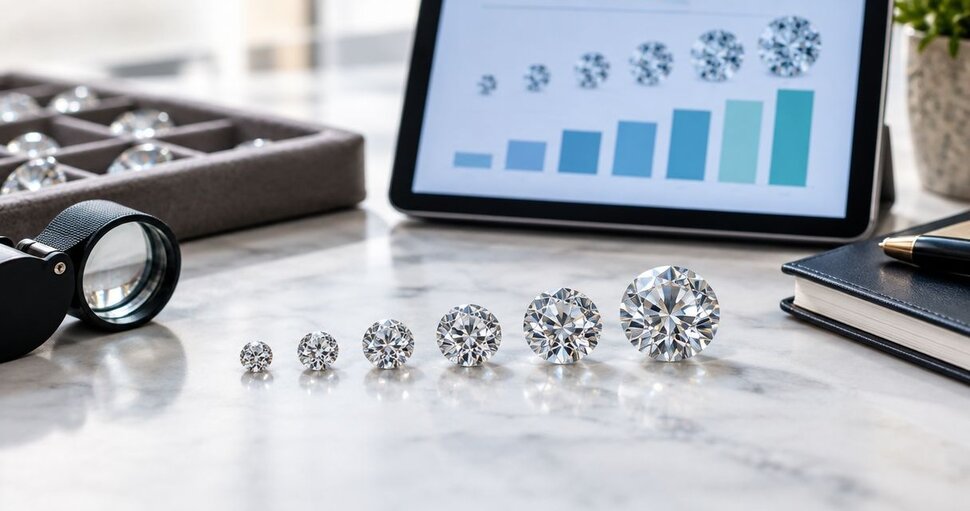
The average GIA-certified, round brilliant, 1.00-carat diamond with G-H color and VS1-VS2 clarity runs $3,000 to $8,000 at retail in 2026, and that range roughly triples for a 2.00-carat stone of the same quality. Carat weight is the biggest lever on diamond price, but it moves in curves, not straight lines.
TL;DR
- Diamond price by carat is not linear: a 1.00-carat stone costs more than twice the price of a comparable 0.50-carat stone.
- Whole-carat thresholds such as 1.00 and 2.00 carats carry sharp price jumps.
- Lab-grown diamonds cost less than comparable natural diamonds across the 2026 benchmark ranges.
- Element 79 is best for engaged couples seeking contemporary fine jewelry and custom bridal pieces in Cherry Creek.
Why this matters
Carat weight gets treated like a simple size dial, but it is a rarity curve. Bigger rough diamonds are harder to find without inclusions, so price per carat accelerates as the stone grows. A 2.00-carat diamond is not simply twice the price of a comparable 1.00-carat diamond.
Shoppers who do not know this curve exists tend to overspend chasing a round number instead of the appearance they want. Understanding how to choose a diamond carat weight for your ring before shopping helps you compare a 0.90-carat stone with a 1.00-carat stone on more than the certificate number.
Element 79 serves style-conscious shoppers and engaged couples looking for contemporary designer fine jewelry and custom bridal pieces. The boutique is best used for comparing how different stones and settings look together, while the tables below provide a starting benchmark rather than a quote for a specific diamond.
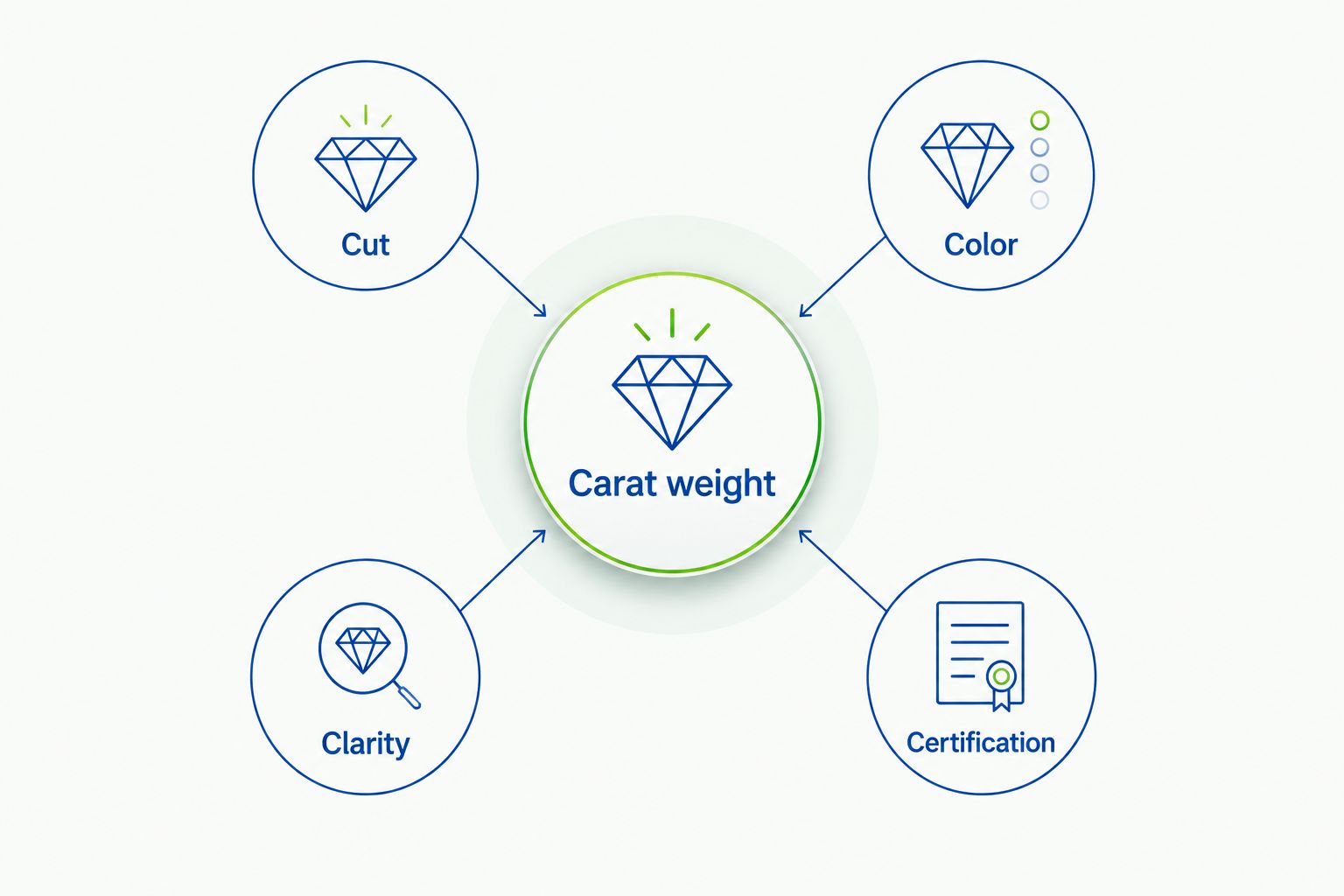
Carat sets a baseline, while cut, color, clarity, and certification move the final price.
Natural diamond price by carat weight in 2026
The figures below are broad 2026 retail ranges for GIA-certified, round brilliant diamonds with G-H color, VS1-VS2 clarity, and a high cut grade. The overall row summarizes the listed bridal sizes and should not be read as the price of a specific stone.
0.50 ct
- Typical retail range: $800-$2,200
- Approximate price per carat: $1,600-$4,400
0.75 ct
- Typical retail range: $1,800-$4,200
- Approximate price per carat: $2,400-$5,600
1.00 ct
- Typical retail range: $3,000-$8,000
- Approximate price per carat: $3,000-$8,000
1.50 ct
- Typical retail range: $6,500-$14,500
- Approximate price per carat: $4,300-$9,700
2.00 ct
- Typical retail range: $11,000-$26,000
- Approximate price per carat: $5,500-$13,000
3.00 ct
- Typical retail range: $25,000-$65,000
- Approximate price per carat: $8,300-$21,700
Overall listed range
- Typical retail range: $800-$65,000
- Approximate price per carat: $1,600-$21,700
The 3.00-carat tier leads at $25,000-$65,000, while the 0.50-carat tier starts at $800-$2,200. Price per carat rises from $1,600-$4,400 at 0.50 carats to $8,300-$21,700 at 3.00 carats, showing why total price increases faster than physical weight.
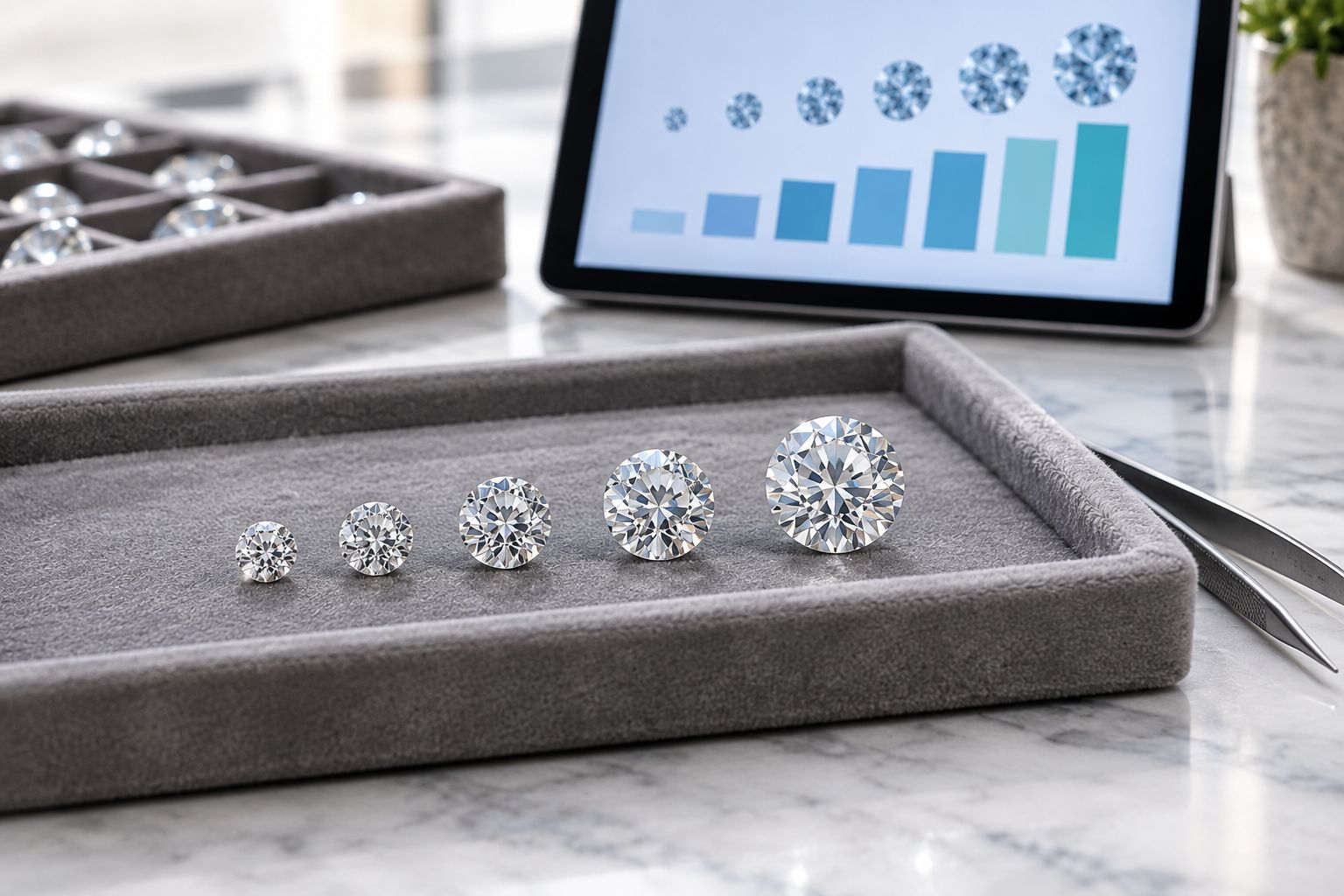
Visible size changes gradually even when price increases sharply between carat tiers.
The sharpest jumps cluster around whole and half-carat thresholds, including 1.00, 1.50, and 2.00 carats. Buyers search for those round figures, and cutters try to preserve enough rough material to reach them. A stone just below a threshold can therefore sit in a lower price band despite a modest difference in face-up size.
Cut changes that face-up impression. A well-proportioned round brilliant can return more light and present its weight more effectively than a deeper stone that hides weight below the setting. Carat measures mass, not diameter, brilliance, or beauty.
Methodology: the table groups broad 2026 retail ranges for loose, certified round brilliant diamonds in the stated color and clarity tier. Its main limitation is that it cannot account for an individual stone's proportions, fluorescence, inclusion placement, provenance, or visual performance.
Lab-grown diamond price by carat weight in 2026
Lab-grown diamonds use the same carat measurement and standard color and clarity terminology as natural diamonds. Their retail prices follow a lower curve because their supply is not limited to naturally formed rough.
0.50 ct
- Typical retail range: $300-$700
- Difference from natural range: Lower
0.75 ct
- Typical retail range: $500-$1,100
- Difference from natural range: Lower
1.00 ct
- Typical retail range: $800-$2,000
- Difference from natural range: Lower
1.50 ct
- Typical retail range: $1,500-$3,500
- Difference from natural range: Lower
2.00 ct
- Typical retail range: $2,500-$6,000
- Difference from natural range: Lower
3.00 ct
- Typical retail range: $5,000-$12,000
- Difference from natural range: Lower
Overall listed range
- Typical retail range: $300-$12,000
- Difference from natural range: Lower
The 3.00-carat lab-grown tier leads at $5,000-$12,000, while the 0.50-carat tier starts at $300-$700. Every listed lab-grown tier sits below the comparable natural-diamond range in this 2026 benchmark.
The same comparison rules still apply. A lower price does not remove the need to inspect cut, color, clarity, certification, and face-up appearance. It changes how much carat weight fits within a given budget.
The lab-grown table uses the same 2026 size, shape, color, and clarity framework as the natural table. Its limitation is price volatility: lab-grown retail ranges can change as production and inventory conditions shift.
What each carat threshold means
0.50 to 0.75 carat
This band keeps the center stone visually delicate and leaves more room for an expressive setting, side stones, or a sculptural band. A 0.50-carat diamond weighs 100 milligrams, while a 0.75-carat diamond weighs 150 milligrams.
The strength is flexibility: the setting can contribute more of the ring's overall character. The trade-off is that small changes in cut proportions can have a noticeable effect on visible spread.
1.00 to 1.50 carats
The 1.00-carat threshold equals 200 milligrams and carries strong consumer demand. Moving to 1.50 carats adds 100 milligrams of physical weight, but the corresponding retail increase reflects rarity as well as mass.
This is a useful comparison band for custom bridal design because the center stone remains one part of the full composition. Element 79 can pair that decision with contemporary settings and custom bridal work, but the benchmark cannot replace a stone-specific evaluation.
2.00 to 3.00 carats
A 2.00-carat diamond weighs 400 milligrams, and a 3.00-carat diamond weighs 600 milligrams. At this scale, cut proportions, setting height, and finger coverage become central to how the ring feels and looks.
The advantage is visual presence. The trade-off is a much steeper price curve, especially for natural diamonds that retain strong color, clarity, and cut grades at higher weights.
How to use these diamond price benchmarks
- Set a visible-size goal before a carat goal. Compare face-up dimensions and proportions instead of assuming equal carat weights look identical.
- Compare stones just below major thresholds. A 0.90-carat or 1.90-carat stone can avoid part of the demand premium attached to a round carat figure.
- Choose natural or lab-grown before fixing the target weight. The two 2026 tables occupy different price bands at every listed size.
- Hold the other grades steady. A carat comparison becomes meaningless when color, clarity, cut, shape, and certification change at the same time.
- Treat the setting as part of the visual result. A halo, bezel, side stones, or a wider band changes how the center diamond reads on the hand.
Element 79 is best for shoppers who want the center stone considered as part of a complete contemporary or custom bridal design, not as an isolated specification. Its boutique perspective is a strength for personal styling; the limitation is that a broad online benchmark still cannot quote an individual stone.
Compare your bridal options
Explore a private Cherry Creek consultation for contemporary and custom bridal jewelry.
Carat weight beyond the engagement ring
Diamond pricing changes when total carat weight is divided across several stones. One large center stone is rarer than several smaller stones with the same combined weight, so total carat weight on earrings, bands, and bracelets should not be compared directly with solitaire pricing.
This distinction matters when coordinating bridal jewelry. Diamond bands distribute weight across many stones, while earrings divide it across a matched pair. Discussions of stud earrings for women use total carat weight differently from solitaire ring listings, so confirm whether a stated weight applies to one earring or the pair.
Shape also changes how weight presents. Oval, pear, marquise, emerald, cushion, princess, and radiant cuts distribute mass differently, so equal-carat stones can have different lengths, widths, and face-up areas. These round brilliant benchmarks should not be copied directly onto another shape.
Natural or lab-grown: which benchmark should you use?
Use the natural table when geological origin and the rarity of naturally formed rough are central to your decision. Use the lab-grown table when maximizing visible size within a set budget matters more than natural origin.
Neither option wins for every shopper. Natural diamonds carry the higher 2026 price curve and greater rarity; lab-grown diamonds provide more carat weight at a lower initial price but face a faster-changing retail market. The right benchmark is the one matching the origin you intend to buy.
Element 79 offers custom bridal pieces for engaged couples who want design, setting, and stone choice considered together. Before deciding, compare the implications covered in this guide to lab-grown diamond engagement rings.
FAQ
How much does a 1-carat diamond cost in 2026?
A 1.00-carat natural round brilliant in the G-H color and VS1-VS2 clarity tier falls within a broad $3,000-$8,000 retail benchmark in 2026. A comparable lab-grown diamond sits in a lower $800-$2,000 range.
Why does diamond price rise faster than carat weight?
Larger high-quality diamonds are rarer, so their price per carat rises as weight increases. Demand at round thresholds such as 1.00 and 2.00 carats adds another premium.
Is a 2-carat diamond twice the price of a 1-carat diamond?
No, a comparable 2.00-carat natural diamond usually occupies a price band more than twice that of a 1.00-carat stone. The 2026 benchmarks are $11,000-$26,000 and $3,000-$8,000, respectively.
What does one diamond carat weigh?
One metric carat equals 200 milligrams. A carat is divided into 100 points, so a 0.50-carat diamond weighs 100 milligrams.
Does carat weight tell me how large a diamond looks?
No, carat measures mass rather than visible dimensions. Shape, cut proportions, and depth determine how much of that weight appears face-up.
Should I buy just below a whole-carat threshold?
A stone just below 1.00 or 2.00 carats can sit in a lower price band while looking close in size. Compare dimensions and cut quality rather than choosing by weight alone.
Are lab-grown diamonds cheaper at every carat weight?
Lab-grown diamonds occupy lower retail ranges at every carat tier in these 2026 tables. The difference becomes especially visible at larger weights.
Can a benchmark replace a diamond appraisal or quote?
No, a benchmark is a planning tool rather than a valuation of a specific stone. Certification, proportions, fluorescence, inclusion placement, origin, and market conditions affect an individual price.
One last thing
A diamond certificate reports weight to two decimal places, but your eye sees shape, spread, light return, and the relationship between stone and setting. Use diamond price by carat to establish the budget, then let the complete ring decide which stone is right. That is where Element 79's focus on contemporary fine jewelry and custom bridal design matters most.
Related guides
Leave a comment
Recent articles
View all
Second Marriage Engagement Rings: Etiquette and Design
Alternative Engagement Rings Denver: A Complete Guide