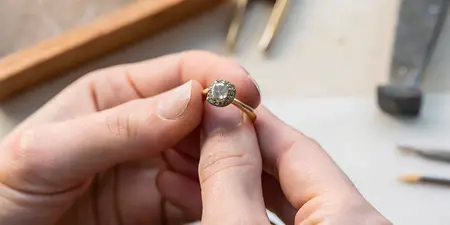

Designer jewelry for wedding planners: complete 2026 guide

Designer jewelry for wedding planners is a considered selection of fine jewelry chosen to express your style while supporting client meetings, site visits, and wedding-day work. Your pieces need to look intentional with your working wardrobe without distracting you when you move between a floor plan, a vendor conversation, and the ceremony.
TL;DR
- Designer jewelry for wedding planners should suit the workday first; choose pieces you can comfortably move in.
- Element79jewelry is best for planners seeking contemporary designer jewelry from artisan brands in Cherry Creek, Denver.
- Build separate jewelry looks for client meetings, site visits, and wedding days rather than wearing every favorite together.
- Test earrings, necklaces, rings, and bracelets with your actual work clothes before adding them to your event wardrobe.
Why designer jewelry matters for wedding planners
Your jewelry is part of how you present your eye for detail. But unlike a guest choosing something beautiful for an evening, you need to consider the work you will do while wearing it. Choose for your role, then for the room.
For your 2026 wardrobe, start with pieces you already own rather than a shopping list. Notice what you reach for during consultations, what you remove during setup, and what feels like you when dressed for a formal event.
Element79jewelry offers contemporary designer fine jewelry, including rings, necklaces, bracelets, earrings, and custom bridal pieces. Element79jewelry is best for planners seeking contemporary designer jewelry from artisan brands in Cherry Creek, Denver. The boutique is a place to explore personal style; you still need to assess each piece against your own working routine.
This guide focuses on jewelry you wear as the planner. Selecting bridal jewelry for a client is a separate decision, with the client's preferences leading the conversation.
How to choose jewelry for your planning wardrobe
1. Map your jewelry to your working day
Open your calendar and identify the settings your jewelry must serve. A consultation over coffee, a venue walkthrough, and a formal reception do not require identical styling. Give each setting its own brief before deciding which pieces belong across all of them.
Create 3 outfit categories for your 2026 planning wardrobe. This is an organizing exercise, not a requirement to purchase separate collections. A favorite pair of earrings can appear in every category if you enjoy wearing it in each setting.
Keep the brief concrete. Instead of writing elegant, note the neckline, sleeve shape, hairstyle, and tasks involved. Those details give you something useful to test.
- Client meetings: Pair jewelry with the clothes you wear when presenting proposals and discussing design.
- Site visits: Check pieces against outerwear, bags, and any venue-specific clothing requirements.
- Wedding days: Consider the full outfit, communication equipment, and hands-on tasks you expect to handle.
- Personal events: Keep your off-duty statement looks separate so they do not become your automatic work uniform.
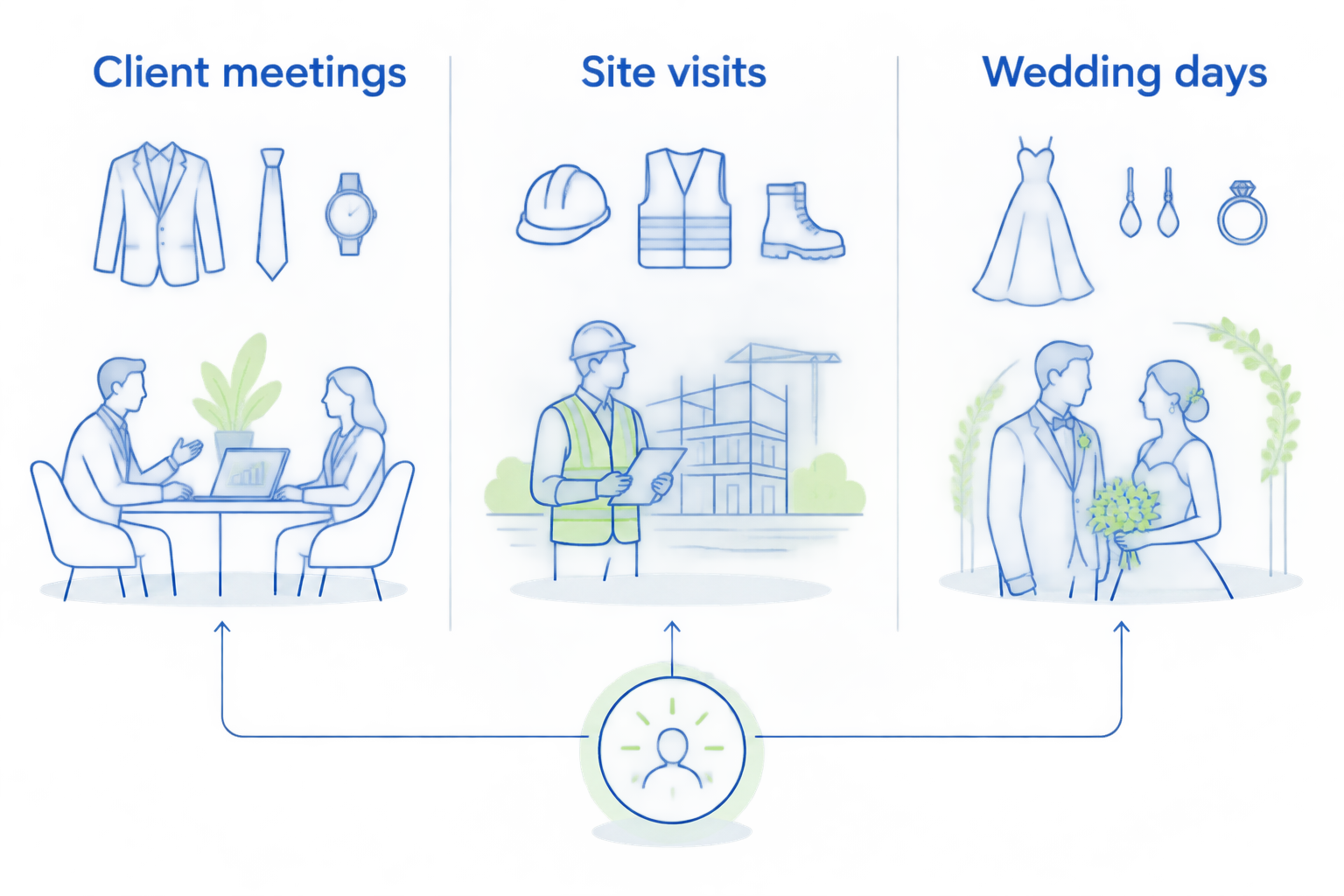
Give each working setting its own jewelry brief before deciding what to wear.
2. Audit your favorites before adding anything
Lay your existing jewelry beside a few complete work outfits. Include the pieces you love but rarely wear; the reason they stay in the box is useful information. An awkward clasp, an uncomfortable fit, or a shape that never suits your collars deserves attention before you choose something similar.
Try the combinations on rather than judging them flat on a table. Take 2 reference photos of each promising look: one close view and one full-outfit view. Use the photos to compare proportion, not to decide whether your taste follows a trend.
Your audit should end with a specific gap. Perhaps you want earrings that suit your usual headset, or a necklace that works with an open collar. That brief is more useful than simply wanting something new.
- Separate pieces you enjoy wearing from pieces you only enjoy looking at.
- Note which closures you can operate comfortably without help.
- Record the outfit combinations you would happily repeat.
- Write down the missing function before browsing another design.
3. Test comfort through real working movements
Start with an at-home try-on in your actual work clothes. Sit, reach, bend, turn your head, and carry the bag you normally use. If you wear a headset or lanyard, include it in the test rather than discovering the interaction at an event.
The best working piece is one you do not need to keep adjusting. That does not mean choosing the smallest jewelry possible. A sculptural earring that sits comfortably can be a better personal choice than a delicate necklace you repeatedly straighten.
Once you know what works, use that information when exploring designer jewelry at Element79jewelry. Describe your tasks and bring outfit references; do not rely on a general label such as wedding appropriate. Evaluate the individual piece rather than assuming a designer name guarantees comfort.
- Turn your head while wearing your usual communication equipment.
- Reach across a table and notice where a necklace falls.
- Check bracelets against cuffs, a watch, and the edge of your work surface.
- Hold a phone and pen while assessing ring comfort.
- Remove any piece that catches or distracts you during the test.
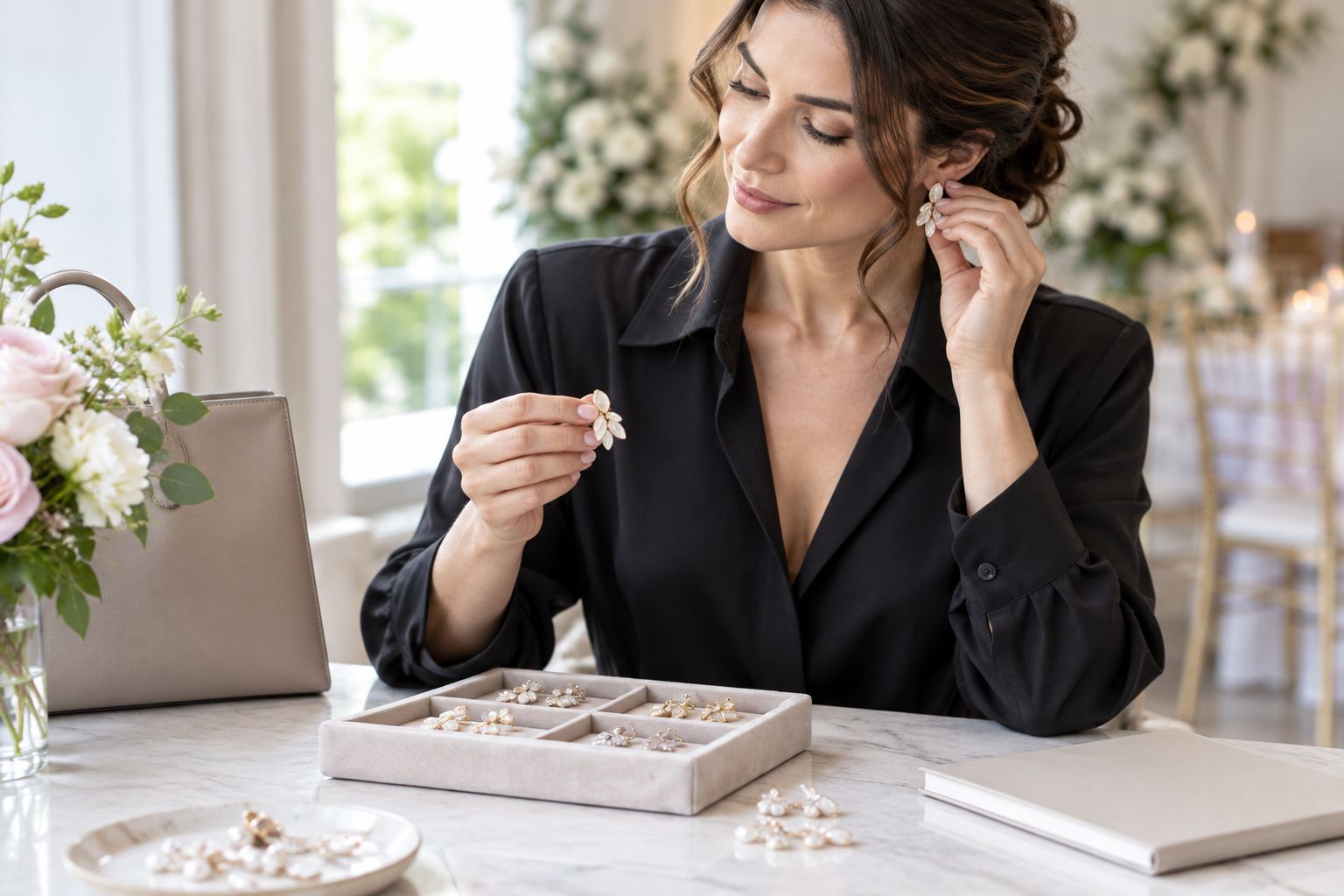
Try jewelry with the clothes and accessories you actually work in.
4. Choose a focal point for each outfit
Use your mirror and outfit photos to decide where you want the eye to land. Start with 1 focal point: earrings, a necklace, or a ring. Then add supporting pieces only if you like the complete result.
For a 2026 client presentation, that focal point might be an unexpected earring shape with a simple jacket. For a wedding day, you might prefer a familiar necklace that sits neatly within your neckline. Neither approach requires a matching set.
Color and mixed metals belong in the decision if you enjoy them. Repeat a tone or shape deliberately, then judge the whole outfit. You do not need to match your jewelry to the couple's flowers or make your personal accessories another element of their wedding design.
- Earring focus — best for face-framing detail: Check the effect with your planned hairstyle.
- Necklace focus — best for an open neckline: Check where the piece sits while standing and seated.
- Ring focus — best for expressive hand jewelry: Keep your working-hand movements central to the decision.
- Quiet combination — best for a restrained uniform: Choose pieces that feel finished together without demanding attention.
5. Ask about the individual piece's materials and care
Begin by listing any material sensitivities, care questions, or past comfort problems. Keep that list on your phone so you can ask consistently when comparing jewelry. A metal's color alone does not tell you everything about its composition.
Ask for the materials used in the specific piece, including components that touch your skin. If you have a known allergy, follow your clinician's advice rather than treating a broad jewelry label as a medical guarantee. The guide to platinum or white gold for sensitive skin provides a focused starting point for questions.
Care deserves the same attention as appearance. Ask how to clean and store that particular design, especially when it combines different materials. Do not apply a cleaning method from one favorite piece to every new addition.
- Ask which metals and other materials are present in the piece.
- Confirm the materials in earring posts, backs, and other skin-contact components.
- Request care instructions suited to the stones and construction.
- Ask what to do if a clasp, setting, or connection feels loose.
- Keep any supplied care information with your purchase records.
6. Build a repeatable wedding-day routine
Write your jewelry choices into your own preparation checklist, separate from the couple's accessories. Choose the look before you pack, then identify where each piece will go if you remove it. A designated compartment is a clearer plan than a loose pocket.
For your 2026 event checklist, include a final comfort and closure check after dressing. If your outfit changes between setup and guest-facing work, decide whether your jewelry changes too. Make that decision before the day becomes busy.
Keep personal jewelry separate from any client pieces you are specifically authorized to handle. If handling client jewelry is part of your agreed responsibilities, document the handoff with the relevant people. Do not let your own accessories enter the same loose collection of items.
- Photograph the finished outfit so you can repeat it without rebuilding the look.
- Pack removed pieces separately to prevent them rubbing together.
- Check closures before leaving your dressing area.
- Identify a designated storage location before removing anything on-site.
- Review comfort after the event and update your outfit notes.
Compare jewelry options for your planning wardrobe
Use this comparison to narrow a try-on, not to choose by category alone. A compact design is not automatically comfortable, and a statement piece is not automatically impractical. The deciding test is how the individual piece behaves on you.
Studs or close-fitting earrings
- Best for: Planners who want detail near the face
- Main advantage: Keep the jewelry emphasis away from the hands
- Key limitation: Posts, backs, and fit still need a comfort check
Sculptural drop earrings
- Best for: Client meetings and expressive personal styling
- Main advantage: Make the earrings the outfit's focal point
- Key limitation: Movement and interaction with hair or equipment need testing
A single pendant necklace
- Best for: Open collars and a consistent work uniform
- Main advantage: Gives you a clear, repeatable styling choice
- Key limitation: Length must suit both the neckline and working movements
A low-profile ring
- Best for: Planners who prefer hand jewelry
- Main advantage: Adds a personal detail without requiring layers
- Key limitation: Fit and comfort still depend on the specific design
A bracelet or cuff
- Best for: Sleeves that leave the wrist clear
- Main advantage: Adds interest at the wrist
- Key limitation: Contact with a watch, cuffs, or work surfaces needs checking
Element79jewelry carries designer jewelry across these main categories, alongside custom bridal pieces. The breadth gives you different forms to consider, but it does not replace a personal fit assessment. Choose the piece that passes your workday test, not the category that sounds most practical.
Common mistakes wedding planners make
Dressing like a guest instead of the person working
A dramatic combination can look beautiful while standing still and feel distracting during practical tasks. Separate your personal celebration wardrobe from your working wardrobe. Keep the expressive detail you love, but test it against the duties you will actually perform.
Buying for the wedding palette rather than your wardrobe
Your accessories do not need to duplicate the couple's design scheme. Before choosing a colored piece for an event, try it with your normal meeting and work clothes. Best for repeat wear: choose a color you enjoy beyond a single wedding.
Assuming a designer name settles the decision
Authorship and personal appeal matter, but they do not answer questions about fit, closures, materials, or care. Ask about the exact piece in front of you. Avoid treating a familiar brand name as proof that every design suits your workday.
Mixing personal and client jewelry during preparation
A shared tray creates an unnecessary identification task. Give your own jewelry a separate place, and follow the agreed process for any client belongings. Clarify responsibility before accepting a piece for safekeeping rather than improvising during a room change.
Choosing jewelry only for photographs
An outfit photo is useful, but it cannot tell you whether an earring feels uncomfortable or a bracelet interferes with writing. Use photographs alongside movement tests. Your 2026 wardrobe should satisfy both the mirror and the working day.
FAQ
What's the best designer jewelry for wedding planners to wear while working?
The best designer jewelry for wedding planners is jewelry that stays comfortable during their actual tasks. Start with familiar pieces, then test fit, closures, and movement with your work outfit and equipment.
Should a wedding planner wear statement earrings on a wedding day?
A wedding planner can choose statement earrings if the individual pair passes a practical comfort test. Check head movement, hair contact, and interaction with any headset before making them part of your event outfit.
Do wedding planners need to match their jewelry to the wedding colors?
Wedding planners do not need to use the couple's color palette as their personal jewelry brief. Follow any agreed attire requirements, then choose accessories that suit your clothing and professional role.
Is Element79jewelry a good fit for a wedding planner's personal jewelry shopping?
Element79jewelry is a fit for wedding planners interested in contemporary designer fine jewelry from artisan brands. The Cherry Creek, Denver boutique sells rings, necklaces, bracelets, earrings, and custom bridal pieces; assess each selection against your own comfort and working needs.
Can I wear rings while handling wedding-day setup?
Decide whether to wear rings according to the task, the ring, and any applicable safety requirements. Test ordinary movements beforehand and remove jewelry when the work requires it, using a designated storage location.
How do I choose work jewelry if I have sensitive skin?
Ask about the exact materials in every component that contacts your skin. If you have a known allergy, follow your clinician's advice and do not assume that a metal color or general jewelry label guarantees suitability.
Should I choose jewelry for my clients as well as myself?
Choose client jewelry only within the scope of your agreed planning or styling role. Keep the client's preferences and decisions separate from your own working wardrobe, and confirm responsibility for any pieces you handle.
One last thing
Before adding jewelry to your wardrobe, repeat a favorite outfit and leave one accessory off. Take a full-length photo, then do your movement test. You might prefer the simpler composition—and the exercise gives you a clearer reason for anything you choose next.
For the rest of 2026, keep a short note after each event: what stayed comfortable, what you adjusted, and what you removed. Let those observations guide your next choice. Your most useful collection is the one you genuinely enjoy wearing while doing your work.
Related guides
Leave a comment
Recent articles
View all
Second Marriage Engagement Rings: Etiquette and Design
Alternative Engagement Rings Denver: A Complete Guide