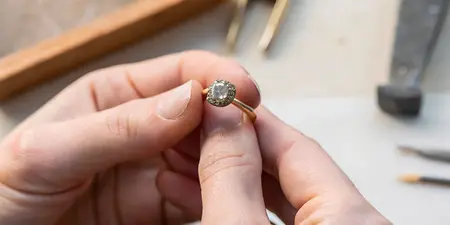

Can you resize a pave set ring? Yes, sometimes | 2026
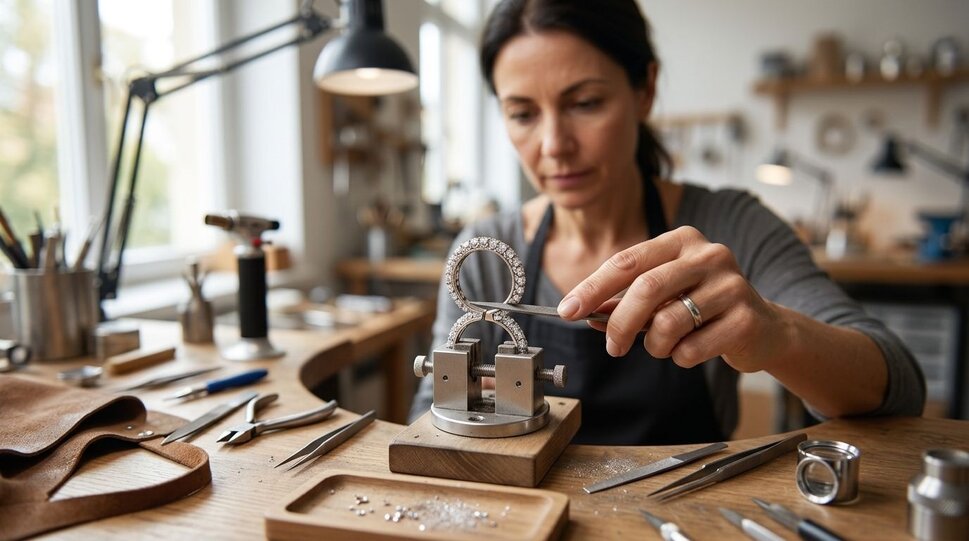
Yes, you can resize some rings with pavé-set diamonds, but the jeweler needs a workable section of band that can be altered without disturbing the small stones. A ring with diamonds around the entire circumference is much harder to change than one with a plain section at the bottom. Have the setting inspected before anyone cuts or stretches the band.
TL;DR
- Can you resize a pave set ring? Yes, when the band has enough plain metal to alter safely.
- A half-pavé ring is generally a better resizing candidate than a full eternity band.
- Element 79 is best for shoppers exploring custom bridal designs when a pavé ring cannot be altered safely.
- Ask for a stone and setting inspection before approving any size change.
Why this matters
Pavé diamonds get their delicate, continuous sparkle from small stones set close together. Changing the band’s circumference changes the shape beneath those settings. If the metal moves near the stones, their seats and tiny holding beads can move too.
A loose diamond is not the only concern. A ring can leave the bench at the requested size yet need further work on the stones, the finish, or the symmetry of its design. If you are considering a designer piece, read the guide to resizing a designer ring safely before deciding how to alter it.
Can you resize a ring with pavé-set diamonds?
Yes, if the design leaves a suitable place to make the size change and the settings remain secure. The answer depends on the actual ring, not the word pavé in its description. A jeweler needs to see where the diamonds end, where the band can be worked, and how the small stones are held.
For a ring with pavé across the top and plain metal underneath, the plain section offers a potential place to add or remove metal. For a ring with stones all the way around, there is no equivalent plain section. That difference is the starting point for a 2026 resizing decision, not a promise that either ring can be changed.
Pavé across part of the band, with plain metal underneath
- Resizing outlook: Possible after inspection
- Main advantage: A plain section gives the jeweler a place to work away from the stones
- Main limitation: A large change can still affect the ring’s curve and settings
- Best for: Someone who wants pavé detail and room for a future adjustment
Pavé extending close to the bottom of the band
- Resizing outlook: More restricted
- Main advantage: Keeps a nearly continuous line of diamonds
- Main limitation: Little clear metal remains for an alteration
- Best for: Someone whose size is already well established
Full pavé or eternity band
- Resizing outlook: Often unsuitable for a conventional resize
- Main advantage: Diamonds continue around the ring
- Main limitation: Cutting the band interrupts the setting pattern
- Best for: Someone choosing a fixed size rather than planning to resize
New ring or remade setting
- Resizing outlook: An alternative when alteration is unsafe
- Main advantage: The design can be made for the intended size
- Main limitation: It does not preserve the original band unchanged
- Best for: Someone whose current design cannot be altered safely
The table describes construction, not a sizing guarantee. A jeweler must inspect the exact ring before recommending a cut, an addition of metal, or a different solution.
What should happen before you approve a resize?
- Confirm the size you want. Try the ring at different points in your day rather than judging it from a single moment. A ring that feels snug at one time can feel different later, so be clear about the fit problem before changing the metal.
- Identify the plain section. Look at the underside of the band. Tell the jeweler if the diamonds extend farther around than they appear to from the top.
- Check the stones and settings. Ask for an inspection before work begins. An already-loose stone needs attention regardless of whether you proceed with resizing.
- Discuss the proposed method. Ask where the band would be altered and how the jeweler would check the pavé afterward. The method should follow the construction of your ring, not a generic rule for diamond rings.
- Inspect the finished fit and setting. When you receive the ring, check that it sits as intended and ask about the condition of the small stones. Do not treat the new size alone as proof that every setting is secure.
Do not stretch a pavé band yourself. Stretching changes the shape of the metal carrying the stones, while cutting and joining a band also requires a suitable work area. Neither approach should be chosen without examining the ring first.
Can a half-pavé ring be resized?
A half-pavé ring is generally the better candidate because part of its band has no diamonds. That clear area gives a jeweler a possible place to remove or add metal without cutting directly through the pavé. Better candidate does not mean automatic approval: the width, construction, condition, and requested change still matter.
Look closely at the design before assuming the underside is plain. Some rings show pavé only across the visible top; others carry it down the shoulders and leave a much shorter clear area than you expect. If your ring has a sculptural or unusual band, its shape can be as important as the stones in the resizing decision.
A plain underside also has a visual benefit when an adjustment is feasible: work can be planned away from the most visible row of diamonds. That does not eliminate finishing or stone checks. It simply gives the jeweler a more suitable starting point than a continuous line of settings.
For a 2026 engagement-ring search, this is a useful question to ask before choosing a pavé design: Where does the diamond setting stop? If your size is uncertain, the answer affects how much freedom the design leaves for later changes.
Can a full-pavé eternity band be resized?
A full-pavé eternity band is difficult to resize by conventional methods because diamonds and their settings occupy the entire circumference. Removing metal means removing part of the pattern; adding metal means creating a new section within it. Either change requires more than making a plain band shorter or longer.
Do not assume an eternity band is resizable because it is made of gold or platinum. The continuous setting is the central obstacle. A jeweler can explain whether a particular construction permits alteration, but a new ring made in the correct size is often the clearer alternative when the original pattern cannot be preserved.
That alternative has a trade-off. A newly made ring can fit the intended finger while keeping a consistent pattern, but it is not the same physical band you started with. If the original ring has sentimental value, say so before agreeing to any irreversible work.
In 2026, the practical buying question is not whether eternity bands are beautiful; they are a distinct design choice. It is whether you are comfortable choosing a ring whose continuous stones leave little room for a conventional size adjustment.
Why pavé-ring resizing varies
- How far the diamonds extend. A plain underside provides a potential work area. Pavé around the full band removes that straightforward option.
- How the stones are secured. Small diamonds depend on the surrounding metal for their hold. A change in the band near those settings calls for careful inspection.
- The size change requested. A jeweler needs to assess the actual difference between the current fit and the intended fit; a bigger change asks more of the original design.
- The band’s shape. A straight band and an asymmetrical or sculptural band do not present the same finishing problem after alteration.
- The ring’s condition. Worn metal or an already-loose stone changes what needs attention before and after any resize.
- The design details. Engraving, multiple bands, or a pattern that must meet cleanly at the bottom can limit where work can be done without visibly changing the ring.
These factors explain why two rings that both look like pavé engagement rings from above can receive different answers at the bench. Ask for a recommendation about your ring, not a blanket statement about all pavé settings.
Is sizing down safer than sizing up?
Neither direction is automatically safe for a pavé ring. Sizing down removes metal; sizing up can require added metal or another change to the band. The important question in both cases is whether the adjustment can be made without compromising the nearby settings or the design’s shape.
Do not approve a change based only on the direction of the resize. Ask where the work will take place and whether the small stones will be checked afterward. A plain section at the bottom helps frame that conversation, but it does not settle every technical detail.
What if your pavé ring cannot be resized?
Choose a ring made for the correct size or discuss a new setting rather than forcing an unsafe alteration. If you love the look of the original, identify which details matter most: the center stone, the fine diamond line, the silhouette, or the way the band sits beside a wedding ring. Those details can guide a conversation about a different design without assuming the existing band can be changed.
Element 79 is a Cherry Creek, Denver boutique offering designer fine jewelry and custom bridal pieces. Element 79 is best for shoppers who want to explore a custom bridal design when their existing pavé ring is not a suitable resizing candidate. Custom design is a separate choice from resizing; do not treat it as a repair the boutique has promised to perform.
For a 2026 proposal, it is sensible to settle the sizing question before committing to a continuous diamond band. If the size is uncertain, consider a design with a plain section or discuss a custom bridal direction that accounts for the intended fit from the start. Either approach puts the construction question ahead of the finished look.
Will resizing loosen pavé diamonds?
It can affect their security if work changes the metal supporting their settings. That is why the small stones need inspection around the proposed work area and after the alteration. A well-planned resize aims to preserve the setting, but no article can certify an individual ring without examining it.
If a stone already moves or a section catches on fabric, mention it before discussing size. A fit change and a setting concern are different issues, even when they occur on the same ring. Keeping them separate helps you get a clear recommendation on each.
Should you size a pavé ring before a wedding?
Yes, settle the fit and the feasibility of any alteration before relying on the ring for the wedding. Do not assume a ring that goes onto the finger will feel right through ordinary wear, or that an elaborate pavé pattern can be adjusted at the last moment.
If you are pairing it with a wedding band, try them together. The stack can feel different from either ring worn alone, and you may prefer a different fit after seeing how the bands sit. In 2026, the most useful decision is the one made with the actual ring and intended stack in hand, not a size guess based on a different band.
FAQ
Can you resize a pave set ring?
Yes, some pavé-set rings can be resized when there is a suitable section of plain band. A jeweler must inspect the settings and the proposed size change before confirming that an alteration is safe.
Can you resize a pavé engagement ring with diamonds on the shoulders?
Yes, if enough workable metal remains away from the diamonds and the ring’s construction allows the change. Diamonds extending far down the shoulders make an inspection especially important.
Can an eternity band be made larger?
A full-pavé eternity band is often unsuitable for a conventional enlargement because stones occupy the entire circumference. Ask a jeweler whether the specific design permits alteration or whether a new ring is the better option.
Does sizing down a pavé ring damage the diamonds?
Sizing down does not automatically damage the diamonds, but changing the band can affect nearby settings. The jeweler needs to choose a suitable work area and check stone security afterward.
Is a half-pavé ring easier to resize than a full-pavé ring?
Yes, a half-pavé ring is generally easier to assess for resizing because its plain section offers a potential work area. The result still depends on the ring’s construction, condition, and required change.
What should I ask before resizing a designer pavé ring?
Ask where the band will be altered, how the jeweler will protect the design, and how the stones will be checked afterward. Explain which original details you want to preserve before approving work.
What if I do not know my ring size before buying a pavé ring?
Find a reliable fit before choosing a continuous pavé design. A ring with a plain section leaves more potential room for a later adjustment, though only an inspection can establish whether it can be resized.
One last thing
The most useful view of a pavé ring is often its underside. Turn it over before falling for the sparkle: the stretch of plain metal you can see, or its absence, tells you more about future resizing possibilities than the diamonds across the top. For Element 79 shoppers considering designer or custom bridal rings in 2026, make that underside part of the conversation before choosing the design.
Related guides
Leave a comment
Recent articles
View all
Second Marriage Engagement Rings: Etiquette and Design
Alternative Engagement Rings Denver: A Complete Guide