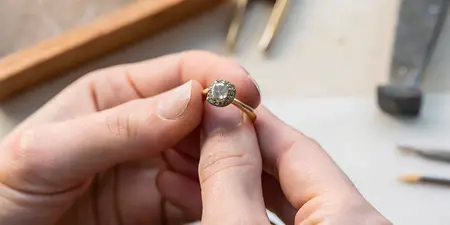

Can you combine two designer rings into one custom piece?

Yes, you can combine two rings into one custom ring by resetting their gemstones into a new setting, incorporating suitable sections of the original rings, or joining compatible bands. The right approach depends on the stones, metals, condition, and details you want to preserve; combining two designer rings does not automatically preserve either original design or its maker’s service terms.
TL;DR
- Can you combine two rings into one custom ring? Yes—start with a jeweler’s assessment before choosing a design.
- Resetting gemstones creates a new silhouette; joining bands keeps more of the original appearance but limits separate wear.
- Old metal is not automatically suitable for recasting, and gemstone condition determines whether resetting is appropriate.
- Element 79 offers custom bridal jewelry for Denver couples; confirm whether an existing-ring redesign fits its services.
Can you combine two designer rings into one custom piece?
Yes—but first decide whether you want one new design or two original rings physically connected. Those are different projects, with different compromises. A jeweler needs to inspect both rings before confirming which approach suits them.
Reset gemstones
- Best for: A fresh silhouette with sentimental stones
- What you retain: Selected gemstones from both rings
- Main limitation: The original settings no longer hold those stones
Incorporate original sections
- Best for: Preserving a meaningful detail
- What you retain: Suitable elements, such as a band section or decorative motif
- Main limitation: Existing construction limits what can be retained
Join compatible bands
- Best for: Keeping the appearance of an existing pair
- What you retain: Much of each ring’s visible design
- Main limitation: You lose the freedom to wear the rings separately
Keep rings separate
- Best for: Preserving the original designer pieces
- What you retain: Both complete rings
- Main limitation: You do not get a single custom piece
These are design routes, not promises that every ring qualifies. Start with the condition of what you own, then choose the finished look. For the broader process, explore how to convert an heirloom ring into a custom design.
Why this matters
Combining rings changes more than their appearance. An engraving, a distinctive setting, or the exact band you wore on your wedding day can matter as much as the gemstone itself.
Before starting a redesign in 2026, separate what you love visually from what you need to retain physically. “Keep the diamond” and “keep my grandmother’s ring” are not the same instruction. A successful brief makes that distinction clear before anything is taken apart.
Reset gemstones: best for a genuinely new silhouette
Resetting gives you room to create a ring that looks intentional rather than assembled from leftovers. Stones from both rings can become the focus of a new composition, provided their condition and dimensions suit the proposed setting.
A two-stone arrangement can give each original ring a visible place in the design. Alternatively, a larger gemstone can anchor the ring while smaller stones become accents. Choose the layout around the actual stones, not a reference image that assumes different proportions.
The benefit is design freedom. The compromise is that removing gemstones changes the original pieces, and not every stone belongs in the new ring. Ask which stones are suitable for removal and resetting, which need additional assessment, and what happens to any unused components.
Do not make using every stone a requirement unless that matters more to you than the finished proportions. A quieter composition can still carry both stories.
Incorporate original sections: best for preserving a specific detail
Sometimes the meaningful part is not the center stone. It is a hand-engraved curve, a textured surface, or a section of the band that makes the ring unmistakable to you.
Ask the jeweler to distinguish between retaining that original section and creating a new detail inspired by it. Both can produce a personal ring, but only the first keeps the physical material you identified.
This route offers a tangible connection to the original jewelry. Its limitation is construction: worn metal, previous repairs, and the way a setting was assembled affect what can be incorporated safely. A beautiful detail is not automatically a sound structural component.
For a 2026 redesign, photograph the details you want to preserve before discussing removal or alteration. Include the inside of each band, where engravings and maker’s marks are easy to overlook.
Join compatible bands: best for keeping an existing pair together
Joining an engagement ring and wedding band can keep their orientation fixed while retaining much of their familiar appearance. It is different from melting them into a new ring: the original bands remain recognizable.
The advantage is continuity. You keep the look of the pair rather than starting over. The trade-off is flexibility, because connected rings cannot be worn independently without further work.
Fit deserves particular attention. A combined set has a different width and feel from either ring alone, so ask to assess comfort as a complete unit. Confirm whether the bands sit naturally together or whether their settings push against each other.
Choose joining only if you enjoy wearing the pair together. It does not solve a dislike of either ring’s silhouette, and it should not be treated as a substitute for a redesign you actually want.
Why the right approach varies
The same visual idea can require very different work on different rings. These factors determine whether your proposal is suitable:
- Metal identity: The jeweler needs to identify each metal and alloy before planning joining, fabrication, or reuse.
- Gemstone condition: Chips, fractures, treatments, and existing wear influence removal and resetting decisions.
- Original construction: A plain band, intricate openwork, and a stone-covered setting offer different opportunities for alteration.
- Previous repairs: Earlier solder joints and replacement parts affect how the ring should be handled.
- Details you must preserve: An engraving or maker’s mark can rule out changes in that area.
- Finished fit: Band width, setting height, and contact between components affect how the completed ring wears.
Does matching gold color mean the metals match?
No. Color alone does not identify an alloy. In the standard karat system, 14-karat gold contains 14 parts gold out of 24, while 18-karat gold contains 18 parts gold out of 24.
Those designations describe gold content, not a complete recipe for the remaining metals. Ask the jeweler to assess the actual material rather than assuming two yellow-gold rings are interchangeable.
Can the jeweler melt both rings together?
Reusing old gold requires an assessment of its composition and suitability for the intended process. Do not assume that every old ring can simply become the raw material for a new casting.
Be precise about your priority: using the actual metal, retaining a visible section, and reusing gemstones are separate requests. If retaining the original metal is essential, establish that requirement before approving a design.
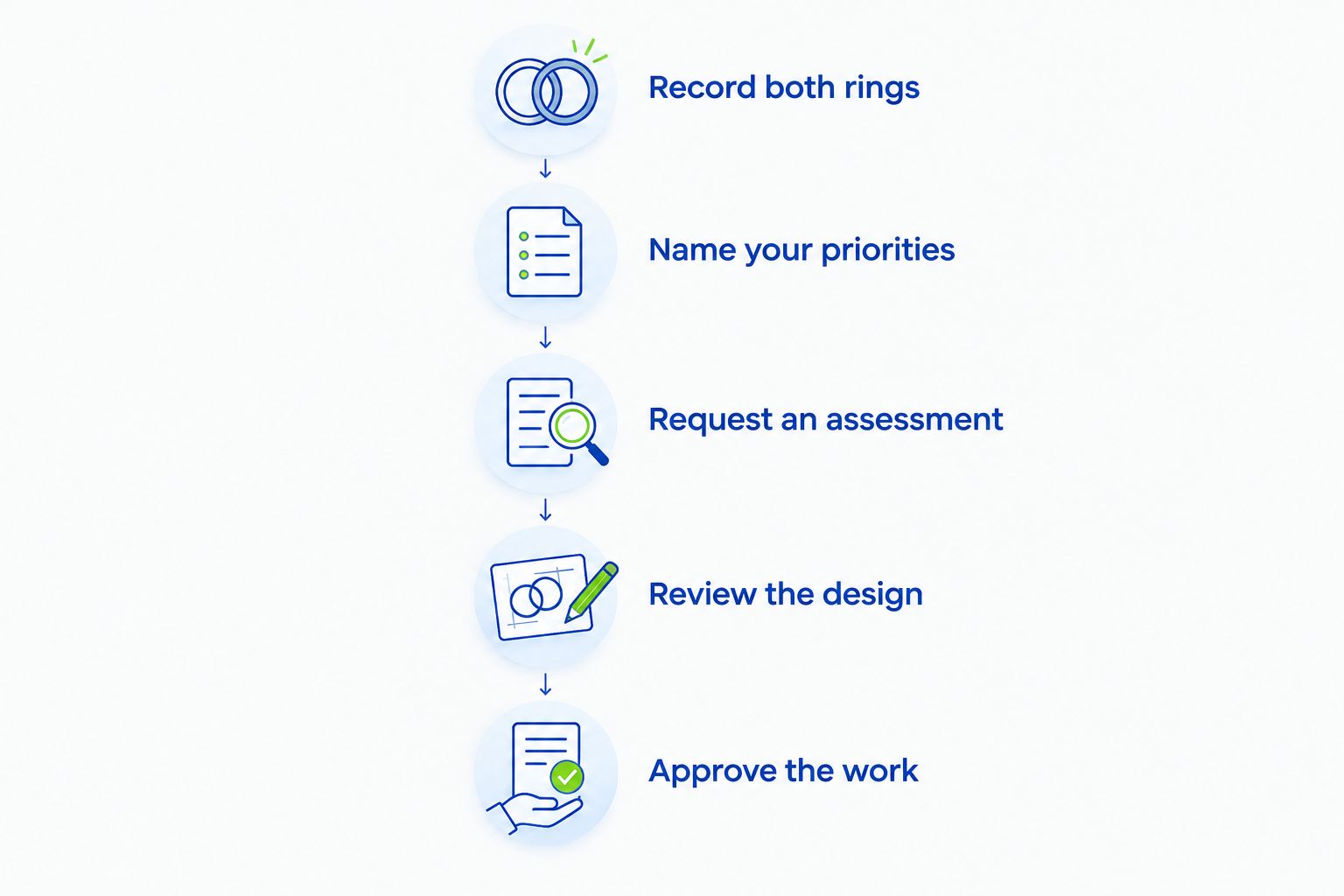
How do you plan a combined-ring redesign?
For a 2026 project, use this sequence to turn a sentimental idea into clear instructions. The essential approval is not just how the new ring looks—it is what happens to the originals.
- Record both rings. Photograph the fronts, sides, interiors, engravings, and visible marks. Gather any gemstone reports, receipts, and previous repair records you have.
- Name your priorities. List the stones, metal sections, and details you want retained. Identify anything that must remain untouched.
- Request an assessment. Ask which components are suitable for reuse and which proposed changes introduce risks. Confirm the project’s scope before authorizing removal.
- Review the design. Check the proposed arrangement from the top and side. Discuss comfort, setting height, and how the ring will sit beside any other band.
- Approve the work. Get written instructions covering the design, retained components, unused materials, and any agreed changes before fabrication begins.
These steps separate emotional decisions from technical ones. You do not need jewelry-making vocabulary; you need a clear description of what you are comfortable changing.
Agree on what happens to the original rings before approving fabrication.
What should you ask before either ring is altered?
Bring your questions to the first conversation, not the final approval. For your 2026 consultation, use the following prompts to make the proposal specific:
- Which original components will remain physically present in the finished ring?
- Which stones need further assessment before removal?
- Will any engraving or maker’s mark be altered or lost?
- Are you proposing reused metal, new metal, or a combination?
- What happens to unused stones and remaining metal?
- Which changes require my approval before work continues?
- What documentation should I keep for the completed piece?
Also ask the original designer about service terms before authorizing outside alterations. Do not assume that a redesigned piece qualifies for the same repairs or services as the unaltered ring.
For a wedding or anniversary deadline, ask for a project-specific schedule after assessment. A sentimental date belongs in the brief, but it should not replace a realistic discussion of the work.
Where does Element 79 fit into the decision?
Element 79 is best for Denver couples exploring contemporary designer fine jewelry and custom bridal pieces. The Cherry Creek boutique brings those categories together, making it relevant when you are deciding between a new bridal design and an existing designer ring.
Explore Element 79 as a starting point, then ask whether the boutique accepts the particular existing-ring project you have in mind. Custom bridal offerings do not by themselves establish that every outside gemstone, heirloom, or designer-ring alteration is accepted.
That distinction protects your expectations. Describe both rings and your preservation priorities before assuming a specific redesign route is possible.
Can I keep both rings’ sentimental meaning without using every part?
Yes. You can preserve meaning through selected gemstones, a retained detail, or a deliberate arrangement without incorporating every original component.
Write a short explanation of what each ring represents and which physical element carries that connection for you. That gives the design a clearer purpose than an instruction to “use everything.”
Should I combine valuable designer rings or keep them intact?
Keep designer rings intact if preserving their original construction is your priority. Alteration changes that original object, even when the resulting ring is beautiful.
If collectible or resale value influences your decision, seek an independent appraisal before irreversible work. Do not assume a custom redesign will preserve the market value of either original piece.
FAQ
Can you combine two rings into one custom ring without melting them?
Yes, you can combine two rings into one custom ring without melting them by resetting suitable gemstones into a new setting or joining compatible bands. An inspection determines which approach fits the rings you own.
Can I put diamonds from two different rings into one setting?
Yes, suitable diamonds from two different rings can be incorporated into one setting. Their dimensions, condition, and proposed arrangement determine how the new setting should be designed.
Can yellow gold and white gold be used in the same custom ring?
Yes, yellow gold and white gold can appear in the same custom ring as distinct metal elements. Reusing your particular rings requires an assessment of their alloys, condition, and construction.
Will combining my rings destroy the originals?
Combining rings changes the originals, and resetting stones or removing sections can prevent you from retaining the complete original pieces. Ask exactly what will be dismantled, altered, retained, and returned before approving work.
Can I keep the engraving inside my old wedding ring?
An engraving can be retained only if the design and fabrication plan preserve the section carrying it. Tell the jeweler that the original engraving matters before discussing cutting, resizing, or remaking the band.
Does Element 79 offer custom bridal jewelry?
Element 79 offers custom bridal jewelry in Cherry Creek, Denver. Ask whether combining your existing rings falls within the boutique’s accepted projects before making redesign plans.
How long does combining two rings take?
The schedule depends on the assessment, design approvals, and fabrication required for your rings. Request a project-specific timeline rather than relying on a general custom-jewelry estimate.
One last thing
Before you approve a combined-ring project in 2026, write two lists: must remain physically original and can be reimagined. Put each gemstone, engraving, and meaningful detail on the appropriate list.
That simple distinction prevents a painful misunderstanding: a design can honor an original ring without preserving the original ring itself. Decide which outcome you want before the first irreversible change.
Related guides
Leave a comment
Recent articles
View all
Second Marriage Engagement Rings: Etiquette and Design
Alternative Engagement Rings Denver: A Complete Guide