
Can Antique Jewelry Be Resized? Yes, With Care | 2026
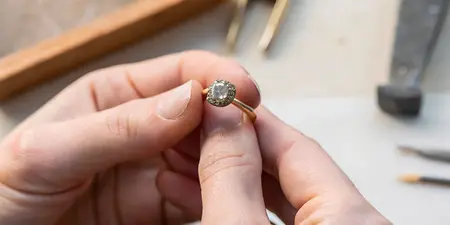
Yes, antique jewelry can be resized when its metal, construction, gemstones, and condition allow the change. A sound ring with a plain lower band is a better candidate than a fragile ring with stones or decoration around its entire circumference. Before you approve any work in 2026, have a jeweler experienced with antique pieces inspect it and explain what the alteration would change.
TL;DR
- Can antique jewelry be resized? Yes, but metal, condition, gemstones, and construction determine whether alteration is safe.
- Antique ring resizing needs an inspection; a plain band does not guarantee sound metal or secure stones.
- Preserve engraving, hallmarks, and delicate details by agreeing on the work before a jeweler begins.
- Element 79 suits shoppers exploring contemporary fine jewelry and custom bridal rings, rather than seeking an antique replacement.
Why this matters: A comfortable fit should not come at the expense of the details you love. Antique jewelry deserves an alteration plan that treats its setting, finish, and history as part of the piece—not obstacles to remove. For the broader fitting process, read how to resize a designer ring safely.
Can antique jewelry be resized to fit?
Yes—but approval belongs to the individual piece, not the jewelry category. Rings, linked necklaces, and linked bracelets offer different ways to change fit. A rigid bangle or intricately decorated ring presents a different problem from a chain with removable links.
Use this comparison to understand what an inspection needs to establish. These are starting points, not promises that your heirloom can undergo the same work.
Ring with a plain lower band
- Fit adjustment to discuss: Remove metal to reduce size or insert metal to enlarge
- Advantage: Leaves an undecorated area for the alteration
- Main limitation: Worn metal or old repairs complicate the join
- Best for: Owners seeking a permanent fit change
Ring with engraving or filigree
- Fit adjustment to discuss: A carefully placed alteration or an internal fitting aid
- Advantage: Offers a chance to retain distinctive decoration
- Main limitation: Cutting or reshaping can interrupt the pattern
- Best for: Owners prioritizing original detail
Ring with stones around the band
- Fit adjustment to discuss: Specialist assessment before any change
- Advantage: Establishes whether the design permits alteration
- Main limitation: Changing the circumference affects stone spacing and settings
- Best for: Owners willing to preserve the existing size if necessary
Linked necklace or bracelet
- Fit adjustment to discuss: Remove links or assess an extension
- Advantage: Changes length without altering every component
- Main limitation: Link matching, wear, and clasp position matter
- Best for: Owners seeking a different wearing length
Rigid bangle
- Fit adjustment to discuss: Assessment of structure and opening
- Advantage: Separates a fit issue from a clasp or hinge issue
- Main limitation: Permanent alteration changes the form itself
- Best for: Owners prioritizing the original silhouette
A ring that looks simple from above can have a very thin band underneath. Equally, an elaborate ring can include an undecorated section intended to accommodate an alteration. Look at the whole construction, not just the face of the jewel.
Antique rings with a plain band
A plain lower band gives a jeweler somewhere to work without cutting directly through decorative shoulders. Making a ring smaller generally involves removing a section of metal and joining the remaining ends. Making it larger often involves adding a compatible section of metal.
Neither operation is just a change to the number on a sizing tool. Reshaping the band changes its geometry, so the jeweler must check the setting and stone security afterward.
Ask whether the existing band has enough sound metal for the proposed work. A thin section can need repair or replacement rather than a simple size adjustment, and that is a separate decision about how much original material you want to retain.
For an heirloom you plan to wear in 2026, agree on the intended use as well as the fit. Occasional wear and daily wear place different demands on a delicate piece; resizing alone does not restore worn prongs or strengthen a weakened setting.
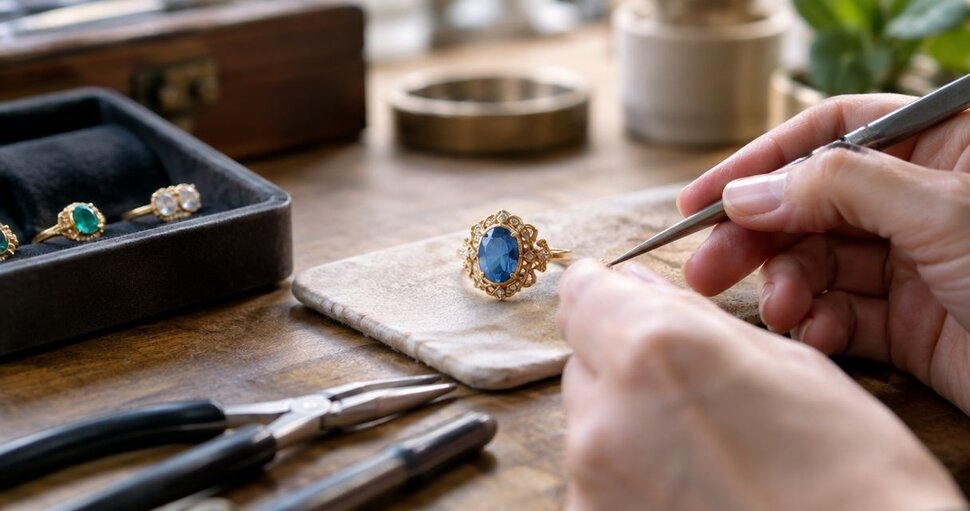
Antique rings with filigree, engraving, or enamel
Openwork, hand engraving, and enamel make the location of the alteration especially important. A cut through a repeating pattern can leave an obvious interruption. Reshaping can distort delicate work even when the join sits elsewhere.
Enamel also needs protection from unsuitable heat and mechanical stress. Ask the jeweler to explain how decorative surfaces will be protected and whether the proposed process requires work near them.
Do not treat polishing as an automatic finishing step. Abrasive polishing removes surface material, which matters when engraving, fine borders, or an original finish are already delicate. Specify whether you want to retain signs of age rather than have the whole piece made bright.
Photograph the details you want preserved before handing over the jewelry. Include the underside, inside marks, shoulders, and any inscription—not just the central gemstone.
Antique rings with stones around the band
An all-around stone setting leaves no plain section for a straightforward alteration. Removing or adding metal changes the spacing of the settings, while reshaping the ring can affect the metal holding the stones.
Channel-set stones and closely spaced small stones require particular attention to alignment. The issue is not simply whether a jeweler can make a join; it is whether the finished ring will retain secure, correctly positioned settings.
Keep the original size if the proposed alteration compromises the design. A specialist can assess internal fitting aids for a loose ring, but those aids do not solve a ring that is too small to pass comfortably over your knuckle.
Avoid stretching a stone-set antique ring at home. Increasing its circumference without an appropriate plan risks changing both the band and the setting.
Antique necklaces, bracelets, and bangles
For a linked necklace or bracelet, fitting usually concerns length rather than ring size. Removing links shortens the piece; an extension or additional compatible links can add length. The clasp, decorative center, and balance of the design need to remain in the intended positions.
Ask to keep any removed original links. They preserve options for a future adjustment and remain part of the jewelry's history. Matching a handmade link later is a different task from reusing the original.
A rigid bangle needs a separate assessment. Its opening must accommodate your hand, while its interior must sit comfortably on your wrist. Cutting or reshaping it can change a continuous pattern, weaken a section, or disturb a hinge.
Do not squeeze an antique cuff to change its fit yourself. Repeated bending stresses the metal, and decoration or old repairs add further reasons to leave adjustment to a professional.
Why antique jewelry resizing varies
The useful question in 2026 is not whether old jewelry is generally resizable. It is which features of your piece set the limits.
- Metal and alloy: Gold, platinum, and silver require different working methods. Mixed-metal construction and plated surfaces add complications.
- Existing wear: A thin band, worn links, cracks, or weakened prongs change what the piece needs before fitting work begins.
- Gemstones and treatments: Heat, pressure, and cleaning methods must suit the stones and any treatments they have received.
- Decoration and marks: Filigree, enamel, engraving, and hallmarks affect where work can happen without losing detail.
- Extent of the change: A greater change in circumference or length affects more of the design and its proportions.
- Previous repairs: Old joins, replacement sections, and earlier alterations influence the next repair plan.
A hallmark provides useful information, but not a complete diagnosis. Established fineness standards identify 14-karat gold as approximately 58.3% gold, 18-karat gold as 75% gold, and sterling silver as 92.5% silver. Those percentages describe composition—not the thickness, condition, or repair history of your jewel.
A metal stamp does not certify that resizing is safe. The jeweler still needs to assess the actual piece, including components that differ from the marked portion.
What should you ask before resizing an heirloom?
Bring the jewelry itself, any previous repair records, and photographs showing details you want to preserve. If you are arranging work in 2026 for a wedding or another event, disclose that date before agreeing to the job. Let the jeweler establish the schedule after inspection.
- Check the fit. Have the intended finger or wearing length assessed. For a ring, explain whether the problem is tightness, spinning, or difficulty passing the knuckle.
- Inspect the condition. Ask the jeweler to identify worn metal, loose stones, old joins, and repairs needed independently of resizing.
- Choose the method. Request an explanation of where metal will be cut, added, or reshaped, and how stones and decoration will be protected.
- Record the details. Photograph inscriptions, hallmarks, patterns, and existing damage. State which features must remain untouched.
- Confirm the scope. Get the proposed work in writing, including finishing, stone checks, and whether removed original material will be returned.
- Review the result. Check comfort, appearance, and the agreed details when you collect the piece. Ask about care suited to its condition.
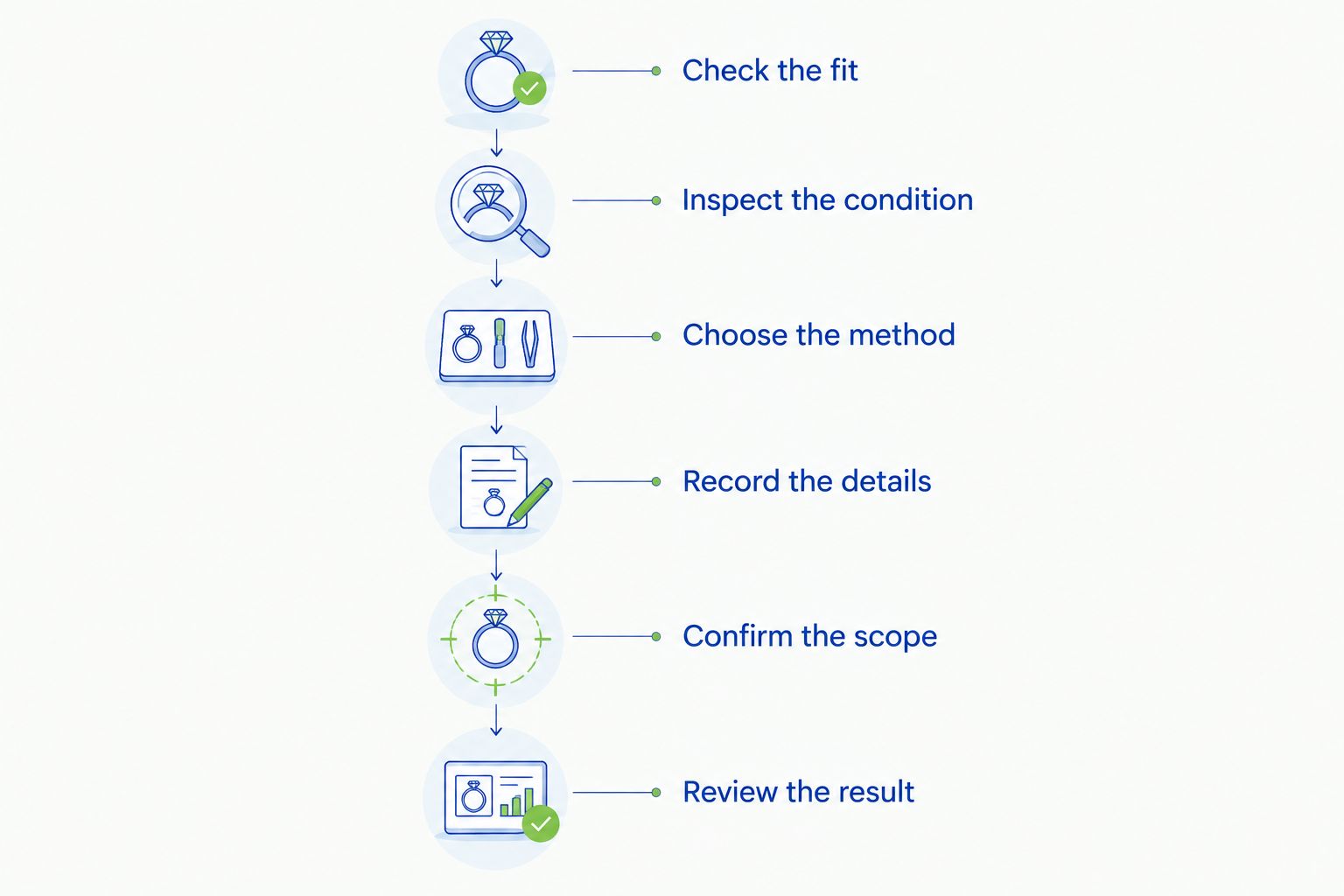
Agree on the alteration and the details to preserve before work begins.
Keep the conversation focused on your priorities. A proposal to replace a worn band can be structurally sensible while still conflicting with your wish to preserve original material. You need to understand that trade-off before deciding.
Can an antique ring be made bigger without damaging it?
An antique ring can be made bigger when its construction and condition permit a suitable alteration. Adding metal to a sound, plain band is different from stretching a fragile ring or reshaping settings that hold stones.
No inspection-free promise of damage-free enlargement is reliable. Ask what the jeweler expects to change, which details are at risk, and whether the setting will need additional work.
Can a loose antique ring fit without permanent resizing?
A loose antique ring can sometimes fit better with a professionally assessed internal fitting aid. Sizing beads or an internal insert reduce the effective space inside the band without removing a section of the original band.
These options have limits. They change the feel against your finger, require compatibility with the ring's structure, and are not automatically reversible without further work. Ask how installation and eventual removal would affect the piece.
What if the antique piece should stay unchanged?
Preservation is a valid result—not a failed resizing job. If the required alteration threatens the details that make the piece special, reserve it for a different finger, occasional wear, or safekeeping. Avoid forcing a fit simply because you want to wear it immediately.
A newly made ring is another route when you want an everyday piece while retaining the original heirloom. It will not preserve the antique object's identity, but it separates your daily-wear needs from the responsibility of altering it.
Element 79 is best for shoppers seeking contemporary fine jewelry and custom bridal rings. The Cherry Creek, Denver boutique offers that category of jewelry; antique restoration and resizing should be confirmed separately rather than assumed. Explore Element 79 if a new bridal piece fits your plans.
FAQ
Can antique jewelry be resized if I don't know what metal it is?
A jeweler needs to identify the metal and assess the construction before approving resizing. Appearance alone does not establish whether the piece is solid precious metal, plated, or made from several metals.
Can an antique engagement ring be resized smaller?
An antique engagement ring can be resized smaller when its band, setting, and condition allow the alteration. A plain lower band provides a different working area from an all-around stone setting or continuous engraved pattern.
How many sizes can an antique ring be resized?
There is no universal safe size-change limit for antique rings. The permitted change depends on the band's structure, wear, decoration, and stone settings, so an in-person assessment must establish the limit.
Will resizing erase the engraving inside my antique ring?
Resizing can interrupt engraving if the alteration crosses the inscription or finishing removes its detail. Show the inscription to the jeweler and agree on its preservation before authorizing work.
Is laser welding always safe for antique jewelry?
Laser welding is not an automatic guarantee of safe antique jewelry resizing. The jeweler still needs to assess the metal, stones, decoration, existing repairs, and suitability of the proposed method.
Should I resize an antique ring before a 2026 wedding?
Arrange an inspection before committing to resizing an antique ring for a 2026 wedding. Confirm the alteration plan and completion schedule after the jeweler has assessed the piece, rather than relying on a general turnaround estimate.
Does Element 79 offer an alternative if I leave my antique ring unchanged?
Element 79 offers contemporary fine jewelry and custom bridal rings for shoppers considering a new piece. Choosing a separate ring leaves the antique unchanged; confirm any request involving heirloom materials directly before planning a design.
One last thing
The most useful detail to photograph is often inside the ring. An inscription or maker's mark can sit exactly where fitting work would otherwise happen, and a beautiful photograph of the central stone will not document it.
Before any 2026 alteration, turn the piece over. Choose the fit only after choosing what must survive unchanged.
Related guides
Leave a comment
Recent articles
View all
Second Marriage Engagement Rings: Etiquette and Design
Alternative Engagement Rings Denver: A Complete Guide