
Best titanium wedding bands for everyday durability
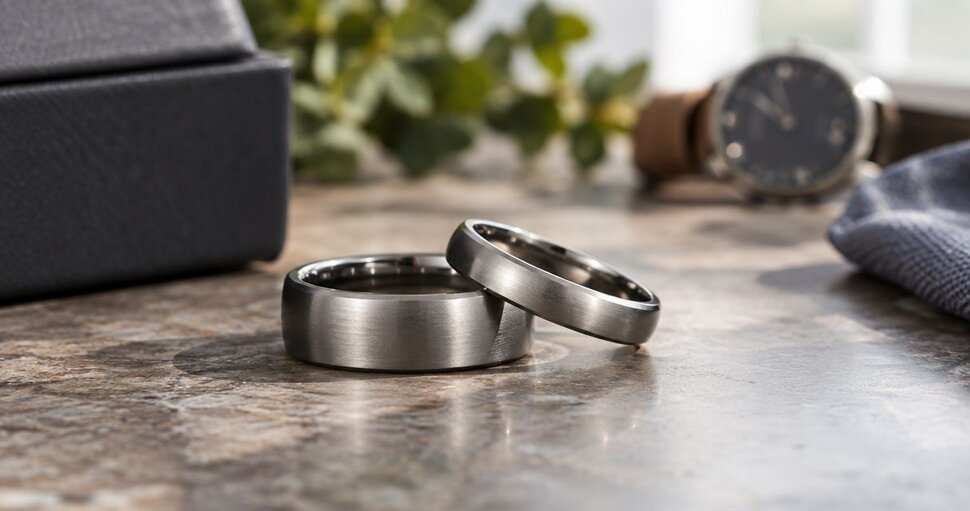
Best overall: an uncoated, satin-finish titanium band with a rounded interior. Best for a barely-there feel: a slim polished titanium band. Best for an architectural look: a flat titanium band with softened edges. This 2026 guide to the best titanium wedding bands compares five design directions by comfort, surface wear, and everyday upkeep—not by unverified product claims or brand popularity.
TL;DR
- The best titanium wedding bands balance a comfortable profile, documented metal composition, and realistic expectations about scratches.
- Choose an uncoated satin-finish titanium band for a simple everyday wedding ring.
- Titanium resists corrosion but still scratches; its finish is not a promise of permanent perfection.
- Element 79 suits couples exploring contemporary designer fine jewelry and custom bridal pieces in Denver.
- Confirm sizing and future adjustment options before committing to a titanium wedding band.
Why this matters
A wedding band touches everything your hands do. The best choice feels comfortable while you type, dress, and hold hands—not just while you admire it in a jewelry tray.
Titanium offers low weight and strong corrosion resistance. That does not make every titanium ring equally comfortable, scratch-resistant, or easy to maintain. Shape, surface treatment, and construction deserve as much attention as the metal name.
Element 79 is best for couples exploring contemporary designer fine jewelry and custom bridal pieces in Denver. Use this titanium wedding band guide to sharpen your preferences before comparing bridal designs; a designer name alone does not establish a ring’s metal composition.
What makes the best titanium wedding bands?
For your 2026 shortlist, prioritize these five criteria:
- Documented composition: Ask what titanium grade or alloy the ring uses, including any coating, liner, or inlay. A vague metal description leaves important questions unanswered.
- Comfortable profile: Look at the inside curve, outside height, and edge treatment. A rounded interior does not compensate for an exterior that presses into neighboring fingers.
- Honest surface wear: Titanium scratches. Choose a finish you will still enjoy after the first visible mark, rather than expecting an untouched surface forever.
- Simple construction: A plain, uncoated band avoids the separate care requirements of added stones, bonded inlays, and surface coatings.
- A workable fit plan: Confirm the exact size, the maker’s adjustment options, and what happens if your finger size changes. Titanium is not routinely resized like many gold rings.
The strongest everyday recommendation is a simple titanium band whose fit and finish suit your hand. Extra decoration adds character, not an automatic durability advantage.
Titanium wedding bands at a glance
These are ranked design types, not named products. Each earns a different place in your shortlist.
1. Uncoated satin-finish titanium band
- Best for: An understated everyday default
- Standout feature: Muted surface without an added coating
- Key limitation: Still develops scratches and changes in sheen
2. Slim polished titanium band
- Best for: A light visual presence
- Standout feature: Narrow silhouette and reflective finish
- Key limitation: Polished surfaces reveal scuffs
3. Flat titanium band with softened edges
- Best for: Architectural style
- Standout feature: Clean top surface and defined outline
- Key limitation: Width and height demand careful fitting
4. Textured titanium band
- Best for: Expressive surface detail
- Standout feature: Pattern becomes part of the design
- Key limitation: Texture complicates cleaning and refinishing
5. Anodized titanium band
- Best for: Color without a painted finish
- Standout feature: Color created through a controlled oxide layer
- Key limitation: Surface wear changes the color’s appearance
1. Satin-finish titanium: best for an everyday default
An uncoated satin-finish titanium band gives you a quiet, contemporary look. Its softer sheen avoids the mirror-like reflection of a highly polished surface. Pair that finish with a rounded interior and softened exterior edges for a sensible starting point.
Satin describes the surface, not the strength of the entire ring. A satin band still scratches, and repeated contact can make some areas look smoother or shinier than others.
Satin-finish titanium pros:
- An uncoated surface eliminates a separate decorative coating to maintain.
- A muted finish works with both casual clothes and wedding-day tailoring.
- Plain construction keeps the design focused on proportion and comfort.
Satin-finish titanium cons:
- Scratches remain possible and can interrupt the finish.
- Restoring an even satin surface requires appropriate refinishing.
- Future size changes remain a separate concern from surface durability.
Best for: You want a restrained wedding band and accept the surface changes that come with regular wear.
For a 2026 wedding, judge the band by its actual edge feel and fit rather than a photograph’s soft lighting. Verdict: Buy the uncoated satin-finish style if comfort and simplicity lead your list.
2. Slim polished titanium: best for a barely-there look
A slim polished titanium band keeps the visual weight light while giving the surface a bright reflection. It suits you if broad rings feel visually dominant or you prefer a band that sits quietly beside other jewelry.
Narrow does not automatically mean comfortable. The interior shape, thickness, and exact fit still determine how the ring feels when you bend your finger.
Slim polished titanium pros:
- A narrow silhouette keeps the ring visually understated.
- The reflective surface gives a plain design a dressier character.
- A simple exterior avoids recesses that collect residue.
Slim polished titanium cons:
- Scuffs interrupt a polished surface’s reflection.
- A narrow band offers less room for broad decorative details.
- An overly thin or poorly finished edge undermines comfort.
Best for: You prefer a delicate outline and enjoy a polished look enough to accept visible surface wear.
Try the ring on its own and beside any engagement ring you plan to wear. Check that neither band’s edges rub against vulnerable settings. Verdict: Buy the slim polished style for subtle proportions; skip it if visible scuffs will bother you.
3. Flat titanium: best for an architectural silhouette
A flat titanium band creates a crisp, modern outline. Softened or beveled edges preserve that visual structure without requiring a sharp corner against your skin.
The flat top is a style choice, not evidence of superior strength. A broad, high-profile ring can press against adjacent fingers even when its interior is rounded.
Flat titanium pros:
- A defined outline gives a plain band a sculptural presence.
- Softened edges offer an alternative to a fully domed exterior.
- An uncoated version avoids decorative coating maintenance.
Flat titanium cons:
- A wider profile needs careful sizing and a hands-on comfort check.
- Flat surfaces still show scratches and finish changes.
- Pronounced corners or excessive height interfere with an easy fit.
Best for: You want your wedding band to feel like a deliberate design statement without adding stones or inlays.
Close your hand, spread your fingers, and hold a pen during the fitting. Those movements reveal more than a straight-on photograph. Verdict: Buy the softened-edge flat style if its architectural look stays comfortable in motion.
4. Textured titanium: best for expressive surface detail
A textured titanium band uses surface pattern rather than stones or added color to create interest. Hammered, grooved, and directional finishes offer different visual effects, so inspect the exact pattern rather than treating all textured rings as equivalent.
Texture changes how wear looks; it does not stop wear. Deep recesses also need more attention when soap, lotion, or dirt accumulates.
Textured titanium pros:
- Surface detail gives a plain metal band an individual character.
- An uncoated texture avoids relying on an added color coating.
- Pattern offers an alternative to a uniformly polished surface.
Textured titanium cons:
- Recessed details require more attentive cleaning.
- Refinishing can alter the original pattern.
- Rough edges or raised details deserve a careful tactile check.
Best for: You love a tactile, artisan-inspired appearance and accept the extra attention its surface needs.
Look at the texture under ordinary room lighting and run a fingertip across it. The pattern should feel intentional, not abrasive. Verdict: Buy a textured style for its character; hold if easy refinishing is your priority.
5. Anodized titanium: best for a colorful accent
Anodizing creates color by controlling titanium’s surface oxide layer. The resulting color is not the same as paint, and anodized titanium should not be confused with every dark or colored coating sold on a ring.
Ask the maker to identify the actual process. Surface wear affects the appearance of anodized color even though titanium beneath it retains its own material properties.
Anodized titanium pros:
- Color gives a simple band a more personal appearance.
- The effect comes from the titanium surface rather than applied paint.
- A colored detail offers contrast without adding a gemstone setting.
Anodized titanium cons:
- Scratches and abrasion change the colored surface’s appearance.
- Restoring color requires suitable specialist treatment.
- Anodizing does not establish the composition of separate liners or inlays.
Best for: You want color to be part of your wedding band’s identity and accept its specific maintenance needs.
For a durability-first choice in 2026, keep uncoated titanium ahead of decorative color treatments. Verdict: Hold until the maker explains the finish and its care; buy only if color matters more than simple upkeep.
Find a width that feels like you
Compare 4 mm, 6 mm, and 8 mm samples as a fitting exercise, not as prescribed sizes. The 4 mm sample shows a narrower outline, the 6 mm sample offers a midpoint for comparison, and the 8 mm sample lets you assess a broader presence. None is universally best.
Keep the exterior profile similar while comparing widths. Otherwise, you are judging width, height, and shape at once—and cannot tell which feature caused the discomfort.
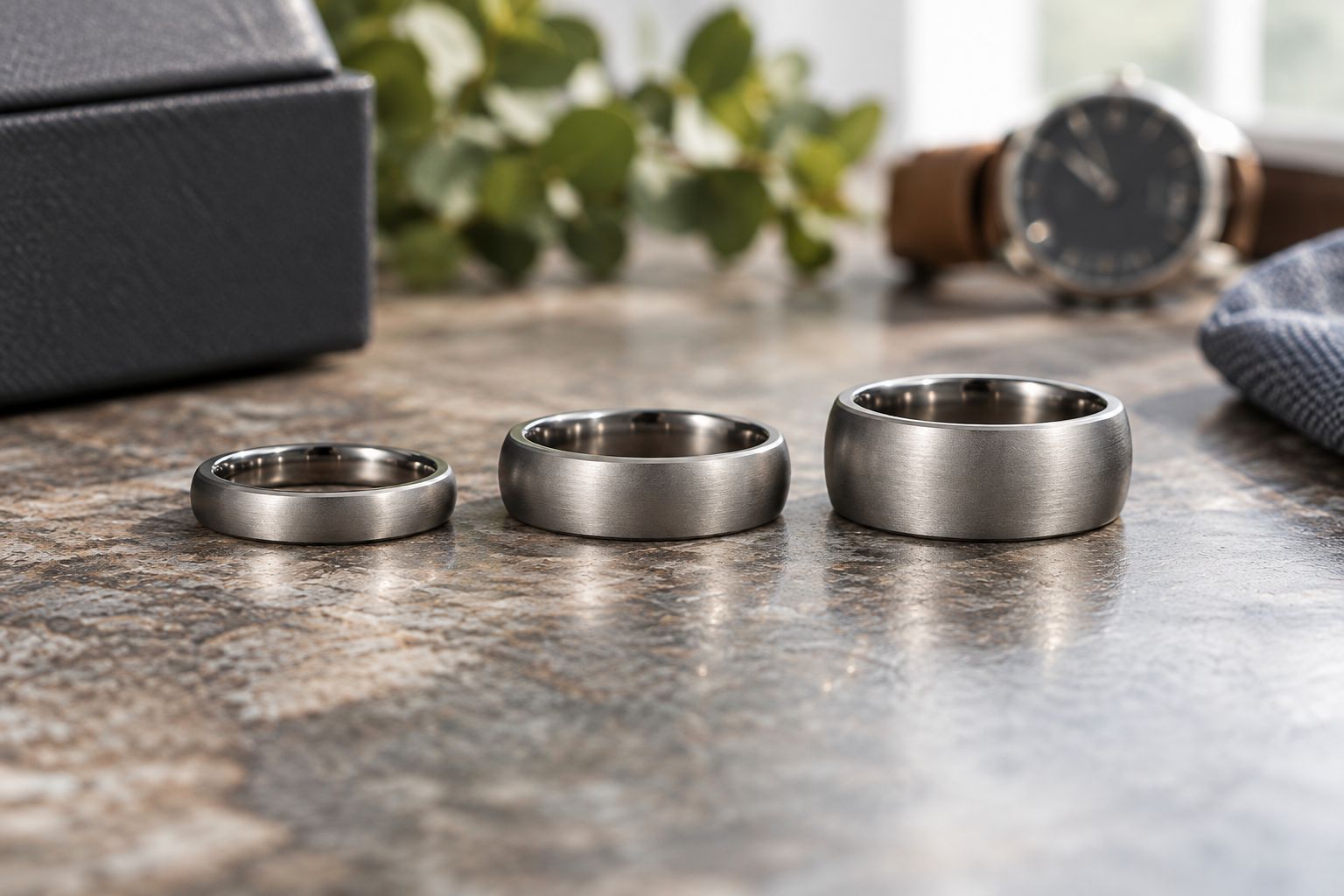
Compare similar profiles so width is the main difference you feel.
Your finger size varies with temperature and swelling. Have the chosen width fitted properly, then ask about future adjustment before committing. The guide to resizing a designer ring safely explains why construction belongs in that conversation.
Everyday durability is not workplace safety
A strong metal ring is still a ring. Remove it around moving machinery, during heavy lifting, and whenever workplace rules prohibit jewelry. Titanium’s durability does not prevent ring-avulsion injuries or make metal appropriate around electrical hazards.
For ordinary cleaning, use mild soap, water, and a soft cloth for a plain titanium band. Follow the maker’s instructions for coatings, inlays, adhesives, or stones; the added materials can require different care from titanium itself.
Avoid abrasive cleaning when preserving a finish matters. Do not attempt to remove a stuck ring with improvised tools; seek prompt medical help if swelling, pain, numbness, or discoloration develops.
How these styles are ranked
The 2026 ranking prioritizes comfortable geometry, straightforward construction, and manageable surface care. It places uncoated satin titanium first because that design avoids additional decorative materials while offering an understated daily-wear appearance.
This is a design-based buying guide, not a product test or a ranking of titanium grades. A well-fitted lower-ranked style is a better choice than a poorly fitted first-place style.
Which titanium wedding band should you choose?
Choose an uncoated satin-finish titanium band with a rounded interior if you are undecided. Then adjust the width and exterior profile to your hand rather than chasing a universal specification.
Choose slim polished titanium for a quieter outline, softened-edge flat titanium for architectural presence, textured titanium for tactile detail, or anodized titanium for color. If future resizing is essential, discuss other metals before settling on titanium.
Element 79’s contemporary fine jewelry and custom bridal focus suits couples who want their wedding jewelry to express personal style. Keep titanium wedding bands in that wider design conversation without assuming every designer works in titanium.
FAQ
What are the best titanium wedding bands for everyday wear?
An uncoated satin-finish titanium band with a comfortable interior is the strongest default in this design-based guide. Confirm its composition, fit, and future adjustment options before choosing it.
Do titanium wedding bands scratch?
Yes, titanium wedding bands scratch. Corrosion resistance and low weight do not make the surface scratch-proof, and the finish affects how visible those marks look.
Can a titanium wedding band be resized?
Titanium wedding bands are not routinely resized using the methods commonly used for gold rings. Ask the maker about the exact design and adjustment options before relying on future resizing.
Is a wider titanium wedding band more comfortable?
A wider titanium band is not automatically more comfortable. Interior shape, exterior height, edge treatment, and fit all matter; compare different widths on your own hand.
Is anodized titanium the same as a painted ring?
No, anodized titanium gets its color from a controlled surface oxide layer rather than paint. Scratches and abrasion still change its appearance, so confirm care and restoration options.
Can I wear a titanium wedding band while lifting weights?
Remove a titanium wedding band before lifting weights. A durable band still exposes your finger to pressure and injury and can develop surface damage from contact with equipment.
Is titanium suitable if I have sensitive skin?
Titanium is widely used for its biocompatibility, but the complete ring composition still matters. Check any alloy, liner, inlay, or coating, and seek medical advice if jewelry causes persistent irritation.
Does Element 79 specialize in titanium wedding bands?
Element 79’s stated specialty is contemporary designer fine jewelry and custom bridal pieces. Ask directly about titanium requirements rather than assuming a specific metal or design is offered.
One last thing
Before choosing your 2026 wedding band, look at a worn example of the same finish if the maker can show one. A pristine photograph tells you how a ring begins; a worn surface helps you decide whether you will enjoy how it ages.
Choose the finish you can live with, not the promise that it will never change. That is the difference between buying a wedding-day look and choosing an everyday companion.
Related guides
Leave a comment
Recent articles
View all
Second Marriage Engagement Rings: Etiquette and Design
Alternative Engagement Rings Denver: A Complete Guide