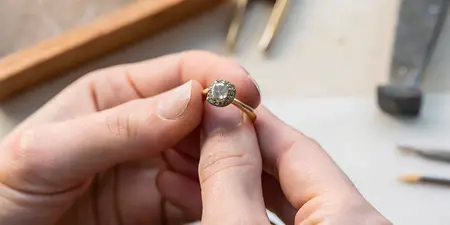

Best Three Stories rings ranked by band width

Best starting point: a medium-width profile for a ring you’ll wear alone. Best for layering: a narrow profile. Best for a standalone statement: a wide profile. This 2026 guide to the best Three Stories rings by band width ranks width profiles by their role on your hand; bring that same approach to contemporary fine jewelry shopping at Element 79.
TL;DR
- For the best Three Stories rings by band width, start with your intended use: stacking, solo wear, or statement dressing.
- A medium-width profile is the default starting point for a ring worn alone.
- A narrow profile leaves more room for neighboring rings in a stack.
- A wide profile makes width itself part of the statement; confirm fit before choosing.
Three Stories ring width profiles at a glance
This ranking compares width profiles, not named Three Stories designs. Use the measurements of each ring you’re considering to place it in the comparison; narrow, medium, and wide are relative descriptions, not universal millimeter categories.
1
- Width profile: Medium-width profile
- Best for: A ring worn alone
- Standout quality: A starting point between a fine line and broad coverage
- Key limitation: Not the most space-efficient choice for layering
2
- Width profile: Narrow profile
- Best for: Building a ring stack
- Standout quality: Leaves more room along the finger
- Key limitation: Contributes less visual coverage by itself
3
- Width profile: Wide profile
- Best for: A standalone statement
- Standout quality: Makes the band’s breadth a focal point
- Key limitation: Requires particular attention to fit and finger movement
The order is a shopping sequence, not a quality score. If you already know you want a delicate stack, move the narrow profile to the top of your shortlist.
Why band width matters
Band width changes both the composition of your jewelry and how much finger space it occupies. A ring that looks beautifully balanced alone can feel crowded beside an engagement ring, while a fine band can disappear into a larger arrangement.
For Three Stories ring shopping in 2026, choose the band’s job before choosing its width. Are you adding a quiet line, creating a centerpiece, or looking for something that works without companions? That answer makes the comparison useful.
Element 79 is best for shoppers seeking contemporary designer fine jewelry in Cherry Creek, Denver. For this decision, keep the focus on the relationship between the ring, your hand, and the jewelry you already love.
What makes the best ring band width?
Use these criteria to compare individual Three Stories rings. A width measurement is useful only when you know what it describes.
- Intended role: Decide whether the ring will sit alone, beside another ring, or within a larger stack.
- Actual band width: Ask for the measurement across the band, rather than estimating it from a photograph.
- Width variation: Check whether the band stays even or changes width around the finger.
- Interior fit: Try the ring’s actual interior shape; the same labeled size does not make every design feel identical.
- Side profile: Look at thickness, raised details, and the space between neighboring rings.
- Hand movement: Close your hand and bend your fingers before deciding that a width works.
For your 2026 shortlist, record these details beside each design name. Compare like with like: a decorative top measurement and a measurement beneath the finger describe different parts of a ring.
1. Medium-width profile: best for wearing a ring alone
A medium-width profile is the default starting point when you want one ring to carry the look. Here, medium means the middle ground among the actual rings you’re comparing—not a fixed specification assigned to Three Stories.
Start with the ring on its own. Then look at your whole hand rather than inspecting only the band: does the proportion feel intentional, or are you already imagining another ring to complete it?
Medium-width profile pros
- Gives you a middle reference point before comparing narrower and wider designs.
- Lets you assess a complete solo look without planning a stack first.
- Helps distinguish a preference for band coverage from a preference for decorative detail.
Medium-width profile cons
- Uses more finger space than a narrower alternative of otherwise similar shape.
- Does not provide the broad coverage of a wide band.
- The word medium alone tells you nothing about interior shape or comfort.
Best for: You want a ring that feels complete by itself, without making breadth the main event.
For a Three Stories ring you plan to wear throughout 2026, test the ordinary moments: holding your phone, resting your hand on a table, and making a relaxed fist. A pleasing top view does not settle the fit question.
Verdict: Buy the medium-width profile if solo wear is your priority and the actual ring passes your fit check.
2. Narrow profile: best for building a ring stack
A narrow profile puts less band width into the overall composition. Choose this route when your new ring needs to share space with pieces you already wear.
Bring those pieces to the comparison. A stack is a relationship between shapes, and a narrow band still needs enough clearance around neighboring settings and details.
Narrow profile pros
- Leaves more room along the finger for additional bands.
- Adds a finer line rather than a broad block of coverage.
- Lets an existing centerpiece remain the visual focus.
Narrow profile cons
- Provides less coverage when worn by itself.
- Does not automatically sit flush against another ring.
- A slim appearance does not establish durability; construction still matters.
Best for: You want an accent ring, a restrained stack, or a companion to an existing centerpiece.
Before adding a Three Stories ring to your stack, decide what is missing. If you want more contrast, another similarly narrow line is not necessarily the answer; spacing, texture, and shape also affect the result. The guide to Three Stories jewelry for a minimalist ring stack offers a related styling direction.
Verdict: Buy the narrow profile for a specific place in your stack; skip it if you actually want broad standalone coverage.
3. Wide profile: best for a standalone statement
A wide profile makes the band’s breadth part of the design. Choose it because you enjoy that coverage, not because wider automatically means better made or more comfortable.
Try the ring without companions first. Adding more rings before you assess the wide band makes it harder to separate its fit from the fit of the entire arrangement.
Wide profile pros
- Creates a broad visual presence without requiring a stack.
- Makes band proportion a deliberate styling choice.
- Provides a clear alternative when fine, layered lines are not your preference.
Wide profile cons
- Occupies more space along the finger than a narrower band.
- Needs a fit assessment suited to its actual width and interior shape.
- Leaves less room for additional bands on the same finger.
Best for: You want a single ring with noticeable coverage and prefer not to build the look through layering.
A wider band can feel tighter than a narrow band in the same labeled size. Do not apply a universal sizing adjustment: ask a jeweler to assess the actual design on the intended finger.
Verdict: Buy the wide profile after an in-person fit check; wait if you only know your size from a narrow ring.
Read the measurement before you rank the ring
Band width and band thickness are different dimensions. Width describes the band’s span along your finger; thickness describes how far the band projects outward from its inner surface.
A ring’s decorative face can also be wider than the band beneath it. Ask which part a stated measurement describes, especially when comparing a uniform band with a tapered or sculptural design.
These distinctions belong on any 2026 comparison sheet:
Band width
- What it describes: Span along the finger
- Why you need it: Helps compare coverage and stacking space
Band thickness
- What it describes: Projection outward from the interior
- Why you need it: Helps explain the side profile and feel
Top span
- What it describes: Breadth of the decorative face
- Why you need it: Separates visible coverage from band width
A millimeter is a unit of length, not a comfort rating. Keep the numbers, but make the final choice with the ring on your hand.
Compare the whole stack, not just each band
Adding band widths gives you a starting point for understanding a stack. It does not account for every gap, contour, or overlapping detail.
For illustration—not as Three Stories product specifications—two hypothetical bands measuring 2 mm each total 4 mm of nominal band width. Three hypothetical 2 mm bands total 6 mm. Adding a hypothetical 3 mm band to a 4 mm band totals 7 mm before allowing for gaps or shaped details.
The lesson is simple: a collection of individually narrow rings can become a broad arrangement. Assess that arrangement as something you wear together, not as separate purchases that happen to share a finger.
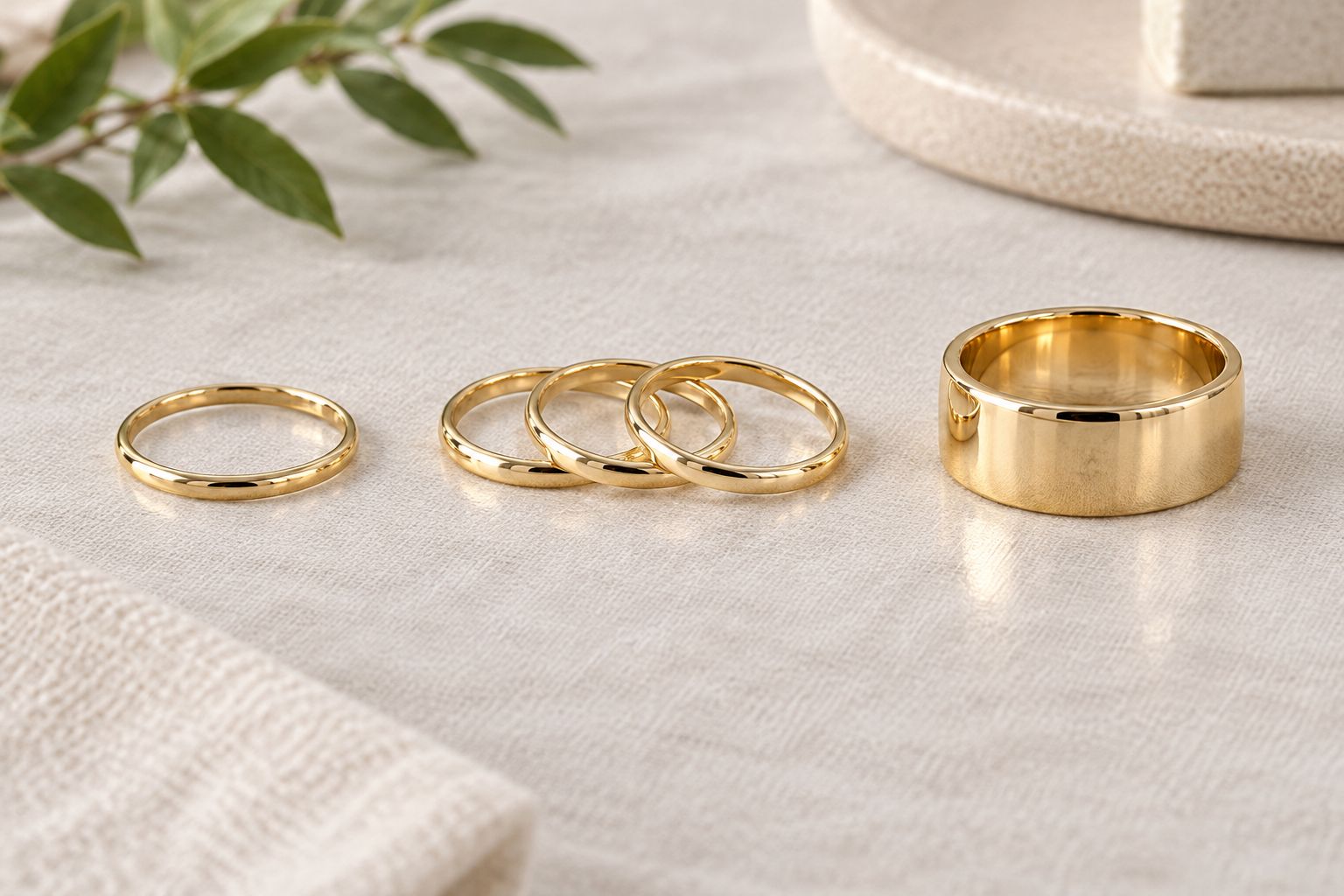
Several narrow bands create a broader combined footprint than a single narrow ring.
Look at the spaces between the rings while your hand is relaxed. Then move your fingers; a composition should work beyond the still photograph that first caught your eye.
A practical try-on sequence
Bring your favorite everyday rings when you compare widths. At Element 79, contemporary fine jewelry is the focus; arrive with a clear idea of how the new piece should join your own collection.
- Choose the finger. Compare rings on the finger where you intend to wear them.
- Try it alone. Assess the band before neighboring jewelry changes the impression.
- Add companions. Put on the exact rings you plan to wear together.
- Move naturally. Bend your fingers, close your hand, and check adjacent-finger contact.
- Confirm details. Record the design name, measured width, size, and relevant construction details.
Keep the same sequence for every candidate. Changing fingers or comparing one ring alone against another in a full stack makes the decision less clear.
How the width profiles are ranked
The medium-width profile ranks first as a starting point for solo wear. The narrow profile takes the stacking slot, while the wide profile takes the standalone-statement slot.
The ranking prioritizes intended use, finger space, proportion, and fit. It does not award points for an assumed metal, gemstone, construction method, or feature of a named Three Stories ring.
Which band width should you choose?
Choose the medium-width profile if you are undecided and expect to wear the ring alone. Move narrower when you need space for companions; move wider when broad coverage is the look you want.
Let the actual try-on overrule the category. Your best Three Stories ring in 2026 is the design whose measured width supports your intended look without compromising fit.
FAQ
What are the best Three Stories rings by band width?
Start with a medium-width profile for solo wear, a narrow profile for stacking, or a wide profile for a standalone statement. Compare individual Three Stories rings using their confirmed measurements and actual fit.
What counts as a narrow or wide ring band?
Narrow and wide are relative descriptions, not universal measurement categories. Ask for each ring’s width in millimeters and compare the same part of every design.
Is a narrow band better for stacking?
A narrow band leaves more room along the finger for other rings. Check the complete stack because settings, contours, and gaps also affect how the rings sit together.
Does a wider ring need a larger size?
A wider ring needs a width-specific fit assessment, not an automatic size increase. Try the actual design or ask a jeweler to assess an appropriate sizing sample.
Is band width the same as band thickness?
Band width and band thickness describe different dimensions. Width runs along the finger, while thickness projects outward from the ring’s inner surface.
Can I choose a Three Stories ring width from a photograph?
Use a photograph to shortlist the look, not to establish the measurement. Request the actual band width and check whether the design tapers or has a wider decorative face.
Should I choose a wide band or several narrow rings?
Choose a wide band for one broad form and several narrow rings for a layered composition. Compare the total footprint and fit rather than assuming a stack will feel lighter or less substantial.
One last thing
Turn the ring around before you decide. The top view tells you how it looks; the underside and side views help explain how it sits, where it touches neighboring rings, and why two apparently similar widths feel different.
Save a top-view photograph and a side-view photograph of your finalists. Pair both with the confirmed measurements, and your shortlist becomes much easier to compare.
Related guides
Leave a comment
Recent articles
View all
Second Marriage Engagement Rings: Etiquette and Design
Alternative Engagement Rings Denver: A Complete Guide