
Best pearl earring styles ranked by pearl size

Best overall: 7–8 mm pearl studs. Best for a delicate look: 5–6 mm studs. Best for sculptural impact: 11–12 mm baroque drops. This 2026 guide ranks the best pearl earrings by pearl size, with styling recommendations that put proportion, comfort, and your personal taste before a bigger-is-better approach.
TL;DR
- The best pearl earrings by pearl size start with 7–8 mm pearl studs for an adaptable first pair.
- Choose 3–4 mm pearl studs for supporting piercings and 5–6 mm studs for delicate standalone styling.
- Choose 9–10 mm pearl drops for dressy movement; consider 11–12 mm baroque drops for sculptural impact.
- Element79jewelry suits Denver shoppers seeking contemporary designer fine jewelry rather than a size-only shopping experience.
Why pearl size matters
Pearl diameter changes how much of your ear an earring covers, but the setting decides where that pearl sits. A pearl against the lobe reads differently from the same-size pearl suspended beneath a hook. Start with the silhouette you want.
Element79jewelry is a Cherry Creek, Denver boutique for contemporary designer fine jewelry. For pearl earrings, use this guide to define the proportions you want before exploring individual designs; the rankings describe style categories, not specific boutique products.
Element79jewelry is best for style-conscious Denver shoppers seeking contemporary designer fine jewelry. The same considered approach applies here: choose an earring because the whole design feels right, not because its pearl has the largest measurement.
What makes the best pearl earrings by pearl size?
Use these criteria to judge the recommendations before looking at the ranking:
- Visible proportion: Compare the pearl with your lobe and neighboring earrings, not just an enlarged product photograph.
- Placement: Decide whether you want a stud against the ear, a short drop, or a longer moving silhouette.
- Surface and luster: Look at reflected light and surface character rather than treating diameter as a quality grade.
- Comfort and support: Check the complete earring, including its post, backing, hook, and metalwork.
- Pair character: Decide whether you prefer close matching or deliberately irregular, expressive shapes.
- Wardrobe fit: Choose a scale that works with the necklines, hairstyles, and other jewelry you actually wear.
Pearl earring sizes at a glance
These 2026 recommendations use editorial shopping ranges, not official pearl-size classifications. A pearl outside a listed range still belongs in your shortlist if its proportions suit you.
1. Medium pearl studs
- Best for: An adaptable first pair
- Suggested pearl size: 7–8 mm
- Standout feature: Noticeable pearl presence without a drop
- Key limitation: No movement or elongated silhouette
2. Small pearl studs
- Best for: Delicate standalone styling
- Suggested pearl size: 5–6 mm
- Standout feature: A restrained accent at the lobe
- Key limitation: Less visual emphasis with hair down
3. Petite pearl studs
- Best for: Supporting a curated ear
- Suggested pearl size: 3–4 mm
- Standout feature: Leaves room for neighboring earrings
- Key limitation: Easily lost beside larger pieces
4. Large pearl drops
- Best for: Dressy movement
- Suggested pearl size: 9–10 mm
- Standout feature: Combines a fuller pearl with a suspended setting
- Key limitation: Total length adds another fit decision
5. Oversized baroque drops
- Best for: Sculptural statement dressing
- Suggested pearl size: 11–12 mm across
- Standout feature: Irregular outline and expressive volume
- Key limitation: Width alone does not describe the shape
The table ranks usefulness by purpose, not pearl quality. Medium studs take the default position because they offer a clear starting point; petite studs and oversized drops answer different styling needs rather than competing for the same job.
1. Medium pearl studs: best for an adaptable first pair
Best for: Your first pearl earrings when you want a visible, uncomplicated stud. Begin your comparison with 7–8 mm pearls, then move smaller or larger according to how they sit on your lobes.
Medium pearl studs keep the outline simple. You get the rounded pearl shape without adding the length of a drop, making this a useful starting point when you want earrings to accompany several kinds of outfits.
Look from the side as well as the front. A stud that projects farther from the ear creates a different profile from a flatter design, even when both have the same stated diameter.
Medium pearl stud pros:
- A clear focal point without a hanging component.
- An easy silhouette to compare across different pearl colors and settings.
- Leaves the neckline open for a necklace or an interesting collar.
Medium pearl stud cons:
- Offers no swinging movement.
- A prominent pearl still needs a backing that supports it comfortably.
For your 2026 shortlist, use medium studs as the reference pair. Compare every alternative against them while wearing your usual hairstyle, not just with your hair tucked behind your ears.
Verdict: Buy medium pearl studs if you want the default first-pair silhouette.
2. Small pearl studs: best for delicate standalone styling
Best for: You want a quiet pearl accent rather than an obvious focal point. Try 5–6 mm pearl studs when your favorite jewelry is fine-scaled and restrained.
Small pearl studs bring a rounded detail to the lobe without filling as much visible space as a larger pearl. They make particular sense when you want your earrings to accompany a textured necklace, patterned blouse, or expressive ring rather than lead the look.
Keep the comparison honest. A close-up photograph makes a small pearl appear substantial; an on-ear view tells you whether the scale matches what you imagined.
Small pearl stud pros:
- A restrained standalone silhouette.
- Leaves visual room for other jewelry.
- Gives you a clear alternative when medium studs feel too prominent.
Small pearl stud cons:
- Creates less visual emphasis beneath loose hair.
- Does not provide the movement of a drop earring.
Choose small pearl studs intentionally, not because you assume smaller automatically means more comfortable. The post position, backing, and complete construction still deserve attention.
Verdict: Buy small pearl studs for a delicate look; skip them if visibility is your main goal.
3. Petite pearl studs: best for supporting a curated ear
Best for: A supporting piercing where the pearl should complement another earring. Consider 3–4 mm pearl studs as an accent rather than the centerpiece of your ear arrangement.
Petite pearl studs let you repeat a rounded shape beside a hoop, gemstone stud, or larger pearl. Their role is compositional: they add a detail without asking every piercing to carry equal visual weight.
Check the spacing between your actual piercings. A size label cannot tell you whether a neighboring hoop, backing, or decorative setting will crowd the pearl.
Petite pearl stud pros:
- Gives a supporting piercing a distinct accent.
- Leaves more visible space between neighboring designs.
- Lets a larger first-lobe earring remain the focal point.
Petite pearl stud cons:
- Easy to overlook when worn alone.
- Small scale does not guarantee a suitable post or backing for every piercing.
For a curated ear in 2026, establish the main earring first. Add the petite pearl afterward, and judge the combination from a normal mirror distance rather than an extreme close-up.
Verdict: Buy petite pearl studs for a supporting role; skip them as your only pair if you want presence.
4. Large pearl drops: best for dressy movement
Best for: An occasion look that needs a suspended pearl rather than a static stud. Use 9–10 mm pearls as a starting point, then compare the entire drop length.
Large pearl drops combine pearl size with placement below the lobe. That extra dimension changes the silhouette: the metal connector, hook, or decorative top becomes part of the composition, not merely a way to attach the pearl.
Try the earrings with the neckline you plan to wear. A drop that looks balanced with an open neck creates a different relationship with a high collar or embellished shoulder.
Large pearl drop pros:
- Adds movement that a fixed stud does not provide.
- Makes the setting part of the visible design.
- Offers a distinct occasion silhouette without requiring an oversized pearl.
Large pearl drop cons:
- Pearl diameter does not describe total earring length.
- Hanging components need checking against hair, collars, and nearby details.
Move your head during the try-on. Notice where the pearl lands and whether the complete earring feels settled rather than judging it only while holding still.
Verdict: Buy large pearl drops for movement; hold until you check the complete length and feel.
5. Oversized baroque drops: best for sculptural impact
Best for: You want expressive shape to lead the outfit. Start by comparing baroque pearls around 11–12 mm across, while checking their length and outline separately.
Baroque describes an irregular pearl shape, not a specific diameter or pearl type. An elongated baroque pearl and a rounded one can share a width measurement yet create very different earrings.
Let the asymmetry be a conscious choice. Compare the pair together and decide whether you enjoy the relationship between the shapes rather than expecting identical outlines.
Oversized baroque drop pros:
- Makes irregular form part of the appeal.
- Offers a sculptural alternative to round studs.
- Gives a simple outfit an obvious jewelry focal point.
Oversized baroque drop cons:
- A single measurement leaves much of the shape undescribed.
- Unsuitable if closely matched round silhouettes are your priority.
- Complete earring weight still needs a personal comfort check.
For statement dressing in 2026, let oversized baroque drops set the scale of your other jewelry. Add another strong piece only if you like the resulting balance.
Verdict: Buy oversized baroque drops for expressive shape; skip them if you want uniformity.
Read the measurements before choosing the size
For round pearls, millimeters describe diameter. For an irregular pearl, ask which dimension the listed measurement represents and look for both width and length; one number does not describe the complete outline.
Keep pearl size separate from earring size. A small pearl on a long wire can create a longer silhouette than a larger pearl stud. Likewise, a decorative surround adds visible width beyond the pearl itself.
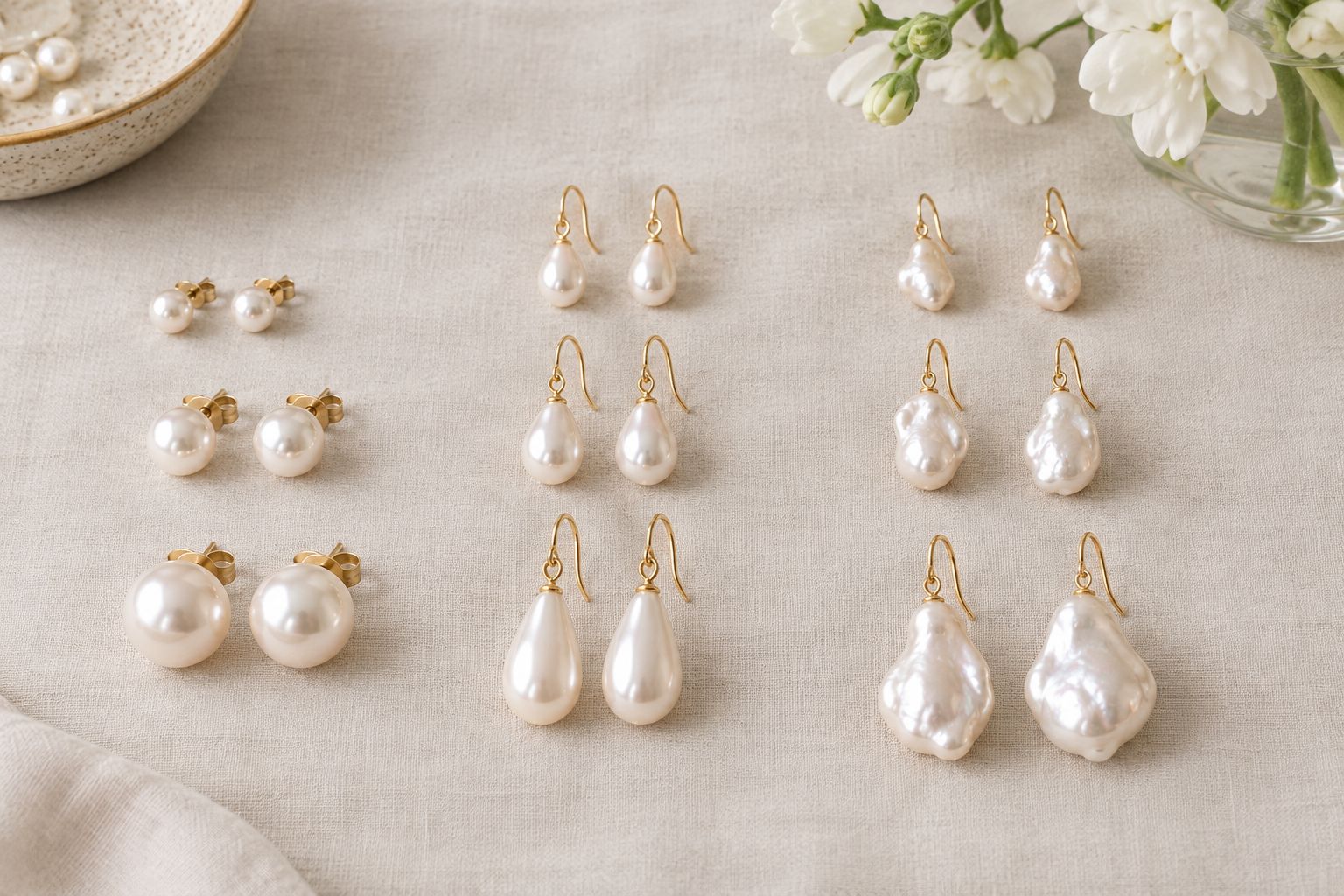
Compare the complete earring silhouette, not just the pearl's width.
Ask to see both earrings together, from the front and side. For an online comparison, request an on-ear view and a clear account of the complete dimensions rather than estimating scale from a photograph with no reference.
How these pearl earring styles were ranked
This ranking prioritizes a distinct purpose for each style: an adaptable first pair, delicate styling, a supporting piercing, dressy movement, or sculptural impact. It is a buying framework, not a product test or a claim that one diameter produces better pearls.
The criteria remain the same throughout: visible proportion, placement, luster, support, pair character, and wardrobe fit. Size narrows your search; it does not replace a close look at the individual earrings.
Which pearl earring size should you choose?
Choose 7–8 mm pearl studs if you are undecided. Use them as your comparison point, then make a deliberate adjustment: smaller for restraint, a drop for movement, or baroque for shape.
Before you commit, make these checks:
- Front view: Do you like how much of the lobe the pearl covers?
- Side view: Does the earring sit at an angle you enjoy?
- Movement: Does the complete design stay comfortable when you turn your head?
- Outfit: Does it work with the neckline and hairstyle you actually intend to wear?
For your 2026 purchase, write down the pearl dimensions, total earring dimensions, and metal details. That gives you a useful comparison between designs instead of a shortlist built around enlarged photographs.
FAQ
What's the best pearl earring size for a first pair?
Start with 7–8 mm pearl studs as an editorial reference point for a visible, uncomplicated first pair. Compare them on your own ears with smaller studs before deciding.
Are 6 mm pearl earrings too small for an adult?
No. A 6 mm pearl is a valid choice for an adult who prefers a restrained look; age does not determine the right pearl diameter.
Are larger pearls always better quality?
No. Pearl size is separate from qualities such as luster, surface condition, shape, and matching, so compare the individual pearls rather than ranking quality by diameter.
Should I choose pearl studs or pearl drops?
Choose pearl studs for a fixed silhouette against the ear and pearl drops for a suspended silhouette with movement. With drops, check total earring length as well as pearl size.
How do you measure baroque pearl earrings?
Compare the pearl's width and length, then check the complete earring dimensions. An irregular outline cannot be described adequately by a single diameter.
What size pearl earrings work in a second piercing?
Consider 3–4 mm pearl studs as a starting point for a supporting piercing. Check your piercing spacing and the complete setting beside your main earring.
Can I wear pearl earrings every day?
You can choose pearl earrings for regular wear, but remove them before swimming, showering, exercise, and sleep. Protect pearls from cosmetics and chemicals, and follow the care instructions for the complete piece.
One last thing
Try your favorite pair with your hair exactly as you wear it on an ordinary day. Then step back from the mirror. If the pearls disappear or take over more than you intended, change the scale—not your personal style.
Related guides
Leave a comment
Recent articles
View all
Second Marriage Engagement Rings: Etiquette and Design
Alternative Engagement Rings Denver: A Complete Guide