Best Miles McNeel engagement rings ranked by stone cut

Best overall starting point: round brilliant. Best for an elongated outline: oval. Best for architectural clarity: emerald cut. If you’re comparing the best Miles McNeel engagement rings by stone cut in 2026, use this shape-first ranking to define your preferences, then assess the individual ring rather than choosing by cut name alone.
TL;DR
- For the best miles mcneel engagement rings by stone cut, start with round brilliant for classic sparkle.
- Oval suits an elongated silhouette; emerald cut suits clean geometry and broad flashes of light.
- This engagement ring ranking compares stone cuts, not named Miles McNeel models or designer-specific specifications.
- Element 79 suits Denver couples exploring contemporary fine jewelry and custom bridal rings.
Why stone cut matters
A stone’s outline sets the mood before you notice the finer details. Round feels balanced, oval introduces length, and emerald cut brings crisp geometry—but the finished setting changes how each shape looks and wears.
For your 2026 search, separate three decisions: the outline you love, the light pattern you prefer, and the setting that suits your day. You’ll find contemporary fine jewelry and custom bridal pieces at Element 79, a boutique in Denver’s Cherry Creek neighborhood.
Element 79 is best for Denver couples seeking contemporary designer jewelry and custom bridal rings. For a Miles McNeel selection, judge the specific stone and mounting together; a familiar shape is not proof of a particular designer’s construction, materials, or customization options.
What makes the best engagement ring stone cut?
Use these criteria before falling for a photograph. They explain the order below without pretending that every shopper wants the same ring.
- Light pattern: Decide whether you prefer small, lively flashes or broader reflections. Brilliant and step-cut faceting create different effects.
- Outline: Look at the silhouette on your hand, not just against a white background. Length, width, and rounded versus angular edges shape the impression.
- Individual execution: A cut name does not establish beauty. Examine symmetry, distracting dark areas, and how the stone responds as you move.
- Setting protection: Consider exposed points, corners, and the security of the mounting. Stone shape alone does not determine daily-wear suitability.
- Wedding-band fit: View the engagement ring beside a band. The center setting, not simply the stone’s outline, determines the space between them.
- Personal style: Choose the shape you enjoy in ordinary clothes. Your engagement ring should feel like yours outside the proposal photograph.
Stone cuts at a glance
This 2026 shortlist ranks useful starting points by distinct style priorities. It is a comparison of cut characteristics, not a catalog of Miles McNeel ring models.
1
- Stone cut: Round brilliant
- Best for: Classic sparkle
- Standout characteristic: Circular outline with brilliant faceting
- Key limitation: Not the choice for a long or angular silhouette
2
- Stone cut: Oval
- Best for: An elongated silhouette
- Standout characteristic: Curved outline with length
- Key limitation: A distracting bow-tie shadow needs close inspection
3
- Stone cut: Emerald cut
- Best for: Architectural style
- Standout characteristic: Rectangular step-cut geometry
- Key limitation: Inclusions can be easier to notice
4
- Stone cut: Cushion
- Best for: Soft-edged geometry
- Standout characteristic: Rounded corners on a square or rectangular outline
- Key limitation: Faceting styles vary substantially
5
- Stone cut: Radiant
- Best for: Angular sparkle
- Standout characteristic: Brilliant faceting within a clipped-corner outline
- Key limitation: Some stones show busy or uneven light patterns
6
- Stone cut: Pear
- Best for: Directional asymmetry
- Standout characteristic: Rounded end tapering to a point
- Key limitation: The tip needs appropriate protection
1. Round brilliant: best engagement ring cut for classic sparkle
Round brilliant is the default recommendation when sparkle matters more than an unusual outline. Its circular shape offers a balanced starting point without a pointed tip or angular corners.
For a Miles McNeel ring you’re considering, look beyond the round label. Watch the actual stone in motion and decide whether its pattern stays lively rather than relying on a still image under display lighting.
Round brilliant pros:
- Circular symmetry creates a balanced focal point.
- Brilliant faceting suits shoppers who enjoy lively flashes.
- The outline has no pointed tip to accommodate.
Round brilliant cons:
- The silhouette does not provide the length of oval or pear.
- Round stones still differ in light performance; shape alone is insufficient.
Best for: You want a classic center stone and expect the setting to provide the more personal design details.
Ask to see the ring from above and in profile. A round center can look understated or sculptural depending on the surrounding metal and setting height, so judge the whole composition.
Verdict: Buy for classic sparkle; skip if a distinctive outline is your priority.
2. Oval: best engagement ring cut for an elongated silhouette
Oval gives you a curved outline with a clear sense of length. It is a natural next comparison when round feels too compact but sharp corners do not appeal.
Inspect the center carefully. Oval diamonds can show a bow-tie effect—a dark pattern across the middle—and the important question is whether that contrast distracts you during normal movement.
Oval pros:
- The elongated outline creates a different look from round.
- Curved edges keep the silhouette soft.
- Length-to-width proportions offer visibly different personalities.
Oval cons:
- A prominent bow-tie effect can interrupt the light pattern.
- A photograph does not reliably communicate the stone’s proportions on your hand.
Best for: You want length without a pointed end or a rectangular outline.
Try the oval with its long axis running along your finger, then compare the overall balance with a round stone. There is no universal ideal proportion; choose the outline you like rather than treating a ratio as a beauty score.
Verdict: Buy for elongated softness; wait if the center looks persistently dark.
3. Emerald cut: best engagement ring cut for architectural style
Emerald cut means a rectangular step-cut shape, not an emerald gemstone. Its long facets create broader reflections and a more ordered visual pattern than brilliant-cut styles.
Choose emerald cut because you enjoy that quieter geometry. It is not the substitute for a round brilliant when your main goal is a similar sparkle pattern in a rectangle.
Emerald cut pros:
- Straight lines create an architectural focal point.
- Step facets offer broad flashes and visible structure.
- Clipped corners soften the rectangular outline.
Emerald cut cons:
- Its open-looking facet pattern can make inclusions easier to notice.
- It does not deliver the same visual effect as brilliant faceting.
Best for: You prefer clean lines, deliberate symmetry, and a stone whose geometry is part of its appeal.
Examine clarity with your unaided eye as well as any grading information. Decide whether you notice an inclusion at a normal viewing distance, rather than choosing entirely from a magnified image.
Verdict: Buy for architectural clarity; skip if you want constant, fine-grained sparkle.
4. Cushion: best engagement ring cut for soft-edged geometry
Cushion cuts combine rounded corners with a square or rectangular outline. They suit you when round feels too circular and angular cuts feel too sharp.
The name covers different proportions and facet arrangements. Compare actual stones because two cushions can produce noticeably different patterns, even when their outlines look similar.
Cushion pros:
- Rounded corners soften a geometric silhouette.
- Square and elongated outlines create different styling directions.
- Distinct facet patterns give you room to choose a personal look.
Cushion cons:
- The cut name alone tells you little about the precise light pattern.
- Depth and proportions affect face-up dimensions, so weight is not enough.
Best for: You want a softly structured center stone rather than a strict circle or rectangle.
Check the stone’s length and width in millimeters. A 1-carat diamond weighs 200 milligrams, but that weight does not specify how large the diamond looks from above; the stone’s proportions also matter.
Verdict: Buy for soft geometry; wait until you have compared individual facet patterns.
5. Radiant: best engagement ring cut for angular sparkle
Radiant combines a square or rectangular outline with brilliant faceting and clipped corners. It belongs on your shortlist when you like emerald-cut geometry but prefer a more sparkling internal pattern.
Do not treat radiant as an emerald cut with a different name. Their faceting is different, and that difference is central to the choice.
Radiant pros:
- Brilliant faceting brings sparkle to an angular outline.
- Clipped corners distinguish it from a pointed-corner square.
- Square and elongated versions offer different proportions.
Radiant cons:
- Some facet patterns look too busy for shoppers who prefer broad reflections.
- Uneven brightness still requires inspection in the individual stone.
Best for: You want a geometric silhouette without the ordered step-facet appearance of emerald cut.
Compare radiant and emerald cut side by side. If your eye keeps returning to the radiant’s smaller flashes, that preference is more useful than a ranking that places architectural simplicity above everything else.
Verdict: Buy for angular sparkle; skip if you prefer a calm, clearly structured facet pattern.
6. Pear: best engagement ring cut for directional asymmetry
Pear combines a rounded end with a pointed tip. The outline gives the ring a clear direction and an asymmetric character that the other cuts here do not share.
Inspect the transition from the rounded shoulders to the point. Look for a pleasing outline, then check whether central darkness distracts you as the stone moves.
Pear pros:
- The tapered outline creates a distinctive focal point.
- Asymmetry suits shoppers who want something less conventional.
- The shape introduces length with a visibly directional finish.
Pear cons:
- The pointed tip needs suitable setting protection.
- A distracting bow-tie effect can interrupt the appearance.
Best for: You want an expressive silhouette and enjoy the contrast between a curved end and a pointed one.
Ask how the mounting protects the tip. Turn the ring to see whether the setting supports the outline without obscuring the feature that attracted you.
Verdict: Buy for expressive asymmetry; wait until tip protection is clear.
How this stone-cut ranking works
Round leads this 2026 ranking as a starting point for classic sparkle, not as a promise that every round stone outshines every other shape. Oval, emerald cut, cushion, radiant, and pear each earn a separate place because they answer different style preferences.
The order follows outline, light pattern, individual execution, setting protection, and band fit. It does not assign designer-specific quality scores or treat a shape preference as a laboratory result.
How to compare your finalists on your hand
Keep the comparison simple. Choose your preferred outline first, inspect the stone’s behavior second, and assess the finished mounting last.
- Outline: View the ring at arm’s length as well as close up. Decide whether its proportions feel balanced on your hand.
- Light: Compare at least 2 lighting settings, such as diffuse daylight and indoor light. Avoid making the decision under spotlights alone.
- Profile: Check 3 viewing angles: top, side, and alongside a wedding band. Notice height, exposed edges, and the space between rings.
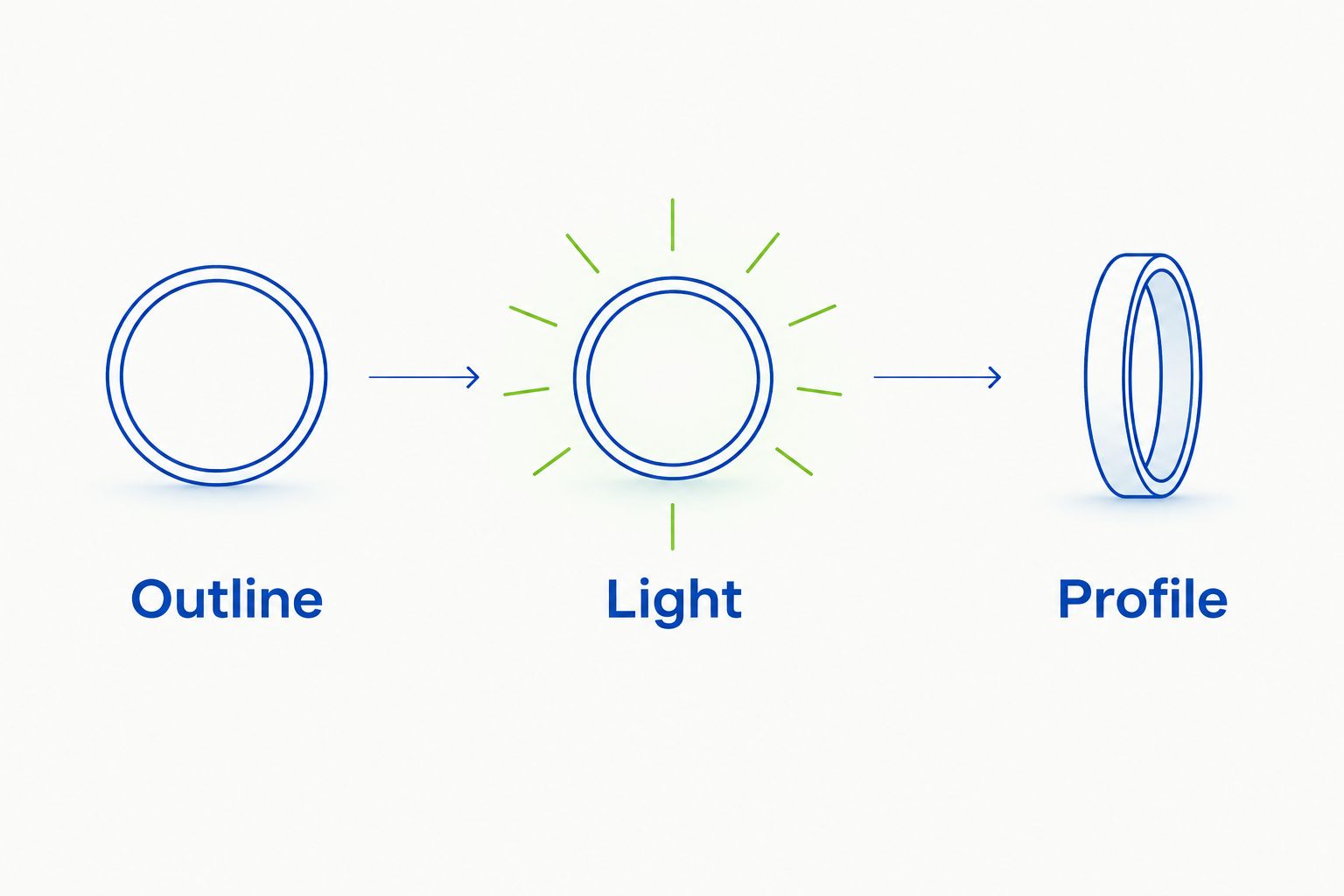
Choose the outline you love, then check its light pattern and the finished setting.
Bring a short list of preferences rather than a folder of unrelated favorites. Element 79’s contemporary bridal focus makes a clear brief useful: describe the silhouette, sparkle pattern, and setting details you want to explore without assuming a specific designer offers every combination.
Which engagement ring stone cut should you choose?
Start with round brilliant if you are undecided. Compare it with oval for length and emerald cut for architectural contrast; those choices reveal whether you care most about sparkle, outline, or geometry.
For your final 2026 decision, choose the individual ring that satisfies your priorities in ordinary light. A lower-ranked shape that feels right on your hand beats a first-ranked shape you admire only in photographs.
FAQ
What are the best Miles McNeel engagement rings by stone cut?
Start with round brilliant for classic sparkle, oval for an elongated outline, and emerald cut for architectural geometry. These are stone-cut recommendations, not rankings of named Miles McNeel models; assess the specific ring’s stone and setting before choosing.
Is round brilliant better than oval for an engagement ring?
Round brilliant is the better starting point for a circular silhouette, while oval suits an elongated look. Compare individual stones in motion because the shape name alone does not establish light performance.
Does emerald cut mean the engagement ring has an emerald gemstone?
No. Emerald cut describes a rectangular step-cut shape and can apply to a diamond or another gemstone. Confirm the gemstone separately from its cut.
Is cushion cut better than radiant cut?
Cushion suits rounded corners and softer geometry; radiant suits a more angular, clipped-corner outline with brilliant faceting. Neither is universally better, and individual facet patterns matter.
What should I check before choosing a pear-shaped engagement ring?
Check the outline, central light pattern, and protection around the pointed tip. View the finished ring from the side as well as above so the mounting is part of your decision.
Does a higher carat weight mean a bigger-looking diamond?
Not necessarily. Carat measures weight, while face-up dimensions and proportions determine how much of the stone you see from above. Compare length and width in millimeters rather than weight alone.
What should I prioritize when shopping for an engagement ring in 2026?
Prioritize an outline you enjoy, a pleasing light pattern, and a setting suited to your daily routine. Inspect the individual ring rather than choosing entirely from a designer name, cut label, or photograph.
One last thing
Your wedding band changes the composition. Before you settle on a center-stone shape, view the engagement ring beside the kind of band you intend to wear—even if that band comes later.
A small gap, a curved band, or a wider neighboring ring creates a different look. Let that complete picture guide your choice, not the center stone alone.
Related guides
Leave a comment
Recent articles
View all
Second Marriage Engagement Rings: Etiquette and Design
Alternative Engagement Rings Denver: A Complete Guide