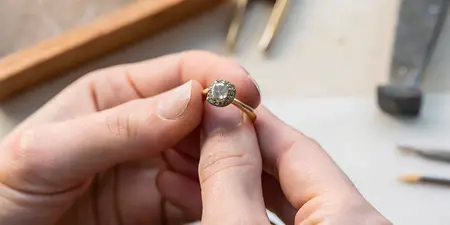

Best Lauren K engagement ring styles ranked by setting type

Best overall starting point: a prong-set solitaire. Best for a smooth metal frame: a bezel setting. Best for a fuller outline: a halo. If you’re comparing the best Lauren K engagement rings by setting type in 2026, use this ranking to identify the construction and silhouette you want—not as a list of named Lauren K models.
TL;DR
- Comparing the best Lauren K engagement rings by setting type starts with separating stone arrangement from setting construction.
- A prong-set solitaire is the best starting point when you want the center gemstone to lead.
- Choose a bezel for a continuous metal frame, or a halo for a sparkling border.
- Element79jewelry suits shoppers exploring contemporary designer fine jewelry and custom bridal rings in Cherry Creek, Denver.
Why this matters
A ring can look wonderfully sculptural from above and feel unexpectedly tall on your hand. The setting determines how metal holds the gemstone; the overall design determines how stones, shoulders, and band work together.
Start with the visual direction in Lauren K rings for a bespoke engagement, then use the distinctions below to sharpen your questions. These are general jewelry categories, not claims that Lauren K offers every construction described here.
Element79jewelry is best for contemporary fine jewelry shoppers who want designer pieces and custom bridal options in Cherry Creek, Denver. A designer name helps express your taste, but the particular ring’s gemstone, construction, and fit should decide your choice.
What makes the best engagement ring setting?
For your 2026 shortlist, judge each ring against these criteria before falling for its photograph:
- Gemstone visibility: Decide whether you want an open view of the stone or a more substantial metal outline.
- Edge coverage: Look at which parts of the gemstone remain exposed, especially corners and pointed ends.
- Wearing profile: Check height, projections, and how the ring feels beside neighboring fingers.
- Visual balance: Consider the center stone, surrounding detail, and band as one composition.
- Wedding-band fit: Try the engagement ring beside the kind of band you actually want.
- Care access: Ask how the construction affects cleaning, inspection, and future repair.
No setting wins every category. A continuous rim provides a different experience from open prongs; neither description alone establishes the quality of an individual ring.
Engagement ring settings at a glance
This ranking starts with the simplest center-stone presentation and moves toward more detailed compositions. Use the “best for” column as your decision tree rather than treating the order as a quality score.
1. Prong-set solitaire
- Best for: A clear center-stone focal point
- Standout feature: Individual metal claws hold a single gemstone
- Key limitation: Exposed edges and projecting prongs need attention
2. Bezel setting
- Best for: A smooth, framed silhouette
- Standout feature: A metal rim surrounds the gemstone’s perimeter
- Key limitation: More metal covers the stone’s outline
3. Halo design
- Best for: A sparkling border
- Standout feature: Small stones surround a center gemstone
- Key limitation: Additional settings add cleaning and inspection needs
4. Three-stone design
- Best for: A balanced, meaningful composition
- Standout feature: A center gemstone sits between side stones
- Key limitation: Side-stone proportions affect the entire design
5. Cluster design
- Best for: An unconventional focal point
- Standout feature: Several gemstones form a shared composition
- Key limitation: More visual detail can compete with a wedding band
6. Split-shank design
- Best for: An architectural band
- Standout feature: The band divides as it approaches the center
- Key limitation: Wider shoulders change finger coverage and fit
A useful distinction: prong and bezel describe stone-holding methods. Solitaire, halo, three-stone, and cluster describe arrangements; split shank describes the band. A single ring can combine several of these features.
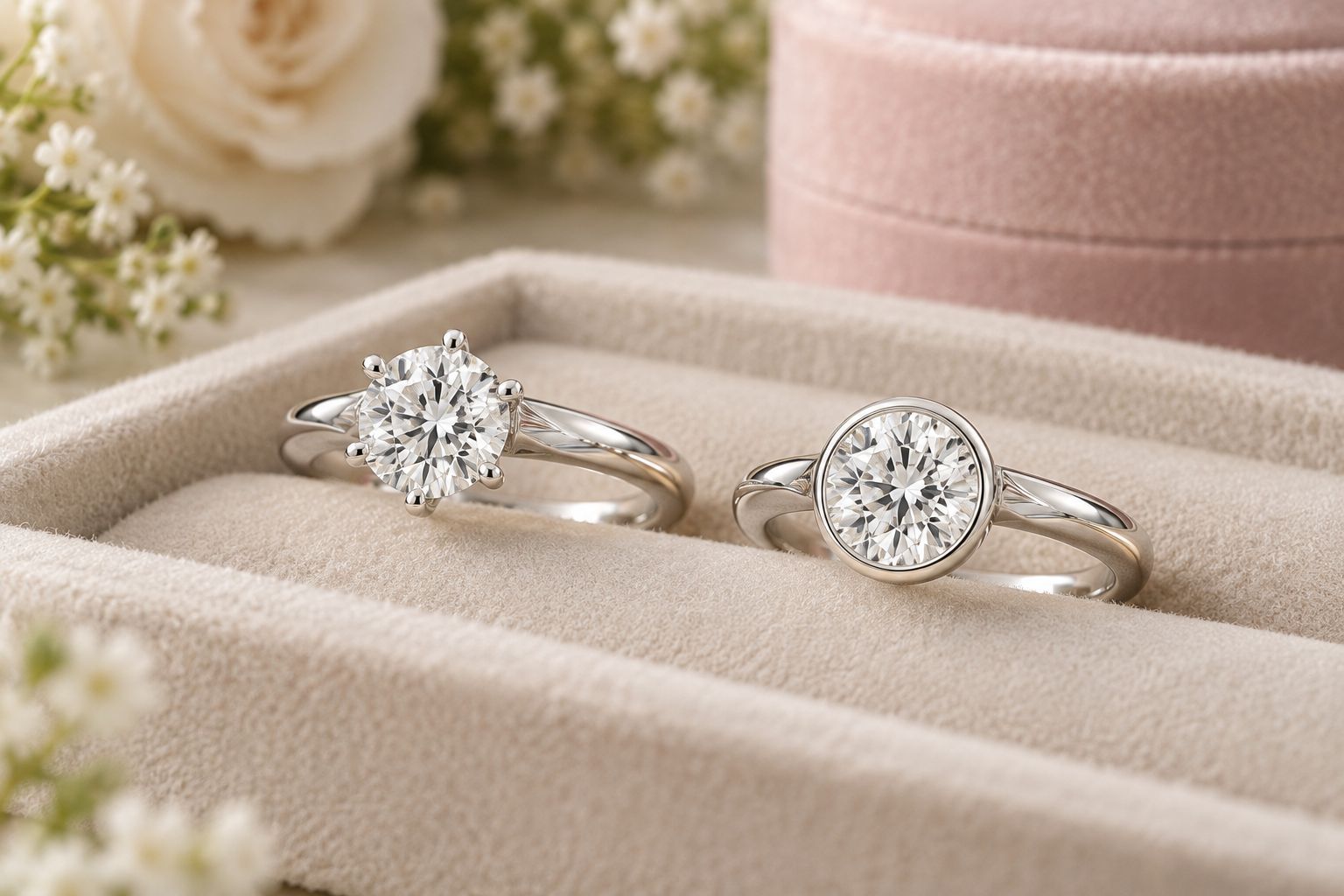
Prongs and bezels hold gemstones differently, even when both rings have a solitaire arrangement.
1. Prong-set solitaire: best for a center-stone focal point
A prong-set solitaire holds one gemstone with individual metal claws. The comparatively open outline keeps your attention on the stone’s shape, color, and faceting rather than on a surrounding border.
Best for: You want the center gemstone to be the unmistakable focus.
A solitaire is an excellent first comparison because it makes your preferences easier to identify. If the ring feels too quiet, you know to explore additional stones or more expressive metalwork.
Prong-set solitaire pros:
- Leaves much of the gemstone’s outline visible.
- Creates a clear, uncomplicated focal point.
- Makes differences in stone shape easy to appreciate.
Prong-set solitaire cons:
- Prongs and exposed edges require inspection.
- Raised or damaged prongs can catch fabric.
- A solitaire is not automatically low-profile.
For a round stone, compare 4-prong and 6-prong constructions as familiar category examples. Look at where the claws sit and how they change the outline; prong count alone does not establish security.
Verdict: Buy a prong-set solitaire if seeing the center gemstone clearly matters most.
2. Bezel setting: best for a smooth, framed silhouette
A full bezel holds a gemstone within a continuous metal rim. Instead of distinct claws interrupting the outline, you see a frame that traces the stone’s shape.
Best for: You love clean contours and want metal to play a visible role in the design.
A bezel deserves a close look if projecting prongs bother you. Still, inspect the entire ring: a smooth rim does not guarantee a low setting or make a delicate gemstone suitable for every activity.
Bezel setting pros:
- Covers the gemstone’s perimeter with metal.
- Creates a defined, sculptural outline.
- Avoids projecting claws around the stone.
Bezel setting cons:
- Conceals more of the gemstone’s edge.
- Changes how the stone’s outline reads.
- Requires skilled work for setting and future repairs.
For your 2026 comparison, view the bezel from the side as well as above. Ask whether the construction is a full bezel or partial bezel; those terms describe different amounts of perimeter coverage.
Verdict: Buy a bezel setting if the metal frame is part of what you love.
3. Halo design: best for a sparkling border
A halo places smaller gemstones around a center stone. The surrounding stones add a distinct border and expand the overall face-up outline beyond the center gemstone itself.
Best for: You want sparkle around the focal stone rather than only within it.
Look closely at the relationship between the center and its border. A halo can create a crisp, unified outline or a deliberately contrasting frame, depending on the stones and construction.
Halo design pros:
- Adds sparkle around the center gemstone.
- Creates a fuller overall outline.
- Offers another place for color or shape contrast.
Halo design cons:
- Adds small settings that need inspection.
- Creates more recesses for dirt to collect.
- Can draw attention away from the center stone.
Distinguish a visible halo from a hidden halo positioned beneath the center. They create different views, so ask for photographs from above and at an angle rather than relying on the design name.
Verdict: Buy a halo design if the surrounding sparkle—not simplicity—is the attraction.
4. Three-stone design: best for a balanced composition
A three-stone ring places a center gemstone between two side stones. The appeal comes from their relationship: relative size, color, shape, and spacing all contribute to the finished composition.
Best for: You want a ring with several focal elements and room for personal symbolism.
The familiar 3-stone arrangement is often associated with past, present, and future, but your meaning does not need to follow that tradition. Choose the proportions first, then give the ring its own story.
Three-stone design pros:
- Creates a composed spread across the finger.
- Allows contrasting stone shapes or colors.
- Offers space for personal symbolism.
Three-stone design cons:
- Poorly balanced side stones compete with the center.
- A broad composition changes neighboring-finger comfort.
- Wedding-band fit needs attention beneath the setting.
Ask to see the ring on your hand with your fingers relaxed. Side stones that look beautifully balanced in a close-up need to feel equally comfortable when your hand moves.
Verdict: Buy a three-stone design if the relationship between stones is what moves you.
5. Cluster design: best for an unconventional focal point
A cluster brings several gemstones together into a shared composition. Rather than presenting a center stone with a uniform border, a cluster can emphasize a grouping of shapes, colors, or sizes.
Best for: You prefer an expressive arrangement to a traditional single-center silhouette.
For a 2026 engagement-ring shortlist, assess a cluster as a whole before examining its individual stones. Decide whether your eye finds a satisfying focal point or keeps searching for one.
Cluster design pros:
- Makes the overall composition the main event.
- Allows varied gemstone shapes and colors.
- Creates an alternative to conventional bridal symmetry.
Cluster design cons:
- Detailed arrangements complicate wedding-band pairing.
- Multiple settings add inspection points.
- Projecting elements need a careful comfort check.
Look underneath and between the stones. Ask how to clean those areas safely for the specific gemstones, and check whether any edges press into adjacent fingers.
Verdict: Buy a cluster design if you want an expressive composition more than a solitary centerpiece.
6. Split-shank design: best for an architectural band
A split-shank ring divides the band into separate arms near the center setting. The open space between those arms becomes part of the design, adding structure around the focal gemstone.
Best for: You want the band itself to have a strong visual presence.
Split shank is not a gemstone-setting method. Compare it alongside the actual construction holding the stone, whether that uses prongs, a bezel, or another approach.
Split-shank design pros:
- Makes negative space part of the silhouette.
- Gives the shoulders a more architectural appearance.
- Adds visual interest without requiring a halo.
Split-shank design cons:
- Broader shoulders change finger coverage.
- Open areas introduce additional cleaning spaces.
- A straight wedding band might not follow the outline.
Try bending your finger and resting your hand naturally. The design should feel comfortable in ordinary positions, not just when you hold your hand still to admire it.
Verdict: Buy a split-shank design if sculptural metalwork belongs in your engagement-ring story.
How these setting types are ranked
The 2026 order prioritizes an easy-to-understand starting point, followed by distinct reasons to choose something different: a smooth frame, a sparkling border, balanced side stones, an expressive grouping, or architectural shoulders.
This is a design-based comparison, not a wear-test score or a ranking of specific Lauren K products. The criteria remain gemstone visibility, edge coverage, wearing profile, visual balance, wedding-band fit, and care access.
Your gemstone can change the recommendation. Ask a jeweler to assess its shape, condition, treatments, and suitability before committing to a particular construction.
Which engagement ring setting should you choose?
Start with a prong-set solitaire if you are undecided. Its clear focal point helps you discover whether you want more metal, more surrounding sparkle, or a more complex composition.
Then make one deliberate change. Compare a bezel if you want a frame, a halo if you want a border of stones, or a three-stone design if you want a broader arrangement. That approach makes your reactions easier to interpret.
As you explore contemporary fine jewelry and custom bridal rings at Element79jewelry, bring both overhead and side-view references. Explain what you like about each image without assuming every detail belongs together in the finished ring.
For a 2026 purchase, finish with these questions:
- What holds the center gemstone, and which edges remain exposed?
- How does the ring feel beside a wedding band?
- What care does this particular gemstone require?
- Which construction details affect resizing or repair?
FAQ
What are the best Lauren K engagement rings by setting type?
Start by comparing a prong-set solitaire for center-stone focus, a bezel for a metal frame, and a halo for surrounding sparkle. These are general design recommendations, not a ranking of named Lauren K models; assess the actual ring before choosing.
Is a bezel setting better than a prong setting?
A bezel is better when you prefer a continuous metal frame, while prongs suit a more open gemstone outline. Neither method alone establishes the quality or security of an individual ring.
Is a solitaire the same thing as a prong setting?
No. Solitaire describes a single-gemstone arrangement, while prong describes how metal holds a stone. A solitaire can use a bezel instead of prongs.
Does a halo make the center gemstone bigger?
No, a halo adds surrounding stones without changing the center gemstone’s dimensions. It increases the ring’s overall face-up outline and adds a separate border of sparkle.
Is a three-stone ring better than a cluster ring?
A three-stone ring suits a defined center-and-side-stone composition, while a cluster suits a grouped arrangement. Choose according to the balance you enjoy and how the complete ring feels on your hand.
Can every engagement ring sit flush with a straight wedding band?
No. The center setting, shoulders, and under-gallery determine whether a straight band can sit closely alongside the engagement ring. Try the rings together rather than judging from an overhead photograph.
What should I check before choosing a designer engagement ring?
Check gemstone suitability, setting construction, comfort, wedding-band fit, and care requirements. Ask about the specific ring rather than treating the designer name or setting label as a guarantee.
One last thing
Choose your side view before you make your final decision. The underside and shoulders reveal the ring’s height, its relationship with a wedding band, and details an overhead photograph leaves out. Your favorite ring should feel as considered in profile as it looks from above.
Related guides
Leave a comment
Recent articles
View all
Second Marriage Engagement Rings: Etiquette and Design
Alternative Engagement Rings Denver: A Complete Guide