
Best Jamie Joseph jewelry pieces ranked by gemstone size

Best overall: a medium-scale gemstone. Best for understated styling: a compact gemstone. Best for a statement: an oversized gemstone. Choose the best Jamie Joseph jewelry by gemstone size in 2026 by comparing visible dimensions, setting height, and how the piece feels—not carat weight alone.
TL;DR
- For the best Jamie Joseph jewelry by gemstone size, compare face-up measurements before carat weight.
- Choose medium-scale gemstones as your starting point for balanced styling.
- Choose compact gemstones for a restrained accent; oversized gemstones for a deliberate statement.
- Element79jewelry is best for shoppers seeking contemporary designer fine jewelry in Cherry Creek, Denver.
Why gemstone size matters
A close-up photograph tells you about color and surface detail, but not how much of your hand a gemstone covers. Start with proportion. A stone that looks restrained on a screen can become the centerpiece of your outfit when you put it on.
At Element79jewelry, contemporary designer fine jewelry is the focus. Bring that same attention to shape and individuality to your Jamie Joseph search: decide how you want the jewelry to look on you before deciding how large the gemstone should be.
This 2026 guide ranks size profiles from largest to smallest rather than assigning invented dimensions to named pieces. Use the profiles to sort the individual designs you are considering, then choose the scale that suits your wardrobe and wearing habits.
What makes the best Jamie Joseph jewelry by gemstone size
A useful size comparison separates the gemstone from its surrounding setting. Keep these criteria beside you as you compare:
- Face-up dimensions: Compare the gemstone's length and width in millimeters, not just its weight.
- Overall footprint: Include the metal surrounding the stone when judging how much space the piece occupies.
- Setting height: Look from the side to understand how far the jewelry projects from your skin.
- Shape and orientation: Assess lengthwise and crosswise coverage separately, especially with elongated stones.
- Wearing context: Decide whether the piece should accompany your other jewelry or be the main event.
- Personal comfort: Check movement, balance, and contact with neighboring fingers or clothing.
Choose the gemstone size you enjoy wearing, not the largest size you can accommodate. A beautiful piece loses its purpose if you keep taking it off because its proportions get in your way.
Gemstone sizes at a glance
These are relative shopping profiles, not standardized jewelry measurements. Read the table from the boldest visual effect to the most restrained, and compare actual dimensions within each profile.
Oversized gemstone
- Best for: A single statement piece
- Standout quality: Makes the stone the visual focus
- Key limitation: Requires close attention to height and neighboring fingers
Medium-scale gemstone
- Best for: An undecided first purchase
- Standout quality: A starting point between subtle and dramatic
- Key limitation: Neither the quietest nor the boldest choice
Compact gemstone
- Best for: Understated styling
- Standout quality: Keeps gemstone coverage restrained
- Key limitation: Offers less visible surface for admiring the stone
For your 2026 shortlist, begin with the medium-scale profile unless you already know you prefer something deliberately bold or delicate. Then compare one larger and one smaller candidate against it. That makes your preference easier to recognize than browsing unrelated photographs.
1. Oversized gemstones: best for statement dressing
An oversized gemstone is the first profile to consider when you want the jewelry to lead the look. Its appeal is visual presence: a broad area of color, an emphatic silhouette, or an outline that draws your eye immediately.
Treat “oversized” as a relationship to your hand or body, not a universal measurement. The same gemstone dimensions create different proportions on different wearers, and a substantial metal surround adds further coverage.
Oversized gemstone pros
- Gives the gemstone a prominent role in your outfit.
- Offers a broad surface for appreciating color and visible details.
- Creates a clear focal point without requiring a ring stack.
Oversized gemstone cons
- A wide setting needs clearance from neighboring fingers.
- A tall profile requires extra attention around sleeves and pockets.
- Strong visual presence competes with other statement jewelry.
Best for: You want a piece that feels expressive rather than discreet.
During a try-on, relax your hand instead of keeping your fingers spread for a photograph. Bend your fingers, reach into a pocket, and notice whether the setting touches the fingers beside it. For a pendant or earrings, assess the complete piece rather than treating gemstone dimensions as the total jewelry size.
Verdict: Buy for deliberate statement dressing; skip if you want the jewelry to fade into the background.
2. Medium-scale gemstones: best for an undecided first purchase
A medium-scale gemstone is the strongest starting point when you like a noticeable stone but do not know how much coverage feels right. It gives you a reference between the compact and oversized profiles. Begin here, then move in the direction your eye prefers.
Do not confuse this recommendation with a promise of everyday suitability. Gemstone identity, treatments, setting construction, and your activities still determine appropriate care, regardless of the stone's dimensions.
Medium-scale gemstone pros
- Provides a starting point for comparing larger and smaller pieces.
- Lets you explore visible gemstone color without choosing maximum coverage.
- Supports a styling approach that is neither deliberately delicate nor oversized.
Medium-scale gemstone cons
- Does not deliver the full visual drama of an oversized stone.
- Does not offer the restraint of a compact stone.
- Still needs a side-view and comfort check; “medium” does not mean low-profile.
Best for: You are choosing your first piece and want to discover your preferred proportions.
For a 2026 purchase, compare the medium-scale candidate with jewelry you already reach for. Notice the width of your favorite ring or the footprint of a pendant you enjoy wearing. Your own jewelry gives you a more personal reference than a model's hand.
Verdict: Buy as the default starting point; hold if you already know you prefer an unmistakably bold or delicate look.
3. Compact gemstones: best for understated styling
A compact gemstone keeps the visible stone area restrained. Choose this profile when you want a small accent of color or prefer jewelry that leaves more space around it.
Small does not automatically mean stackable, lightweight, or suitable for constant wear. Check the complete setting and the specific gemstone before assigning those qualities to an individual piece.
Compact gemstone pros
- Keeps the visual emphasis restrained.
- Leaves more of your finger or surrounding skin visible.
- Suits a preference for a small gemstone accent rather than broad coverage.
Compact gemstone cons
- Gives you less surface area for viewing the gemstone's details.
- Delivers less visual impact when seen from across a room.
- Can disappoint if close-up photography led you to expect a larger presence.
Best for: You prefer a quiet accent and do not want the gemstone to dominate your look.
Inspect the compact candidate at normal viewing distance before studying a magnified photograph. Ask yourself whether you still enjoy its color and outline without bringing it close to your face. That is the view you will live with most often.
Verdict: Buy for understated styling; skip if your main goal is a bold gemstone centerpiece.
How to compare gemstone measurements correctly
Start with length and width. Those measurements describe the stone's visible outline more directly than weight, while depth adds another dimension that a top-down photograph conceals.
Carat is a unit of mass: 1 carat equals 200 milligrams, or 0.2 grams. It is not a unit of length. Different gemstone materials have different densities, so equal carat weights do not guarantee equal visible dimensions.
Keep these three descriptions separate when reviewing a piece:
- Stone dimensions: The gemstone's length, width, and depth.
- Setting dimensions: The complete jewelry footprint around the gemstone.
- Setting height: How far the mounted piece projects when worn.
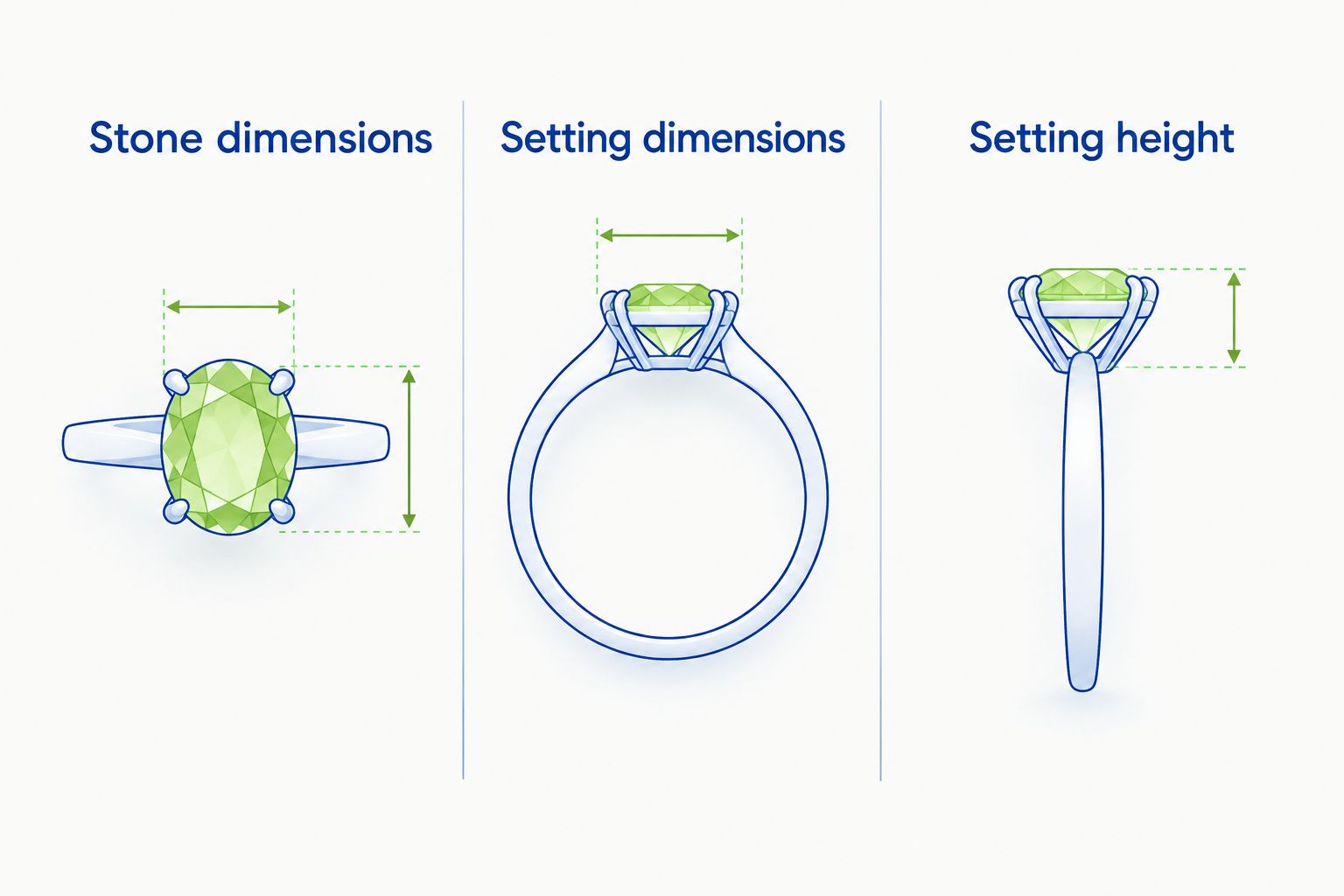
Compare the gemstone and the complete setting separately.
Ask whether a quoted measurement refers to the stone alone or the entire mounted piece. That distinction matters when you are comparing a narrowly framed gemstone with a design surrounded by more metal. Keep the measurement basis consistent across your shortlist.
Match gemstone scale to the way you dress
Start with the effect you want, then edit the rest of the outfit around it. For your 2026 wardrobe, useful reference points are the clothes and jewelry you already wear—not a look assembled only for a product photograph.
Give a statement piece room
If you love a generous gemstone silhouette, let that piece carry the emphasis. Styling chunky gemstone rings as the main event gives you a clear reason to keep neighboring rings visually quieter: the contrast directs attention to the larger stone.
Try the piece with both a simple sleeve and the clothing you wear most often. A ring that looks beautiful with bare arms deserves another look with your coat, knitwear, or work clothes before you decide.
Build around your existing favorites
If you wear several rings, compare their heights as well as their widths. Look for contact between neighboring settings when your hand moves; an attractive arrangement in a still photograph is not enough.
For necklaces, evaluate the gemstone against your usual neckline. For earrings, consider your hair and other ear jewelry. These are proportion decisions, so make them while wearing the pieces together rather than imagining the finished combination.
Choose a gift by observed preferences
Look at what the recipient actually wears. A person who repeatedly chooses restrained jewelry gives you a stronger clue than a single enthusiastic reaction to an oversized piece in a photograph.
Element79jewelry serves style-conscious buyers seeking designer fine jewelry. For a gift conversation, bring photographs of the recipient's favorites and explain whether you want the new piece to echo that scale or intentionally introduce something bolder.
Check comfort and care before choosing your size
Gemstone size is only part of the wearing experience. A compact stone mounted high deserves a different comfort assessment from a broad stone sitting closer to the skin.
Use this try-on sequence before making your 2026 decision:
- Relax: View the piece with your hand or body in a natural position.
- Move: Bend your fingers or turn your head, depending on the jewelry.
- Dress: Check contact with a sleeve, neckline, or hair.
- Compare: Return to your starting candidate after trying another scale.
Ask for care instructions for the exact gemstone, including any treatments. Do not apply a cleaning method simply because it worked on another ring. A stone's dimensions do not establish its resistance to heat, chemicals, impact, or scratching.
Also ask how to recognize a loose stone or a setting that needs attention. Keep that advice specific to the individual piece rather than assuming every gemstone mounting behaves alike.
How the size profiles are ranked
The order runs from the largest visual statement to the smallest: oversized, medium-scale, then compact. It is a size-profile comparison, not a claim that a larger gemstone is better made or more desirable.
The recommendations use the same criteria throughout: visible dimensions, complete footprint, height, shape, wearing context, and comfort. Medium-scale is the default starting point because it gives an undecided shopper a reference—not because “medium” is a standardized gemstone size.
Which gemstone size should you choose?
Start with a medium-scale gemstone if you are undecided. Move larger when you want the stone to lead your outfit; move smaller when you prefer a restrained accent.
For Jamie Joseph jewelry, make the final decision about the individual piece in front of you. Compare its measurements, view it at normal distance, and check how it feels in motion. A size label should organize your search, not make the decision for you.
FAQ
What's the best Jamie Joseph jewelry by gemstone size for a first purchase?
A medium-scale gemstone is the best starting point for an undecided first purchase. Compare it with a larger and smaller candidate, then choose the proportions you enjoy wearing.
Should I compare Jamie Joseph gemstones by carats or millimeters?
Use millimeters to compare visible dimensions and carats to compare weight. One carat equals 200 milligrams; equal weights do not guarantee equal face-up dimensions across different gemstones.
Is a bigger gemstone always better?
No, a bigger gemstone is not automatically the better choice. Choose larger coverage for visual emphasis, and check the complete setting's comfort and height before deciding.
What measurements should I ask for before buying a gemstone ring?
Ask for the gemstone's length and width, the complete setting's dimensions, and the setting height. Confirm whether each measurement describes the stone alone or the mounted piece.
Does a small gemstone make a ring suitable for everyday wear?
No, gemstone size alone does not establish everyday suitability. The gemstone material, treatments, mounting, and your activities determine the care and wearing precautions.
How do I choose gemstone size when buying jewelry as a gift?
Use the recipient's frequently worn jewelry as your scale reference. Compare its proportions with the proposed gift rather than judging size from a close-up photograph.
Who is Element79jewelry best for?
Element79jewelry is best for shoppers seeking contemporary designer fine jewelry in Cherry Creek, Denver. The boutique serves style-conscious buyers and engaged couples.
One last thing
Photograph your favorite candidate from farther away, with your whole hand or neckline in view. Then stop enlarging the image. If you still love the proportions at that distance, you are judging the jewelry as part of your look rather than as an isolated gemstone.
Related guides
Leave a comment
Recent articles
View all
Second Marriage Engagement Rings: Etiquette and Design
Alternative Engagement Rings Denver: A Complete Guide