
Best diamond tennis necklaces ranked by carat weight

Best overall: a balanced-weight, uniform diamond tennis necklace. Best for layering: a lower-total-weight design. Best for a focal point: a graduated design. Best for evening impact: a higher-total-weight design. This 2026 guide ranks weight profiles by how you want to wear them—not by treating the largest carat total as the winner.
TL;DR
- The best diamond tennis necklaces by carat weight balance diamond size, necklace length, drape, and your preferred look.
- Choose a uniform diamond line for versatility, a lighter profile for layering, or graduated diamonds for a focal point.
- Total carat weight measures all diamonds together; it does not describe individual stone size or sparkle.
- Element79jewelry suits Denver shoppers seeking contemporary designer fine jewelry and a boutique setting.
Diamond tennis necklace profiles at a glance
These are design recommendations, not named products or fixed industry weight bands. Here, lower and higher weight mean relative to necklaces of comparable length, diamond shape, and construction; balanced weight means the visual middle ground you prefer when trying them together.
1. Balanced-weight, uniform necklace
- Best for: A versatile first tennis necklace
- Standout feature: An even diamond line without an intentionally oversized look
- Key limitation: Total weight alone cannot identify this balance
2. Lower-total-weight necklace
- Best for: Layering with other necklaces
- Standout feature: A finer diamond line when length and construction are comparable
- Key limitation: Less visual presence when worn alone
3. Graduated diamond necklace
- Best for: A defined focal point
- Standout feature: Larger diamonds concentrated toward the front
- Key limitation: Total weight conceals the variation in stone sizes
4. Higher-total-weight necklace
- Best for: A necklace-led evening look
- Standout feature: Greater diamond presence in a comparable design
- Key limitation: More visual emphasis than some wardrobes need
If you enjoy contemporary fine jewelry, Element79jewelry is a Cherry Creek, Denver boutique offering designer rings, necklaces, bracelets, and earrings. Start with your preferred silhouette, then compare the specifications of the actual necklaces you are considering.
Why this matters
A tennis necklace is a continuous line of individually set stones. Its appeal comes from the whole composition: the rhythm of the diamonds, the setting between them, and the way that line rests against your neckline.
For your 2026 shortlist, use carat weight to compare diamond quantity, not to declare a quality winner. A larger total tells you more diamond mass is present. It does not tell you whether the necklace lies flat, whether the diamonds match attractively, or whether you love wearing it.
What makes the best diamond tennis necklaces
Before comparing carat totals, judge each necklace against these criteria:
- Weight in context: Compare total carat weight alongside necklace length and stone count.
- Diamond consistency: Look for a pleasing match in color, shape, and appearance across the line.
- Drape: Watch how the settings articulate as you turn your head and move your shoulders.
- Front-facing stability: Check whether the diamonds stay facing outward during ordinary movement.
- Clasp usability: Make sure you can operate the closure and understand any additional safety mechanism.
- Wardrobe fit: Choose the profile that works with your own necklines and other jewelry.
A necklace that disappoints on fit does not become a better choice because its carat total is larger. Keep comfort and appearance ahead of the headline number.
1. Balanced-weight uniform necklace: best for versatility
A uniform diamond tennis necklace repeats similarly sized stones around its length. Choose a visual middle ground rather than the finest or boldest line in your comparison, and you have a starting point for both relaxed and dressed-up outfits.
This is the default recommendation for your first tennis necklace in 2026. The even silhouette gives you a clear way to judge stone matching and setting consistency without a deliberately enlarged center drawing your eye away from the rest.
Balanced-weight uniform necklace pros:
- An even diamond line creates a consistent visual rhythm.
- The shape does not depend on a prominent center section.
- You can compare individual settings across the necklace easily.
Balanced-weight uniform necklace cons:
- Balanced weight is a personal preference, not a standardized specification.
- An even diamond layout still needs a movement test for flipping or twisting.
Best for: You want one tennis necklace that feels at home with several kinds of outfits.
Verdict: Buy the balanced-weight uniform profile if versatility is your priority, after checking its drape on you.
2. Lower-total-weight necklace: best for layering
A lower-total-weight tennis necklace offers a finer diamond line when you hold length, shape, and construction reasonably constant. It lets you bring diamonds into a layered arrangement without making the tennis necklace the only thing you notice.
Think about the pieces you already reach for. If you love a personal pendant or a sculptural gold chain, choose the tennis necklace alongside those pieces rather than imagining the combination from separate photographs.
Lower-total-weight necklace pros:
- A finer diamond line leaves visual room for a pendant.
- The understated profile suits shoppers who dislike a dominant necklace.
- It gives you a quieter alternative to a bold, standalone diamond line.
Lower-total-weight necklace cons:
- Small diamonds do not guarantee a lightweight metal setting.
- A delicate-looking line offers less standalone visual presence.
Best for: You want diamonds to be part of a layered look rather than its centerpiece.
Keep the necklaces physically separated during your try-on. Different lengths help define the arrangement, but length alone does not prevent tangling or contact between settings.
Verdict: Buy the lower-total-weight profile for layering; skip it if you want strong standalone presence.
3. Graduated diamond necklace: best for a focal point
A graduated diamond tennis necklace changes stone size along the line, typically placing larger diamonds toward the front. That distribution directs attention toward the center instead of giving every part of the necklace equal emphasis.
Graduation is a separate design choice from total weight. You can compare graduated and uniform necklaces with similar totals and still see noticeably different compositions, so ask about the largest stones as well as the combined weight.
Graduated diamond necklace pros:
- Larger front stones establish a clear focal point.
- The changing proportions give the diamond line a distinct silhouette.
- You can prioritize the appearance of the front section.
Graduated diamond necklace cons:
- Average stone weight says little about the largest center diamonds.
- The focal section needs to sit where you want it on your neckline.
Best for: You want the necklace to frame your neckline with a more defined center.
Bring the outfit you intend to wear, or a photograph showing its neckline. A graduated design deserves to be judged in the position it will actually occupy, not only laid flat in a display tray.
Verdict: Buy the graduated profile for a focal point; skip it if you prefer an uninterrupted, uniform line.
4. Higher-total-weight necklace: best for evening impact
A higher-total-weight tennis necklace puts greater diamond mass into the design. In otherwise comparable necklaces, that gives you a starting point for finding a bolder diamond line—but the setting and stone arrangement still determine what you see.
Choose this profile when you want your necklace to lead the outfit. Pairing it with quieter surrounding jewelry keeps the composition focused without requiring every piece to compete for attention.
Higher-total-weight necklace pros:
- It suits a deliberately necklace-led look.
- Comparable designs offer a direct way to explore larger stones.
- A bold diamond line works as the main jewelry statement.
Higher-total-weight necklace cons:
- Additional diamond mass does not establish better cut or matching.
- The stronger visual emphasis is less adaptable if you prefer subtle jewelry.
Best for: You want a statement necklace for evening dressing or meaningful occasions.
Do not confuse diamond weight with the finished necklace's weight. Ask for the complete piece's weight separately, then judge comfort while wearing it.
Verdict: Buy the higher-total-weight profile for intentional impact; skip it if you want your necklace to recede into a layered look.
How to read total carat weight correctly
Carat measures mass, not diameter. The metric definition used in gemology is 1 carat = 0.2 grams, so 5 carats = 1 gram and 10 carats = 2 grams of diamond mass, excluding the setting.
Those conversions do not predict how wide a necklace looks. Diamond shape, proportions, stone count, and spacing all influence its appearance.
For a clearly hypothetical comparison, imagine two necklaces that each contain 5 carats of diamonds. If one contains 100 equal-weight diamonds, each averages 0.05 carat; if the other contains 50 equal-weight diamonds, each averages 0.10 carat. These are arithmetic examples, not product specifications or recommended construction standards.
Graduated necklaces need another question: how is the weight distributed? Ask for the center-stone sizes or the range of stone sizes rather than relying on an average that conceals the design.
The same discipline matters when comparing diamond necklaces with moissanite tennis necklaces: compare measured stone dimensions, because the materials have different densities. A diamond-equivalent weight describes a size comparison, not the actual mass of the moissanite.
Try the necklace, not just the number
For a 2026 purchase, make the try-on a small, practical exercise. You are choosing something that moves with you, not a still photograph.
- Check the neckline: Wear the collar or neckline you expect to pair with the necklace.
- Watch the drape: Look straight ahead, turn gently, and notice whether the line rests evenly.
- Test movement: Watch for sections that turn inward or collect awkwardly at the front.
- Work the clasp: Open and close it yourself, including any safety fastening.
- Compare lighting: Look beyond concentrated display lighting to judge the appearance you enjoy.
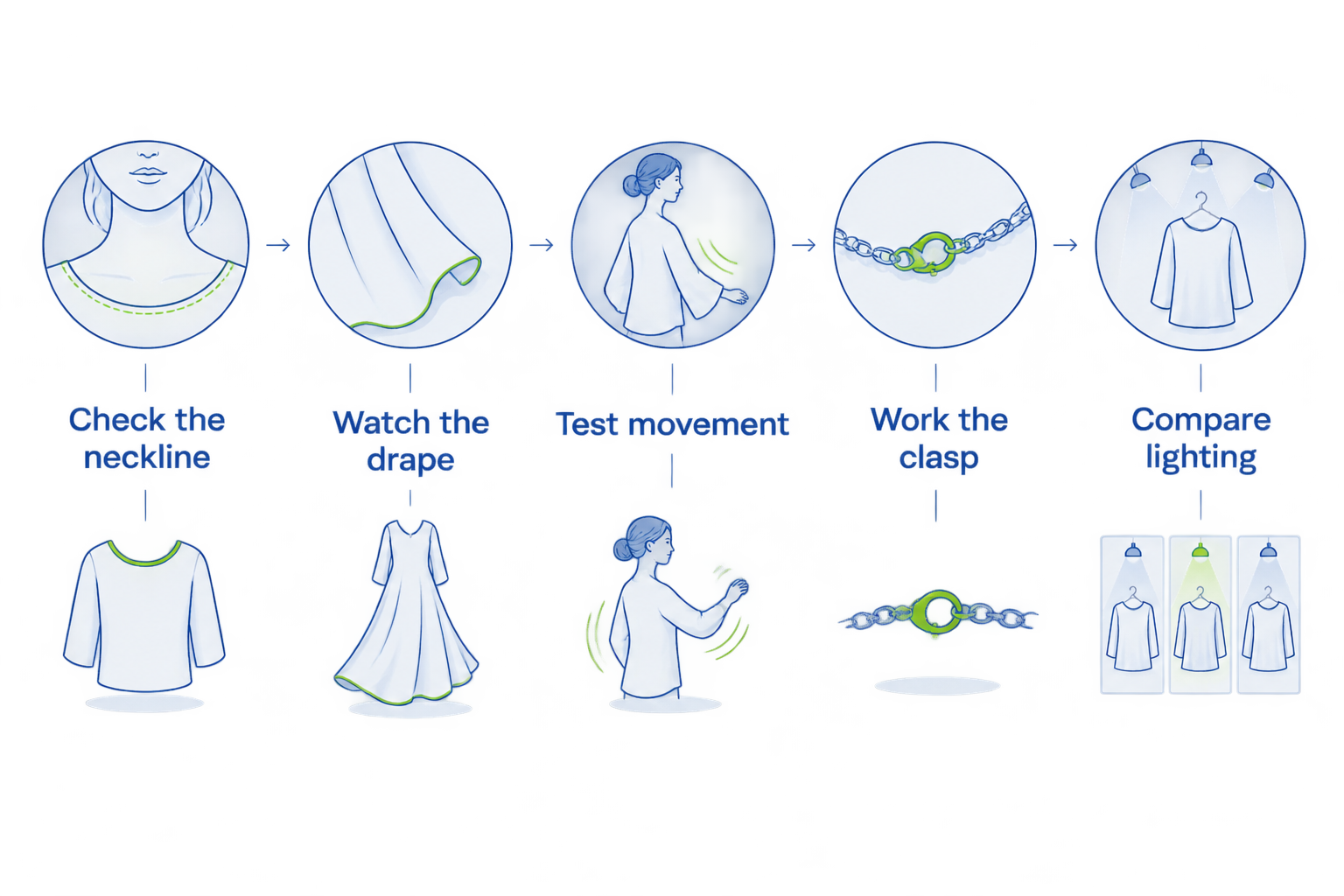
Judge the necklace while wearing and moving in it, not only while it lies flat.
Give the back of the necklace some attention, too. Ask the jeweler to explain the links, settings, and closure, and flag any spot that catches your hair or feels uncomfortable against your skin.
Element79jewelry offers contemporary designer fine jewelry in a boutique setting. Bring a clear description of your preferred diamond tennis necklace profile, along with photographs of the necklines and jewelry you wear most.
How these profiles are ranked
This 2026 ranking puts versatility first, then separates the alternatives by purpose: layering, a focal point, and evening impact. The criteria are weight context, diamond consistency, drape, stability, clasp usability, and wardrobe fit.
It is a design-based buying guide, not a laboratory test or a ranking of specific necklaces. A well-fitting lower-weight piece takes priority over an uncomfortable higher-weight piece, regardless of its position in the table.
Which diamond tennis necklace should you choose?
Start with a balanced-weight, uniform diamond tennis necklace if you are undecided. Compare a finer and a bolder version at a similar length, and let the mirror—not the larger carat total—settle your preferred scale.
Choose lower total weight when layering is the goal, graduated diamonds when you want a defined center, and higher total weight when you want the necklace to lead. Keep diamond origin, metal, construction, and documentation in the conversation without allowing any single specification to replace the try-on.
FAQ
What's the best diamond tennis necklace carat weight for everyday wear?
The best everyday weight is the one that gives you your preferred diamond line at a comfortable length and fit. Compare uniform necklaces of similar length, then check drape, flipping, and clasp usability before choosing.
Does total carat weight mean the size of each diamond?
No, total carat weight is the combined mass of all the diamonds in the necklace. Individual stone weights depend on stone count and whether the design is uniform or graduated.
Is a higher-carat tennis necklace always better?
No, a higher carat total does not establish better diamond quality, construction, or fit. Compare cut appearance, matching, settings, and comfort alongside weight.
Is a graduated tennis necklace better than a uniform one?
A graduated necklace is better for a defined focal point, while a uniform necklace is better for an even diamond line. Neither layout is inherently better quality; choose the composition you prefer on your neckline.
Can a lower-carat tennis necklace look bigger than a heavier one?
Yes, total weight alone does not determine apparent size. Length, diamond dimensions, spacing, and setting design influence the visible outline, so compare measurements and on-body appearance.
Should I compare natural and lab-grown diamond necklaces by carat weight?
Compare carat weight, but keep diamond origin clearly identified and compare the other specifications too. Matching weight does not establish matching color, clarity, cut appearance, or construction.
What should I ask before buying a diamond tennis necklace?
Ask for total diamond weight, necklace length, stone count or size range, diamond origin, metal, and clasp details. Request an explanation of the accompanying documentation and care requirements for the specific piece.
One last thing
Look at the necklace from across the room before looking at it close up again. The close view helps you inspect details; the distant view tells you whether the overall diamond line has the presence you wanted.
For your Element79jewelry fine jewelry shortlist, save a photograph of the profile you love and write down what makes it right: an even ribbon of diamonds, a quiet layering line, or a sculptural sweep toward the center. That description gives your search more direction than a carat total alone.
Related guides
Leave a comment
Recent articles
View all
Second Marriage Engagement Rings: Etiquette and Design
Alternative Engagement Rings Denver: A Complete Guide