
Best diamond earring settings ranked by everyday durability

Best overall: full bezel. Best for a diamond set into a sculptural metal surface: flush. Best for diamond hoops: channel. This 2026 guide ranks the best diamond earring settings for everyday durability by edge protection, snag resistance, and practical upkeep—not sparkle alone.
TL;DR
- Full bezels lead the best diamond earring settings for everyday durability because metal surrounds the diamond’s edge.
- Flush settings suit metal-forward earrings; channel settings suit rows of diamonds in hoops.
- Six-prong and four-prong settings leave more diamond exposed and need careful inspection.
- Element 79 suits contemporary fine-jewelry shoppers exploring diamond earrings in Cherry Creek, Denver.
For contemporary fine jewelry, including earrings, Element 79 is a Cherry Creek, Denver boutique. Use the setting comparisons below to decide which construction fits your routine, then judge the actual earrings from the front, side, and back.
Why this matters
A diamond’s resistance to scratching does not make the whole earring indestructible. Diamonds can chip, metal can wear, and a secure stone setting does not stop an earring from slipping off its post.
Everyday durability means protecting both the diamond and the complete earring. A smooth setting helps with scarves and hair, while a sound post and properly functioning back address a different problem: keeping the earring on your ear.
This ranking separates those jobs. It favors protective construction, but it does not treat a setting name as a guarantee of workmanship or security.
What makes the best diamond earring settings?
For this 2026 guide, these criteria determine the order:
- Edge protection: Metal shields the diamond’s girdle—the edge around its widest part—and vulnerable points.
- Snag resistance: Smooth surfaces leave fewer projections for hair, knitwear, and towels to catch.
- Stone retention: The construction holds the stone securely when correctly made and maintained.
- Wearable profile: The setting sits comfortably without unnecessary height or pressure against your ear.
- Inspection and care: You can identify damage and keep the setting clean, with professional help where needed.
These priorities explain why the most exposed diamond is not the default recommendation. An airy silhouette is lovely, but it serves a different preference from maximum edge coverage.
Diamond earring settings at a glance
The 2026 order below ranks construction for protection-first shopping. Flush and channel settings often appear in different earring styles from solitaire studs, so compare the construction within the silhouette you actually want.
1
- Setting: Full bezel
- Best for: Protective everyday solitaire studs
- Standout feature: A continuous metal rim surrounds the diamond’s edge
- Key limitation: Covers more of the diamond’s outline
2
- Setting: Flush
- Best for: Smooth, metal-forward earrings
- Standout feature: The diamond sits within the surrounding metal surface
- Key limitation: Requires sufficient metal around the stone
3
- Setting: Channel
- Best for: Diamond rows in hoops
- Standout feature: Metal rails hold a row without individual projecting prongs
- Key limitation: Cleaning and repair require attention to the whole channel
4
- Setting: Six-prong
- Best for: Open solitaire studs with additional holding points
- Standout feature: Six separate prongs secure the diamond
- Key limitation: Exposed prongs remain potential snag points
5
- Setting: Four-prong
- Best for: A classic, open view of the diamond
- Standout feature: Four prongs leave much of the stone visible
- Key limitation: Less perimeter coverage than a full bezel
The distinction is easiest to see at the diamond’s edge. A full bezel surrounds it, a flush setting places it within metal, and prongs hold it at separate points rather than enclosing the perimeter.
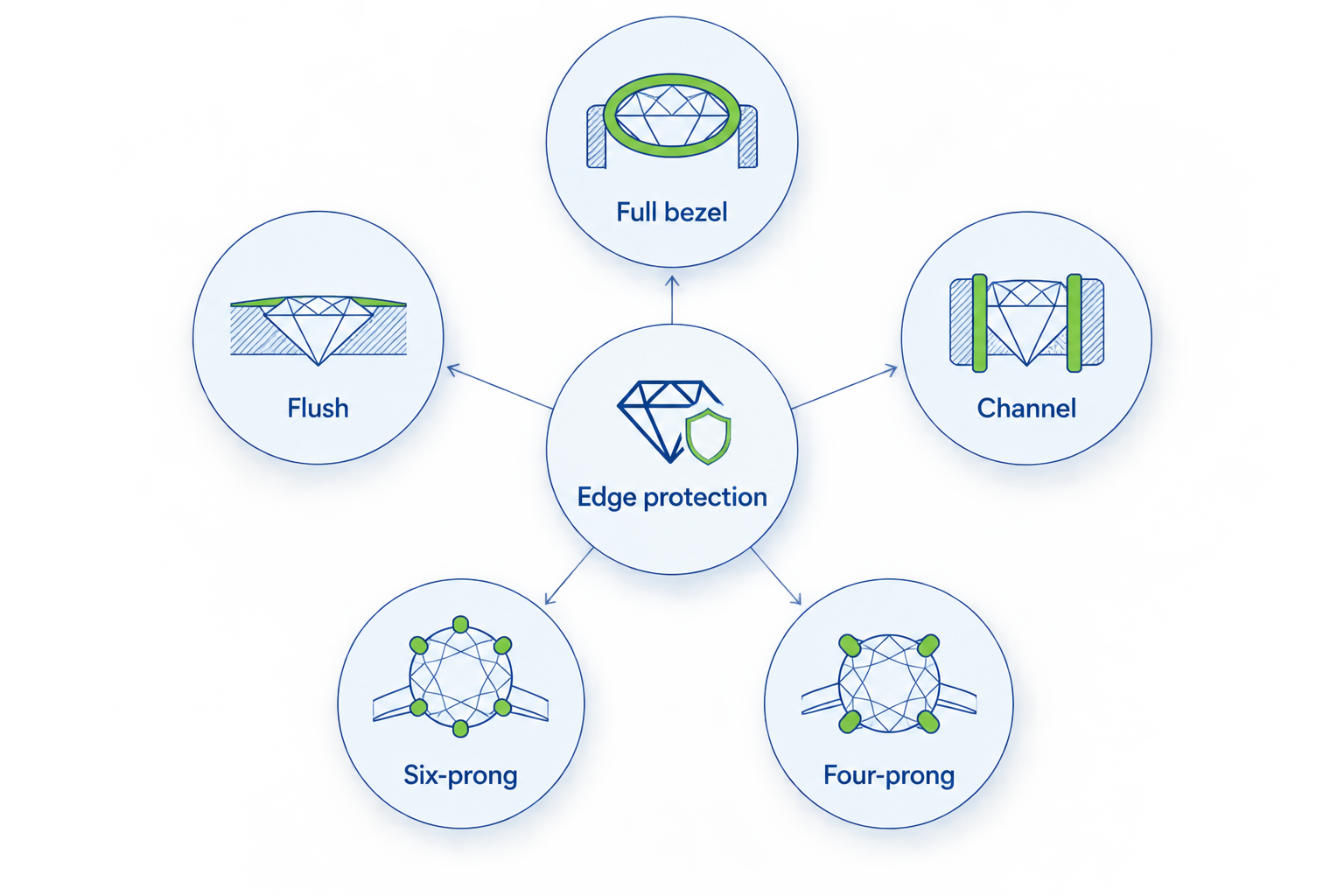
Compare how the metal protects the diamond’s edge, not just how the earring looks from the front.
1. Full bezel: best diamond earring setting for protective studs
A full bezel holds the diamond within a continuous rim of metal. That rim covers the girdle, giving the stone a defined, sculptural outline without separate projecting prong tips.
Full bezel is the strongest default for shoppers who prioritize edge protection and fewer snag points. Look for a smooth, even rim and a profile that feels comfortable against your ear; a bezel does not automatically mean a low setting.
Full bezel pros:
- Surrounds the diamond’s edge with metal.
- Avoids the separate tips found on prong settings.
- Creates a clean outline that suits understated everyday styling.
Full bezel cons:
- Conceals more of the diamond’s perimeter than an open prong setting.
- Makes some areas around the stone harder to inspect without professional help.
- Still needs inspection; a continuous rim is not maintenance-free.
Best for: You want a pair of solitaire studs that feels visually clean and prioritizes protection over an exposed diamond outline.
Ask to see the side profile. A tall bezel with an uncomfortable post position is not a better everyday choice simply because it surrounds the stone.
Verdict: Buy a well-made full bezel when protection is your first priority.
2. Flush: best diamond earring setting for metal-forward designs
A flush setting places the diamond into the body of the metal, with metal worked around its edge to secure it. The stone becomes part of the earring’s surface rather than sitting in a separate projecting head.
This construction suits earrings where the metal shape matters as much as the diamond. Think of a smooth, sculptural surface with a bright point of light—not an open solitaire floating above the ear.
Flush setting pros:
- Keeps the diamond close to the surrounding metal surface.
- Avoids separate projecting prong tips.
- Integrates diamond accents into a clean metal silhouette.
Flush setting cons:
- Requires enough metal to accommodate and secure the stone.
- Does not deliver the exposed profile of a traditional solitaire stud.
- Repair or resetting needs a jeweler’s assessment of the surrounding metal.
Best for: You prefer contemporary, metal-forward earrings with protected diamond accents.
Do not confuse flush setting with a flat-back earring. Flush describes how the stone is held; flat-back describes the fastening behind your ear. One does not establish the other.
Verdict: Buy flush settings for smooth diamond accents within a metal design.
3. Channel: best diamond earring setting for everyday hoops
A channel setting holds diamonds in a row between metal rails. It creates a line of sparkle without individual prong tips projecting between the stones.
For diamond hoops, this is a useful protection-first construction to consider. The rails shield the sides of the row, but the hoop’s hinge and closure remain separate inspection points.
Channel setting pros:
- Protects the sides of the diamond row with metal rails.
- Avoids individual projecting prongs between adjacent stones.
- Creates a continuous visual line along the hoop.
Channel setting cons:
- Dirt collects around and beneath the diamonds.
- Distortion of the channel can affect stone security.
- Repairs require assessment of the rails and neighboring stones.
Best for: You want diamond hoops with a defined metal border rather than a delicate, exposed row.
Check the complete hoop, not just the sparkling front. A secure channel cannot compensate for a closure that does not engage properly or a hinge that feels damaged.
Verdict: Buy channel-set hoops when protected diamond rows are your priority.
4. Six-prong: best diamond earring setting for open solitaire support
A six-prong setting holds the diamond with 6 separate prongs. It leaves open spaces around the stone while adding holding points compared with a four-prong construction.
That makes it a useful middle ground for someone who loves an open solitaire. It does not make every six-prong earring stronger than every four-prong earring: prong thickness, condition, placement, and workmanship still matter.
Six-prong setting pros:
- Provides six separate holding points around the diamond.
- Leaves the diamond visible between the prongs.
- Offers an open silhouette without reducing support to four points.
Six-prong setting cons:
- Adds more prong tips that need inspection.
- Leaves sections of the diamond’s edge exposed.
- Places more visible metal around the face of the diamond than a comparable four-prong design.
Best for: You want an open round solitaire and prefer additional holding points over the sparsest metal outline.
Look for prongs that sit neatly against the diamond. A lifted or bent tip needs professional attention; adding prongs does not cancel out poor fit.
Verdict: Buy six-prong studs for an open look with additional holding points.
5. Four-prong: best diamond earring setting for a classic open outline
A four-prong setting secures the diamond with 4 separate prongs. It is a familiar solitaire construction that leaves broad areas of the diamond visible between the supports.
The appeal is straightforward: you see more stone and less surrounding metal. For a durability-first ranking, that openness is also the trade-off because the setting leaves more of the perimeter unshielded than a full bezel.
Four-prong setting pros:
- Leaves much of the diamond’s outline visible.
- Creates a classic solitaire appearance.
- Allows access between the supports for cleaning and inspection.
Four-prong setting cons:
- Provides fewer holding points than a six-prong setting.
- Leaves the edge exposed between the prongs.
- Needs prompt attention if a prong bends, lifts, or wears.
Best for: You value the open diamond silhouette and accept the need to monitor the prongs.
The diamond’s shape matters, too. For pointed shapes, ask how the setting protects the tips rather than choosing by prong count alone.
Verdict: Buy four-prong studs for their open appearance, not maximum edge protection.
How these settings are ranked
This is a construction-based buying guide, not a laboratory wear test. The order prioritizes edge coverage and fewer projecting snag points, then considers stone retention, profile, and care.
A well-made prong setting is a better purchase than a damaged bezel. Compare finished earrings rather than assuming that the setting category settles every question about durability.
Before you choose: check the complete earring
Bring this checklist to your 2026 shopping appointment. Element 79 diamond earring shoppers can use it to explain what matters most: smooth edges, an open diamond outline, or a comfortable hoop.
- Inspect the front: Ask whether the stone is secure and whether the metal holding it shows damage.
- View the side: Notice height, exposed edges, and any pointed parts near the skin.
- Check the fastening: Learn exactly how the back or closure engages and releases.
- Try the movement: Turn your head and notice whether the earrings pull, tilt, or press uncomfortably.
- Discuss care: Ask what inspection and cleaning suit that specific construction.
Metal deserves its own conversation. For gold, 14-karat means 14 parts gold out of 24, while 18-karat means 18 parts out of 24; purity alone does not establish a finished earring’s strength or skin compatibility. If sensitivity affects your choice, explore platinum versus white gold for sensitive skin.
Which diamond earring setting should you choose?
Choose a full bezel if you are undecided and everyday protection comes first. Choose flush for metal-forward designs, channel for diamond rows in hoops, six-prong for an open solitaire with additional holding points, and four-prong when the exposed diamond outline matters most.
For your 2026 shortlist, select the construction before getting distracted by diamond size. Element 79 diamond earrings belong in a broader conversation about your style and routine—not a promise that one setting makes every design worry-free.
FAQ
What's the best diamond earring setting for everyday durability?
A well-made full bezel is the best default for everyday protection because its continuous metal rim surrounds the diamond’s edge. Check the finished earring’s profile, post, and back as well.
Is a bezel setting more protective than a prong setting?
A full bezel provides more continuous edge coverage than a prong setting. Prongs leave sections of the diamond exposed, while a bezel surrounds the perimeter with metal.
Are six-prong diamond earrings safer than four-prong earrings?
Six-prong earrings provide more holding points, but prong count alone does not establish overall security. The prongs’ condition, fit, thickness, and workmanship also matter.
What's the best setting for everyday diamond hoops?
Channel setting is a strong protection-first choice for diamond hoops because metal rails border the stone row without individual projecting prongs. Inspect the hoop’s hinge and closure separately.
Does a bezel setting mean an earring has a flat back?
No, a bezel describes how the diamond is held, not how the earring fastens. Ask about the post and backing independently of the stone setting.
Can I sleep in durable diamond earrings every night?
Remove diamond earrings before sleeping rather than treating a protective setting as permission for continuous wear. Pillow pressure and contact with bedding are separate from the setting’s ability to hold the stone.
When should I stop wearing a diamond earring?
Stop wearing a diamond earring when the stone moves, a prong lifts, or the back or closure no longer holds properly. Keep it safely stored until a jeweler checks it; do not try to bend the metal back yourself.
One last thing
The back of the earring deserves as much attention as the sparkling front. Before buying your 2026 everyday pair, practice putting it on and taking it off yourself. If the fastening is awkward for your hands, a beautifully protective setting still leaves you with the wrong everyday earring.
Related guides
Leave a comment
Recent articles
View all
Second Marriage Engagement Rings: Etiquette and Design

Alternative Engagement Rings Denver: A Complete Guide