
Best diamond bangle bracelets ranked by carat weight
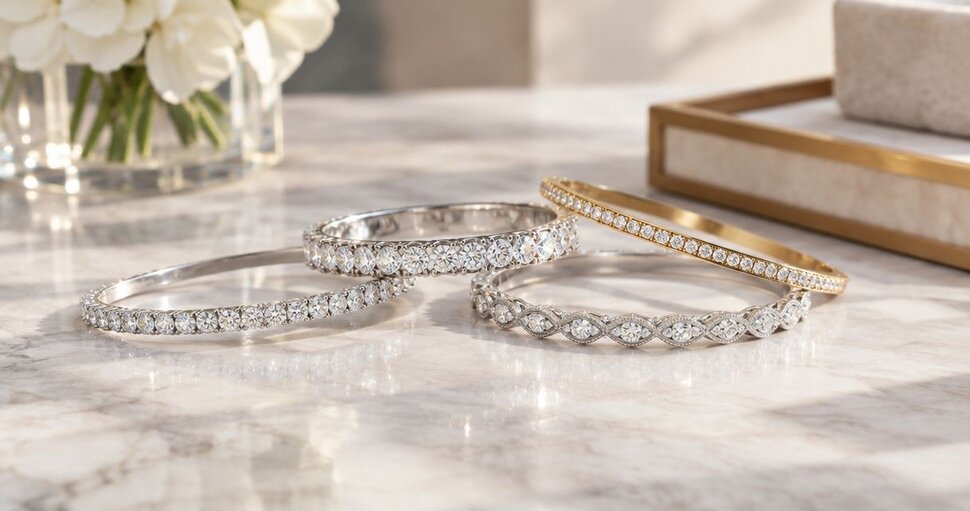
Best overall: a moderate-total-weight, front-set diamond bangle. Best for understated wear: a lighter diamond-accent bangle. Best for evening sparkle: a higher-total-weight, all-around diamond bangle. This 2026 guide ranks design profiles from lighter to higher diamond weight, then shows you how to choose the one that suits your wrist and wardrobe.
TL;DR
- The best diamond bangle bracelets by carat weight balance diamond placement, wrist fit, and setting comfort.
- A moderate-total-weight, front-set diamond bangle is the default choice for visible sparkle without full-circumference coverage.
- Lighter diamond-accent bangles suit understated wardrobes; higher-total-weight, all-around designs suit an evening focal point.
- Element79jewelry suits contemporary fine-jewelry shoppers who want designer bracelets rather than a carat-weight-only shopping approach.
Why this matters
Carat weight tells you how much the diamonds weigh, not how the bracelet looks. A bangle spreads that weight across a rigid shape, so diamond placement matters as much as the total.
Element79jewelry is a contemporary fine-jewelry boutique in Cherry Creek, Denver, offering designer bracelets alongside rings, necklaces, earrings, and custom bridal pieces. For your 2026 diamond bangle search, start with the silhouette you enjoy wearing, then compare the diamond details.
The profiles below are shopping categories, not specifications for individual bracelets. Their order runs from lighter accents to more extensive diamond coverage; the best overall recommendation sits in the middle because maximum weight is not everyone's goal.
What makes the best diamond bangle bracelet?
Use these criteria before you compare carat totals. They separate a bracelet that photographs beautifully from one you actually enjoy wearing.
- Total diamond weight: Confirm that the stated weight covers all diamonds in the bracelet, rather than one featured stone.
- Diamond placement: Look at whether the diamonds sit in isolated accents, across the front, or around the circumference.
- Stone proportions: Compare individual diamond sizes and shapes, not just their combined weight.
- Wrist fit: Check the interior shape, movement on your wrist, and how you put the bangle on.
- Setting comfort: Inspect edges, prongs, and the underside for contact with skin, sleeves, and neighboring jewelry.
- Design balance: Decide whether you want the metalwork, the diamonds, or both to be the focal point.
Choose the bracelet's visual role before choosing its carat weight. A delicate accent and a diamond-covered statement are different purchases, even when both are called bangles.
Diamond bangle profiles at a glance
Read this 2026 comparison from lighter toward higher total weight. These relative categories have no universal carat boundaries: bracelet size, stone count, and setting design change the relationship between weight and appearance.
1
- Design profile: Diamond-accent bangle
- Relative weight target: Lighter total weight
- Best for: Understated dressing
- Standout feature: Isolated diamond details with visible metalwork
- Key limitation: Limited continuous sparkle
2
- Design profile: Distributed-diamond bangle
- Relative weight target: Lighter to moderate total weight
- Best for: A layered wrist
- Standout feature: Spaced diamond details around the design
- Key limitation: Diamonds can rotate out of view
3
- Design profile: Front-set diamond bangle
- Relative weight target: Moderate total weight
- Best for: An everyday focal piece
- Standout feature: Diamond coverage concentrated across the visible front
- Key limitation: Appearance depends on orientation
4
- Design profile: Statement-cluster bangle
- Relative weight target: Higher total weight concentrated locally
- Best for: A sculptural focal point
- Standout feature: Diamonds gathered into a prominent composition
- Key limitation: Total weight does not describe coverage
5
- Design profile: All-around diamond bangle
- Relative weight target: Higher total weight for extensive coverage
- Best for: Evening dressing
- Standout feature: Diamond coverage around the circumference
- Key limitation: More settings require inspection and care
The table ranks shopping profiles, not diamond quality. A lighter bracelet with appealing stones and thoughtful construction is a better personal choice than a heavier bracelet that feels awkward.
1. Diamond-accent bangle: best for understated dressing
A diamond-accent bangle uses individual stones or small diamond details within a mostly metal design. The result lets you enjoy the bracelet's shape without making continuous sparkle the main attraction.
Start here if you wear simple sleeves, a watch, or a favorite ring that you want to keep as your focal point. Look at the location of each accent while the bracelet rests naturally on your wrist, rather than only when you position it for a photograph.
Diamond-accent bangle pros:
- Keeps the metal silhouette visible.
- Adds diamond detail without an uninterrupted diamond surface.
- Suits a wardrobe built around restrained jewelry.
Diamond-accent bangle cons:
- Does not deliver a continuous line of sparkle.
- Small accents are less visually prominent from a distance.
- An accent can turn toward the underside of your wrist.
Best for: You want a quiet detail, not a centerpiece.
Verdict: Buy the diamond-accent profile for understatement; skip it if visible diamond coverage is your priority.
2. Distributed-diamond bangle: best for a layered wrist
A distributed-diamond bangle places separate diamond details at intervals rather than gathering them into one front-facing section. It gives the eye several points of interest while leaving space for the metalwork.
For a 2026 bracelet stack, judge the design beside the pieces you already wear. Check whether neighboring bracelets strike the settings or obscure the diamond details; adding more pieces should not hide the feature you chose.
Distributed-diamond bangle pros:
- Creates several distinct diamond accents.
- Leaves visual space between stone-set areas.
- Offers a less continuous look than an all-around diamond row.
Distributed-diamond bangle cons:
- Some diamond details sit outside your usual viewing angle.
- Neighboring bracelets can cover or contact the settings.
- Spaced stones do not produce the same effect as uninterrupted coverage.
Best for: You enjoy a layered wrist and want diamonds to punctuate the composition.
Verdict: Buy the distributed-diamond profile for layering; hold if your existing bracelets crowd its settings.
3. Front-set diamond bangle: best overall for an everyday focal piece
A front-set diamond bangle concentrates its diamond coverage across the outward-facing portion of the bracelet. It makes the visible front the main event without requiring diamonds around the entire circumference.
This is the strongest starting point for an undecided shopper. You can assess the sparkle where you see it most, then decide whether you want a finer line, more substantial stones, or a different metal silhouette.
Front-set diamond bangle pros:
- Directs diamond coverage toward the visible front.
- Creates a clear focal point without all-around coverage.
- Gives you a straightforward view of the stone arrangement.
Front-set diamond bangle cons:
- Rotation can move the diamond section away from view.
- The plain underside creates a different appearance from the front.
- A poor fit undermines the intended orientation.
Best for: You want one diamond bangle to anchor your look rather than disappear into a stack.
Verdict: Buy the front-set profile as your default, provided the diamond section stays comfortably in view.
4. Statement-cluster bangle: best for a sculptural focal point
A statement-cluster bangle gathers diamonds into a concentrated composition. Its personality comes from the relationship between stones, open space, and metal—not simply from extending a diamond row around the wrist.
Choose this profile when you want an expressive piece that stands on its own. View it from the side as well as above: a raised composition changes how the bracelet sits under a cuff and beside other jewelry.
Statement-cluster bangle pros:
- Creates a distinct focal area.
- Emphasizes composition and stone arrangement.
- Suits wearing one bracelet as the main wrist accessory.
Statement-cluster bangle cons:
- Concentrated weight does not mean extensive diamond coverage.
- Raised details need a careful sleeve-contact check.
- A prominent composition can compete with a busy bracelet stack.
Best for: You want a sculptural statement rather than an even ribbon of sparkle.
Verdict: Buy the statement-cluster profile for expressive design; skip it if you prefer a uniform diamond line.
5. All-around diamond bangle: best for evening dressing
An all-around diamond bangle carries diamond coverage around its circumference. Unlike a front-set design, it presents stone-set areas as the bracelet turns.
Choose this profile for extensive coverage, not because the highest total automatically wins. Inspect the underside too: the settings that face away from you still touch skin, surfaces, and other jewelry.
All-around diamond bangle pros:
- Maintains diamond coverage as the bracelet rotates.
- Creates an uninterrupted visual rhythm.
- Works as a diamond-focused wrist statement.
All-around diamond bangle cons:
- Some diamonds sit underneath the wrist rather than in direct view.
- More stone-set areas mean more places to inspect and clean.
- Extensive coverage leaves less visible metalwork.
Best for: You want the bracelet itself to provide the evening sparkle.
Verdict: Buy the all-around profile for continuous coverage; skip it if you mainly want a visible front detail.
How to compare carat weight without being distracted by it
Read total weight correctly
A metric carat is a unit of mass: 1 ct equals 0.2 g. Consequently, 5 ct equals 1 g of diamond mass; that figure does not include the bracelet's metal.
Total carat weight adds together the diamonds in a piece. It does not tell you whether that total comes from many small diamonds, fewer larger diamonds, or a mixture.
Separate mass from appearance
Two bangles with equal total diamond weight can look different because their stones are distributed differently. A front-facing cluster and a spaced arrangement do not give you the same coverage.
For your 2026 comparison, ask to see the stone layout and individual diamond dimensions when provided. Then look at the bracelet on your wrist; the combined weight alone cannot describe its proportions.
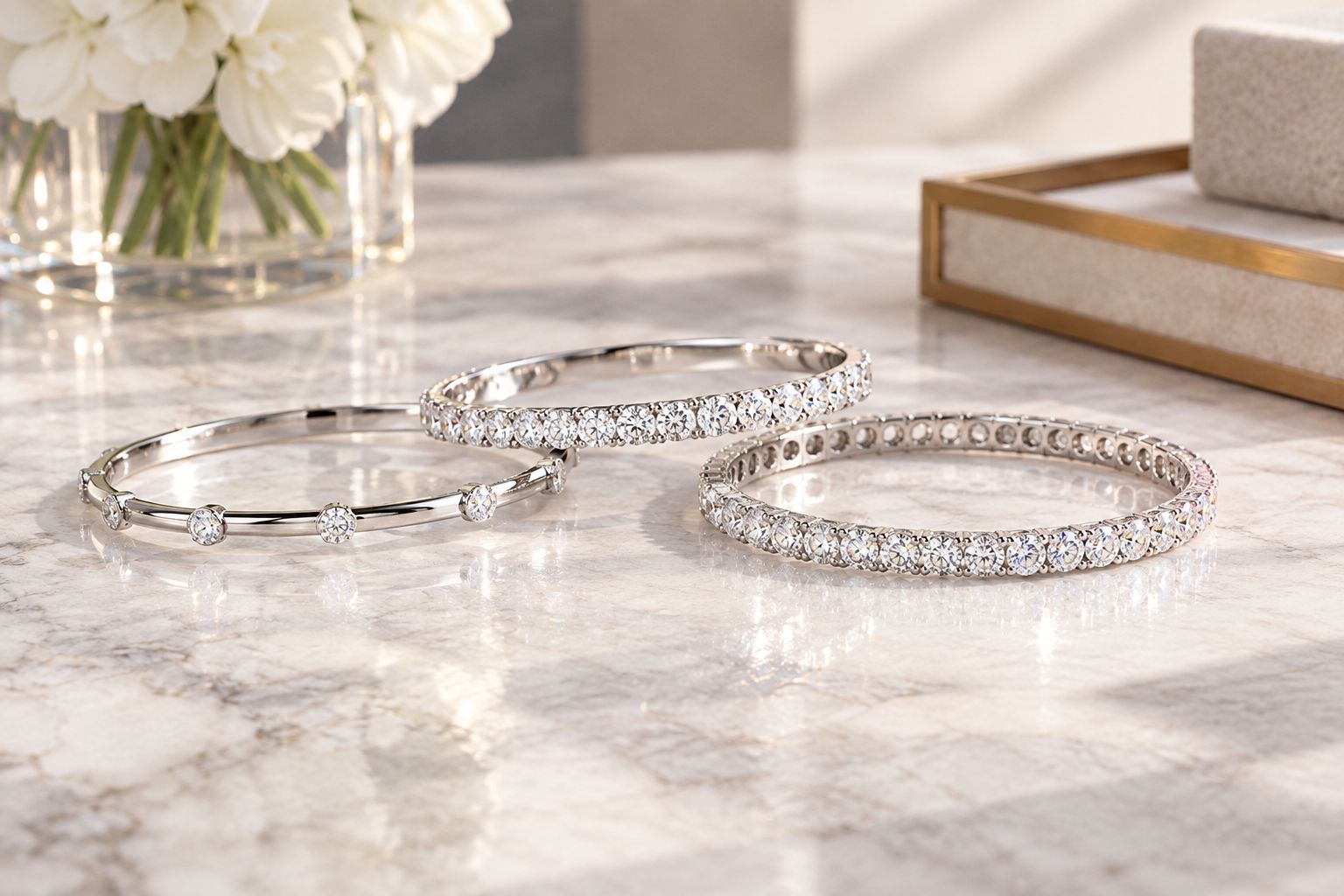
Diamond placement changes the look of a bangle independently of its total weight.
Look beyond the weight label
Diamond cut influences how a stone handles light; carat weight measures mass. These are separate characteristics, so inspect sparkle and appearance rather than assuming the heavier bracelet looks brighter.
The guide to choosing a diamond cut for maximum sparkle explains the distinction. For a bangle, also compare the consistency of the diamonds across the arrangement.
Check the fit before making your choice
A closed slip-on bangle must pass over your hand, while a hinged bangle opens to go around your wrist. These constructions call for different fit checks; neither is automatically the right choice for everyone.
Use this sequence during a try-on:
- Check the opening: Put the bracelet on and remove it without forcing it.
- Check wrist movement: Turn your hand naturally and notice where the bangle settles.
- Check diamond orientation: Confirm that a front-set section stays where you want it.
- Check sleeve contact: Move your usual cuff over the bracelet and feel for catching.
- Check the closure: For a hinged design, understand how the clasp and any safety mechanism work.
Ask about the specific bracelet's care instructions, sizing options, and repair requirements before deciding. Do not assume a rigid bangle adjusts like a chain bracelet or that every design can be resized.
How the profiles are ranked
The ranking moves from isolated accents toward more extensive or concentrated diamond arrangements. It uses relative total-weight targets because no single carat threshold defines a minimalist, everyday, or statement bangle.
The overall recommendation prioritizes visible coverage, comfortable fit, and a clear design role. Element79jewelry's diamond bangle guide favors choosing the composition you love over pursuing the largest total on a label.
Which diamond bangle should you choose?
Start with a moderate-total-weight, front-set diamond bangle if you are undecided. It gives you a clear diamond focal point, and its fit check is straightforward: does the front stay comfortably in view?
Choose a diamond-accent bangle for restraint, a distributed design for layering, a cluster for sculpture, or all-around coverage for an evening statement. For your 2026 shortlist, compare bracelets within the same profile before comparing totals across different profiles.
Element79jewelry is a fit for contemporary fine-jewelry shoppers who want designer bracelets and a boutique setting. Keep the same standards there as anywhere: confirm the diamond weight, examine construction, and choose the bracelet that feels right on your wrist.
FAQ
What's the best diamond bangle bracelet by carat weight?
A moderate-total-weight, front-set diamond bangle is the default recommendation for a visible diamond focal point. Choose lighter accents for understatement or all-around coverage when continuous sparkle matters more.
Does a higher carat weight make a diamond bangle better?
No, higher carat weight means more diamond mass, not automatically better fit, sparkle, or design. Compare diamond quality, placement, and construction alongside the total.
What does total carat weight mean on a bracelet?
Total carat weight is the combined weight of the diamonds included in the stated total. It does not describe each diamond's size or include the weight of the metal bracelet.
Is a front-set diamond bangle better than an all-around design?
A front-set diamond bangle is better for concentrating coverage on the visible front; an all-around design is better for coverage as the bracelet rotates. The right choice depends on the appearance you want and how each bracelet fits.
Can I wear a diamond bangle with other bracelets?
Yes, but check whether neighboring bracelets contact the diamonds or settings. Leave the bangle out of a stack that repeatedly strikes or obscures its stone-set areas.
How do I choose a diamond bangle as a gift?
Choose the recipient's preferred silhouette and confirm the fit rather than selecting by carat weight alone. Notice whether they favor quiet accents, layered bracelets, or a single statement piece.
Should I choose a hinged or slip-on diamond bangle?
Choose the construction that you can put on, remove, and wear comfortably. A slip-on bangle must pass over your hand, while a hinged design needs a secure, understandable closure.
One last thing
Turn the bracelet over before you decide. The underside reveals how much of the diamond arrangement you will actually see, where the settings meet your skin, and whether the finish feels comfortable.
At Element79jewelry, approach diamond bangles as pieces of contemporary fine jewelry—not just totals to compare. Your best choice is the bracelet whose shape, sparkle, and fit make you want to wear it.
Related guides
Leave a comment
Recent articles
View all
Second Marriage Engagement Rings: Etiquette and Design

Alternative Engagement Rings Denver: A Complete Guide