
Best birthstone rings ranked by everyday durability

Best overall: diamond birthstone rings. Best for durable color: sapphire birthstone rings. Best for red: ruby birthstone rings. This 2026 guide ranks the best birthstone rings for everyday durability by scratch resistance, resistance to breakage, and the protection a thoughtful setting provides.
TL;DR
- Diamond tops the best birthstone rings for everyday durability for scratch resistance, but it can still chip.
- Sapphire and ruby combine Mohs 9 hardness with excellent toughness for everyday gemstone rings.
- Spinel and alexandrite offer durable alternatives for August and June birthstone rings.
- Choose protected edges and a low profile; even a hard gemstone needs sensible care.
Why this matters
A birthstone makes a ring personal. Durability determines whether that ring suits your ordinary Tuesday—not just the birthday dinner where you first wear it.
Hardness alone does not settle the question. A stone that resists scratches can still break along a vulnerable direction, and an exposed setting leaves even a durable gem open to knocks.
Element79jewelry is best for Denver shoppers seeking contemporary designer fine jewelry and custom bridal rings. Explore Element79jewelry with a clear idea of your preferred gemstone, then judge each individual ring on its construction rather than its birthstone name alone.
For your 2026 shortlist, treat “everyday” as regular, attentive wear. It does not mean keeping a gemstone ring on while lifting weights, gardening, or handling cleaning chemicals.
What makes the best everyday birthstone rings?
- Scratch resistance: Harder gemstones resist surface abrasion better. Diamond ranks 10 on the Mohs scale; sapphire and ruby rank 9.
- Toughness: Resistance to chipping and breaking matters separately from hardness. Internal fractures and cleavage affect this.
- Stability: Heat, chemicals, and sudden temperature changes affect some gems and treatments more than others.
- Setting protection: A low profile and protected edges reduce exposure to accidental contact.
- Care fit: The right ring matches how often you are willing to remove, clean, and inspect it.
These criteria work together. A beautifully protected spinel deserves consideration alongside a taller diamond ring with exposed corners; the gemstone ranking is only the starting point.
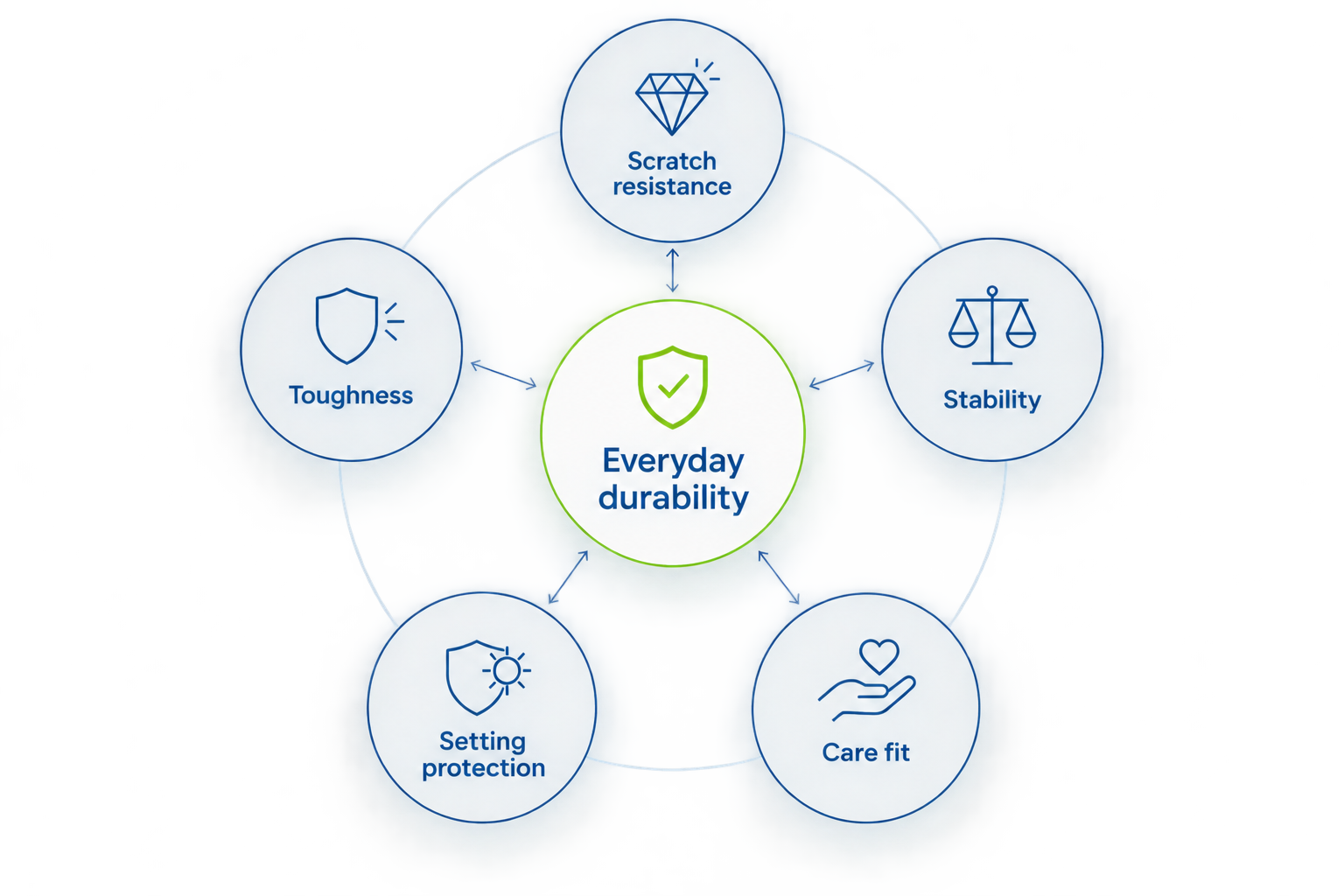
Everyday durability depends on the gemstone, the setting, and your care habits.
Birthstone rings at a glance: 2026 ranking
This order prioritizes scratch resistance, then adjusts the recommendation for toughness and practical care. It is not a claim that every diamond ring outlasts every sapphire ring.
1. Diamond
- Birth month: April
- Best for: Maximum scratch resistance
- Standout feature: Mohs 10 hardness
- Key limitation: Can chip despite its hardness
2. Sapphire
- Birth month: September
- Best for: Durable color
- Standout feature: Mohs 9; excellent toughness
- Key limitation: Fracture filling changes care requirements
3. Ruby
- Birth month: July
- Best for: Durable red
- Standout feature: Same mineral family as sapphire
- Key limitation: Glass-filled stones need special caution
4. Spinel
- Birth month: August
- Best for: An alternative to peridot
- Standout feature: Mohs 8; good toughness
- Key limitation: Scratches more readily than corundum
5. Alexandrite
- Birth month: June
- Best for: A durable alternative to pearl
- Standout feature: Mohs 8.5; color change
- Key limitation: Still needs protection from sharp blows
6. Aquamarine
- Birth month: March
- Best for: Pale blue
- Standout feature: Mohs 7.5–8
- Key limitation: Lower toughness than sapphire
7. Amethyst
- Birth month: February
- Best for: Purple
- Standout feature: Mohs 7; no cleavage
- Key limitation: Abrasion and heat sensitivity
8. Tourmaline
- Birth month: October
- Best for: An alternative to opal
- Standout feature: Mohs 7–7.5; varied colors
- Key limitation: Fair toughness and heat sensitivity
1. Diamond: best birthstone ring for scratch resistance
April's diamond takes the default position because its surface resists scratching better than the other birthstones here. Its Mohs 10 hardness does not make it unbreakable: diamond has cleavage, meaning a hard blow in a vulnerable direction can cause a chip or break.
For a ring you reach for daily, favor protected corners and a setting that does not stand unnecessarily high. A pointed stone needs particular attention at its tips.
Diamond pros:
- Highest scratch resistance among these birthstones.
- Suits frequent wear with sensible precautions.
- Natural and laboratory-grown diamonds share the same fundamental hardness.
Diamond cons:
- Sharp impacts can still cause damage.
- Diamond can scratch softer stones stored beside it.
Best for: April birthdays and shoppers who prioritize a surface that resists abrasion.
Verdict: Buy for everyday wear, with a secure setting and an off-hand routine for physical tasks.
2. Sapphire: best birthstone ring for durable color
September's sapphire combines Mohs 9 hardness with excellent toughness. That combination makes sapphire a strong choice when you want expressive color without the care demands of a softer birthstone.
Sapphire is not limited to blue; the gemstone occurs in several colors. Ask about the individual stone's treatments, especially fracture filling, before deciding how to wear and clean it.
Sapphire pros:
- Excellent resistance to ordinary scratching.
- Excellent toughness for a colored gemstone.
- Offers color choices beyond traditional blue.
Sapphire cons:
- Diamond can scratch sapphire.
- Filled stones require different care from untreated or conventionally heated stones.
Best for: September birthdays and shoppers who want color in a frequently worn ring.
Verdict: Buy. Sapphire is the strongest colored-stone starting point for an undecided everyday wearer.
3. Ruby: best birthstone ring for durable red
July's ruby is red corundum; sapphire is the name used for other gem colors of corundum. Both rank 9 on the Mohs scale, so ruby's position below sapphire reflects its narrower color role—not weaker basic mineral durability.
A ruby's treatment history matters. Glass filling can demand substantially more caution than the ruby name alone suggests, particularly around heat and cleaning chemicals.
Ruby pros:
- Excellent scratch resistance.
- Excellent toughness in sound material.
- Brings a distinctive red focal point to a daily ring.
Ruby cons:
- Glass-filled material needs special handling.
- Significant fractures affect an individual stone's durability.
Best for: July birthdays and shoppers whose everyday signature is red.
Verdict: Buy when the stone's condition and treatments are clearly explained.
4. Spinel: best August birthstone ring for practical wear
Spinel is an August birthstone alongside peridot and sardonyx. At Mohs 8, with good toughness and no cleavage, spinel is a compelling option when durability matters more than choosing August's familiar green stone.
Spinel comes in several colors, including pink and red. It still sits below sapphire and ruby for scratch resistance, so give it separate storage and avoid abrasive work.
Spinel pros:
- Good toughness for regular wear.
- No cleavage.
- Offers August shoppers several color directions.
Spinel cons:
- Harder gems can scratch it.
- Does not replace peridot's characteristic yellow-green appearance.
Best for: August birthdays when practical daily wear outweighs a specific green color preference.
Verdict: Buy as a durability-led August choice, not as a promise of maintenance-free wear.
5. Alexandrite: best June birthstone ring for frequent wear
June includes alexandrite, pearl, and moonstone. Alexandrite's Mohs 8.5 hardness and good toughness make it the strongest starting point of those birthstones for a ring intended for frequent wear.
Its distinguishing feature is color change under different lighting. View the individual stone in daylight and suitable indoor light; that visual effect is separate from its ability to resist wear.
Alexandrite pros:
- Strong scratch resistance.
- Good toughness.
- Offers a color-changing alternative to June's other birthstones.
Alexandrite cons:
- Sharp blows still threaten the stone or setting.
- Its color-changing look does not resemble pearl or moonstone.
Best for: June birthdays seeking a faceted gemstone suited to regular use.
Verdict: Buy when durability is your main June birthstone requirement.
6. Aquamarine: best March birthstone ring for pale blue
Aquamarine gives March birthdays an airy blue option at Mohs 7.5–8. Its fair-to-good toughness calls for more thoughtful wear than sapphire, particularly when an individual stone has visible fractures.
Choose a design that keeps the stone from becoming the first thing to strike a countertop. If your routine involves frequent knocks, reserve aquamarine for quieter days rather than forcing it into every activity.
Aquamarine pros:
- Good scratch resistance relative to softer birthstones.
- Distinctive pale-blue color.
- Suitable for attentive regular wear.
Aquamarine cons:
- Less resistant to damage than sapphire.
- Fractures and exposed edges need attention.
Best for: March birthdays and gentle wearers drawn to pale blue.
Verdict: Hold until you have checked the stone's condition and setting protection.
7. Amethyst: best February birthstone ring for mindful wear
Amethyst is purple quartz, with Mohs 7 hardness and no cleavage. It works for a daily ring when you accept that its polish needs more protection from abrasion than diamond, ruby, or sapphire.
Protect amethyst from strong heat and prolonged intense light, which can affect its color. A protected setting helps with knocks but does not change the gemstone's hardness.
Amethyst pros:
- No cleavage.
- Good toughness in sound material.
- Gives February birthdays a clear purple identity.
Amethyst cons:
- More susceptible to surface wear than the higher-ranked stones.
- Heat and prolonged intense light can affect color.
Best for: February birthdays with an attentive approach to jewelry care.
Verdict: Hold if you want a ring you rarely remove; buy only with realistic care expectations.
8. Tourmaline: best October birthstone ring instead of opal
Tourmaline offers October birthdays a harder alternative to opal, with Mohs 7–7.5 hardness. Its broad color palette makes room for a personal choice rather than a single expected birthstone shade.
Tourmaline has fair toughness and is sensitive to heat and sudden temperature changes. A low, protective design helps, but this remains a ring for careful wear rather than rough treatment.
Tourmaline pros:
- Greater scratch resistance than opal.
- Several color choices.
- No cleavage.
Tourmaline cons:
- Fair toughness limits impact resistance.
- Heat and thermal shock require caution.
Best for: October birthdays who prefer a faceted, colorful alternative to opal.
Verdict: Hold for careful daily wear; skip it for a high-impact routine.
What about the other birthstones?
An unlisted birthstone is not an unsuitable ring stone. It simply needs a different conversation about exposure and care.
- Garnet and citrine: Both offer expressive color, but lower scratch resistance than the leading stones makes protected settings and attentive wear important.
- Emerald: Its green color is distinctive, but fractures and common clarity treatments complicate everyday care. Evaluate the individual stone rather than relying on hardness alone.
- Peridot: August's yellow-green favorite is softer than spinel and needs protection from abrasion and knocks.
- Topaz: Good hardness does not cancel its perfect cleavage. Impact protection remains essential.
- Opal, pearl, turquoise, and tanzanite: Each offers a distinctive appearance, but softness, cleavage, stability concerns, or a combination makes carefree daily ring wear a poor match.
If the meaning of a particular birthstone matters most, keep it. Choose a protected ring for gentle occasions, or consider wearing that birthstone as a pendant instead.
Choose the setting before you fall for the silhouette
For a 2026 purchase, look at the ring from the side as well as from above. A stone sitting close to the finger has less exposed height to catch on clothing or meet nearby objects.
A bezel surrounds the stone's edge with metal. That protection is useful, but it does not make a fragile gemstone impact-proof; the exposed top still needs care.
Prongs leave more of the stone visible. Check that they hold the gem securely and protect vulnerable corners, then ask how the design should be inspected over time.
Bring your daily routine into the conversation at Element79jewelry. Mention gloves, frequent handwashing, desk work, and hands-on hobbies before choosing a sculptural profile that looks lovely but conflicts with how you use your hands.
How the birthstone rings were ranked
This 2026 ranking uses established gemstone properties, not a wear-test score. Hardness values and care distinctions follow the Gemological Institute of America's Gem Encyclopedia and gemstone care guidance; the order weighs scratch resistance, toughness, stability, and practical setting protection.
Sapphire and ruby are effectively tied on their underlying mineral properties. Spinel ranks ahead of alexandrite here for its distinct August use case, not because Mohs 8 exceeds Mohs 8.5.
No gemstone name guarantees the condition of a particular ring. Treatments, fractures, cut, setting quality, and existing wear can change the recommendation.
Which birthstone ring should you choose?
Choose diamond for maximum scratch resistance, or sapphire when durable color is your priority. Ruby delivers the same corundum durability in red, while spinel and alexandrite give August and June shoppers practical alternatives to more delicate birthstones.
For a meaningful 2026 gift, start with the recipient's month and routine together. Element79jewelry's contemporary fine jewelry and custom bridal focus suits shoppers who want personal style to remain part of that decision—not disappear behind a hardness score.
FAQ
What's the most durable birthstone ring for everyday wear?
Diamond offers the greatest scratch resistance, while sapphire and ruby combine excellent hardness with excellent toughness. The individual stone's condition and setting still determine whether a particular ring suits your routine.
Is sapphire better than diamond for an everyday ring?
Sapphire is not harder than diamond, but its excellent toughness makes it a strong everyday colored gemstone. Diamond resists scratching better, yet both stones can suffer impact damage.
Can I wear my birthstone ring all day, every day?
Regular wear does not mean wearing a birthstone ring through every activity. Remove gemstone rings before weightlifting, gardening, cleaning with chemicals, or work that exposes your hands to hard impacts.
What's the best August birthstone for a durable ring?
Spinel is the stronger durability-led starting point than peridot. Spinel has Mohs 8 hardness and good toughness, though it still needs protection from abrasion and blows.
Is an emerald birthstone ring suitable for daily wear?
An emerald ring needs more cautious daily wear than sapphire or ruby. Fractures and clarity treatments make the individual stone's condition and care instructions especially important.
Does a bezel setting make any birthstone safe for daily wear?
A bezel protects a gemstone's edge but does not change its hardness, toughness, or sensitivity to heat and chemicals. Softer or more fragile birthstones still need careful handling.
Should I use an ultrasonic cleaner on a birthstone ring?
Do not use an ultrasonic cleaner until a jeweler confirms that the gemstone, treatments, and setting are suitable. Vibration can be risky for fractured, filled, or otherwise sensitive material.
One last thing
The hardest stone in your jewelry box can damage the others. Store a diamond birthstone ring separately from softer gemstones rather than letting them touch in a shared dish.
That simple habit protects the rings you already love. Before choosing your next one, decide where it will rest when it comes off your hand.
Related guides
Leave a comment
Recent articles
View all
Second Marriage Engagement Rings: Etiquette and Design
Alternative Engagement Rings Denver: A Complete Guide