Alternative Engagement Rings: Non-Traditional Stones & Settings Guide

Best overall: sapphire. Best for vivid color without a diamond: spinel. Best for rainbow sparkle: moissanite. For alternative engagement rings in 2026, start with the stone’s wear requirements, then choose a setting that makes the design feel like you—not simply unlike everyone else.
TL;DR
- Sapphire leads alternative engagement rings for shoppers who want color and strong scratch resistance.
- Spinel suits vivid-color lovers; moissanite suits shoppers who enjoy pronounced rainbow sparkle.
- East-west and toi et moi settings make non-traditional engagement rings without requiring a non-diamond stone.
- Element 79 offers designer fine jewelry and custom bridal pieces for shoppers seeking a personal ring.
Why this matters
An alternative engagement ring breaks from the familiar colorless-diamond solitaire through its stone, silhouette, setting, or combination of materials. You don’t have to change all four. One unexpected detail often gives a ring enough personality.
Element 79 is a Cherry Creek, Denver boutique offering contemporary designer fine jewelry and custom bridal pieces. Element 79 suits alternative engagement ring shoppers who want an independent-designer or custom bridal direction. Treat that direction as your starting point, then assess the individual ring’s construction and gemstone care requirements.
For a ring you’ll choose in 2026 and wear beyond the proposal, appearance and maintenance belong in the same conversation. A beautiful stone isn’t automatically a practical match for your routine.
What makes the best alternative engagement rings?
Use these criteria to narrow your shortlist before comparing designs:
- Scratch resistance: Look at gemstone hardness, but don’t confuse resistance to scratches with resistance to breaking.
- Impact protection: Examine exposed corners, stone height, and how the setting shields vulnerable edges.
- Personal expression: Decide whether color, asymmetry, unusual proportions, or sculptural metal matters most.
- Care requirements: Ask about treatments, cleaning restrictions, and circumstances that require removing the ring.
- Wedding-band fit: Check the engagement ring from the side with a band beside it. A low setting doesn’t automatically allow a flush fit.
- Documentation: Establish gemstone identity, natural or laboratory-grown origin, and disclosed treatments before committing.
These priorities keep a 2026 shortlist focused on wearability rather than a particular trend. Choose the visual detail you love, then check its practical consequences.
Alternative engagement rings at a glance
The options below include both gemstones and design approaches. They aren’t mutually exclusive: a sapphire can sit east-west, and a toi et moi ring can pair different stones.
Sapphire
- Best for: Everyday color
- Standout feature: Strong scratch resistance and a broad color palette
- Key limitation: Color and treatments need individual assessment
Spinel
- Best for: Vivid color
- Standout feature: Expressive hues without a diamond center
- Key limitation: Less scratch-resistant than sapphire
Moissanite
- Best for: Rainbow sparkle
- Standout feature: Pronounced fire and strong scratch resistance
- Key limitation: Its optical character differs from diamond
East-west diamond
- Best for: An unconventional silhouette
- Standout feature: A familiar gemstone turned across the finger
- Key limitation: Pointed ends still need protection
Toi et moi
- Best for: A symbolic two-stone design
- Standout feature: Contrasting shapes or colors in one composition
- Key limitation: Wider layouts complicate band pairing
Emerald
- Best for: A green statement
- Standout feature: Distinctive green color and visible character
- Key limitation: Fractures and treatments complicate daily care
1. Sapphire: best alternative engagement ring stone for everyday color
Sapphire is the strongest default here when you want a colored center stone for frequent wear. GIA’s gemstone guidance places sapphire at 9 on the Mohs hardness scale; that measures scratch resistance, not immunity to chips.
Blue is only one direction. Pink, yellow, and other sapphire colors let you choose a palette that feels personal without relying on an elaborate setting.
Sapphire pros:
- Strong scratch resistance for a colored gemstone.
- Color choices beyond traditional blue.
- Works with restrained or expressive settings.
Sapphire cons:
- Heat and other treatments require clear disclosure.
- Color appearance changes with lighting, so photographs aren’t enough.
Best for: You want color without choosing one of the more care-intensive stones below. Compare the actual stone in daylight and indoor light, not only under jewelry lighting.
Verdict: Buy sapphire as the default colored-stone starting point.
2. Spinel: best alternative engagement ring stone for vivid color
Spinel deserves a place beside sapphire when color drives your decision. Its palette includes pink, red, purple, and gray, giving you room to choose something lively or quietly unexpected.
GIA lists spinel at 8 on the Mohs hardness scale. That makes it less scratch-resistant than sapphire, although hardness alone doesn’t describe the durability of a particular stone.
Spinel pros:
- Offers vivid and understated color directions.
- Makes color the focus of a simple setting.
- Provides an alternative to both diamond and sapphire.
Spinel cons:
- Surface wear remains a consideration with regular use.
- Natural and laboratory-grown identity must be established.
Best for: You’ve found a particular hue you love and are comfortable considering its care alongside its appearance. Ask to see the stone away from concentrated display lighting.
Verdict: Buy spinel when its individual color wins you over.
3. Moissanite: best alternative engagement ring stone for rainbow sparkle
Moissanite is a distinct gemstone, not a type of diamond. Its pronounced fire—the colored flashes visible as it moves—is the reason to choose it, rather than something to overlook.
GIA describes moissanite as 9.25 on the Mohs hardness scale. Strong scratch resistance makes it a practical contender, but you still need a well-constructed setting.
Moissanite pros:
- Strong resistance to scratching.
- Pronounced rainbow flashes for sparkle lovers.
- Accommodates classic and unconventional silhouettes.
Moissanite cons:
- Its fire looks different from diamond’s appearance.
- Double refraction gives it a different optical character.
Best for: You enjoy bright, colorful flashes and want a non-diamond center. Watch the stone move through different lighting before deciding; a still photograph misses much of its character.
Verdict: Buy moissanite for its own appearance, not as an exact diamond lookalike.
4. East-west diamond: best alternative engagement ring for a new silhouette
An east-west setting turns an elongated stone across the finger rather than along it. You keep a diamond center while changing the ring’s proportions—a clear choice if unusual design matters more to you than unusual material.
Oval and rectangular outlines create different effects. Try both rather than assuming the same orientation makes them feel alike.
East-west diamond pros:
- Changes the silhouette without changing gemstone identity.
- Lets the center stone’s outline lead the design.
- Works with minimal or more substantial metalwork.
East-west diamond cons:
- Pointed shapes need thoughtful end protection.
- Across-finger width needs an on-hand comfort check.
Best for: You love diamond but don’t connect with a conventional solitaire. Check the side profile, too; rotating a stone doesn’t necessarily lower the setting.
Verdict: Buy an east-west diamond when shape—not color—is your priority.
5. Toi et moi: best alternative engagement ring for two-stone symbolism
A toi et moi ring brings two principal stones into one composition. Matching stones create continuity; contrasting shapes or colors create a more unexpected relationship.
The design works best when you like the entire arrangement, not just each stone separately. Look at spacing, height, and how the stones meet.
Toi et moi pros:
- Gives two stones a shared focal role.
- Allows deliberate contrasts in shape or color.
- Offers a personal alternative to a single center.
Toi et moi cons:
- Different gemstones can require different care.
- Wider compositions complicate wedding-band pairing.
Best for: You want the relationship between two stones to define the ring. Assess both settings individually; an attractive outline doesn’t tell you how securely each stone is held.
Verdict: Buy toi et moi for the composition, after checking the complete ring on your hand.
6. Emerald: best alternative engagement ring for a green statement
Emerald brings unmistakable green color, but its care requirements deserve equal attention. GIA places emerald at 7.5–8 on the Mohs hardness scale and explains that fractures and clarity-enhancement treatments affect care.
That distinction matters: a stone can resist some scratching yet remain vulnerable to impact. Don’t treat hardness as a complete durability score.
Emerald pros:
- Makes green the central design statement.
- Suits both geometric and organic compositions.
- Offers visible individuality from stone to stone.
Emerald cons:
- Fractures demand caution around knocks.
- Treatments introduce cleaning restrictions.
Best for: You love emerald enough to accept a more deliberate wearing routine. Obtain stone-specific cleaning instructions rather than applying generic diamond-ring advice.
Verdict: Hold until the emerald’s condition, treatments, and care needs are clear.
Choose a setting that supports the stone
A non-traditional setting should do more than change the outline. It also determines how much stone remains exposed, how the ring sits against your hand, and where everyday knocks land.
Bezel: A metal rim surrounds the stone’s edge. Choose it when a defined outline and edge protection appeal to you; the trade-off is that more of the stone’s perimeter is covered.
Prongs: Separate metal supports hold the stone while leaving more of its outline visible. Choose prongs for an open appearance, but inspect exposed corners and ask about ongoing setting checks.
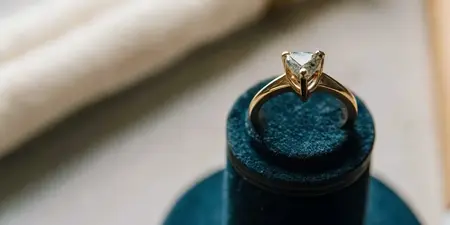
Protected points: V-shaped prongs or suitable bezel coverage help shield pointed ends. Prioritize this detail for pear, marquise, and other pointed shapes rather than choosing by the top view alone.
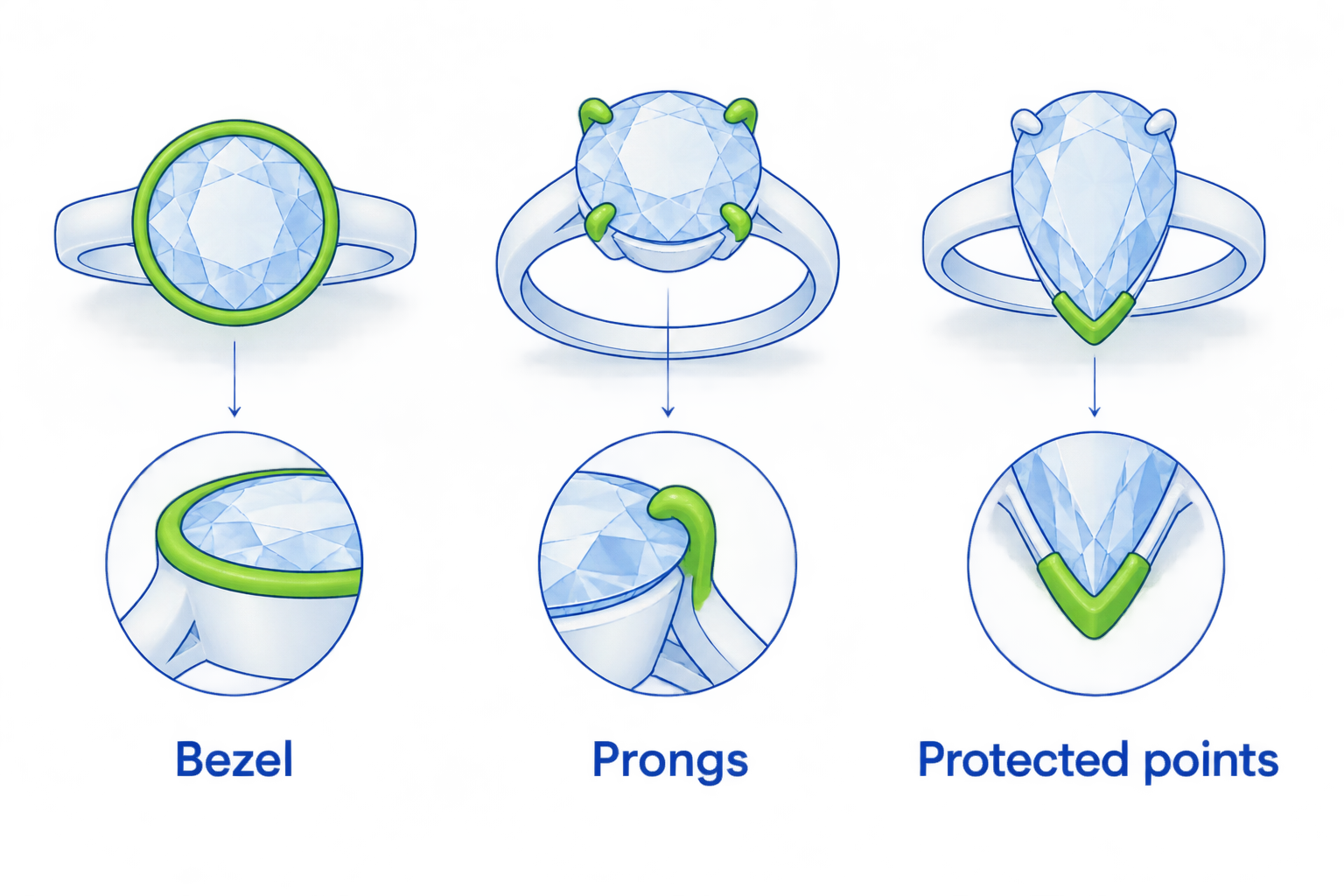
The setting changes both the visible outline and the protection around a gemstone’s edges.
Shape and material are separate decisions: oval moissanite engagement rings combine an elongated outline with moissanite’s pronounced fire, while turning that oval east-west changes its orientation without changing the gemstone. Separate those choices before adding accent stones or an elaborate band.
For a colored center, choosing an engagement ring setting for a colored stone starts with the individual gem’s dimensions and vulnerabilities. Don’t approve a setting solely because it looks attractive around a different gemstone.
Turn your shortlist into a ring decision
Bring a small, edited selection of reference images to a bridal conversation. Label what you like in each: the color, outline, metal, surface texture, or negative space. That gives a designer more direction than a folder of unrelated favorites.
For your 2026 ring search, make these checks before approving the design:
- Confirm the gemstone. Ask for its identity, origin, disclosed treatments, and relevant documentation.
- Inspect the profile. Look for height, exposed edges, and areas that catch against neighboring fingers.
- Test the pairing. Place a wedding band beside the engagement ring and decide whether a gap appeals to you.
- Discuss future changes. Ask how the specific construction affects resizing, maintenance, and repairs.
- Request care instructions. Use guidance for the actual stone and setting, not a generic cleaning routine.
Element 79 offers custom bridal pieces alongside designer fine jewelry. Best for: shoppers who want to explore a personal design direction. The trade-off is that a designer name or custom brief doesn’t answer every practical question; stone suitability and construction still need individual assessment.
How these options are ranked
This 2026 ranking puts colored-stone wearability first, then separates the remaining options by distinct design goals: vivid color, rainbow sparkle, silhouette, symbolism, and green color. Hardness references follow GIA’s gemstone guidance and describe scratch resistance only.
This is a comparison of design directions, not a claim that individual rings underwent hands-on testing. The final choice depends on the particular stone, its condition, and its setting.
Which alternative engagement ring should you choose?
Choose sapphire if you’re undecided and want a colored center for frequent wear. Choose spinel for a specific hue, moissanite for rainbow flashes, an east-west diamond for shape, or toi et moi for a two-stone composition.
Choose emerald only when you accept its care requirements. At Element 79, keep the discussion focused on the ring you want to live with, not simply the design that looks most unusual in a photograph.
FAQ
What makes an engagement ring alternative?
An alternative engagement ring departs from a conventional colorless-diamond solitaire through its gemstone, setting, silhouette, or materials. A diamond ring can still be alternative when its design is unconventional.
What's the best non-diamond stone for an everyday engagement ring?
Sapphire is the strongest default in this guide for shoppers seeking everyday color and strong scratch resistance. The individual stone's condition, treatments, and setting still matter.
Is moissanite the same as a lab-grown diamond?
No, moissanite and laboratory-grown diamond are different materials. Laboratory-grown diamond is diamond; moissanite is silicon carbide and has a different optical appearance.
Can an alternative engagement ring still have a diamond?
Yes, an alternative engagement ring can have a diamond center. East-west orientations, asymmetrical arrangements, and toi et moi compositions change the design without requiring a different gemstone.
Is emerald durable enough for an engagement ring?
Emerald requires more cautious wear than sapphire because fractures and treatments affect its durability and care. Choose an emerald engagement ring only after discussing the actual stone and its maintenance requirements.
Is a bezel better than prongs for a non-traditional ring?
A bezel suits shoppers who want a defined metal outline and coverage around the gemstone's edge; prongs suit a more open appearance. Neither setting makes every gemstone suitable for every activity.
Should I choose the engagement ring or wedding band first?
Choose the engagement ring and wedding band together when their fit matters to you. A low center setting or wide two-stone layout can prevent a straight band from sitting flush.
One last thing
Try your favorite ring from the side before deciding from above. The top view sells the composition; the profile reveals how that composition meets your daily life. A small change in height or edge protection can matter more than another decorative detail.
Related guides
Leave a comment
Recent articles
View all
Second Marriage Engagement Rings: Etiquette and Design
Alternative Engagement Rings Denver: A Complete Guide