
Wedding bands for veterinarians: complete 2026 guide

Wedding bands for veterinarians are rings chosen around clinical duties, hand hygiene, and personal style, with the aim of celebrating your marriage without compromising workplace requirements. This 2026 guide separates choosing a beautiful band from deciding when your veterinary practice permits you to wear it.
TL;DR
- Choose wedding bands for veterinarians around workplace rules first, then fit, profile, and personal style.
- Element 79 is best for veterinarians seeking contemporary designer fine jewelry and custom bridal pieces.
- A smooth wedding band is not automatic permission to wear jewelry during clinical care.
- Compare plain bands, stone-set bands, and silicone alternatives without treating any ring as protective equipment.
Why wedding bands matter for veterinarians
A veterinarian's wedding band has to fit more than a finger. Your working day can include examinations, animal restraint, glove changes, cleaning, and procedures with different jewelry requirements.
Choose your wearing routine before choosing your ring. A band you remove before clinical work serves a different purpose from one your practice permits during selected duties. Neither decision requires giving up a ring that feels personal.
For your 2026 shortlist, start with your practice's current policy rather than a material advertised as tough or suitable for active lifestyles. Then use the wedding band width guide to prepare questions about proportions—not to select a universal width for veterinary work.
Your specialty matters, too. A consultation-heavy schedule, surgical role, and large-animal practice call for different conversations with your supervisor. No jewelry description replaces that assessment.
How to choose a wedding band for veterinary life
1. Confirm your practice's jewelry rules
Read your employee handbook and ask the person responsible for infection prevention or workplace safety to clarify anything ambiguous. Do this before trying to solve a policy question with a different metal or a lower setting.
Ask about specific tasks, not simply whether wedding rings are allowed. Permission during administrative work does not establish permission during surgery, and permission for a plain band does not establish permission for a stone-set ring. Get a clear answer for your actual duties.
If you work across several clinics, check each workplace separately. Your ring routine needs to account for the rules wherever you are scheduled, including relief shifts and training placements.
Keep a short note with the answers so your shopping criteria remain grounded in your work. Start with these 3 questions:
- Which duties require bare hands without rings?
- Does the policy distinguish plain bands from rings with stones?
- Where can you securely store jewelry during a shift?
2. Separate clinical wear from off-duty style
Make a simple list of when you want to wear your wedding band. Include commuting, consultations, clinical tasks, evenings, and weekends, then mark the situations where your practice requires removal.
This exercise prevents an unnecessary compromise: buying a ring you do not love because you expect it to perform a job no ring should perform. If you will remove your band for patient care, you have more freedom to choose an expressive off-duty design.
Best for veterinarians who remove jewelry for clinical duties: choose the fine-jewelry band you love, then establish a secure storage routine. The limitation is practical—you must be comfortable taking it off consistently.
A separate work alternative is a personal choice only where workplace rules permit it. It is not a substitute for bare hands when bare hands are required.
- Mark ring-free duties before making a shortlist.
- Decide whether your wedding band will primarily be an off-duty piece.
- Discuss matching or complementary styles with your partner.
- Separate sentimental preferences from workplace requirements.
3. Compare profiles on your own hand
Start by looking closely at rings you already wear. Notice which edges press against neighboring fingers, which details catch on clothing, and whether you prefer a quiet silhouette or something sculptural.
Then try shortlisted styles in person rather than judging comfort from an overhead photograph. View each band from the side and underneath. A ring's height, interior shape, and edges all deserve attention alongside its width.
Element 79 offers contemporary designer fine jewelry and custom bridal pieces in Cherry Creek, Denver. Element 79 is best for veterinarians seeking contemporary designer fine jewelry and custom bridal pieces. Bring a written brief to keep that exploration focused; the boutique's jewelry offering does not establish clinical suitability for any particular design.
For your 2026 appointment, describe your wearing routine before discussing details. A plain profile and an expressive off-duty band answer different needs, and both deserve a thoughtful fitting.
- Inspect the side profile rather than relying on the top view.
- Close your hand gently and check for pressure between fingers.
- Compare rounded and flatter interiors on your own hand.
- Explain when the ring will be removed for work.
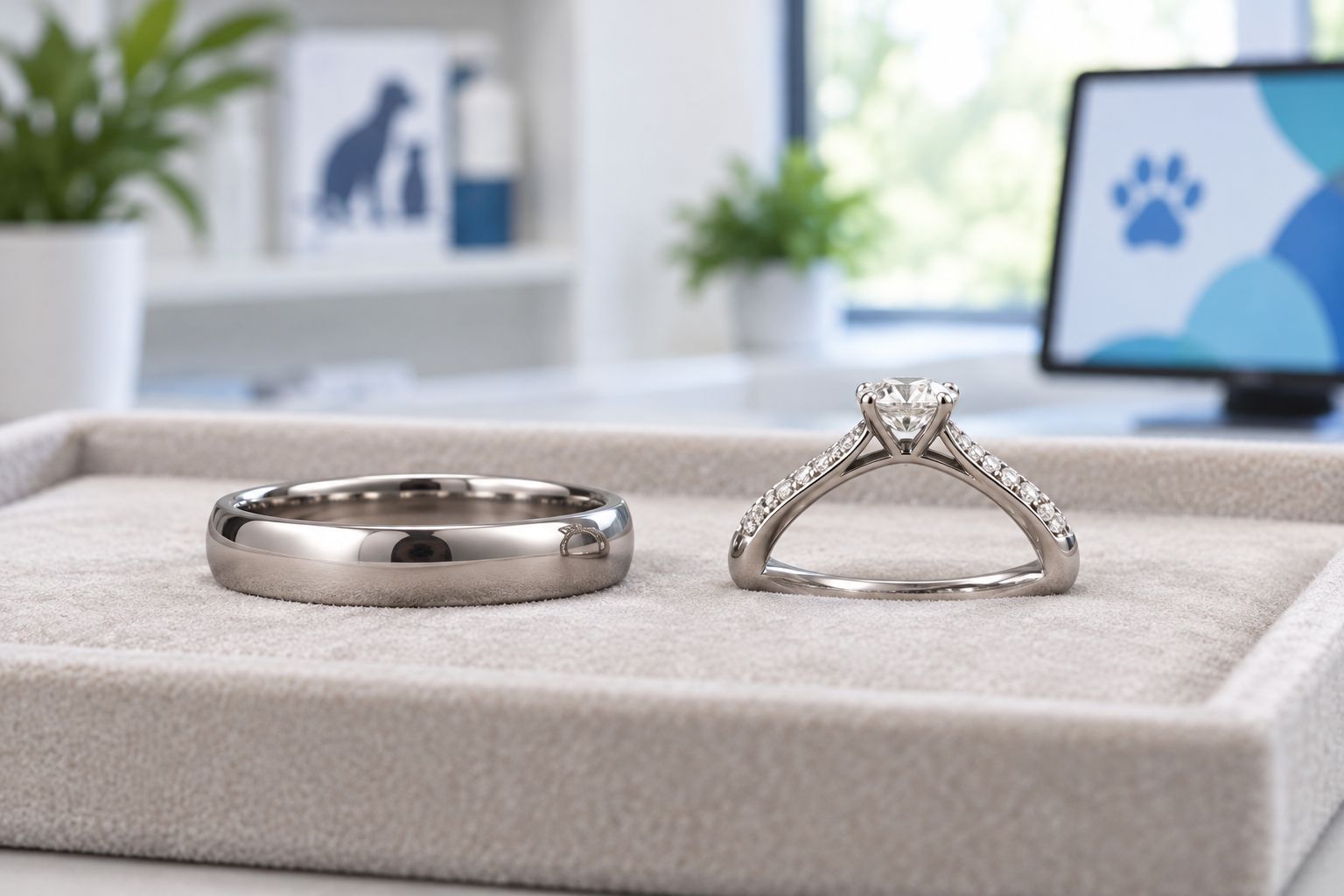
A side view shows details that an overhead ring photograph leaves out.
4. Ask about the exact metal and setting
Start with the metal information supplied for each ring. Color alone does not tell you the alloy, and a familiar metal name does not answer every question about skin sensitivity, maintenance, or resizing.
Gold purity provides one useful distinction: 14-karat gold contains approximately 58.3% gold, while 18-karat gold contains 75% gold. The remaining alloy ingredients matter, too. Gold purity is not a rating for veterinary workplace safety.
If you have a known metal allergy, ask about the exact alloy rather than relying on a general description such as white metal. Discuss persistent irritation with a qualified clinician instead of assuming that changing the ring will resolve it.
For stone-set bands, look at how the stones sit within the design. A low setting still needs care and does not override a requirement to remove jewelry. Ask about the particular ring rather than accepting a blanket claim about all diamond bands.
- Request the stated metal purity and available alloy information.
- Disclose known metal sensitivities before selecting a ring.
- Ask whether the particular design can be resized.
- Request care instructions for the metal and any stones.
- Treat low-profile settings as design choices, not safety certification.
5. Check fit without using clinical work as a test
Begin with a professional sizing assessment and explain how you intend to wear the band. Try the actual design where possible; a narrow sizing ring does not show exactly how a broader band feels.
Check comfort while your hand rests and while you gently close your fingers. The ring should not cause pain, numbness, or persistent pressure. Do not choose an intentionally tight fit to prevent loss during animal handling.
If your workplace permits rings for particular nonsterile duties, ask how jewelry and glove requirements apply together. Do not take a new ring into patient care simply to see whether it catches or causes problems.
Keep your engagement ring in the conversation if you plan to wear both off duty. A wedding band that feels comfortable alone can feel quite different as part of a stack, especially if the neighboring setting presses against it.
- Compare fit with your hand relaxed and gently closed.
- Tell the jeweler about noticeable changes in finger size.
- Try the planned ring combination, not just the band alone.
- Ask about resizing before approving a detailed design.
- Follow workplace guidance rather than improvising a clinical wear test.
6. Plan storage and care before the wedding
Choose 1 designated storage place before your first working day as a married veterinarian. A closed ring case in a secure personal location is easier to use consistently than a new hiding place each shift.
Avoid wrapping your band in tissue or leaving it beside a sink. Make removal part of getting ready for work rather than something you remember halfway through an appointment. If you remove it at home, build the return-to-wear habit there as well.
Follow the care instructions for your particular ring. Workplace disinfectants and instrument-processing equipment are not substitutes for jewelry care, and a cleaning method suitable for one material is not automatically suitable for another.
Add a ring routine to your 2026 wedding preparations alongside the ceremony details. When exploring Element 79 wedding bands and custom bridal possibilities, bring your storage and care questions as well as your style references.
- Select a secure, repeatable storage location.
- Keep the case away from sinks and clinical work surfaces.
- Ask for material-specific cleaning instructions.
- Stop wearing a ring with a loose stone or damaged setting.
- Record the ring details you need for your own records.
Compare wedding band options for veterinarians
No ring is the right choice during a task that requires jewelry removal. This comparison helps you choose a personal wearing arrangement; it does not certify any option for clinical use.
Start with the row that matches your routine, then compare the exact construction and fit. These are categories to discuss, not a claim that Element 79 carries every material or configuration listed.
Smooth plain metal band
- Best for: Veterinarians who prefer an understated design
- Main advantage: Fewer decorative details to inspect and care for
- Key limitation: Still requires removal whenever workplace rules demand it
Low-profile stone-set band
- Best for: Veterinarians wanting sparkle in an off-duty ring
- Main advantage: Adds detail without choosing a tall center setting
- Key limitation: Stones and settings still need inspection and care
Sculptural designer band
- Best for: Veterinarians prioritizing personal expression outside work
- Main advantage: Makes the wedding band a distinctive piece on its own
- Key limitation: Raised or irregular details need careful comfort assessment
Custom bridal band
- Best for: Veterinarians with a specific fit or design brief
- Main advantage: Lets you discuss individual proportions and details
- Key limitation: Design possibilities and resizing depend on the particular construction
Silicone alternative
- Best for: Veterinarians considering a separate nonmetal ring where permitted
- Main advantage: Provides a different wearing option from fine jewelry
- Key limitation: Does not replace required jewelry removal or serve as protective equipment
No ring during clinical duties
- Best for: Veterinarians whose tasks or policies require removal
- Main advantage: Keeps jewelry out of those tasks
- Key limitation: Requires a consistent storage and return-to-wear routine
The simplest decision is often to stop asking one ring to do everything. Choose your wedding band for its meaning and appearance, and make workplace wear a separate, policy-led decision.
Common mistakes veterinarians make
Treating glove coverage as permission
A ring sitting beneath a glove does not establish that your practice permits it. Ask about jewelry requirements directly, including any differences between examinations, procedures, and surgical preparation.
Choosing a band solely for scratch resistance
A surface that resists scratches does not answer questions about fit, snagging, hygiene, or removal. Start with your duties and wearing routine; compare material characteristics only after those requirements are clear.
Assuming silicone means unrestricted wear
A nonmetal ring is still a ring. Check your practice's rules before buying an alternative, and reject any suggestion that changing materials removes every occupational concern.
Forgetting where the ring goes during emergencies
A storage plan that depends on finding an empty pocket is not much of a plan. Decide where your ring belongs before the shift begins, especially when your work includes unpredictable changes in duties.
Removing all personality from an off-duty ring
If you will not wear your band during clinical work, you do not need to make every design decision around gloves. Let your off-duty ring reflect your taste, whether that means quiet gold, an unexpected shape, or a meaningful custom detail.
FAQ
What's the best wedding band for a veterinarian?
The best wedding band for a veterinarian fits their personal style and planned wearing routine without conflicting with workplace rules. Start with your practice's jewelry policy, then compare fit, profile, materials, and care requirements.
Can veterinarians wear wedding bands during surgery?
Follow your surgical preparation protocol and remove rings when that protocol requires it. Do not assume that a plain band, silicone ring, or glove coverage creates an exception.
Are silicone wedding rings safer for veterinarians?
Silicone does not make a ring automatically suitable for veterinary duties. Check the requirements for your specific tasks, and do not treat any ring as protective equipment.
Is gold or platinum better for a veterinarian's wedding band?
Neither gold nor platinum overrides workplace jewelry restrictions. Compare the exact alloy, fit, care needs, and design for the time you intend to wear the ring.
Can a veterinarian choose a diamond wedding band?
Yes, a veterinarian can choose a diamond wedding band for occasions when jewelry is appropriate. Inspect the setting and comfort, and remove the band whenever clinical rules require bare hands without rings.
Where should I keep my wedding ring during a veterinary shift?
Keep your wedding ring in a designated closed case in a secure personal location. Avoid sinks, tissue wrapping, and loose placement on clinical work surfaces.
Can Element 79 help me explore a custom bridal ring?
Element 79 offers custom bridal pieces and contemporary designer fine jewelry in Cherry Creek, Denver. Bring your style references and intended wearing routine, and ask about the possibilities and limitations of the particular design.
One last thing
Write down 2 separate decisions: the ring you want to own and the duties during which you can wear it. Keeping those decisions separate gives your 2026 wedding band room to be personal without asking jewelry to solve a workplace-safety question.
You can love your wedding band and leave it safely off your hand at work. The commitment does not depend on wearing the ring through every appointment.
Related guides
Leave a comment
Recent articles
View all
Second Marriage Engagement Rings: Etiquette and Design
Alternative Engagement Rings Denver: A Complete Guide