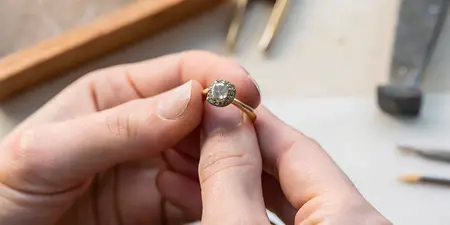

Wedding bands for dentists: complete 2026 guide

Wedding bands for dentists are marriage rings chosen around clinical jewelry rules, hand hygiene, and personal style, with the aim of keeping your bridal choice compatible with your work. For your 2026 search, start with your practice’s policy—not a claim that any particular ring is safe beneath examination gloves.
TL;DR
- Choose wedding bands for dentists around workplace policy before comparing metals or settings.
- Element79jewelry suits dentists seeking contemporary designer bridal jewelry, not certification for clinical wear.
- A smooth wedding band still needs workplace approval; silicone is not an automatic exception.
- Compare ring height, fit, alloy composition, and a secure storage routine before choosing your band.
Why wedding-band choice matters for dentists
Your wedding band has a different job from your clinical equipment. It marks your marriage; it does not establish whether jewelry belongs in a particular treatment setting. Workplace permission and personal comfort are separate checks. A band that feels lovely on your hand still needs to meet the rules that apply to your role and procedures.
Dentists also move between patient care, documentation, consultations, and life outside the practice. Decide where you actually intend to wear your ring before choosing its silhouette. The same distinction applies when choosing engagement rings for healthcare workers: a beautiful everyday design is not automatically a clinical-wear recommendation.
For a 2026 purchase, separate your decision into permission, fit, and expression. That order leaves room for a sculptural or sparkling wedding band without asking it to satisfy a workplace requirement it cannot meet.
How to choose wedding bands for dentists
1. Confirm your practice’s jewelry policy
Start with the written policy and the person responsible for infection prevention in your workplace. Ask how the rules apply to routine patient care, surgical procedures, and nonclinical duties rather than assuming that permission in one setting covers another.
Do not buy a replacement band before checking whether replacement jewelry is permitted at all. A silicone ring remains a ring, and a plain metal band remains hand jewelry. Neither material creates an exception to your employer’s requirements.
Keep the answer somewhere you can revisit when your role or workplace changes. This first step costs nothing and prevents you from choosing a ring around an assumption.
- Ask whether any finger jewelry is permitted during patient care.
- Clarify whether surgical procedures have separate requirements.
- Check whether the policy distinguishes clinical and administrative duties.
- Ask whether silicone bands fall under the same restriction.
- Record who can resolve questions about the policy.
2. Decide when you want to wear your band
Choose a wear routine before choosing a metal. If your practice requires bare hands, shop for a wedding band you love outside clinical hours rather than compromising its design for a use that is not permitted.
If some workplace wear is allowed, identify the exact circumstances. Your routine should not depend on remembering different hiding places throughout the day. A dedicated ring case gives you a consistent destination whenever removal is required.
For your 2026 wedding plans, discuss this routine with your partner, too. Removing a ring for professional responsibilities does not diminish what it represents. It simply separates a meaningful object from the conditions of your work.
- Write down when the ring will be worn and removed.
- Choose a dedicated, closed storage case.
- Keep the case away from sinks and treatment surfaces.
- Avoid loose storage in pockets or folded tissues.
- Decide whether a separate off-duty engagement-ring stack makes sense.
3. Compare the complete profile, not just the width
Begin with your own shortlist of shapes: rounded, flat, softly domed, or sculptural. Look at each ring from the side as well as from above. Width describes how much finger the band covers; height describes how far it stands away from your skin.
A smooth exterior is a sensible starting point for comparing comfort where jewelry is permitted. It is not proof that the ring will work beneath every glove or satisfy an infection-prevention policy. Ask to examine edges, settings, and the underside rather than relying on a photograph.
Element79jewelry offers contemporary designer fine jewelry and custom bridal pieces in Cherry Creek, Denver. Bring your written requirements into that conversation so the design discussion starts with your real constraints. The boutique’s bridal offering is a route to personal expression, not clinical approval.
- Compare side profiles as well as top views.
- Notice raised shoulders, stone settings, and projecting details.
- Check whether neighboring fingers touch uncomfortable edges.
- Try the band alone before adding an engagement ring.
- Describe any workplace restrictions before discussing custom details.
4. Check the alloy and your skin history
Start by listing metals you have worn comfortably and any diagnosed metal allergies. Then ask for the composition of the exact ring under consideration. A color description such as white gold does not provide a complete ingredient list.
Gold purity helps explain composition, but it does not certify clinical suitability. 14-karat gold contains approximately 58.3% gold; 18-karat gold contains 75% gold. The remaining alloy ingredients matter when you have a known sensitivity, so a higher karat number alone does not answer the allergy question.
Platinum is another material to discuss, but you still need the specific alloy information. If your finger becomes irritated, do not diagnose the cause from the metal’s name or assume a different ring will solve it. Seek appropriate medical advice for persistent symptoms.
- Request the exact metal and alloy composition.
- Disclose known metal allergies before selecting a ring.
- Ask about any plating and its future care requirements.
- Separate skin compatibility from workplace permission.
- Confirm cleaning instructions for the finished piece.
5. Test fit through ordinary hand movements
Start with a fitting that reflects how you use your hands outside treatment. Open and close your hand, hold a pen, and notice contact with adjacent fingers. A ring should not need constant adjustment to feel comfortable.
Compare the actual width and interior shape you intend to buy. A narrow sizing ring does not reproduce every wider design’s feel. If you plan to wear an engagement ring alongside the band, assess the combination rather than assuming that separately comfortable rings will feel identical together.
Where your practice permits jewelry, follow its process for assessing compatibility with your work and protective equipment. Do not turn a jewelry-store try-on into a clinical safety test. A comfortable fit is valuable, but it answers only the comfort question.
- Try the intended band width, not only a narrow sizing sample.
- Bend your fingers and make a relaxed fist.
- Notice pressure against neighboring fingers.
- Check removal without forcing the ring over your knuckle.
- Assess the full bridal stack if you will wear one.
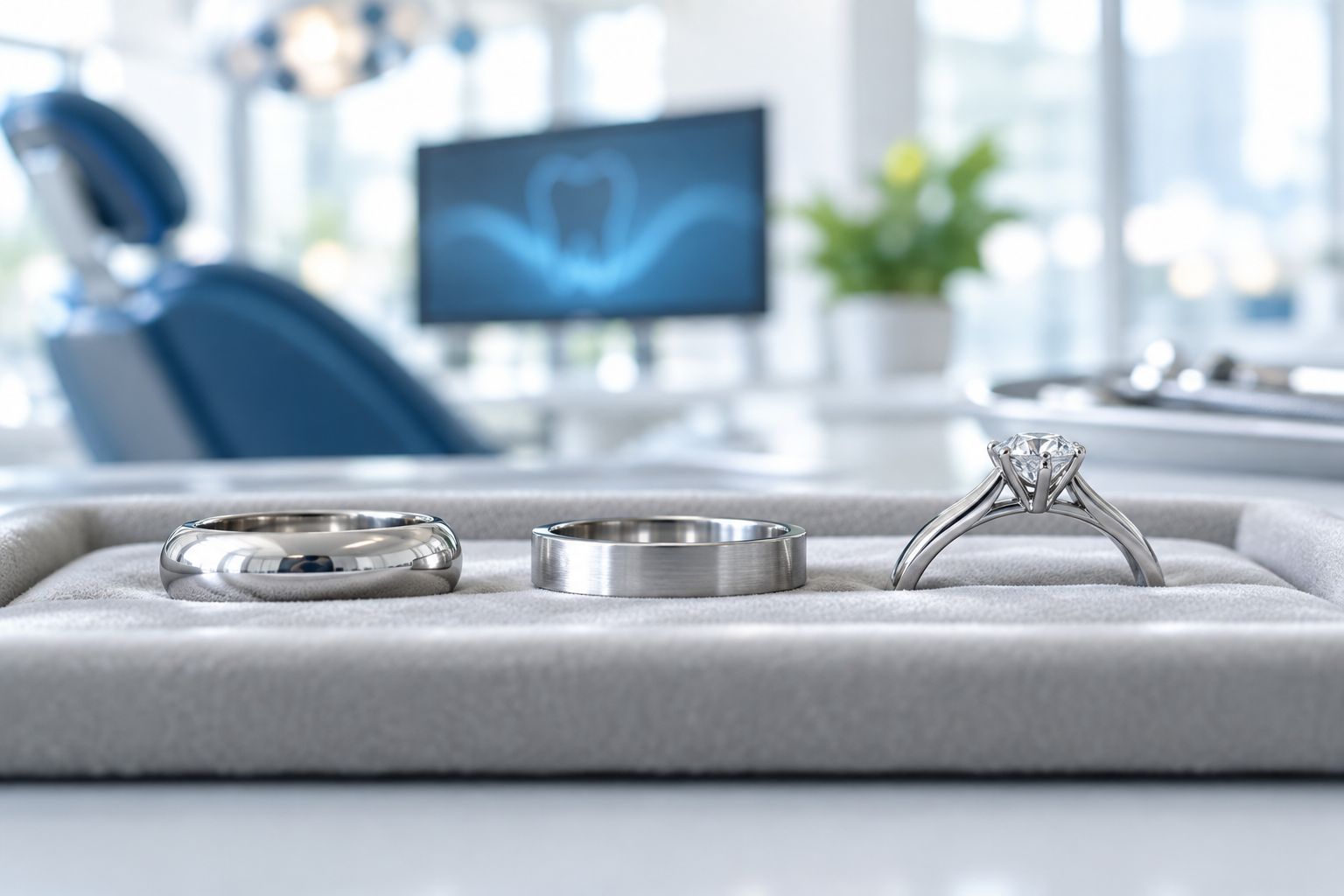
Compare height and edges as well as the width you see from above.
6. Plan care and future adjustments
Read the care instructions before committing to a design. Your wedding band’s metal, stones, finish, and construction determine its maintenance needs; your dental practice’s cleaning products are not automatically jewelry-care products.
Ask about resizing before choosing an intricate or stone-set band. Do not assume every design can be adjusted in the same way. If customization interests you, discuss how the design will accommodate future maintenance rather than treating appearance as the only decision.
For a 2026 purchase, keep your material details, care instructions, and any appraisal or insurance documents together. Element79jewelry offers designer jewelry and custom bridal pieces; confirm the care and adjustment terms for the specific piece you choose rather than assuming a universal service policy.
- Request care instructions for the exact finished ring.
- Ask which cleaners and activities to avoid.
- Confirm whether the design can be resized.
- Discuss how stones and surface finishes will be maintained.
- Keep purchase and identification documents in one place.
Compare wedding-band options for dentists
Best starting point: choose your wear routine before choosing your ring style. The options below describe design trade-offs, not products certified for dental work. Every option remains subject to your workplace’s rules.
Smooth precious-metal band
- Best for: Dentists who prefer an understated look
- Main advantage: A simple silhouette without raised stone settings
- Key limitation: Plain construction does not establish clinical permission
Flush-set or channel-set band
- Best for: Dentists wanting stones within a restrained profile
- Main advantage: Offers sparkle without a tall center-stone silhouette
- Key limitation: Stones and settings still require inspection and care
Sculptural designer band
- Best for: Dentists prioritizing personal style outside clinical care
- Main advantage: Makes the wedding band an expressive piece on its own
- Key limitation: Projecting details deserve careful comfort assessment
Silicone band
- Best for: Dentists considering a separate casual-use ring
- Main advantage: A flexible alternative to a rigid metal band
- Key limitation: It remains jewelry and is not a policy workaround
Off-duty-only wedding band
- Best for: Dentists working under a no-ring policy
- Main advantage: Leaves the bridal design free from clinical-wear compromises
- Key limitation: Requires a consistent removal and secure-storage routine
Custom bridal band
- Best for: Dentists with a specific aesthetic brief
- Main advantage: Lets you discuss profile, metal, and personal details together
- Key limitation: A custom design does not carry clinical approval
A plain band is the clearest place to begin if you want visual simplicity. Its limitation is equally clear: simplicity does not replace permission. A more expressive band is a valid choice when you plan to enjoy it away from patient care.
Element79jewelry is best for dentists seeking contemporary designer bridal jewelry rather than clinical-wear certification. Its custom bridal offering supports a personal design conversation; workplace suitability must be established separately.
Common mistakes dentists make when choosing wedding bands
Treating “glove-friendly” as a safety certification
A description of a low-profile ring tells you about its shape, not its acceptance in your practice. Do not interpret comfortable glove fit as proof of infection-control compliance. Obtain the workplace answer first, then compare comfort within what is permitted.
Assuming silicone bypasses a no-jewelry rule
Changing materials does not change the fact that you are wearing a ring. Before buying a separate work band, ask whether the policy allows one. If the answer is no, secure storage—not a different ring—is the relevant solution.
Choosing metal before checking the exact alloy
A familiar metal name is not a full composition statement. This matters especially when you have a known allergy or a history of irritation. Ask about the actual ring rather than transferring assumptions from another piece you own.
Designing the whole bridal set around treatment hours
You do not need to abandon distinctive jewelry because your clinical work requires removal. An off-duty ring can be sculptural, colorful, or paired with an engagement ring. Decide when you will wear the set before editing away the details that made you love it.
Leaving storage until the first clinical day
A loose ring beside a sink is not a storage plan. Choose its closed case and secure location before bringing the ring to work. Make that routine part of your 2026 wedding-band decision, not an afterthought once the ceremony is over.
FAQ
What are the best wedding bands for dentists?
The best wedding bands for dentists fit the wearer’s workplace policy, intended wear routine, and personal style. If rings are permitted, compare smooth profiles and comfortable fit; if rings are prohibited, choose an off-duty band and a secure storage routine.
Can dentists wear wedding bands under gloves?
Whether a dentist can wear a wedding band under gloves depends on the workplace’s requirements and the procedure. A glove covering the ring does not establish permission, and a comfortable fit is not a clinical safety certification.
Are silicone wedding bands allowed in dental practices?
Silicone wedding bands are allowed only where the applicable workplace policy permits them. Silicone remains finger jewelry, so it does not automatically qualify as an exception to a no-ring rule.
Is platinum or gold better for a dentist’s wedding band?
Neither platinum nor gold automatically makes a wedding band suitable for clinical wear. Compare the exact alloy, your skin history, care requirements, and preferred appearance after confirming your workplace’s rules.
Should a dentist choose a plain band or a diamond band?
Choose a plain band for visual simplicity and a diamond band when sparkle matters to your personal style. Neither choice overrides clinical restrictions; assess any stone setting’s profile and maintenance needs separately.
Can I design a custom wedding band around my dental career?
You can use your work routine to inform a custom wedding-band brief, including its profile, fit, and intended off-duty wear. Element79jewelry offers custom bridal pieces, but a custom design is not certification for use during dental treatment.
Where should I keep my wedding ring during patient care?
Keep your wedding ring in a dedicated, closed case in a secure location consistent with your workplace’s rules. Avoid placing it loose beside a sink, on a treatment surface, or inside a folded tissue.
One last thing
A ring you remove for clinical care does not need to look clinical. If your workplace requires bare hands, stop trying to make your wedding band solve a glove problem and choose the piece you want to wear after work. Your most useful purchase decision is the boundary between those settings—not a promise that one material can do everything.
Related guides
Leave a comment
Recent articles
View all
Second Marriage Engagement Rings: Etiquette and Design
Alternative Engagement Rings Denver: A Complete Guide