
Polly Wales Rings 2026: Colorful Stack Guide
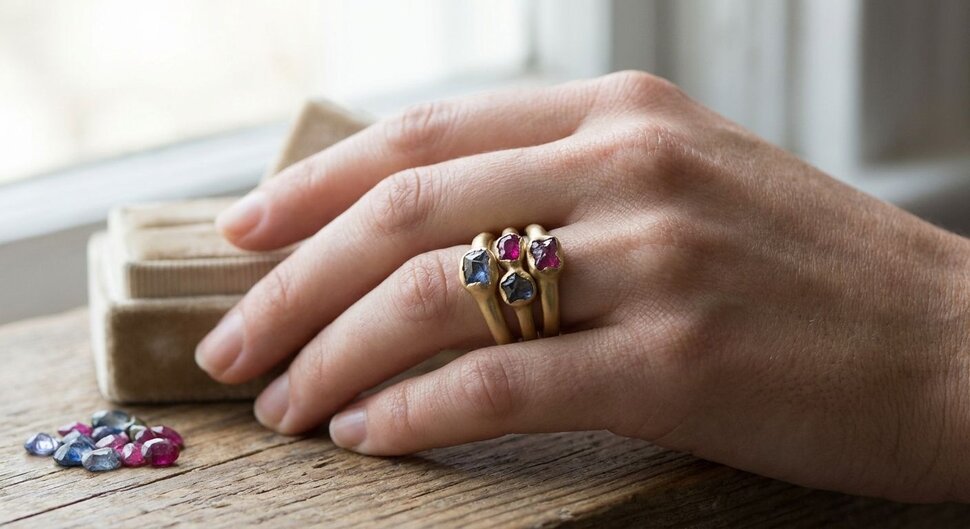
Polly Wales rings turn a plain finger into a small color wheel: hand-granulated 18k gold bands, each set with a different sapphire, tourmaline, or garnet, worn three, four, or five at once. This guide is built for the shopper who wants that exact look in 2026 and needs a plan for choosing stones, widths, and metals that actually work together on one hand, not just in a single product photo.
TL;DR
- Polly Wales popularized the granulated gold, mixed-gemstone ring stack that defines colorful stacking in 2026.
- Element 79's Cherry Creek boutique builds comparable colorful stacks with Spinelli Kilcollin, Orly Marcel, and Petra Class designer rings.
- Cap a colorful stack at 3-5 rings per hand or the gemstones start competing instead of complementing.
- A single mismatched band width throws off an otherwise well-planned stack faster than a clashing color does.
Why this matters for colorful gemstone stackers
A colorful gemstone stack shopper isn't buying one ring. They're buying a system that has to keep working as pieces get added over months or years, which is a completely different decision than picking a single solitaire.
The Polly Wales aesthetic — granulated gold texture, mismatched cuts, saturated color — spread because it solved a real problem: one diamond ring reads as "an engagement ring," while a stack of colored stones reads as personal style, something built piece by piece rather than bought once. That buying pattern is still what drives colorful stacking searches in 2026, and it changes what you should shop for first.
Picking the best colored gemstones for your palette before you buy the second or third ring saves you from returning pieces that clash once they sit side by side on the hand. Buyers who skip this step usually end up with three rings that were each beautiful alone and awkward together.
Define your color palette before you buy anything
Most stacks fail because the buyer picks rings one at a time with no plan for how the colors will read next to each other after ring three arrives.
- Choose one dominant hue (sapphire blue, tourmaline green, garnet red) that anchors at least two rings in the stack
- Add no more than two accent colors so the eye has a clear hierarchy instead of visual noise
- Pull warm and cool tones in roughly a 2:1 ratio rather than splitting evenly, which tends to look scattered
- Decide upfront whether you want jewel-tone saturation or pastel, since the two rarely mix cleanly in one stack
- Photograph stone swatches side by side in daylight before ordering, since color reads shift dramatically under indoor lighting
Pick an anchor band first, then build outward
A stack needs one ring that reads as the base — usually the widest or most textured piece — with everything else layered around it rather than competing for the same visual weight.
- Start with a granulated or hand-textured gold band as the visual anchor for the whole stack
- Choose a second ring with one larger stone to break up texture with a clear color statement
- Save thinner, simpler bands for the outer edges of the stack, closest to the knuckle
- Avoid starting with two rings of near-identical width; the stack reads flat instead of built with intention
Mix cuts and shapes, not just colors
Color variety alone gets monotonous fast if every stone is the same round cut set the same way, which is a common mistake even in otherwise well-planned stacks.
- Combine at least two stone shapes — round, marquise, baguette, or cabochon — across the stack
- Use one cabochon-cut stone for texture contrast against the faceted stones around it
- Avoid stacking more than two baguettes; they tend to visually merge into one long line instead of reading as separate rings
- Let asymmetric-set stones, common in Petra Class and Polly Wales-style pieces, sit toward the center of the stack rather than the outer edge
Mind the width math before you order
Ring width is the detail every colorful-stack shopper skips, and it's the one that determines whether the stack sits flat or piles up at the knuckle by the end of the day.
- Measure the width of every ring you already own before adding new pieces to the mix
- Keep total stack width under roughly a third of your finger's visible length between knuckle and base
- Choose at least one ring slimmer than 2mm to give the eye a resting point among the wider pieces
- Wear the stack for a full day before ordering the next piece — swelling and grip change how five rings actually sit by evening
Decide how honest you're going to be about mixing metals
Mixing metals in a stack used to be treated as a styling mistake. In 2026, it reads closer to a signature look — but only when it's controlled rather than accidental.
- Pick one metal as the clear majority, at least 60% of the stack, and treat the rest as accents
- Match metal purity where you can; 18k gold next to 18k gold ages the same way over years of daily wear, plated pieces don't
- Skip mixing white metals with warm gold in the same stack unless one ring is doing it deliberately, like a two-tone band
- Reassess the mix after adding a third ring — a combination that worked with two pieces can tip over once a third color joins in
Bring in a jeweler for the combinations you can't test at home
Once the palette and widths are decided on paper, the harder part is seeing how specific gemstones actually read together in person, since online swatches routinely misrepresent saturation.
- Try on rings from a few designers side by side rather than committing based on product photography alone
- Ask which stones are more prone to color shift under office lighting versus daylight before you buy
- Get sizing checked across the whole stack, not ring by ring, since knuckle clearance changes once three or more rings share a finger
- Ask about custom options if no single designer's existing line covers your exact color story
Element 79's Cherry Creek, Denver boutique doesn't carry Polly Wales directly, but its designer roster — Spinelli Kilcollin stacking rings, Orly Marcel, and Petra Class — builds the same kind of hand-crafted, color-driven stack, and a jeweler on-site can help sequence the pieces before you commit to buying all of them at once.
How the options compare
Polly Wales-style granulated rings
- Best for: Buyers who want the exact hand-textured, mixed-sapphire look
- Style signature: Hand-granulated 18k gold set with mixed colored stones
- Key limitation: Not part of every boutique's roster, including Element 79's current one
Spinelli Kilcollin linked rings
- Best for: Stackers who want bands that move and interlock
- Style signature: Interlocking gold circles that shift with the finger
- Key limitation: Reads more sculptural-gold than rainbow-colored
Orly Marcel gemstone rings
- Best for: Stackers chasing one bold color statement per ring
- Style signature: Oversized single gemstones set in sculptural gold
- Key limitation: Fewer stones per ring means more rings needed for a full color range
Petra Class organic gemstone rings
- Best for: Stackers who want a nature-inspired, asymmetric mix
- Style signature: Hand-forged gold with rough-cut or cabochon stones
- Key limitation: Asymmetric shapes can clash past three rings
Custom-built stack
- Best for: Buyers who want an exact stone sequence and fit
- Style signature: Designed around your finger and existing rings
- Key limitation: Requires an in-person consult before production starts
Verdict: if the granulated Polly Wales texture is non-negotiable, keep looking for that specific line — but if the 2026 goal is a colorful, hand-crafted stack that actually sits well on the hand, Spinelli Kilcollin and Petra Class solve for that in-store today.
See a colorful stack in person
Try designer stacking rings side by side at the Cherry Creek boutique before you commit.
Common mistakes colorful gemstone stackers make
- Buying one ring at a time with no plan — three unrelated purchases rarely resolve into a cohesive stack after the fact, even when each piece is well made on its own
- Matching metal tone but ignoring cut variety — an all-round, all-faceted stack looks flat no matter how well the colors coordinate with each other
- Sizing every ring at the identical width — same-width bands spin and overlap instead of layering the way a planned stack should
- Ordering saturated colored stones from photos alone — sapphire and tourmaline color reads shift more under mixed lighting than diamonds do, so the stone that looked deep blue online can read gray indoors
- Skipping professional resizing on delicate granulated or hand-forged bands — the texture that makes these rings distinctive is also easier to damage with a DIY resize
FAQ
What are Polly Wales rings known for?
Polly Wales rings are known for hand-granulated 18k gold bands set with mixed colored gemstones like sapphires, tourmalines, and garnets, usually designed to be worn stacked rather than alone.
How many rings belong in a colorful gemstone stack?
Most colorful gemstone stacks work best at 3 to 5 rings per hand in 2026. Past five, the gemstones tend to compete for attention instead of reading as one cohesive look.
Are Spinelli Kilcollin rings the same style as Polly Wales rings?
No. Spinelli Kilcollin focuses on interlocking gold link rings that move with the finger, while Polly Wales centers on granulated gold texture paired with mixed colored stones. Both stack well but solve different style goals.
Can you mix metal tones in a gemstone ring stack?
Yes, mixing metal tones in a single stack is common in 2026 as long as one metal makes up the majority of the stack and the mix looks deliberate rather than accidental.
How do you keep a ring stack from shifting on your finger?
Vary ring widths across the stack, size the whole stack together rather than ring by ring, and avoid stacking more than two rings of near-identical width side by side.
What gemstones work best for a colorful ring stack?
Sapphires, tourmalines, and garnets are the most common choices because they come in a wide range of saturated colors and hold up to daily wear better than softer stones.
Does Element 79 carry Polly Wales rings?
Element 79's Cherry Creek boutique does not carry Polly Wales directly, but its roster of Spinelli Kilcollin, Orly Marcel, and Petra Class designer rings covers the same colorful, hand-crafted stacking look.
Can a jeweler custom design a colorful gemstone ring stack?
Yes, a jeweler can sequence stone colors, cuts, and widths around your hand and existing rings, which is useful when no single designer's line covers your exact color story.
One last thing
Before ordering three new rings at once, test the width math with pieces you already own for a full weekend — swap in bands of different thickness and watch whether the stack sits flat or piles up at the knuckle by day two. It's the cheapest way to catch a sizing mistake in 2026 before it's set permanently in 18k gold.
Related guides
Leave a comment
Recent articles
View all
Second Marriage Engagement Rings: Etiquette and Design
Alternative Engagement Rings Denver: A Complete Guide