
Jamie Joseph Jewelry: Raw Gemstone Guide for 2026
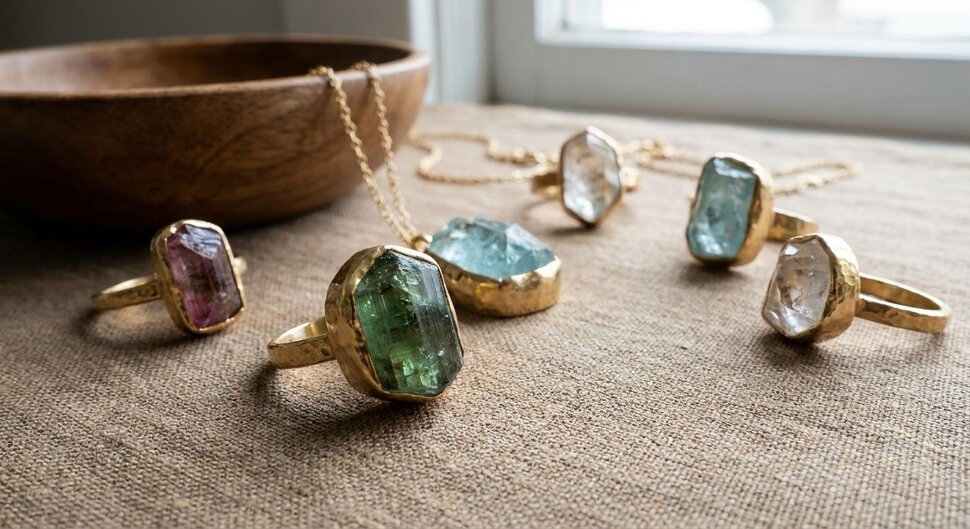
Jamie Joseph jewelry shoppers want raw, uncut gemstones set in freeform gold rather than a faceted stone locked into a symmetrical prong setting, and in 2026 that specific search almost always means someone already knows the designer by name and wants to see the look up close before buying. The category skews toward collectors and style-conscious buyers who treat mineral texture as the main event, not a supporting detail next to a diamond.
TL;DR
- Jamie Joseph jewelry sells one-of-a-kind raw stone slices, so exact repeats of a sold piece rarely exist.
- Petra Class jewelry at Element 79 offers a comparable hand-forged, nature-inspired raw-stone aesthetic you can try on in Cherry Creek.
- Bezel settings protect uncut stones far better than prongs for daily-wear jewelry in 2026.
- Todd Reed jewelry is the raw-diamond answer if you want rough texture without colored gemstones.
Why raw gemstone jewelry matters for this shopper
Anyone typing "jamie joseph jewelry" into a search bar in 2026 isn't browsing casually. They've already seen a raw stone slice ring on someone's hand, or scrolled past one online, and they're looking for the specific texture: rough mineral edges, visible banding, a piece that looks pulled from the earth rather than cut to a formula. That's a narrower, more decisive search pattern than someone typing "gold ring" or "statement necklace."
The constraint this segment runs into is availability. Raw gemstone pieces are frequently sold as singles, not restocked SKUs, which means the exact ring someone saw isn't guaranteed to exist by the time they go looking for it. That reality should shape how this shopper searches and shops, not just which name they search for.
If you're chasing the Jamie Joseph look specifically, plan to compare designers working in the same raw-stone tradition rather than waiting on one exact piece to reappear.
How to shop for a raw gemstone statement piece
Define your stone preference first
Raw gemstone jewelry isn't one look. Slices, druzy clusters, and rough rutilated quartz all read differently on the hand, and picking a lane before you shop saves time.
- Slice-cut stones (agate, tourmaline) for visible internal banding
- Druzy clusters for a sparkly, crystalline surface
- Rough, uncut nuggets for a heavier, more organic shape
- Rutilated or included quartz for texture without strong color
- Rough colored gemstones (sapphire, emerald) for a jewel tone without a facet
Pick a setting built for uncut stones
A raw stone doesn't have the flat facets a prong grips onto, so the setting matters more here than in standard fine jewelry.
- Bezel settings wrap the stone edge for daily-wear security
- Prong settings work only on stones with a defined girdle to catch
- Hand-forged or hammered settings suit irregular, non-symmetrical shapes
- Freeform gold wraps that follow the stone's natural outline
- Avoid claw settings on soft or heavily included stones
Match metal weight to stone size
Raw stones run heavier and less predictable in shape than cut stones, so the metal has to carry more visual and structural weight.
- 14k or 18k gold for daily-wear durability under stone weight
- Thicker bezel walls (not thin wire) for larger raw slices
- Sterling silver only for occasional-wear statement pieces
- Mixed metal accents to balance an asymmetrical stone shape
Decide where the statement piece goes
A raw gemstone doesn't need to be a ring. Where you place it changes how bold it reads day to day.
- Rings for maximum visibility, best on a dominant hand
- Pendants for a lower-commitment way to wear a large stone
- Cocktail rings for occasional wear at events
- Earrings for smaller, lighter-weight raw stone cuts
See the piece in person before you commit
Photos flatten texture. A raw stone's banding, inclusions, and surface catch light differently in person than they do on a screen, and scale is almost impossible to judge from an image alone.
This is where a boutique matters more than a marketplace search. Element 79 in Cherry Creek, Denver carries Petra Class jewelry, which works in the same nature-inspired, hand-forged tradition as raw slice jewelry, and it's a piece you can try on rather than guess at from a product photo.
- Check how the stone catches light from multiple angles
- Try the piece on your actual hand or neckline, not a model's
- Ask to see the bezel or setting edge up close for security
- Compare scale against a piece you already own
See raw gemstone pieces in person
Explore nature-inspired designer jewelry at Element 79's Cherry Creek boutique.
Budget without a carat-weight formula
Raw gemstone jewelry doesn't price the way faceted diamond jewelry does. There's no standard carat-weight-times-quality-grade math, because the value sits in the stone's uniqueness and the metal work around it.
- Expect pricing to vary piece to piece, not by a fixed formula
- Ask what's driving the price: stone rarity, metal weight, or hand-fabrication time
- Compare designers, not just stone size, since setting craft varies widely
- Confirm current pricing directly with the seller before assuming a range
Care for the stone for the long run
Uncut and rough stones can be softer or more porous than their polished counterparts, which changes daily-wear habits.
- Remove raw stone rings before workouts, cleaning, or manual work
- Store separately so surfaces don't scratch against harder stones
- Clean with a soft cloth only; skip ultrasonic cleaners on porous stones
- Have the bezel checked annually if worn daily
Raw gemstone jewelry designers compared
Jamie Joseph
- Best for: Collectors who want raw stone slices with visible mineral banding
- Key limitation: Pieces sell as one-of-a-kind, so an exact repeat isn't guaranteed
Petra Class
- Best for: Buyers who want hand-forged settings around rough, uncut stones
- Key limitation: The asymmetry is intentional, which reads as a flaw to shoppers expecting matched pairs
Todd Reed
- Best for: Shoppers who want raw diamond texture instead of colored rough stone
- Key limitation: Raw diamond color runs brown or gray, not white, which surprises first-time buyers
Verdict: if the exact Jamie Joseph piece you saw is gone, Petra Class jewelry through Element 79 is the closest hand-forged, nature-inspired alternative you can try on in person in 2026, and Todd Reed jewelry is the move if you want the raw look in diamond rather than colored stone.
Common mistakes raw gemstone shoppers make
- Assuming raw means lower quality. Uncut stones are priced on rarity and craft, not on the same clarity scale as faceted diamonds.
- Skipping the bezel check. A stone without a defined girdle needs full bezel coverage, and a loose or thin bezel wall is the top reason raw stone rings get damaged.
- Applying diamond pricing logic. There's no carat-weight-times-grade formula here, so comparing two raw stone pieces by size alone misses the actual value.
- Buying sight-unseen for a one-of-a-kind piece. Photos don't show true scale or light behavior on a raw, irregular surface.
- Wearing rough stone jewelry through daily manual tasks. Softer or porous stones chip and dull faster than faceted, harder-graded gems.
FAQ
What is Jamie Joseph jewelry known for?
Jamie Joseph jewelry is known for raw, uncut gemstone slices and rough mineral pieces set in freeform gold. Each piece is typically one-of-a-kind rather than part of a repeatable product line.
Is raw gemstone jewelry more fragile than faceted stone jewelry?
Raw and rough-cut stones can be softer or more porous than polished, faceted stones, which makes setting security more important. A proper bezel setting protects an uncut stone far better than a prong.
Does Element 79 sell Jamie Joseph jewelry?
Element 79 carries a curated set of artisan designers including Petra Class, Spinelli Kilcollin, Artemer, and Orly Marcel rather than Jamie Joseph specifically. Petra Class works in a comparable nature-inspired, hand-forged raw-stone tradition.
How much does raw gemstone jewelry cost?
Pricing on raw gemstone jewelry varies by stone rarity, metal weight, and hand-fabrication time rather than a fixed carat-weight formula. Check current pricing directly with the designer or retailer for an accurate figure.
What setting works best for an uncut gemstone?
A bezel setting that wraps the full edge of the stone works best for uncut or rough gemstones. Prong settings need a defined girdle to grip, which most raw stones don't have.
Can raw gemstone rings be resized?
Resizing depends on the setting style; freeform and hand-forged bands built around an irregular stone can be harder to resize than a standard band. Ask the jeweler before buying if size is uncertain.
Is Todd Reed jewelry similar to Jamie Joseph jewelry?
Todd Reed jewelry shares the raw-stone philosophy but focuses on rough diamonds instead of colored gemstone slices. The texture is similar; the material and color range differ.
How do I clean a raw gemstone ring at home?
Use a soft cloth and avoid ultrasonic cleaners, since porous or included stones can be damaged by vibration and heat. Skip household chemicals entirely on rough-surfaced stones.
One last thing
The detail most first-time raw gemstone buyers miss: the bezel wall thickness matters more than the stone itself for how the ring survives daily wear in 2026. A stunning slice in a thin bezel will loosen within a year of regular wear; the same stone in a properly built, thick-walled bezel setting holds for decades. Ask about wall thickness before you ask about the stone.
Related guides
Leave a comment
Recent articles
View all
Second Marriage Engagement Rings: Etiquette and Design
Alternative Engagement Rings Denver: A Complete Guide