How to Choose a Diamond Cut for Maximum Sparkle (2026)
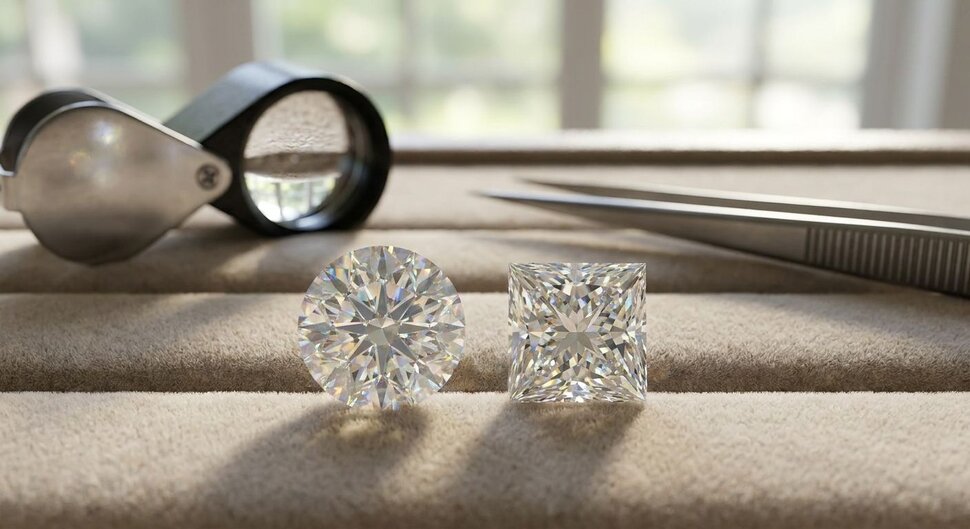
Diamond cut determines sparkle more than carat, color, or clarity combined, and picking the right cut in 2026 comes down to matching facet geometry to the kind of flash you actually want to see on the finger. The round brilliant cut delivers the most sparkle of any diamond shape, engineered with 58 facets specifically arranged to maximize light return, and it's the benchmark every other cut gets measured against. If you want sparkle in a shape other than round, the cushion cut and radiant cut come closest — both use brilliant-style faceting, while emerald and asscher cuts use step-cut facets that produce a quieter, glassier flash instead of firework-style scintillation.
TL;DR
- Round brilliant wins for how to choose a diamond cut in 2026 — 58 facets engineered for maximum light return.
- Cushion and radiant cuts deliver strong fire in fancy shapes; emerald and asscher trade sparkle for clean vintage lines.
- Cut grade (Excellent or Ideal) matters more than shape — a Good-grade round brilliant sparkles less than a well-cut cushion.
- GIA only issues an official cut grade for round brilliants; fancy shapes are judged on proportions, polish, and symmetry instead.
Why this matters
Most engagement ring buyers walk in asking about carat weight first, and that's backwards. Two diamonds can share the same carat weight and clarity grade and still look completely different under light — the one with the better cut throws more fire, plain and simple. The specialists at Element 79 in Cherry Creek see this constantly: a smaller, well-cut stone consistently reads as more brilliant, and more expensive-looking, than a larger stone with a mediocre cut.
Sparkle isn't one thing, either. Jewelers break it into three separate effects: brilliance (white light bouncing back), fire (light splitting into rainbow flashes), and scintillation (the flash pattern you see when the stone or the light source moves). Cut shape and cut grade both drive all three, which is why choosing a cut is really about choosing which combination of these three effects you want.
How to Choose a Diamond Cut for Maximum Sparkle
Start with cut grade before shape — an Excellent or Ideal grade on any shape beats a Good or Fair grade on every shape. Once grade is locked in, shape decides the character of the sparkle:
Round Brilliant
- Facets: 58
- Sparkle Style: Maximum brilliance, fiery flashes
- Best For: Classic solitaires, first-time buyers
Princess
- Facets: 76
- Sparkle Style: Sharp, geometric fire
- Best For: Modern angular settings
Cushion
- Facets: 64
- Sparkle Style: Soft, warm scintillation
- Best For: Vintage-inspired rings
Radiant
- Facets: 70
- Sparkle Style: High brilliance in a rectangle
- Best For: Brides who want size and sparkle
Oval
- Facets: 56-72
- Sparkle Style: Brilliant sparkle, elongates the finger
- Best For: Fashion-forward brides
Emerald
- Facets: 50-58
- Sparkle Style: Hall-of-mirrors flash, quieter sparkle
- Best For: Art Deco and clean-line lovers
Asscher
- Facets: 58
- Sparkle Style: Vintage step-cut flash
- Best For: Heirloom aesthetic
Round Brilliant: 58 Facets for Maximum Brilliance
The round brilliant is the reference point for sparkle because its 58 facets are cut in a circular pattern that GIA has spent decades optimizing for light return. It's the only shape with an official GIA cut grade (Excellent through Poor), which makes it the easiest cut to shop with confidence in 2026. Verdict: Buy if maximum, all-around sparkle is the priority.
Princess Cut: 76 Facets for Geometric Fire
Princess cut packs more facets than round brilliant — 76 versus 58 — but arranges them in a square pavilion that leaks more light out the sides and corners. The result is sharper, more angular fire rather than the softer scintillation of a round stone. Verdict: Buy for a modern, geometric look that still reads as brilliant.
Cushion Cut: 64 Facets for Soft, Warm Sparkle
Cushion cut rounds off the corners of a square or rectangular outline and uses 64 facets to produce a softer, warmer scintillation pattern than round brilliant. It's a favorite for vintage-inspired settings because the larger facets show broader flashes of light instead of tiny pinpoints. Verdict: Buy for brides who want fire with a romantic, less clinical look.
Radiant Cut: 70 Facets for Brilliance in a Rectangular Shape
Radiant cut was designed specifically to bring brilliant-style faceting — 70 facets total — into a rectangular or square outline, closing the gap between emerald cut's clean lines and round brilliant's sparkle. It handles inclusions well because the facet pattern breaks up light in a way that hides small flaws. Verdict: Buy as the hybrid pick between step-cut elegance and brilliant-cut fire.
Emerald and asscher cuts use step-cut facets — long, rectangular planes stacked like stairs — which produce a hall-of-mirrors flash instead of scintillation. They're stunning for clean, geometric elegance, but they show inclusions more readily and sparkle noticeably less than any brilliant-style cut. Verdict: Hold on emerald or asscher if maximum sparkle, not clarity of line, is the deciding factor.
Why sparkle varies by cut
Sparkle differences between cuts and even between two stones of the same cut come down to a handful of measurable factors:
- Cut grade — Excellent and Ideal grades return significantly more light than Good, Fair, or Poor grades on the same shape.
- Proportions — table percentage and pavilion depth control whether light exits through the top of the stone (sparkle) or leaks out the bottom (dullness).
- Polish — rough or uneven facet surfaces scatter light unevenly, muting brilliance.
- Symmetry — misaligned facets create dark or dead zones where light doesn't return to the eye.
- Facet arrangement — brilliant-style faceting (round, princess, cushion, radiant, oval) is built for scintillation; step-cut faceting (emerald, asscher) is built for clarity of reflection instead.
- Lighting environment — fluorescent and LED lighting show off brilliance and fire more dramatically than warm incandescent light, so a stone can look different in a jewelry store than at a candlelit dinner.
Is round brilliant or princess cut better for sparkle?
Round brilliant beats princess cut for sparkle because its 58 facets sit in a circular pattern optimized for light return, while princess cut's 76 facets sit in a square pavilion that leaks more light out the sides and corners. Princess still delivers strong geometric fire — it just trades some raw brilliance for its angular silhouette.
Does a bigger diamond mean more sparkle?
A bigger diamond does not automatically mean more sparkle, because cut grade — not carat weight — determines how much light bounces back to your eye. A 1-carat Excellent-cut round brilliant can out-sparkle a 2-carat Good-cut diamond of the identical shape.
What's the difference between diamond cut and diamond shape?
Diamond shape is the outline of the stone — round, princess, cushion, emerald — while diamond cut is the quality grade (Excellent, Very Good, Good, Fair, or Poor) that measures how precisely the facets were angled and polished. Two round diamonds can share identical shape and still sparkle very differently depending on cut grade alone.
Talk Through Cut and Shape in Person
Book a Cherry Creek appointment to compare sparkle side by side before you decide.
For brides set on the classic pick, round brilliant engagement rings remain the safest bet for maximum sparkle in any lighting, and it's the shape Element 79's boutique sees requested most for solitaire settings.
FAQ
What's the best diamond cut for maximum sparkle in 2026?
Round brilliant with an Excellent or Ideal cut grade is the best diamond cut for maximum sparkle in 2026, thanks to its 58 facets built specifically for light return. Cushion and radiant cuts are the strongest runners-up if you want a fancy shape.
Is princess cut or round cut more sparkly?
Round cut is more sparkly than princess cut because its 58 facets are arranged in a circular pattern optimized for light return, while princess cut's square pavilion leaks more light out the sides. Princess still offers strong, angular fire.
How many facets does a diamond need for maximum sparkle?
Round brilliants use 58 facets as the baseline for maximum sparkle, though cushion (64) and radiant (70) cuts use more facets without necessarily out-sparkling a well-cut round. Facet arrangement matters more than raw facet count.
Does diamond color affect sparkle?
Diamond color affects the warmth of light returned more than the intensity of sparkle itself, so near-colorless grades (G-H) are often chosen when buyers want maximum brilliance without a yellow tint.
Is emerald cut a good choice for maximum sparkle?
Emerald cut is not the top choice for maximum sparkle because its step-cut facets produce a hall-of-mirrors flash rather than scintillation. It's a better choice for buyers who prioritize clean geometric lines over fire.
What cut grade should I look for on a diamond?
Look for an Excellent or Ideal cut grade, since these grades are engineered for the highest light return regardless of shape. Very Good is an acceptable second choice; Good, Fair, and Poor noticeably reduce sparkle.
Can a poorly cut diamond look dull even with high clarity?
Yes, a poorly cut diamond can look dull even with flawless clarity, because clarity affects internal flaws while cut controls how light enters and exits the stone. A Fair or Poor cut grade lets light leak out the bottom instead of reflecting back to the eye.
Should I prioritize cut over carat when budgeting for a ring in 2026?
Yes, prioritizing cut over carat in 2026 is the standard recommendation, since cut grade drives visible sparkle more than carat weight alone. A smaller, better-cut stone reads brighter and more expensive than a larger, poorly cut one.
One last thing
GIA only issues an official cut grade — Excellent through Poor — for round brilliant diamonds. Every fancy shape, including cushion, princess, radiant, oval, and emerald, has no official GIA cut grade at all; you're judging those stones on proportions, polish, and symmetry ratings instead. That's exactly why a side-by-side comparison in person, rather than a certificate alone, decides which fancy-shape stone actually sparkles.
Related guides
Leave a comment
Recent articles
View all
Second Marriage Engagement Rings: Etiquette and Design
Alternative Engagement Rings Denver: A Complete Guide