
Diamond Carat Weight Guide 2026: How to Choose Size
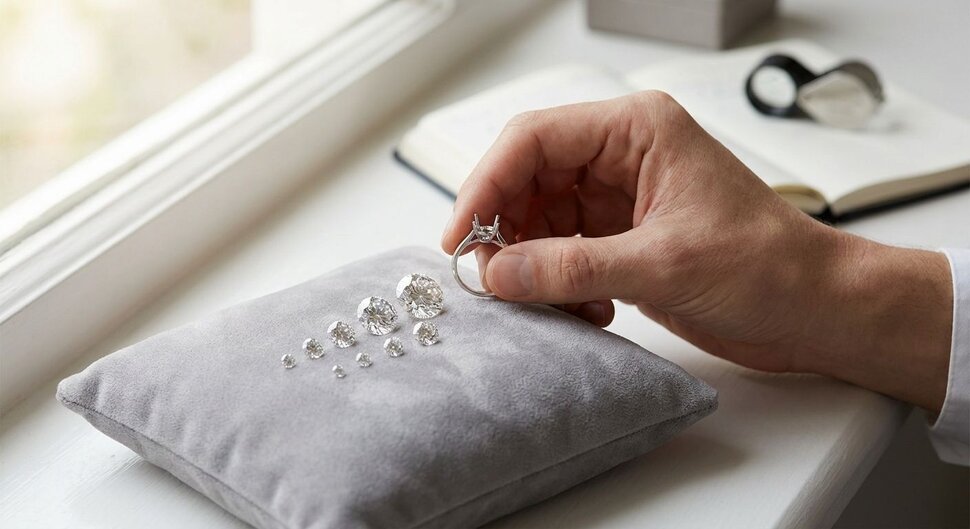
Choosing a diamond carat weight comes down to matching stone size to finger proportion, setting style, and how much visual weight you want the ring to carry, not just picking the biggest number you can afford. Most US engagement ring center stones land between 1.00 and 1.50 carats, though anywhere from 0.50 to 3.00 carats is common depending on hand size, metal choice, and cut quality. Cut has more influence on perceived size than the carat number itself — a well-cut 0.90 carat round can face up larger than a shallow, poorly proportioned 1.10 carat stone.
TL;DR
- A diamond carat weight guide should start with finger size and setting, not just budget — 1.00-1.50 ct is the common US sweet spot for solitaires.
- Price accelerates at magic sizes (0.90 to 1.00 ct, 1.90 to 2.00 ct) because of rarity thresholds, not because the stone looks different.
- Cut quality changes perceived size more than the certificate number — a shallow stone looks smaller than its carat weight suggests.
- Halo settings and pave shanks make a smaller center stone read larger, useful when you want the 1.00 ct look on a 0.60 ct budget.
- Element 79 in Cherry Creek, Denver builds custom bridal pieces around whichever carat weight fits your hand and setting best.
Why this matters
Carat weight is the number every ring shopper fixates on, but it's the least reliable predictor of how a diamond actually looks on a finger. Two stones at the identical carat weight can differ in visible diameter by half a millimeter or more depending on how deep the cutter left the pavilion. In 2026, with lab-grown diamonds pushing carat sizes up across price points, the old assumption that bigger always means better has gotten more complicated, not less.
The real decision isn't "how many carats can I afford" — it's "what stone size and setting combination reads the way I want it to on my specific hand." That's a different question, and it has a different answer for a size 5 finger than a size 8.
How to choose a diamond carat weight for your ring
Start with the diameter, not the carat number. Round brilliant diamonds follow a fairly predictable size chart, so you can picture the stone before you ever try one on:
0.50 ct
- Approx. diameter (round cut): ~5.0mm
- Best for: Petite hands, stacking rings, minimalist solitaires
0.75 ct
- Approx. diameter (round cut): ~5.8mm
- Best for: Classic minimalist solitaire, everyday wear
1.00 ct
- Approx. diameter (round cut): ~6.5mm
- Best for: Traditional benchmark, balanced on most hand sizes
1.50 ct
- Approx. diameter (round cut): ~7.4mm
- Best for: Statement solitaire, confident presence
2.00 ct
- Approx. diameter (round cut): ~8.2mm
- Best for: Bold, cocktail-ring-adjacent presence
Once you know the diameter you want, work backward into carat weight, cut grade, and setting style together. A ring built around designer diamond earrings or a solitaire band, for instance, wears carat weight very differently than a stone buried in a halo.
0.50 to 0.75 carat: the minimalist range
A stone in this range reads as delicate and everyday-wearable rather than a statement piece. It's the range most stacking bands and petite solitaires fall into, and it's forgiving on smaller finger widths where a larger stone can look top-heavy. Buy if your priority is a piece you'll wear daily without thinking about it.
1.00 to 1.50 carat: the traditional sweet spot
This is where most US engagement ring center stones land, and it's the range that reads as "engagement ring size" to most people without any explanation needed. A 1.00 ct round at roughly 6.5mm diameter balances well on most average finger widths. Buy if you want the classic proportion without going into statement-ring territory.
2.00 carat and up: the statement range
Stones at 2.00 ct and beyond shift a ring from "engagement ring" to "the ring people ask about." Cut quality matters more here because any depth or proportion flaw becomes more visible at scale. Buy if the budget and hand proportion support it; wait if cut grade would need to be sacrificed to hit the carat number.
Before you lock in a carat weight, check how much clarity and color grade you're willing to trade for size — the diamond color grade you choose interacts directly with how big a stone looks, since warmer color grades can make a larger stone read as less crisp under office lighting.
Talk through carat weight in person
Book a Cherry Creek appointment to compare stone sizes on your hand.
Why carat weight varies
Five factors decide whether a given carat weight looks right on a specific ring, and none of them are the number on the certificate alone:
- Finger length and width — a 1.50 ct stone on a slender size 4-5 finger reads larger than the same stone on a size 8-9 finger
- Setting style — a halo, pave shank, or hidden halo adds visual size without adding carat weight
- Cut proportion — a shallow or overly deep pavilion hides carat weight below the table, making the stone look smaller face-up
- Metal color and band width — a thin platinum band makes a center stone look larger by contrast; a thick yellow gold band can visually shrink it
- Shape — elongated cuts like oval, pear, and marquise face up larger per carat than round or cushion cuts
- Budget allocation across the 4Cs — stretching for carat weight often means dropping clarity or color a grade, which is a trade worth understanding before you commit
That last point matters more than most shoppers expect. Two 1.00 ct diamonds can be priced thousands apart purely on clarity grade alone, and a slightly lower clarity grade is frequently invisible to the naked eye at normal viewing distance.
Is a 1 carat diamond too small?
A 1 carat diamond is not too small — it's the most common center stone size for US engagement rings and reads as a full, traditional engagement ring on most hand proportions. At roughly 6.5mm diameter for a round brilliant, it sits comfortably between "delicate" and "statement" without leaning hard toward either. Setting style, not carat weight alone, usually decides whether a 1 carat stone feels substantial or understated.
What carat weight looks best on a smaller finger?
Smaller finger widths (roughly size 4-6) typically wear 0.50 to 1.00 carat stones most comfortably, since larger stones can overwhelm a narrow finger and look disproportionate at the base. A halo setting is the classic workaround here — it adds visual diameter around a smaller center stone without pushing the actual carat weight up. Elongated shapes like oval or marquise also help by drawing the eye lengthwise rather than adding bulk.
Should I prioritize carat weight or clarity?
Prioritize carat weight for visual impact and clarity for peace of mind, since most clarity differences below a certain grade are invisible without magnification. If budget forces a trade-off, most jewelers recommend protecting cut grade first, carat weight second, and treating clarity and color as the flexible variables. A well-cut, slightly smaller stone consistently outperforms a larger, poorly cut one in actual sparkle.
FAQ
What is the average carat weight for an engagement ring in 2026?
Most US engagement ring center stones fall between 1.00 and 1.50 carats in 2026, with 1.00 ct remaining the most requested single size. Actual averages shift by budget and region, so this range is a starting point, not a rule.
Does carat weight affect diamond price the most?
Carat weight is one of several price drivers alongside cut, clarity, and color, and price jumps disproportionately at round-number thresholds like 1.00 ct and 2.00 ct. A 0.90 ct stone often costs meaningfully less than a 1.00 ct stone of similar quality despite the size difference being nearly invisible.
Is a 2 carat diamond too big for daily wear?
A 2 carat diamond is not inherently too big for daily wear, but setting style and lifestyle matter more than the number itself. A low-profile setting with a 2 carat stone wears more practically day-to-day than a high halo mounting on a smaller carat weight.
How much bigger does a halo setting make a diamond look?
A halo setting can make a center stone read one full size category larger by surrounding it with smaller accent diamonds that extend the visual diameter. This is the standard technique for stretching a smaller carat budget without changing the actual stone size.
What carat weight is considered a statement ring?
Stones at 2.00 carats and above are generally considered statement-ring territory, where the ring becomes a visible focal point rather than a classic proportion. Below that, in the 1.00-1.50 ct range, rings read as traditional rather than bold.
Do lab-grown diamonds let you go up in carat weight?
Lab-grown diamonds generally allow buyers to reach larger carat weights within the same budget compared to natural stones of equivalent quality. That's the main reason lab-grown carat sizes have trended upward across price points in 2026.
Should carat weight or setting come first when designing a ring?
Setting style should be decided alongside carat weight, not after, because a halo, solitaire, or three-stone setting changes how large a given carat weight visually reads. Deciding the number first and the setting second often leads to a mismatch between expectation and finished ring.
One last thing
Diamond cutters intentionally cut stones just under round-number thresholds — 0.90 ct instead of 1.00 ct, 1.90 ct instead of 2.00 ct — because price jumps sharply at those psychological marks even though the size difference is nearly imperceptible. If a jeweler shows you a 0.92 ct stone next to a 1.01 ct stone at a noticeably higher price, ask to compare them side by side before assuming the extra cost buys anything you can actually see. A custom setting built around the exact stone you choose, rather than a pre-set mounting, is often the more efficient way to spend that saved budget — worth discussing directly with a jeweler who designs bridal pieces around the stone rather than the other way around.
Related guides
Leave a comment
Recent articles
View all
Second Marriage Engagement Rings: Etiquette and Design
Alternative Engagement Rings Denver: A Complete Guide