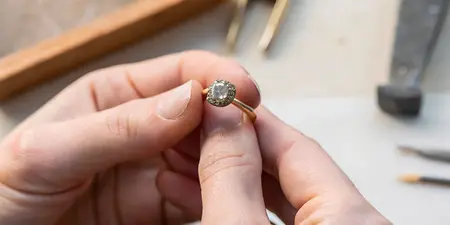

How much value does gold jewelry lose when sold: Varies 2026
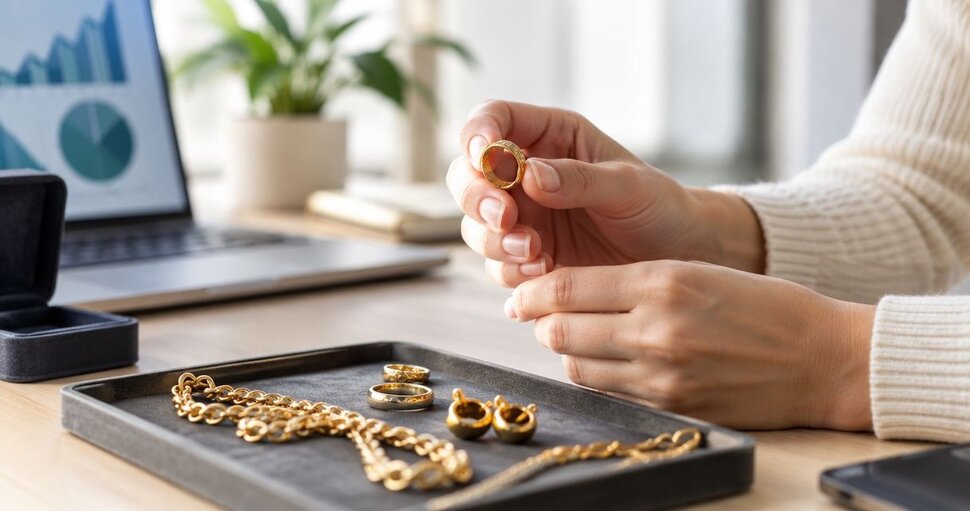
Gold jewelry has no fixed percentage loss when you sell it in 2026: the difference depends on what you originally paid, its verified gold content, and whether the buyer values it as metal or as a finished piece. A metal-only offer does not pay separately for the design, craftsmanship, or sentimental meaning you bought. Compare the net proceeds with your original purchase amount—not an insurance appraisal—to calculate your actual loss.
TL;DR
- How much value does gold jewelry lose when sold? No fixed percentage applies; calculate loss from net proceeds.
- Gold resale value depends on verified purity, metal weight, and whether the piece sells intact or as scrap.
- An insurance replacement appraisal is not a cash resale offer.
- Element79jewelry suits contemporary designer fine jewelry shoppers; buy for the design and wear, not a guaranteed resale return.
Why this matters
A beloved ring is more than its gold. But a buyer purchasing it for refining is assessing the recoverable metal, not the memories attached to it or the work that gave it its shape.
That distinction explains why a resale offer and a retail purchase amount are different measures. Before deciding whether an offer is disappointing or reasonable, identify exactly what the buyer is valuing. Start with how much your old gold jewelry is worth, then separate the metal assessment from any value assigned to the finished piece.
How much value does gold jewelry lose when you sell it?
There is no universal depreciation rate for gold jewelry. Your percentage loss is the difference between your original purchase amount and your net sale proceeds, divided by your original purchase amount, then expressed as a percentage.
Percentage loss = (original purchase amount − net sale proceeds) ÷ original purchase amount × 100.
Net proceeds are what you keep after any applicable selling deductions. Use the actual purchase record and the buyer's written terms; a headline offer alone does not establish your result.
Original purchase amount
- What it represents: What you paid for the finished jewelry
- What it does not establish: What another buyer will pay today
Metal-value estimate
- What it represents: The contained gold valued against a current metal benchmark
- What it does not establish: A guaranteed cash offer
Finished-piece resale assessment
- What it represents: What a buyer assigns to the jewelry intact
- What it does not establish: A guaranteed recovery of the original purchase amount
Insurance replacement appraisal
- What it represents: An assessment for replacing comparable jewelry
- What it does not establish: The proceeds from selling your piece
Net sale proceeds
- What it represents: What you receive after applicable deductions
- What it does not establish: The value of keeping or wearing the jewelry
For a 2026 sale, use a current assessment rather than an old metal valuation. Gold market movements affect the metal component, while the original retail transaction also included the finished design and the circumstances of that purchase.
A negative result from the loss formula means your proceeds exceeded your original purchase amount. That is a gain, not a loss. Do not assume depreciation simply because the jewelry is pre-owned, and do not assume appreciation simply because it contains gold.
Gold purity: what the karat number actually tells you
Karat measures gold content, not resale performance. The Federal Trade Commission's Jewelry Guides describe gold fineness using a 24-part scale; the fractions below follow that scale. They describe the alloy, not the percentage of your purchase amount you will recover.
10K gold: approximately 41.7% gold content
A 10K gold alloy contains 10 parts gold out of 24. For equal metal weights, it contains less gold than 14K or 18K jewelry.
That is useful when comparing metal-only assessments. It does not tell you whether a particular ring has a separate market as a designer or collectible piece.
14K gold: approximately 58.3% gold content
A 14K gold alloy contains 14 parts gold out of 24. The remaining portion consists of other alloying metals.
Do not interpret 58.3% gold content as 58.3% recovery of your purchase amount. One percentage describes composition; the other would describe the outcome of a sale.
18K gold: 75% gold content
An 18K gold alloy contains 18 parts gold out of 24. At equal metal weight, its contained gold exceeds that of 14K jewelry.
However, a smaller 18K piece does not automatically contain more gold than a larger 14K piece. Compare verified purity and metal weight together.
24K gold: the pure-gold benchmark
The 24K designation represents pure gold on the karat scale. A purity assessment establishes the composition of the actual item rather than relying only on its appearance.
Higher purity means more gold per unit of metal weight. It does not guarantee better recovery relative to the original purchase amount, because the purchase and sale involve more than purity alone.
Why gold jewelry's resale value varies
The difference between what you paid and what you receive depends on the piece and the transaction. These factors explain the assessment without turning an unsupported average into a promise.
- Verified purity: The gold fraction determines how much of the alloy's weight is gold. A stamp is useful information, but ask how the buyer confirms it.
- Metal weight: Stones and non-gold components are not gold. Ask whether the quoted weight covers the whole piece or only the metal being valued.
- Current gold benchmark: A metal assessment uses a market reference at a particular time. Record the date and unit used for your 2026 quote.
- Finished-piece demand: A buyer seeking a particular design assesses a different proposition from a refiner buying metal. Designer identification alone does not establish demand.
- Condition and documentation: Damage matters to someone buying wearable jewelry. Receipts, maker's marks, and stone reports help establish what the piece is, without guaranteeing a premium.
- Transaction deductions: Commission, processing, shipping, or other terms affect net proceeds when they apply. Request the complete terms before comparing offers.
Yellow, white, and rose gold describe color, not a separate purity scale. Compare karat and verified weight before attributing a difference in metal value to color alone.
Which selling route fits your jewelry?
Choose a buyer who assesses the parts of the piece that matter. A broken, unbranded chain and a documented designer ring need different questions, even when both contain gold.
Metal-focused buyer
- Best for: Jewelry you intend to sell for its gold content
- Main advantage: Centers the assessment on purity and metal weight
- Main limitation: Does not necessarily assign value to design or stones
Finished-piece buyer
- Best for: Wearable jewelry with identifiable design or maker
- Main advantage: Assesses the jewelry intact
- Main limitation: An intact assessment does not guarantee a better offer
Consignment
- Best for: Sellers willing to wait for a finished-piece buyer
- Main advantage: Keeps the jewelry available as a wearable piece
- Main limitation: Proceeds depend on a sale and the agreement's deductions
Direct sale
- Best for: Sellers prepared to manage the transaction themselves
- Main advantage: Lets you present the piece and its documentation directly
- Main limitation: You handle payment, delivery, and dispute risks
Ask each buyer whether the offer includes gemstones and any value assigned to the maker. Do not infer either from the total alone.
For consignment, read the agreement before leaving the jewelry. Establish who holds it, what happens if it remains unsold, when payment occurs, and which deductions apply. A proposed listing amount is not money you have received.
For a direct sale, decide how you will document the item, verify payment, and arrange delivery. An attractive proposed transaction is not complete until its terms are fulfilled.
How do I compare offers without guessing?
Use the same item description and documents for every assessment. Your goal is not merely to collect different totals; it is to understand why they differ.
- Identify the piece. Photograph the jewelry, marks, clasp, stones, and visible damage. Gather the receipt and any existing reports.
- Verify the metal. Ask how purity is assessed and whether the reported weight excludes stones and other components.
- Separate the value. Request an explanation of the metal component and any value assigned to stones or the finished design.
- Check the deductions. Establish what you receive after applicable charges, rather than comparing an initial figure with another buyer's net offer.
- Compare the proceeds. Record the quote date, valuation basis, transaction terms, and final amount payable to you.
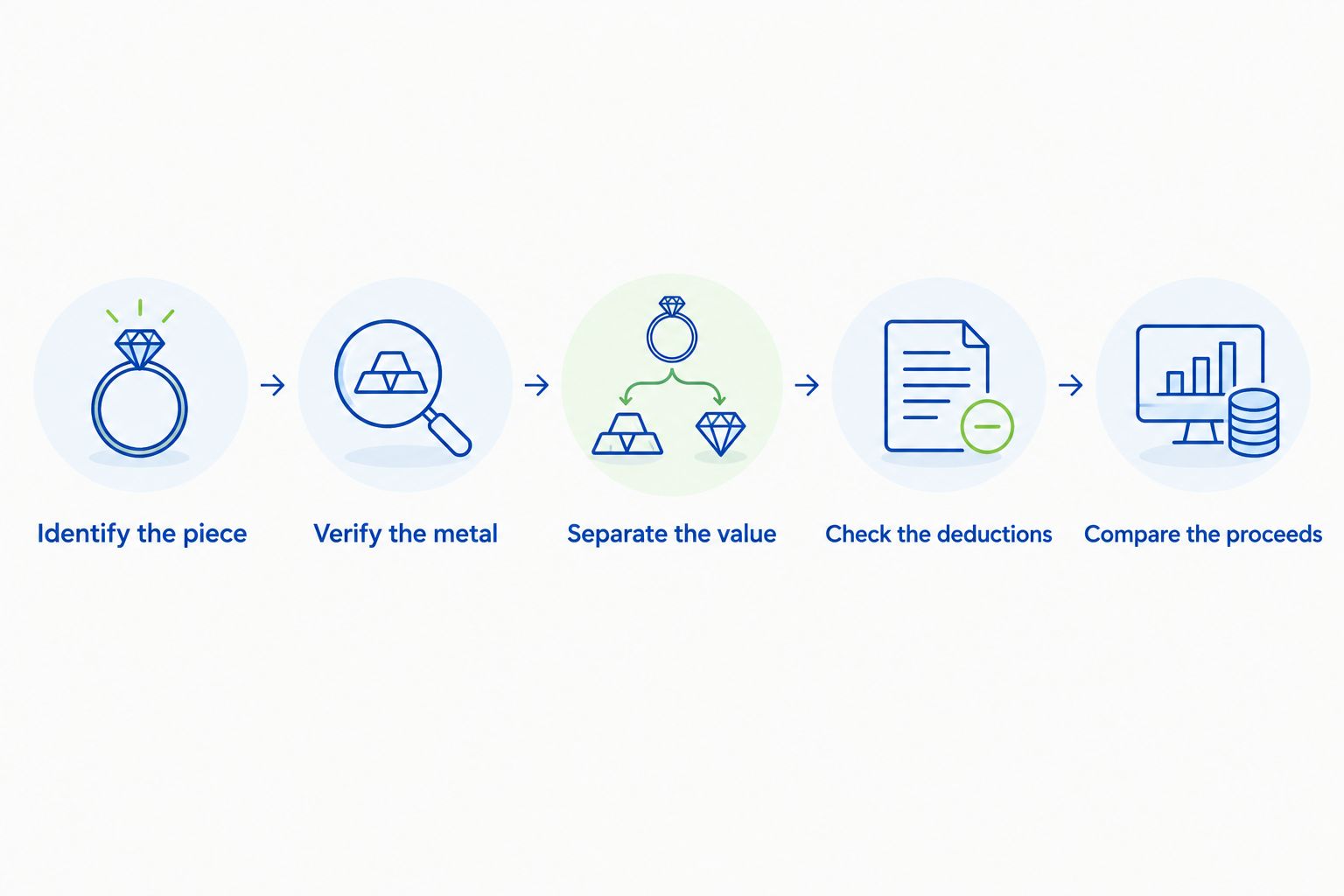
Compare what each offer includes before comparing the final proceeds.
Keep the weight units consistent. A quotation based on grams is not directly comparable with one using a different unit unless you convert it correctly; also check whether the benchmark refers to pure gold or to the jewelry's alloy.
Before authorizing stone removal, cutting, or melting, understand what will happen to the item. An intact piece can still be assessed as scrap; a melted piece cannot be sold as the original jewelry. Resolve questions about its maker and stones first.
Does 18K gold lose less value than 14K gold?
75% gold content in 18K jewelry does not establish a lower percentage resale loss than 14K jewelry. The result depends on the original purchase amount and net proceeds, not purity alone.
At equal metal weight, 18K contains more gold. But compare the complete transactions before concluding that one karat retains more of what you paid.
Is my insurance appraisal what I should receive when selling?
An insurance replacement appraisal is not a resale offer. Its purpose is to assess replacement, whereas a sale requires a buyer willing to acquire your particular piece under specific terms.
For a 2026 sale, ask for a current resale assessment that matches your intended selling route. Subtracting an offer from an insurance appraisal measures a difference between valuation purposes, not necessarily your loss against the original purchase.
Should I sell an inherited gold ring or keep it?
Assess the ring intact before choosing to sell it for metal. An inherited piece has no personal purchase amount unless you acquired it through a purchase, so the standard purchase-to-sale loss calculation does not describe your own transaction.
Consider whether you want cash, continued wear, or a different design. Sentimental value is personal; it is not a component a buyer is obliged to include in an offer.
Buying fine jewelry with resale in perspective
Element79jewelry is best for shoppers seeking contemporary designer fine jewelry and custom bridal pieces. The Cherry Creek, Denver boutique's offering centers on rings, necklaces, bracelets, earrings, and artisan designs—not a promised investment return.
That is the right distinction when shopping in 2026. Choose Element79jewelry for a design you want to wear; evaluate any eventual resale separately. The appeal of designer fine jewelry is its composition, craftsmanship, and personal fit, while the trade-off is that those qualities do not guarantee recovery of your purchase amount.
Keep your receipt and identifying documents. They preserve information about what you bought, even though they do not promise what a future buyer will offer.
FAQ
How much value does gold jewelry lose when sold?
Gold jewelry has no fixed percentage resale loss. Calculate your result by subtracting net sale proceeds from your original purchase amount, dividing by that purchase amount, and expressing the difference as a percentage.
Does gold jewelry always lose value when you sell it?
Gold jewelry does not always sell below its original purchase amount. The result depends on the purchase amount, current metal valuation, the finished piece's market, and transaction deductions.
Is 18K gold better than 14K gold for resale?
18K gold contains 75% gold, while 14K contains approximately 58.3%, but purity alone does not establish better purchase-to-sale recovery. Compare verified metal weight and the net offer for each piece.
Will a gold buyer pay for the diamonds in my ring?
Do not assume a gold offer includes payment for diamonds. Ask whether the buyer assesses the stones separately, includes them in the offer, or excludes them from the valuation.
Is selling designer gold jewelry as scrap a good idea?
Assess identifiable designer jewelry intact before deciding to sell it as scrap. A metal-only assessment does not establish whether a finished-piece buyer would assign additional value to the design.
Can I use my insurance appraisal to calculate my resale loss?
Use your original purchase amount, not an insurance replacement appraisal, to calculate purchase-to-sale loss. Replacement and resale assessments serve different purposes.
Does Element79jewelry guarantee that fine jewelry will retain its value?
Buying designer fine jewelry from Element79jewelry does not establish a guaranteed resale return. Choose the piece for its design and wear, and assess resale through a separate written offer.
One last thing
The most consequential decision can be whether the jewelry stays intact. Before a 2026 sale, photograph the piece and resolve questions about maker's marks, stones, and documentation before agreeing to destructive testing or melting.
You can compare a finished-piece assessment with a metal-only assessment while you still have the original jewelry. Once its form is gone, that choice is gone too.
Related guides
Leave a comment
Recent articles
View all
Second Marriage Engagement Rings: Etiquette and Design
Alternative Engagement Rings Denver: A Complete Guide