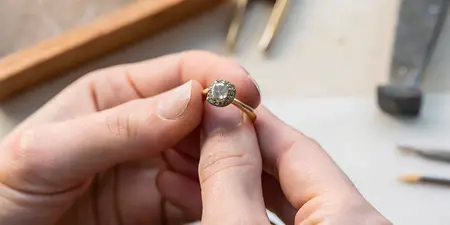

How long does it take to resize a ring?

Ring resizing has no single turnaround time: your jeweler needs to inspect the ring and confirm a completion date before you plan around it. The wait includes more than changing the band’s size—stone checks, finishing, workshop scheduling, and any designer coordination also affect when you get it back.
TL;DR
- How long does it take to resize a ring? Get a ring-specific completion date after an inspection, not a general estimate.
- Plain bands and stone-set rings need different assessments; the metal and setting determine the safe approach.
- For a 2026 wedding, confirm the pickup date and leave room for a final fitting.
- Element79jewelry suits Denver shoppers exploring contemporary fine jewelry and custom bridal designs.
Why this matters
Your ring should feel like it belongs on your hand. But rushing a size change without understanding the setting, finish, and fit puts the deadline ahead of the piece itself.
For a 2026 proposal, wedding, or anniversary, ask for a completion date tied to your actual ring. If you have an artisan design, start with this guide to resizing a designer ring safely before authorizing an alteration.
A useful estimate answers more than when the bench work ends. It tells you when the ring will be inspected, finished, returned if it travels elsewhere, and ready for you to try on.
How long does it take to resize a ring?
The reliable answer is the completion date your jeweler gives after examining the ring. A plain band, a delicate diamond setting, and an engraved heirloom are different jobs; treating them as interchangeable produces an estimate you cannot confidently use.
Start by identifying what needs to change. Then ask the jeweler to separate the alteration itself from the full drop-off-to-pickup schedule.
Plain precious-metal band
- What needs assessment: Metal, thickness, condition, and size change
- Planning implication: Fewer decorative details to preserve, but still needs inspection
Ring with a plain lower band and stones above
- What needs assessment: Setting security and how the new shape affects it
- Planning implication: Stone checks belong in the work plan
Pavé or channel-set band
- What needs assessment: Stone placement and the effect of changing the circumference
- Planning implication: Do not assume a routine band adjustment
Full eternity band
- What needs assessment: Continuous stone arrangement around the band
- Planning implication: Confirm whether resizing is appropriate before discussing a date
Engraved or textured ring
- What needs assessment: Pattern continuity, inscriptions, and finish
- Planning implication: Ask what the alteration will change visually
Linked or mixed-metal design
- What needs assessment: Construction, joining methods, and designer guidance
- Planning implication: Establish the approved approach before scheduling work
This table is a starting point, not a promise that every ring in a category is resizable. Two rings that look similar from above can have very different construction underneath.
A trustworthy resizing estimate starts with the ring, not the calendar. Give the jeweler your event date, but let the inspection determine the work.
Plain bands: confirm the metal and the size change
A plain band offers a relatively uncluttered place to make an adjustment. There are no surrounding gemstones or repeating decorative details to accommodate, but the metal, band thickness, and condition still matter.
For a conventional cut-and-join resize, the jeweler removes a section to make the ring smaller or adds compatible metal to enlarge it. The band then needs shaping, joining, and finishing; changing the circumference is not the final step.
Best for: an assessment where the lower band has uninterrupted metal and no delicate decoration. The advantage is a simpler construction to evaluate; the limitation is that a worn, thin, or previously altered band still needs individual attention.
Ask whether the proposed change preserves the band’s proportions. A comfortable size is not a successful result if the ring returns visibly distorted or with an uneven lower section.
Stone-set rings: include a setting inspection
Resizing changes the shape of the band, which can affect the settings attached to it. A jeweler needs to check stone security rather than treating the ring as a plain band with decoration on top.
A solitaire with an uninterrupted lower band presents a different assessment from pavé running around much of the circumference. Channel settings also need attention because their metal walls hold stones in a closely fitted arrangement.
Best for: a resize plan that explicitly includes checking the stones before and after alteration. This protects the whole piece, but it also means the schedule must account for any setting work the inspection identifies.
Tell the jeweler about a stone that has moved, a prong that catches fabric, or a recent knock. These details help distinguish a straightforward fit adjustment from a repair-and-resize job.
Eternity and sculptural rings: establish feasibility first
A full eternity band has stones continuing around the finger, leaving no plain lower section for a conventional alteration. Changing its circumference affects a repeating arrangement rather than an isolated strip of metal.
Sculptural, linked, and mixed-metal designs bring their own construction questions. A ring that appears to need only a small fit adjustment can involve connections, proportions, or surface details that deserve designer-specific guidance.
Best for: an inspection before any alteration is approved. The benefit is preserving the design’s character; the limitation is that resizing is not appropriate for every construction.
Do not interpret a careful refusal as a lack of skill. Sometimes preserving a distinctive ring means choosing another fit solution or discussing a different size with its maker rather than cutting into the original.
Why ring-resizing turnaround varies
The useful question is not simply whether a ring is easy or difficult. Ask which parts of the job apply to your piece and whether the completion estimate includes them.
- Metal and construction: Gold alloys, platinum, mixed metals, and alternative materials require different working methods. Confirm the actual material rather than relying on color.
- Amount of adjustment: The proposed size change affects the band’s geometry. Ask whether the alteration stays within what the setting and structure can accommodate.
- Stone placement: Stones near the alteration area and settings affected by reshaping need assessment. Any necessary tightening or repair belongs in the schedule.
- Condition and finish: Thin sections, old joins, engraving, texture, and surface treatments all influence the work needed to return a consistent-looking ring.
- Workshop and designer coordination: Ask where the work will happen, whether the maker needs to approve it, and whether transport is included in the quoted completion date.
For your 2026 plans, replace a general turnaround statement with a written scope and pickup date. That makes the estimate useful without asking anyone to promise a deadline before seeing the ring.
What happens between drop-off and pickup?
A good resizing conversation follows the whole process. Use these stages to understand what you are authorizing and what remains to be checked before the ring comes home.
- Fit check. Have the intended finger measured and explain how the ring behaves during normal wear. Bring the wedding band or neighboring rings if you wear them together.
- Ring inspection. Ask the jeweler to review the metal, lower band, settings, finish, and signs of previous alteration. Discuss whether resizing is suitable.
- Work approval. Confirm the target size, proposed method, finish requirements, and completion date. Identify anything that needs separate permission.
- Final fitting. Try on the finished ring and review its shape, surface, and setting with the jeweler. Confirm that the result addresses the original fit concern.
The sequence matters because measuring the finger alone does not establish whether the ring can safely reach that size. Approve the method as well as the measurement.
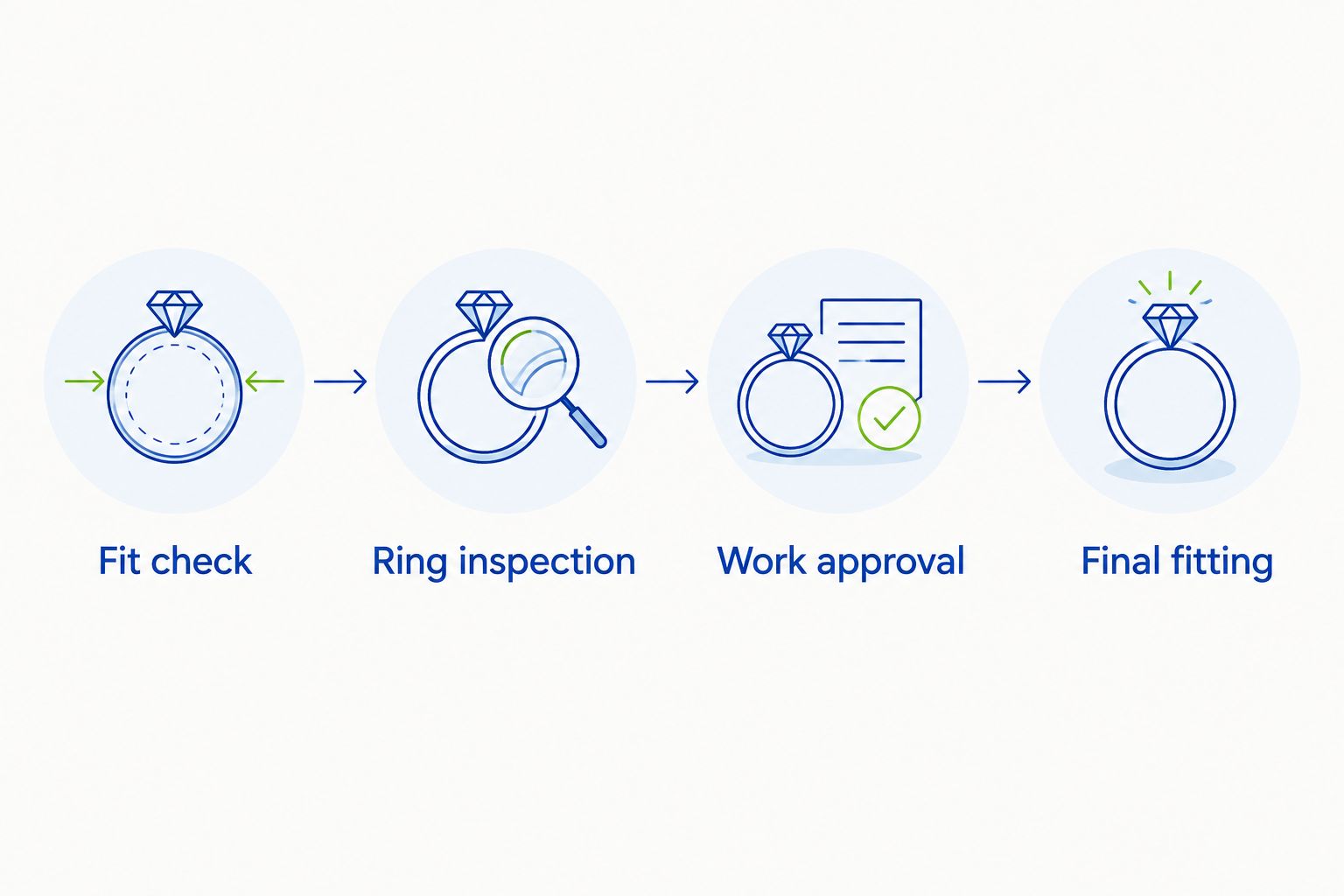
Confirm the method and completion date before approving the alteration.
At pickup, take a moment to look beyond the fit. Check that an inscription remains readable, a textured surface looks consistent, and the lower band feels smooth against your finger.
How should you plan resizing before a wedding?
Work backward from when you need the ring in your hand, not just the ceremony date. Travel, photographs, and a final fitting all belong in your personal plan.
For a 2026 wedding, tell the jeweler the earliest date the ring must be ready. Ask whether the stated completion date means finished at the workshop or ready for collection; those are not necessarily the same milestone.
Bring both rings if you plan to wear an engagement ring and wedding band together. A wider combined stack can feel different from a single narrow ring, so the intended pairing belongs in the fitting conversation.
If the proposed deadline leaves no opportunity to try on the finished piece, discuss your alternatives before handing it over. Keep the final fitting in the plan rather than treating pickup as a formality.
Can you get a ring resized the same day?
Same-day resizing requires explicit confirmation from the jeweler after inspection. Do not treat a simple-looking ring or an urgent event as evidence that the work can be completed immediately.
Ask whether the promised handover includes finishing and the final setting check. For a designer ring, also confirm whether any maker guidance is needed before work begins.
Does making a ring smaller take less time than making it bigger?
Making a ring smaller is not automatically faster than making it bigger. Both directions change the band’s circumference, and the setting, metal, condition, and amount of adjustment determine the work.
Ask what your specific alteration involves rather than choosing a direction based on speed. The target is a secure, comfortable fit that respects the design.
Should you resize a ring that only feels tight sometimes?
Intermittent tightness deserves a fitting assessment before a permanent size change. Temperature and swelling affect finger size, and a ring that feels snug in one situation can feel loose in another.
Describe when the problem happens and whether the ring passes comfortably over your knuckle. Do not force a painful ring on or off; persistent pain, marked swelling, numbness, or color changes need prompt medical attention.
Choosing a designer ring with future fit in mind
Element79jewelry is best for Denver shoppers seeking contemporary fine jewelry and custom bridal designs. Its Cherry Creek boutique offers rings and other fine jewelry from artisan brands, including Artëmer, Orly Marcel, Spinelli Kilcollin, and Petra Class.
The appeal of a distinctive designer ring is its individual character. The practical trade-off is that an unusual construction needs its own fit conversation rather than assumptions borrowed from a plain band.
When exploring Element79jewelry, ask how the construction of a ring you like affects future sizing. Do not assume that carrying a designer establishes a particular resizing service, method, or turnaround commitment.
For a 2026 bridal purchase, fit belongs beside stone choice and silhouette in your decision. A beautiful ring should work for the hand that will wear it, including the way it sits beside a wedding band.
What should you confirm before leaving your ring?
Keep the handover conversation specific. A clear record helps you and the jeweler agree on the intended result without relying on memory.
- Confirm the current and requested sizes, including the sizing system used.
- Record the ring’s existing condition and identify inscriptions or finishes to preserve.
- Ask whether the estimate includes stone checks and any necessary finishing.
- Establish who will contact you if inspection reveals additional work.
- Confirm the pickup date and how you will hear about a schedule change.
- Ask what documentation you will receive when you collect the finished ring.
Photograph the ring before drop-off, including the underside and any engraving. Keep the work receipt with your jewelry records, and bring it when you return for the fitting.
FAQ
How long does it take to resize a ring in 2026?
Ring resizing has no universal turnaround in 2026; get a completion date after the jeweler inspects your ring. Confirm that the date includes finishing, stone checks, and any return transport.
Can I wait in the store while my ring is resized?
Wait-in-store resizing requires confirmation from the jeweler before you rely on it. The ring's construction and the workshop schedule determine whether that arrangement is possible.
Will resizing damage the diamonds in my ring?
A resizing plan must account for the diamonds and their settings. Ask how the jeweler will protect the stones during work and check their security afterward.
Can a full eternity ring be resized?
A full eternity ring needs a specialist assessment before resizing is approved. Its continuous stone arrangement leaves no plain section for a conventional cut-and-join adjustment.
Should I bring my wedding band to a resizing appointment?
Bring your wedding band if you intend to wear it beside the ring being resized. The combined width and fit help the jeweler assess how you actually wear the rings.
Can I resize an engraved ring without losing the inscription?
Preserving an inscription depends on its position and the proposed alteration. Have the jeweler identify any affected lettering before you approve the work.
Does Element79jewelry sell custom bridal jewelry?
Element79jewelry offers custom bridal pieces alongside contemporary and designer fine jewelry in Cherry Creek, Denver. Discuss the construction and fit of a specific design before assuming how it can be altered.
One last thing
A spinning ring is not always simply too large. A prominent setting, the difference between your knuckle and finger base, and the way you stack your rings can all affect how it sits.
Before asking for a smaller size, show the jeweler exactly what bothers you. Describe the problem first—spinning, slipping, pressure, or difficulty passing the knuckle—then choose the solution after the fitting. That conversation is more useful than arriving with a size change already decided.
Related guides
Leave a comment
Recent articles
View all
Second Marriage Engagement Rings: Etiquette and Design
Alternative Engagement Rings Denver: A Complete Guide