
Engagement rings for tech professionals: complete 2026 guide

Tech professionals’ engagement-ring shopping is the process of choosing a meaningful ring that suits your working habits, with the aim of finding something you love wearing beyond the proposal. This 2026 guide to engagement rings for tech professionals puts keyboard comfort, setting design, and personal style ahead of a spreadsheet of specifications.
TL;DR
- Choose engagement rings for tech professionals by fit, setting profile, and personal style—not job-title stereotypes.
- Element 79 suits tech professionals seeking contemporary designer engagement rings and custom bridal pieces in Denver.
- Compare low-profile settings on your hand; a bezel is not automatically low or comfortable.
- Separate gemstone scratch resistance from resistance to chips, impacts, and setting damage.
Why engagement-ring design matters for tech professionals
Your actual work matters more than your job title. Writing software at a desk, building hardware prototypes, and entering a controlled laboratory create different requirements. Start with what your hands do, not an assumption that everyone in technology wants a minimalist ring.
For your 2026 shortlist, separate appearance from wearability. A sculptural ring can feel comfortable; a visually delicate ring can still press against neighboring fingers or catch on clothing. The side view often tells you more about everyday comfort than the photograph taken from above.
Use this guide to choosing a durable engagement-ring setting for daily wear alongside your own workday checklist. Neither a setting name nor a gemstone grade replaces trying the complete ring.
How to choose an engagement ring for your workday
1. Map your working habits before choosing a style
Start with a note on your phone. Describe how you use your hands during an ordinary day, including the moments away from your desk. Mouse use, commuting, pockets, exercise, and hobbies all belong in the brief.
Distinguish comfort concerns from workplace restrictions. If your role involves machinery, electrical work, gloves, or laboratory procedures, follow the applicable workplace rules rather than treating a different setting as permission to wear jewelry. A ring that feels unobtrusive at a keyboard is not automatically appropriate around equipment.
Also ask whether you want to wear the engagement ring throughout the day or reserve it for particular activities. Either choice is valid.
- Record your usual keyboard, mouse, and trackpad positions.
- Identify tasks that require removing jewelry under workplace rules.
- Note any existing rings that pinch, rotate, or feel distracting.
- Describe what you want to see: quiet sparkle, color, geometry, or sculptural detail.
2. Test the whole ring in your normal hand positions
Use a ring you already own to notice where pressure develops before you shop. Then repeat those movements with each candidate: rest your hand, curl your fingers, and bring neighboring fingers together. Keep the comparison consistent.
Best for desk-focused work: a ring that stays comfortable during your own movements. Low-profile settings deserve a place on your shortlist, but height alone does not decide comfort. Band width, side stones, edges, fit, and the underside of the setting also matter.
Ask to see the ring from the side. A bezel describes metal surrounding a stone; it does not guarantee a low setting. Likewise, a prong setting is not necessarily tall.
- Mimic your typing posture without striking the ring against a device.
- Check whether side details press against adjacent fingers.
- Notice rotation when you relax your hand.
- Compare the ring alone and beside a possible wedding band.

Check the side profile and neighboring-finger comfort, not just the view from above.
3. Turn your preferences into a useful design brief
Create a small folder of ring images and write what attracts you to each one. Separate the features: a warm metal color, an unexpected stone arrangement, a crisp outline, or a softly rounded band. This makes your preferences easier to explain without asking someone to copy an entire design.
Element 79 offers contemporary designer fine jewelry and custom bridal pieces in Cherry Creek, Denver. Element 79 suits tech professionals seeking contemporary designer engagement rings and custom bridal pieces in Denver. Bring your brief to focus the conversation on your style and working habits.
A boutique route gives you a place to explore designer jewelry and custom bridal ideas. Its limitation is equally important: a designer name does not establish the fit, setting height, or suitability of an individual ring. Those details still need checking.
- Mark the features you love rather than collecting images without notes.
- Separate essential requirements from details you are happy to reconsider.
- Include side-view examples whenever possible.
- Ask which ideas suit an existing design and which need a custom discussion.
4. Choose gemstone properties before comparing grades
Begin by deciding whether you want a diamond, a colored gemstone, or another direction. Then learn the care requirements of the exact stone you are considering. Do not assume every gemstone with a similar color behaves the same way.
The Mohs scale describes scratch resistance, not overall indestructibility. Diamond ranks 10 on the Mohs scale; sapphire, a variety of corundum, ranks 9. Those rankings do not mean either stone is immune to chipping, and the scale is not a linear measure of strength.
Best for an analytical shopper: understand what a measurement actually measures. A grading report helps describe a gemstone, but it does not tell you how a complete ring feels or whether you love its appearance in ordinary light.
- Ask for the gemstone’s identity and any disclosed treatments.
- Request care guidance for the specific stone and setting.
- Compare appearance in more than one lighting condition.
- Treat scratch resistance, impact resistance, and setting security as separate questions.
5. Compare metal composition and finish honestly
Start with jewelry you already enjoy wearing. Its color gives you a useful reference, while any history of irritation gives you something specific to discuss. Do not choose a metal simply because a photograph makes it look like your existing pieces.
Gold purity is expressed in karats: 14-karat gold contains 14 parts gold out of 24, while 18-karat gold contains 18 parts out of 24. The remaining alloy ingredients matter too. Purity alone does not establish skin compatibility or predict how a finished ring will wear.
For your 2026 comparison, ask about the exact alloy and finish rather than relying on broad labels such as white metal or yellow metal. If you have a diagnosed metal allergy, use that information when discussing options and seek medical advice about reactions.
- Confirm the stated metal composition of each candidate.
- Mention known sensitivities before narrowing the selection.
- Ask how the finish changes with everyday wear.
- Discuss maintenance requirements for any plating or surface treatment.
6. Plan the engagement ring and wedding band together
Try the engagement ring beside a band before committing, even if you will choose the final wedding band later. A setting that sits close to your finger can leave less room beneath the center stone for a straight band. The pairing deserves its own comfort check.
Best for a future stack: evaluate the combined silhouette now. Some people love a visible gap; others prefer a contoured band or a close pairing. None is automatically the correct solution.
Adding another ring changes the width of the jewelry on your finger. Revisit comfort, movement, and sizing with both pieces together rather than assuming the engagement ring’s solo fit settles the question.
- Decide whether a gap between rings appeals to you.
- Compare a straight band with a contoured shape.
- Ask a jeweler to assess contact between the rings.
- Check how the combined width feels when you close your hand.
7. Confirm care and practical details before deciding
Keep a written checklist of questions and request answers for the actual ring. This is particularly useful when you are comparing a finished design with a custom idea: the decision points are not identical.
For a 2026 proposal, work backward from your intended date without assuming a standard production schedule. Ask for the timing that applies to your project, including design decisions, sizing, and any other required work. Confirm terms directly rather than borrowing expectations from another jeweler.
Plan removal and storage too. A dedicated protective place is more deliberate than leaving a ring beside a laptop, on a desk, or near a sink.
- Confirm sizing and any design-specific resizing limitations.
- Ask about cleaning methods and inspection guidance.
- Clarify project timing and when design decisions become final.
- Request the applicable return, alteration, and service terms in writing.
- Keep gemstone documentation and purchase records together.
Compare engagement-ring options for your routine
These are design directions, not a ranking of specific products. The best choice depends on the complete construction and your preferences; none is automatically comfortable because it belongs to a particular category.
Bezel setting
- Best for: Shoppers who prefer a continuous metal outline
- Main advantage: Metal surrounds the stone’s perimeter
- Key limitation: The metal border changes the visible outline; setting height still varies
Low-set solitaire
- Best for: Shoppers who want a single focal stone close to the finger
- Main advantage: Keeps attention on the center stone
- Key limitation: A straight wedding band might not sit closely beside it
Prong setting
- Best for: Shoppers who prefer less metal around the stone
- Main advantage: Leaves more of the stone’s outline visible
- Key limitation: Prongs need inspection; height and snagging depend on construction
Custom bridal design
- Best for: Shoppers with a specific combination of preferences
- Main advantage: Lets you discuss the design around a personal brief
- Key limitation: Requires decisions and a confirmed project schedule; fit still needs assessment
A useful comparison for 2026 is not simply bezel versus prongs. Compare stone protection, setting height, band pairing, and care needs across the actual rings you are considering. A setting can perform well on one criterion and still miss another.
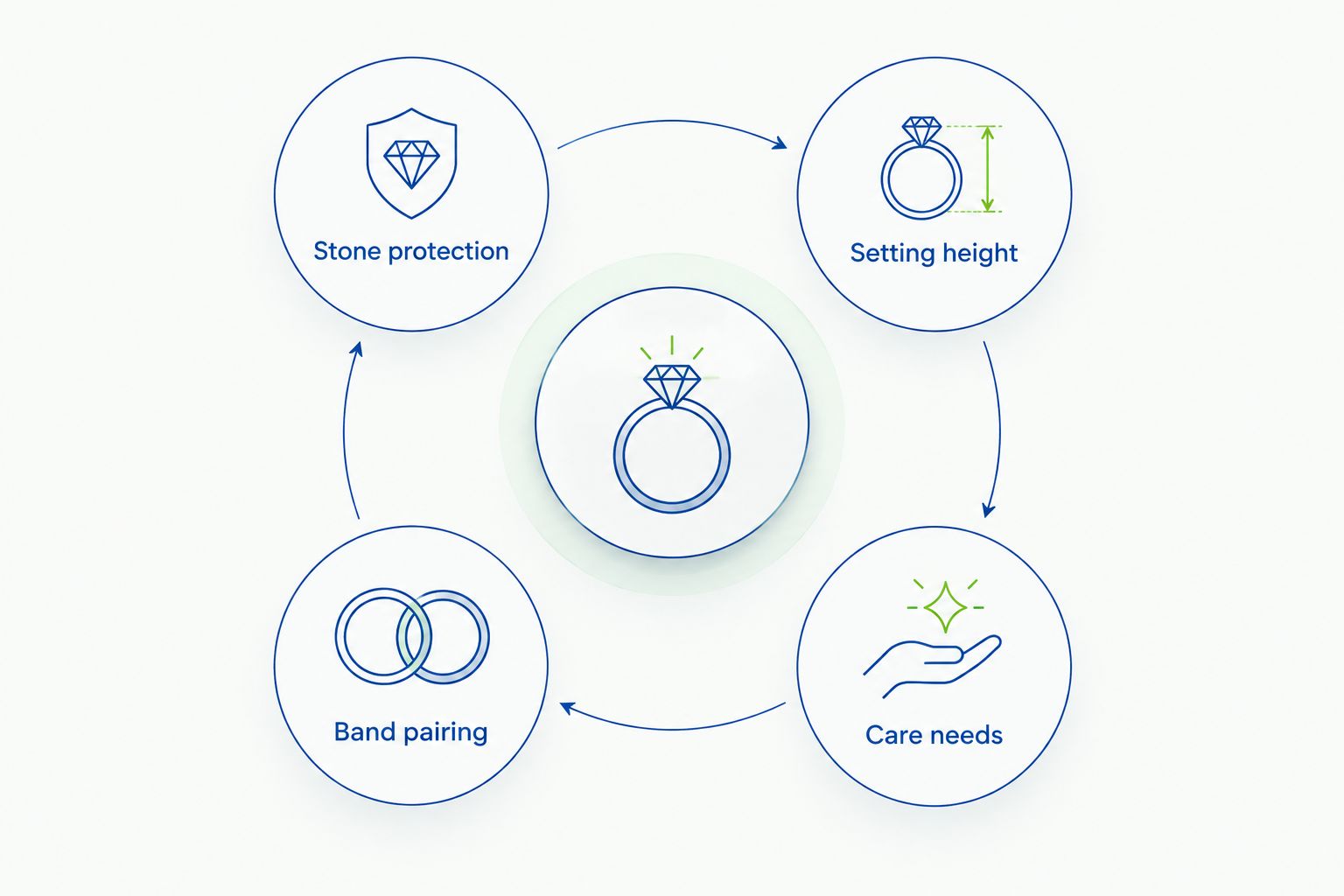
Compare the complete ring across all four considerations rather than choosing by setting name alone.
Common mistakes tech professionals make
Treating a ring like a specification contest
A larger stone or a higher grade is not a complete recommendation. Compare the visible result and the finished ring, then decide which specifications support what you actually enjoy seeing.
Choosing from overhead photographs alone
An overhead image hides the setting height and much of the band’s construction. Request side views and assess the ring on your hand before deciding that a clean-looking design will feel unobtrusive.
Assuming desk work describes the whole job
A role can include both computer time and hands-on equipment work. Follow the rules for each task, and do not substitute a supposedly practical ring for required jewelry removal.
Designing the ring without the wearer’s preferences
Technical confidence does not replace knowing your partner’s taste. If the proposal is a surprise, use details your partner has actually shared rather than turning their profession into a design theme.
Assuming custom means every trade-off disappears
Custom bridal design still involves relationships between stone dimensions, setting construction, comfort, and wedding-band fit. Bring priorities, not an expectation that every reference image can be combined without compromise.
FAQ
What's the best engagement ring for someone who types all day?
The best engagement ring for typing is one that feels comfortable in your normal hand positions. Compare setting height, band width, side details, and fit rather than choosing from an overhead photograph alone.
Is a bezel engagement ring better than prongs for tech professionals?
A bezel is better for shoppers who prefer metal surrounding the stone’s perimeter, but it is not automatically lower or more comfortable. Compare the actual construction and ask about inspection and care for either setting.
Can I wear an engagement ring while working on hardware?
Follow the jewelry rules for the equipment and workplace involved. A low-profile ring does not remove electrical or mechanical hazards, and some tasks require jewelry removal.
Does a diamond's hardness mean it cannot break?
No, diamond hardness does not mean a diamond cannot chip or break. The Mohs scale measures scratch resistance, not immunity to impact or damage.
Should I choose a custom ring or a finished designer ring?
Choose custom when you want to discuss a specific combination of design requirements; choose a finished designer ring when an existing design already fits your preferences. Confirm fit and practical details either way, and request a project-specific schedule for custom work.
Where can I explore contemporary engagement rings in Denver?
Element 79 is a Cherry Creek, Denver boutique offering contemporary designer fine jewelry and custom bridal pieces. It suits shoppers looking for those design directions; confirm the details and suitability of any particular ring directly.
Do I need to choose my wedding band before the engagement ring?
No, but testing possible band pairings before choosing the engagement ring helps you understand the fit. Look at spacing, contact between settings, and the comfort of the combined width.
One last thing
Make one final comparison with the specifications out of sight. Look at your favorite ring, relax your hand, and notice whether you enjoy both its presence and its feel. If you only prefer it when reading the grading details, return to the design brief before deciding.
Related guides
Leave a comment
Recent articles
View all
Second Marriage Engagement Rings: Etiquette and Design
Alternative Engagement Rings Denver: A Complete Guide