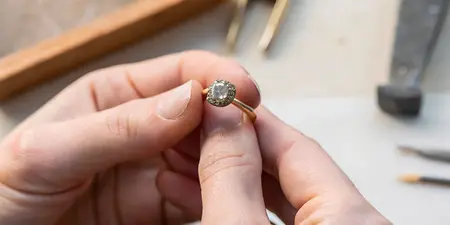

Engagement Rings for Healthcare Workers: 2026 Guide
Engagement rings for healthcare workers have to survive latex gloves, hand sanitizer applied a dozen times a shift, and twelve hours on your feet without snagging, dulling, or breaking a scrub-in seal. The right pick balances the sparkle a proposal deserves with the practical limits of hospital work — setting height, metal hardness, and how the ring behaves under a glove.
TL;DR
- Bezel and flush settings are the top pick for engagement rings for healthcare workers who glove up daily.
- Platinum resists the deformation that repeated hand sanitizer and scrub-sink washing cause in softer 14k gold.
- Moissanite and lab-grown diamonds cut cost without cutting the durability a hospital shift demands.
- Most nurses and doctors should size for end-of-shift swelling and plan a removal routine for direct patient contact.
Why setting choice matters more for healthcare workers
A ring built for an office desk job is not built for a med-surg floor. Frequent glove changes, back-to-back hand washing, and OR infection-control rules all put more stress on a ring than almost any other profession outside of manual trades.
Many hospital infection-control policies restrict raised-setting rings in surgical areas because a prong can tear a glove or trap bacteria under the stone. Nurses and techs who glove up dozens of times a day also feel every millimeter of setting height, since a high prong catches on the glove's interior lining every time you pull one off.
That's why the durable engagement ring setting conversation looks different for a healthcare worker than for a buyer who just wants a ring that photographs well. The setting has to survive a job, not just a dinner out.
How to choose an engagement ring for a healthcare job
Match the setting to your glove routine
Start with how often you're gloving up and how many times a shift you take gloves on and off. That number should drive the setting choice more than the look of the ring on a display card.
- Choose a bezel setting if you glove up more than a few times a shift — the metal rim protects the stone edge and leaves nothing for a glove cuff to catch.
- Choose a flush or gypsy setting if you want the lowest possible profile; the stone sits nearly level with the band.
- Avoid tall six-prong solitaires if you're an ER nurse, surgical tech, or anyone scrubbing in regularly.
- Consider a low-set halo if you want more visual size without adding height above the finger.
- Ask your jeweler to measure setting height in millimeters rather than accept a vague description — under 4mm is a reasonable target for daily glove use.
Choose a metal that survives sanitizer and scrub sinks
Hospital-grade hand sanitizer and repeated scrub-sink washing are harder on jewelry than most daily environments. Metal choice matters as much as setting style here.
- Platinum holds its shape under repeated washing better than softer alloys and won't need re-plating.
- 18k gold is more resistant to bending than 14k but shows scratches faster; 14k resists dents better but can wear down at the shank over years of heavy contact.
- Avoid rhodium-plated white gold if you can't commit to re-plating every 12–18 months, since sanitizer strips the plating faster than normal wear.
- Ask about platinum for an engagement ring band if you wash your hands more than 15 times a shift.
Decide on the center stone durability
Not every gemstone belongs on a hand that's in and out of gloves all day. Hardness on the Mohs scale is the number that matters most here.
- Diamond (10 on Mohs) is the most scratch-resistant option and the safest default for daily hospital wear.
- Moissanite (9.25 Mohs) is nearly as hard and costs less, though it throws more rainbow fire than a diamond under fluorescent hospital lighting.
- Sapphire (9 Mohs) holds up well and comes in colors beyond blue if you want something that isn't a diamond.
- Skip opal, emerald, and pearl center stones for daily hospital wear — all three chip or etch under sanitizer exposure and constant hand contact.
Size for shift swelling
Twelve-hour shifts on your feet change your finger size by the end of the day, and that matters more for a ring you'll wear every shift than for occasional jewelry.
- Get sized at the end of a long shift, not first thing in the morning, when fingers run smaller.
- Leave a small margin rather than sizing tight — swelling from standing, IV fluids, or hot units can make a snug ring painful by hour eight.
- Ask about a slightly wider band if you tend to swell; a 2mm band feels tighter faster than a 3mm band at the same size.
- Re-check sizing after any major change in shift pattern, like moving from day shifts to nights.
Build a wear plan for OR or patient-contact rules
Many units require rings off entirely during direct patient care or surgical scrub-in, so the ring needs a plan beyond just being on your hand.
- Check your unit's specific jewelry policy before buying — some allow flat wedding bands but ban anything with a raised stone.
- Keep a chain or ring holder in your bag or locker for shifts that require full removal.
- Choose a ring that's comfortable to put on and take off one-handed between patients.
- If you're an OR nurse or surgeon, consider a flat band for daily wear and save a statement ring for off-duty hours.
Plan the maintenance schedule
Sanitizer buildup and constant hand contact mean a healthcare worker's ring needs more frequent attention than an office worker's.
- Wipe the ring down weekly to clear sanitizer residue from under the setting.
- Get prongs checked every six months rather than the once-a-year standard, since daily wear loosens settings faster.
- Watch for a cloudy film on the stone — that's usually sanitizer residue, not damage, and a quick soak in warm soapy water clears it.
Budget with alternatives in mind
Healthcare salaries and hospital shift schedules don't always leave room for a five-figure ring, and durability doesn't require the biggest budget option.
- Moissanite or lab-grown diamonds deliver comparable hardness at a lower cost than mined diamonds of the same size.
- A lab-grown diamond engagement ring gives you the same Mohs hardness as a mined stone without the mined-diamond premium.
- Ask about insurance early — a ring that's on your hand through a hospital shift 40+ hours a week is a ring worth covering against loss.
Comparing settings for healthcare workers
Bezel-set solitaire
- Best For: Nurses and techs gloving up multiple times a shift
- Key Limitation: Less faceted sparkle than a prong setting
Flush or gypsy setting
- Best For: Tight glove fit, surgical or ICU roles
- Key Limitation: Harder to resize later without redoing the setting
Platinum band
- Best For: Daily hand sanitizer and scrub-sink exposure
- Key Limitation: Heavier feel and develops a brushed patina over years
Moissanite or lab-grown center stone
- Best For: Budget-conscious buyers who still want brilliance
- Key Limitation: Moissanite reads more fire than a diamond under some lighting
Low-set halo
- Best For: Wanting more visual size without added height
- Key Limitation: Needs more frequent professional cleaning around the stones
Verdict: a bezel-set diamond or moissanite solitaire in platinum is the strongest all-around pick for engagement rings for healthcare workers who glove up daily and wash their hands dozens of times a shift.
Common mistakes healthcare workers make buying a ring
- Buying a high-set halo because it looked good in the case, then catching it on a glove cuff every shift for a year.
- Getting sized first thing in the morning instead of after a full 12-hour shift, then finding the ring binds by hour eight.
- Choosing platinum expecting it to never scratch, then being surprised it develops the same patina every heavy-wear metal shows over time.
- Buying a fixed eternity band without checking the unit's jewelry policy, then having no way to remove it for scrub-in.
- Skipping insurance on a ring worn through hundreds of shifts a year, where daily wear raises the odds of a loose stone or a dropped ring.
Find a ring built for shift work
Explore settings and metals suited to daily glove and sanitizer exposure.
FAQ
What's the best engagement ring setting for healthcare workers?
A bezel or flush setting is the best choice because the metal sits flush or wraps the stone edge, leaving nothing for gloves to catch. Prong settings above 4mm in height are more likely to snag during frequent glove changes.
Can nurses wear engagement rings at work?
Most units allow rings during general patient care but many restrict raised-setting rings in the OR or during procedures requiring gloves. Check your specific unit's infection-control policy before assuming your ring is allowed on every shift.
Is platinum or white gold better for daily hand washing?
Platinum holds up better long-term because it doesn't rely on rhodium plating that sanitizer and scrub-sink washing strip away. White gold needs re-plating every 12 to 18 months under heavy hand-washing conditions.
Should I get a bezel setting if I work in healthcare?
Yes, if you glove up multiple times per shift, since a bezel protects the stone edge and reduces snag points. It trades some sparkle for durability, which is the right trade for daily hospital wear.
Are moissanite rings a good option for a healthcare worker's budget?
Moissanite is nearly as hard as diamond at 9.25 on the Mohs scale and costs less, making it a practical option for a durable daily-wear ring on a hospital salary. It throws more rainbow fire than a diamond, which some buyers like and others don't.
How often should a healthcare worker clean their engagement ring?
Wipe the ring weekly to clear sanitizer film, and get prongs professionally checked every six months instead of the standard once-a-year schedule. Daily glove use and hand washing loosen settings faster than typical wear.
What ring styles snag less under medical gloves?
Bezel-set, flush-set, and low-profile halo styles snag the least because they don't have raised prongs for a glove cuff to catch. Anything under roughly 4mm in setting height is a safer daily-wear choice.
Should I take my ring off at work?
Follow your unit's jewelry policy first — many require removal for scrub-in or direct patient contact regardless of ring style. Keep a chain or ring holder in your bag for shifts that require full removal.
One last thing
The detail most buyers skip is sizing at the wrong time of day. A ring fitted at 8am can bind by the end of a 12-hour shift once swelling sets in — get sized after a full shift, not before one, and the ring will actually fit the job you wear it through.
Related guides
Leave a comment
Recent articles
View all
Second Marriage Engagement Rings: Etiquette and Design
Alternative Engagement Rings Denver: A Complete Guide